
Frontier Tech Perspectives

Contemporary enterprise environments run thousands of software services, autonomous pipelines, and orchestration agents — collectively designated nonhuman identities (NHIs). A 2025 report by Entro Security Labs states that NHIs outnumber human principals at a documented ratio of 144:1 [4]. NHIs span a wide life cycle spectrum, from persistent service accounts with years of operational history, to ephemeral identities such as continuous integration/continuous delivery (CI/CD) pipeline tokens and serverless function credentials that are designed to expire within minutes but routinely outlive their intended window. Despite constituting the dominant identity population in modern infrastructure, NHIs remain structurally underserved by existing security controls. Machine identities authenticate via static tokens and application programming interface (API) keys that carry no second factor; once compromised, adversary-controlled sessions are cryptographically indistinguishable from legitimate operations.
This paper presents a behavioral analytics framework for NHI security — a proof-of-concept platform built around a single operative question: not whether a credential is valid, but whether the identity presenting it is behaving like itself. The framework integrates two complementary pillars. The first is a four-layer real-time anomaly scoring pipeline comprising a deterministic rule engine, a machine learning (ML) ensemble (Isolation Forest and One-Class SVM), a Wasserstein generative adversarial network (WGAN) critic, and a Shannon entropy user and entity behavior analytics (UEBA) module. The second is a Bayesian trust model implemented over the Beta distribution, continuously updated at every observed event and seeded from enterprise identity metadata to encode institutional prior knowledge.
The framework was validated against a 22,130-event synthetic corpus spanning 180 days and 10 discrete attack scenarios, including stable benign operation, post-compromise credential abuse, gradual privilege creep, burst exfiltration, coordinated multi-identity campaigns, Mythos training-window poisoning, and entropy equilibrium evasion. The central finding: credential compromise does not invalidate the authentication token — it invalidates the behavioral consistency of the identity presenting it. That deviation is statistically detectable even when an adversary deliberately calibrates activity to remain within modeled equilibrium bounds.
Keywords: nonhuman identities, synthetic behavioral fingerprinting, zero-trust security, Bayesian trust scoring, Shannon entropy analytics, GAN-based baseline modeling, adversarial evasion detection, Mythos-class attacks.
The NHI attack surface is large, poorly instrumented, and poorly matched to the tooling most enterprises have deployed. Entro Security Labs in 2025 reported that 97% of NHIs hold excess permissions beyond operational requirements; 91% of tokens provisioned for departed employees remain active post-offboarding; and 44% of exposed credentials are discoverable in collaboration platforms, version control commits, and issue trackers rather than in secure vaults [4]. Similarly, IBM Security in 2024 documented a mean time-to-identify of 204 days for compromised machine credentials. This is 34 days longer than any other credential category [7].
These figures reflect a structural mismatch. The identity security tooling deployed in most enterprises was designed for human principals interacting through keyboards, browsers, and multifactor prompts. NHIs do not interact that way. A service account authenticates thousands of times per day with a static token and exhibits none of the session-boundary, cognitive-pacing, or multifactor characteristics on which conventional controls depend. Ephemeral identities compound this further: a CI/CD token or serverless function credential is provisioned for a single task, designed to expire within minutes, and yet routinely left active indefinitely when revocation fails — creating a population of forgotten, over-permissioned credentials with no owner monitoring their activity. When any NHI token is exfiltrated and replicated, the adversary inherits not just access rights but the full trust reputation the legitimate system has accumulated, and then exercises it at machine speed.
Current identity and access management (IAM) platforms enforce credential life cycle policies and permission assignments but provide no mechanism to distinguish legitimate NHI activity from adversary-controlled sessions using identical credentials. Security information and event management (SIEM) platforms collect event telemetry and evaluate it against analyst-defined detection rules. Both determine whether a credential is valid; neither determines whether the behavior associated with it is authentic.
The detection gap widens further with an emergent adversarial capability class this paper designates Mythos-class attacks: AI-driven frameworks that characterize the security model deployed against them and adaptively modify behavior to remain below detection thresholds. A Mythos-class adversary does not require prior knowledge of detection logic; it learns it by observing anomaly scores and gradient-descent toward evasion.
Against rule-based detection, Mythos evades by avoiding pattern matches. Against entropy-based UEBA, it calibrates information-theoretic distributions to maintain apparent equilibrium. Against per-identity monitoring, it distributes attack loads across simultaneously compromised NHIs to suppress individual signal strength. Four specific structural gaps in standard behavioral analytics deployment create the exploitation surface. The framework presented here is architecture to close all four, as detailed in Section 3.6.
This paper presents a proof-of-concept framework addressing the NHI security problem across three dimensions:
Existing research on NHI security concentrates on credential life cycle management and static access controls [5][2][3]. UEBA platforms are calibrated for human behavior and lack NHI-specific features. Zero-trust frameworks from NIST address network segmentation and human-principal authentication but leave machine identity behavioral verification as an acknowledged gap [10]. The WGAN-GP formulation of Arjovsky et al. (2017) provides the generative architecture used here [1][11]; differential privacy guarantees formalized via (ε, δ)-bounds enable deployment in context where raw log retention is legally constrained [6].
Shannon entropy has been applied to network traffic analysis for intrusion detection [18][19] but its application to NHI-specific behavioral equilibrium tracking has not been previously formalized. Prior work monitors entropy level as the anomaly signal; this framework introduces entropy variance — the second-order consistency of entropy across rolling windows — as an independent detection dimension that closes an evasion path unavailable to level-only monitors.
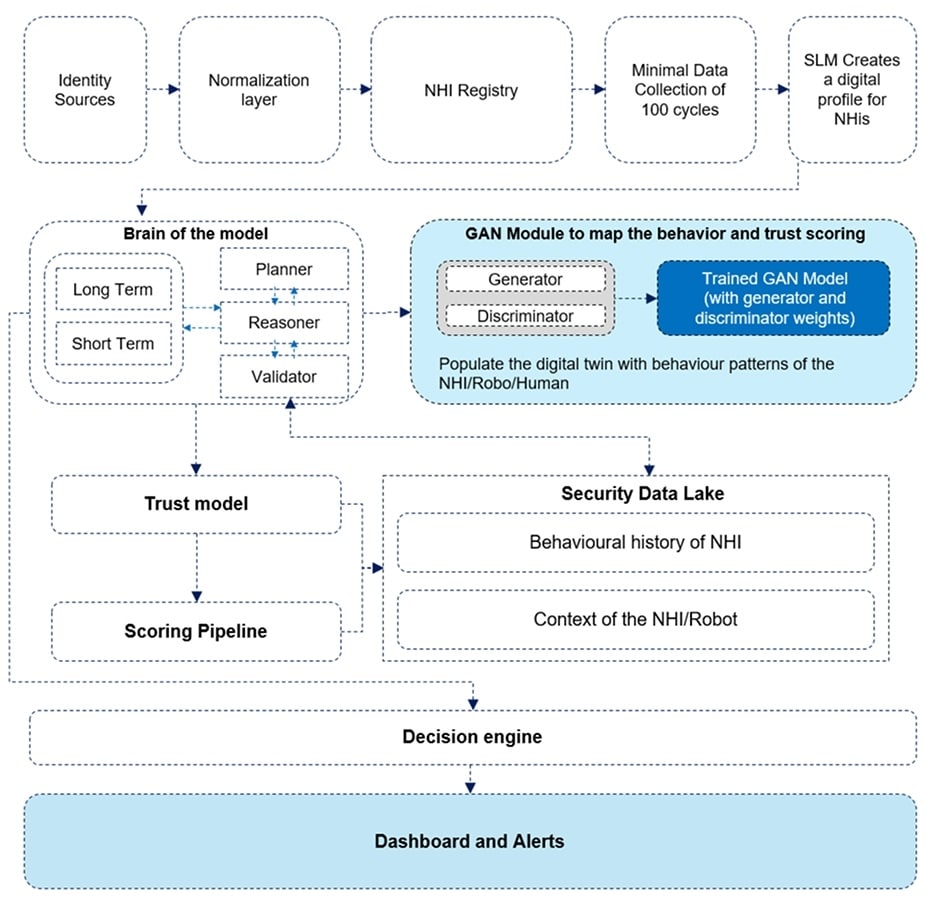
The framework operates as a closed loop. Raw telemetry enters at the ingestion layer, is classified and anonymized, profiled into a digital twin, scored against a continuously updated behavioral fingerprint, contextualized within the fleet-wide ownership graph, and fed back into the Security Data Lake to refine subsequent model iterations. Each component serves a distinct function; together they ensure that every observed event contributes both to immediate detection and to the long-term accuracy of the baseline model.
Figure 1. Model architecture
Source: Infosys
The eight components of the model architecture:
The ingestion layer acquires operational telemetry across all NHI types: API call logs, authentication records, resource access events, network connection metadata, and inter-event timing sequences. Normalization across heterogeneous sources — cloud provider audit logs, CI/CD pipeline records, Kubernetes audit logs, SIEM feeds — produces a unified event schema encoding identity identifier, ISO 8601 timestamp, operation type, resource accessed, source IP address, result code, and contextual metadata including geographic region and service dependency annotations.
The layer maintains a live identity registry cataloging every known NHI with its owning principal, type classification, declared life cycle duration, expected operational window, and current risk state. All downstream analysis is contextualized against registry metadata before scoring; registry is the authoritative ground truth against which behavioral deviation is measured.
The SLM classification engine assigns each principal to one of three categories — human, NHI, or RPA — based on behavioral signatures: human principals exhibit session-bounded activity with cognitive latency; NHIs exhibit continuous high-throughput deterministic operation; RPA agents exhibit near-identical inter-event intervals. The lightweight transformer-class model converges after approximately 100 operational cycles, operates at the edge without GPU infrastructure, and requires no fine-tuning on labeled enterprise data. Following classification, it performs identity-preserving anonymization and produces the digital profile that seeds the GAN training pipeline.
The brain of the model provides core reasoning infrastructure through three modules: a planner that maintains long- and short-horizon behavioral expectations and suppresses spurious alerts for known cyclical patterns; a reasoner that performs multivariate inference across concurrent detection layers, synthesizing anomalous and conformant signals into a composite score; and a validator that enforces quality constraints on digital profiles, synthetic fingerprints, and trust score thresholds throughout the pipeline.

The GAN module generates synthetic behavioral fingerprints — differential-privacy representations of each NHI's legitimate operational distribution — from validated digital profiles. The generative architecture employs a WGAN-GP [1][11]. This architecture was selected for two properties directly relevant to the NHI security domain: training stability that prevents mode collapse when modeling complex multimodal behavioral distributions, and a Wasserstein distance metric that provides a theoretically grounded, continuous measure of distributional divergence rather than the unstable loss landscapes characteristic of standard GAN formulations.
The generator network produces synthetic behavioral sequences satisfying (ε, δ)-differential privacy guarantees with ε = 0.5 and δ = 10⁻⁶ [12][13], bounding the risk of reconstructing any individual identity’s operational details to a negligible value.
Generated profiles populate digital twins with fingerprints across five dimensions: temporal patterns (request frequency, latency, inter-event intervals), operational characteristics (resource access distributions, error rates), contextual attributes (egress locations, service topologies), IP topology (source address clustering), and an entropy profile capturing baseline Shannon entropy across all four UEBA dimensions. The GAN critic validates synthetic profiles for distributional fidelity; the module activates after 100 events, below which scoring relies on the rule engine and Bayesian prior exclusively.
Every NHI maintains a continuous trust score in [0, 1] computed from a Bayesian model over the Beta distribution [14][15], whose parameters α and β accumulate evidence of conformant and anomalous behavior respectively. The prior initializes at α = 2, β = 2 (trust = 0.5). Evidence accumulates asymmetrically: conformant events increment α by 0.3; anomalous events increment β by 0.5. The asymmetry encodes the security principle that trust is hard to earn and easy to lose — an identity accumulating anomalous events develops a high β value that requires substantial evidence of recovery to reverse, not just temporary quiescence.
The initial prior is seeded from enterprise identity metadata rather than a uniform uninformative state. An identity flagged as rogue in the source system begins with α = 1.0, β = 12.0, immediately approaching the BLOCK threshold. An ephemeral pipeline token receives a risk-calibrated moderate prior. A long-established persistent service account begins with a prior reflecting its accumulated operational reputation. This metadata seeding eliminates the cold-start latency problem, where genuinely high-risk identities require many observed anomalous events before reaching a decision threshold.
As described in Section 1.1, ephemeral identities are short-lived NHIs designed to expire within minutes or hours that routinely outlive that window when revocation fails.
Ephemeral identities introduce three distinct risk conditions. First, any activity observed after the declared expiry window is anomalous by definition, regardless of whether the credential token remains technically valid. Second, the high behavioral churn inherent to short-lived workloads — each invocation may access a different resource set, originate from a different IP, or exhibit a different timing profile — makes statistical baseline construction harder and creates natural cover for adversarial activity that would stand out against a stable long-lived identity. Third, as the 91% post-offboarding token retention figure cited in Section 1.1 illustrates, enterprises routinely fail to revoke ephemeral credentials on schedule, leaving short-lived tokens operating indefinitely with their original permissions and no owner monitoring their activity.
The risk calculus for a credential with a designed lifetime of minutes differs fundamentally from that for a persistent service account with years of operational history. A universal anomaly threshold applied uniformly across heterogeneous identity populations mis-calibrates for both ends of the life cycle spectrum. The framework partitions identities by declared life cycle and applies differentiated ALLOW and BLOCK thresholds accordingly as shown below:
Life cycle-aware thresholds prevent exploitation of trust leniency legitimately afforded to long-tenured identities while avoiding systematic misclassification of ephemeral credentials with inherently high behavioral churn
The final trust score integrates outputs from all active scoring layers through a dynamically weighted linear combination:
Trust score = w₁ * Behavioral_Confidence + w₂ * UEBA_Risk_Score + w₃ * Contextual_Risk + w₄ * Historical_Performance
These trust integration coefficients are distinct from the anomaly scoring pipeline weights defined in Section 3.5. They are dynamically assigned by the brain of the model based on data availability, per-layer confidence estimates, and the identity's life cycle stage. With all four inputs available, weights default to w₁ = 0.35, w₂ = 0.30, w₃ = 0.20, w₄ = 0.15.
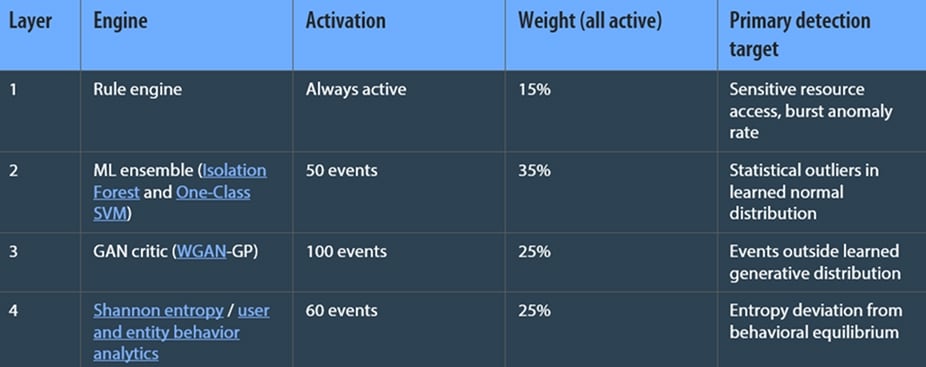
Each event generated by an NHI is evaluated by up to four independent scoring engines operating in progressive activation order, as shown in Figure 2. Architecturally simpler, lower-latency engines activate immediately on minimal data; statistically richer engines activate as behavioral history accumulates. The final anomaly score is a dynamically weighted combination of all active layers, normalized to [0, 1]. The pipeline advances from a fixed threshold-based approach to increasingly probabilistic assessments as each layer accrues sufficient history to operate.
Figure 2. Scoring pipeline
Source: Infosys
The rule engine operates from the first observed event and provides deterministic coverage of explicitly specified threat conditions: access to designated sensitive resource classes (authentication services, primary databases, billing endpoints) and burst-rate thresholds on anomalous event ratios within rolling windows. Computationally efficient and immediately available, the rule engine is epistemically bounded by analyst-specified rule coverage. It contributes 15% of the composite anomaly score when all layers are active, scaling to 100% for identities below the 50-event ML activation threshold.
The ML ensemble activates at 50 events and combines Isolation Forest and One-Class SVM to learn normal behavior from unlabeled operational history — detecting deviations without requiring labeled attack examples. The Isolation Forest isolates anomalous events in shallower tree structures by exploiting their feature-space sparsity [8]; the One-Class SVM learns a minimum-volume hypersphere around the nominal distribution [16]. Their complementary sensitivities improve robustness across different anomaly geometries [8].
The WGAN-GP critic activates at 100 events and scores events by Wasserstein distance from the learned generative distribution [1][11] — a continuous metric well-behaved even when real and generated distributions have disjoint support, making it more sensitive to subtle drift than Jensen-Shannon divergence. Events in low-probability regions receive high critic scores regardless of whether they match any known attack signature, giving the layer particular sensitivity to slow behavioral drift that point-anomaly detectors miss.
The UEBA layer characterizes NHI behavior through Shannon entropy computed simultaneously across four operational dimensions: event type, resource, IP, and temporal distribution [9][18][19]. Shannon entropy is defined as:
H(X) = −Σ p(x) · log₂ p(x)
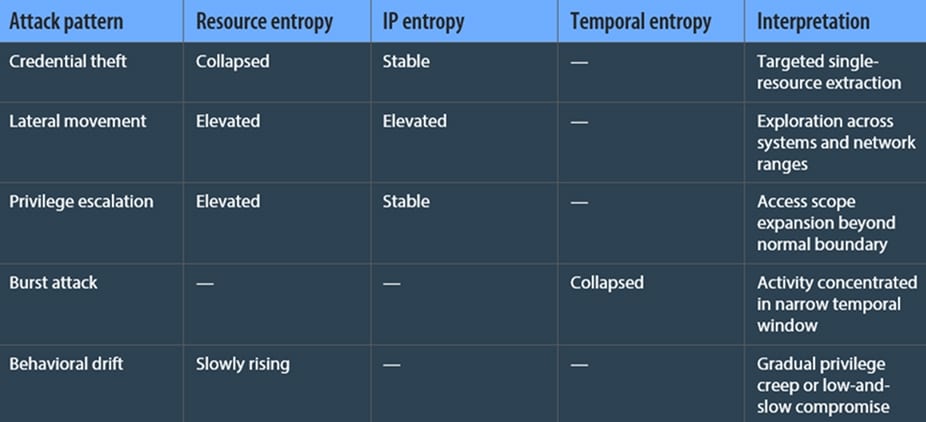
For an NHI consistently accessing three API endpoints in approximately equal proportions, resource entropy stabilizes at approximately 1.58 bits. Adversary-controlled exfiltration concentrating on a single endpoint collapses resource entropy toward zero; lateral movement expanding access across previously unvisited resources elevates entropy above the equilibrium band.
The system computes a rolling equilibrium for each dimension — mean and standard deviation across a sliding window of historical observations — and measures current deviation from that band as the UEBA anomaly signal. In addition to tracking entropy level, the framework monitors entropy variance: the second-order consistency of entropy across rolling windows as shown in Figure 3. Genuine normal behavior exhibits natural fluctuation reflecting the rhythm of operational variability; an entropy trajectory that remains unnaturally flat across all dimensions simultaneously is statistically inconsistent with natural operation and constitutes a distinct evasion signal, as described in Section 3.6.2.
Figure 3. Entropy interpretation by attack pattern
Source: Infosys
Mythos-class attacks represent a qualitatively distinct adversarial capability: adaptive, ML-driven campaigns that characterize the security model deployed against them and iteratively optimize behavior to remain below detection thresholds [20][21]. The four-layer scoring pipeline described in Section 3.5 provides strong coverage against conventional attack patterns. However, four structural gaps remain in any behavioral analytics deployment that an adaptive adversary can systematically exploit. This section describes each gap from the adversary’s perspective and the targeted countermeasure that closes it.
An adversary with foreknowledge of the 100-event GAN activation threshold can maintain artificially clean behavior during the training window, ensuring the resulting baseline encodes the intended operational pattern. Once the baseline is committed, the attack proceeds under the cover of a poisoned synthetic fingerprint — a baseline that represents the adversary's intended behavior rather than the identity's legitimate operation.
The countermeasure inspects the statistical properties of the training corpus itself. Genuine normal behavior exhibits natural variance in anomaly scores; some events are marginally more anomalous than others due to operational variability. A score variance below 0.008 sustained across 40 or more consecutive events is statistically improbable under natural conditions and indicates deliberate score suppression. The system emits one of four training integrity verdicts: clean, suspiciously_clean (unnaturally low variance), baseline_poisoned (elevated anomaly rate throughout training), or post_training_shift (statistically significant increase in mean score immediately after window closure).
An adversary aware that the UEBA layer tracks entropy levels can calibrate resource access proportions to preserve the historical entropy distribution while conducting exfiltration — rotating access across resources in frequencies that maintain the observed distributional profile. Standard UEBA, monitoring entropy level alone, reports nominal equilibrium throughout. This is the evasion path that the entropy variance signal described in Section 3.5.4 is designed to close.
The countermeasure targets entropy variance rather than entropy level. An entropy trajectory that remains unnaturally flat — all four dimensions simultaneously within half a standard deviation of their equilibrium means across multiple consecutive windows — is statistically inconsistent with natural operation. The system computes an evasion score and emits one of two verdicts: natural_variation (expected in highly deterministic pipelines) or equilibrium_evasion / all_dims_controlled (entropy distribution consistent with deliberate maintenance rather than natural operation). This signal is injected into the fast rule engine layer to ensure sub-event-cycle detection latency.
Individual identity monitoring has a structural detectability limit against coordinated campaigns. An analyst triaging one anomalous identity remains unaware that three additional NHIs are simultaneously compromised and operating against different target subsystems; alert fatigue from sequential per-identity investigations can allow the broader campaign to proceed unrecognized.
The countermeasure runs a cross-identity temporal and resource correlation pass on every event cycle. The system identifies NHIs simultaneously meeting an active anomaly threshold — anomaly rate exceeding 30% of recent events, or trust score below 0.5 — and evaluates whether those identities share resource access targets within the temporal overlap window. Temporal co-occurrence combined with shared resource targeting constitutes the signature of coordinated campaign activity rather than independent coincidental anomalies. When detected, the system raises a single coordinated campaign event rather than N individual identity alerts, enabling SOC analysts to immediately characterize and respond to the correct threat model.
A Mythos-class attack operating at machine speed can traverse the complete blast radius of a compromised NHI within two minutes. Standard UEBA deployments operating on 22-event rolling windows with per-cycle update latencies of several seconds may not converge on an alert before data exfiltration is complete.
The countermeasure propagates both the training integrity signal and the equilibrium evasion signal into the fast rule engine layer immediately, bypassing the activation thresholds of the GAN and UEBA layers. Both signals are active from the first event and carry weight in every anomaly score computation regardless of pipeline maturity. When all six scoring signals are simultaneously active — four standard layers plus two Mythos countermeasures — the composite weight allocation adjusts to 12/28/22/22/8/8, preserving the Mythos signals' contribution at all maturity levels.
The countermeasures in Section 3.6 address evasive behavior at the individual identity level. Detection identifies the rogue identity; incident response requires knowing its full reach. The relationship graph makes the ownership and delegation topology of the NHI fleet explicit and traversable, so that a single detected compromise immediately translates into a complete blast radius enumeration.
Anomaly scores characterize the degree of behavioral deviation for an individual identity; they do not establish attribution or enumerate operational consequences. The graph organizes in three tiers: human principals owning or supervising NHIs; NHI identities color-coded by current trust decision (ALLOW in green, ALERT in amber, BLOCK in red); and resources accessed by each NHI. On detection of a rogue identity, the graph expands to enumerate the full blast radius — direct human owners whose credentials are immediately at risk, NHIs to which the rogue identity holds delegation edges constituting the lateral movement path, human principals owning those secondary NHIs comprising the indirect exposure layer, and resources accessed without authorization defining the data-at-risk boundary.
As an illustrative example: “NHI-005 (rogue, owned by Eve Martinez) maintains a delegation edge to NHI-001. Alice Chen and Bob Kumar — owners of NHI-001 — are therefore indirectly exposed. Resources “svc:billing and db:primary are being accessed outside authorized scope.” The damage surface extends from the single compromised credential through the full delegation chain to its second-order ownership relationships.
For fleet-scale deployments with thousands of NHIs, the graph transitions to an aggregate view presenting teams as circles scaled by NHI population, individually surfacing the highest-severity blocked identities, and tracing attack chain paths with directed edges from owning team through rogue identity to targeted resources. This aggregate view enables SOC campaign-level triage without sequential per-identity investigation.
The Security Data Lake closes the loop between detection and model refinement. It stores three data domains: deviation history (longitudinal behavioral records supporting trend and recurrence analysis), contextual metadata (network topology, service dependencies, geographic data), and learning feedback (confirmed true positive and true negative outcomes from authentication decisions and investigations).
Confirmed outcomes recalibrate WGAN-GP training parameters, UEBA equilibrium baselines, and SLM classification weights; threat intelligence integration absorbs novel attack vectors. BLOCK-level decisions trigger a structured response workflow — automated notification, identity suspension, network isolation, and delegation-graph-scoped threat hunting — with all outcomes fed back into the lake to improve subsequent model iterations.
The scoring pipeline described in previous sections operates on trained models whose outputs, in a production deployment, would be calibrated against real enterprise NHI telemetry. The current proof of concept uses a Python-based scenario generator that simulates those model outputs statistically, producing 180 days of realistic synthetic behavioral telemetry across 10 discrete scenarios, each designed to exercise a specific detection capability in controlled isolation. The generator uses a fixed random seed for full reproducibility and operates with no external dependencies.
Recall@3 measures whether the correct attack archetype appears among the top three anomaly signals raised for a given event sequence — a more appropriate metric than rank-1 accuracy for coordinated and evasion scenarios where several detection layers contribute signal concurrently.
Figure 4. Scenario results
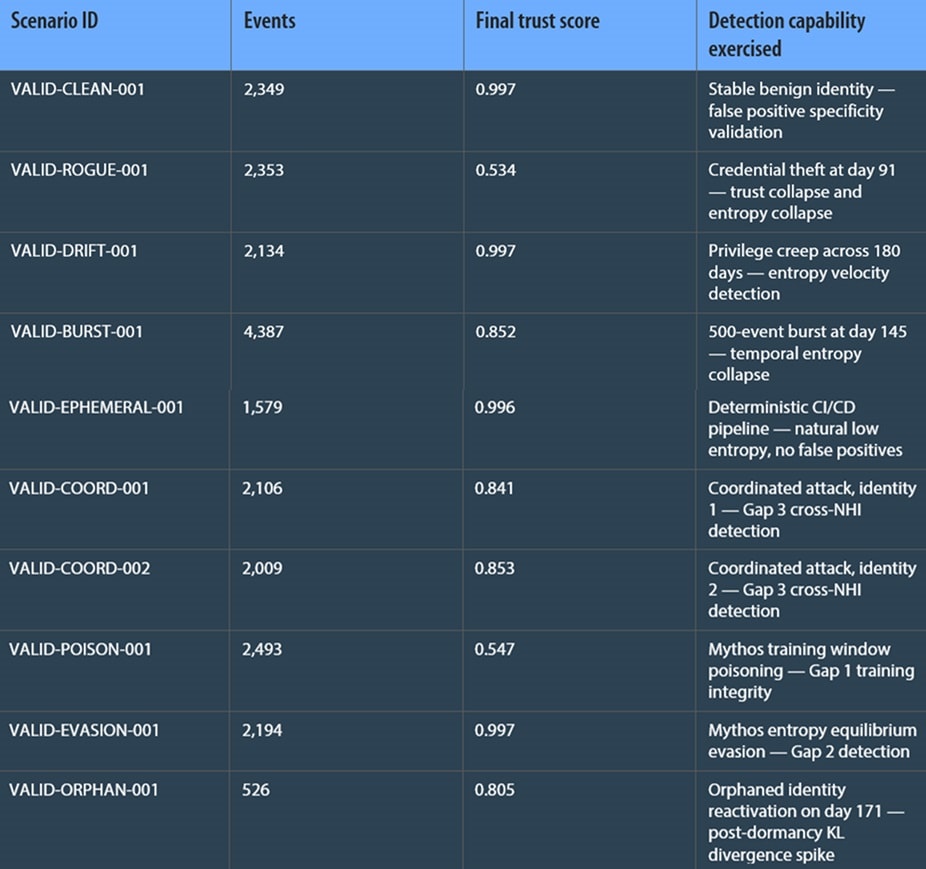
Total validation corpus: 22,130 events, November 2025 through May 2026.
Source: Infosys
Trust score and detection verdict are independent outputs of the framework and should not be read as redundant measures of the same signal. The trust score reflects Bayesian evidence accumulation from per-event anomaly scoring: each event scored as anomalous increments β, pulling the score downward; each conformant event increments α, pulling it upward. Detection verdicts — including entropy velocity for slow drift, entropy variance for equilibrium evasion, and training integrity inspection for poisoning — operate as separate analytical passes that do not necessarily generate per-event anomaly scores and therefore do not necessarily move the trust score. In slow-drift and evasion scenarios, a high final trust score alongside a confirmed detection verdict is not a contradiction — it is the expected and operationally significant result. It means the adversary succeeded in keeping the primary Bayesian model fooled while the secondary signal identified the attack independently. This is precisely the architectural value of maintaining orthogonal detection dimensions: the entropy variance signal in VALID-EVASION-001 and the entropy velocity signal in VALID-DRIFT-001 produce confirmed detections in scenarios where trust score alone would report no anomaly at all. Readers comparing final trust scores across scenarios should therefore treat score collapse as the detection mechanism in compromise and burst scenarios, and treat secondary verdict signals as the detection mechanism in drift and evasion scenarios — both are correct outcomes, measuring different things.
Conventional anomaly detection systems initialize every identity with an identical uninformative prior, requiring observation of a threshold number of anomalous events before the trust score crosses a decision boundary. Seeding the initial Bayesian prior from enterprise identity metadata at registration time compresses detection latency for known-bad identities from dozens of events to near-zero — a meaningful operational improvement in environments where NHIs are provisioned continuously and some fraction of newly registered identities may already be compromised or misconfigured.
An ephemeral token operating four days beyond its declared expiry represents a fundamentally different risk posture than a persistent service account accumulating its first anomalous events after three years of clean operation. Binding ALLOW and BLOCK thresholds to declared life cycle class eliminates the systematic over-permissiveness for long-lived identities and over-aggressiveness for legitimately short-lived ones that universal threshold approaches produce. For enterprises with mixed NHI populations — a common condition in organizations that have grown through acquisition — this calibration has material impact on both false positive rate and true detection rate.
Standard UEBA systems use entropy level as the anomaly signal. An adversary with knowledge of this mechanism can calibrate behavior to maintain entropy within the equilibrium band indefinitely. The entropy variance countermeasure — monitoring the second-order consistency of entropy across rolling windows rather than entropy level alone — closes this evasion path without introducing significant operational complexity. The signal is computationally lightweight, can be injected into existing rule engines, and requires no GAN or ML infrastructure. It is the most immediately deployable contribution from this framework.
The transformation from N individual low-confidence identity alerts to a single high-confidence coordinated campaign event directly addresses a known SOC operational problem: sequential per-identity investigation of what is actually a coordinated campaign wastes triage time and allows the broader attack to proceed unrecognized. Enterprises operating large NHI fleets — particularly those with complex service mesh topologies where a single compromised identity can hold delegation edges to dozens of downstream services — should treat cross-NHI correlation as a required capability rather than an enhancement.
Retaining raw operational logs for extended periods to support behavioral baseline construction creates regulatory exposure under GDPR, HIPAA, and equivalent frameworks [23]. The differential-privacy WGAN-GP approach generates synthetic profiles that preserve the statistical distributional properties of legitimate NHI behavior without encoding information attributable to individual identities — viable in privacy-sensitive deployment contexts where raw log retention would trigger compliance obligations. With (ε, δ)-privacy guarantees of ε = 0.5 and δ = 10⁻⁶ [12], the framework provides a concrete privacy posture rather than a generic differential privacy claim.
This is a proof of concept. Several substantive limitations constrain direct production application. The GAN and ML scoring layers use behavioral simulation rather than trained production models. A production deployment requires a WGAN-GP trained on actual enterprise event telemetry and Isolation Forest and One-Class SVM models fitted to labeled historical operational data. The current implementation approximates the statistical properties of trained model outputs but does not substitute for them.
The Shannon entropy equilibrium model requires a minimum event history; below 60 observed events, the UEBA layer is inactive. Below 50 events, detection relies on the rule engine and Bayesian prior exclusively; between 50 and 60 events, the ML ensemble is also active, providing statistical outlier coverage ahead of UEBA activation. Newly provisioned NHIs have structurally weaker detection coverage during early operational life — a window a sophisticated adversary with foreknowledge of the activation threshold could potentially exploit
The current implementation has no integrations with production identity providers (Okta, Azure Active Directory, AWS IAM), SIEM platforms (Splunk, Microsoft Sentinel), or secrets management systems (HashiCorp Vault, CyberArk). These integrations are prerequisites for production deployment and would materially enrich both the event stream and the metadata available for Bayesian prior seeding.
Adversarial resistance requires ongoing evaluation. An adversary with access to the framework's architecture could potentially exploit the early-life detection gap, attempt to mimic synthetic behavioral fingerprint statistics, or operate at temporal scales below the system's rolling window resolution. Future work should investigate adversarial training techniques and adaptive window sizing to improve robustness against white-box adversaries.
Future work priorities include the following:
NHIs represent the largest and most poorly monitored credential population in contemporary enterprise security. The attack surface they present is structurally different from anything conventional IAM and SIEM tooling was designed to address. The core problem is not credential management — it is the absence of any mechanism to determine whether the identity presenting a valid credential is behaving like itself.
This framework demonstrates that NHI compromise is statistically detectable under precisely the conditions that defeat conventional approaches: when the stolen credential remains cryptographically valid; when the adversary calibrates behavior to remain within modeled detection bounds; and when the attack is distributed across multiple simultaneously compromised identities that each remain below individual-identity alert thresholds. Behavioral deviation is detectable even when no individual observed event is unambiguously anomalous in isolation.
The most significant novel contribution is the entropy variance signal. Where existing UEBA deployments monitor entropy level and can be evaded by an adversary who maintains distributional equilibrium, entropy variance monitors the second-order consistency of that equilibrium across rolling windows. The VALID-EVASION-001 scenario demonstrates this signal constitutes a genuinely independent detection dimension — one that produces a confirmed detection verdict in a scenario where standard entropy monitoring would report no anomaly at all. It is also the most immediately deployable finding: it requires no GAN or ML infrastructure and can be incorporated into existing rule engines with minimal operational complexity.
The path from proof of concept to production runs through real enterprise telemetry. The theoretical detection advantages demonstrated here — against credential theft, coordinated campaigns, training-window poisoning, and entropy equilibrium evasion — require empirical confirmation against live NHI fleets before operational claims can be made with confidence. That validation is the work that remains.

