Data


AI Driven API Management
Insights
- The rise of artificial intelligence has opened a fundamental shift in how organizations design, deploy, secure, and optimize their API ecosystems.
- According to industry research, the average enterprise now manages hundreds or even thousands of APIs, with annual API call volumes reaching into the billions. This scale has created management challenges that far exceed conventional API management approaches.
- The integration of AI into API management leads to a paradigm shift from static, rule-based approaches to dynamic, intelligent systems capable of addressing the complexities at scale while improving security, performance, and developer experience.
Key Challenges in Modern API Management
Let’s understand the key challenges that have made traditional API management approaches challenging:
- Security: Sophisticated Patterns of Attack, Complex and Diverse Authentication Mechanisms, Data Exposure Risks, Access Control at scale
- Performance Optimization Challenges: Complex API chains, Diverse Client requirements, Unpredictable traffic patterns, Cross Region distribution
- Governance and Compliance: Regulatory Requirements, Lifecycle Management, Managing Multiple API versions
- Developer Experience: Finding appropriate APIs, Incomplete API documentation, Complex API onboarding, Challenges in resolving integration issues
AI Powered API Management
AI Driven API management integrates several key intelligent capabilities that work together to address the challenges mentioned earlier.
Figure 1. AI Driven API Management – Core Components
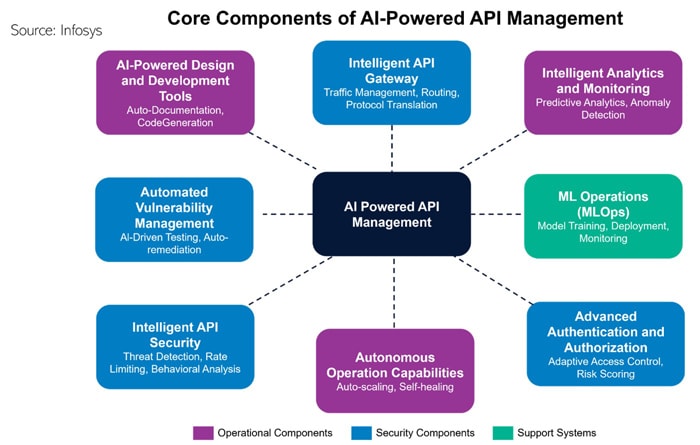
Intelligent API gateway: This front door for API traffic can make it an ideal location for implementing the capabilities using AI tools using approaches to dynamic learning systems that adapt to changing conditions rather than static rule-based approach. This includes:
- Dynamic adjustment of rate limits based on traffic patterns
- Optimizing request routing based on real time performance metrics
- Detect anomaly in unusual traffic patterns that may indicate attacks or issues
- Scanning request payloads for security threats and data violation issues
AI-Powered Design and Development Tools: Artificial intelligence is transforming how APIs are designed and implemented which includes:
- Automatically generating API code based on specifications or requirements
- Suggesting best practices and identifying potential issues during design
- Creating comprehensive test scenarios based on API specifications
- Generating and maintaining API documentation from code and usage patterns
- Recommending backward-compatible changes as APIs evolve
Intelligent Analytics and Monitoring: The visibility in operations is enhanced using AI that includes:
- Forecasting traffic patterns and potential bottlenecks
- Automatically identifying unusual behavior or performance issues
- Tracing problems through complex API dependencies
- Correlating technical metrics with business outcomes
- Creating intuitive dashboards that highlight the most relevant information
Autonomous Operation Capabilities: The operations overhead is drastically reduced while improving consistency with capabilities like:
- Proactively adjusting resources based on predicted demand.
- Continuously tuning settings for optimal performance and taking proactive actions like limiting traffic, graceful restart
- Taking predefined actions when security threats or unusual patterns are detected
Intelligent API Security: The security approaches are enhanced using AI that helps organizations stay ahead of potential security issues rather than reacting after breaches occur. This includes:
- Creating baselines of normal behavior for each API consumer
- Identifying unusual request sequences or payload characteristics
- Flagging activities that occur at unusual times
- Identifying subtle changes in request volumes that may indicate attacks
- Continuously updating "normal" baselines as legitimate usage patterns evolve
- Learning from attacks seen across multiple customers
Advanced Authentication and Authorization: AI enhances identity and access management for APIs that provide stronger security while reducing friction for legitimate users:
- Adjusting authentication requirements based on risk factors and scoring accordingly
- Identifying stolen or compromised API credentials
- Suggesting appropriate access controls based on usage patterns
- Identifying unusual permission usage patterns
Implementation Strategies
| Tools | Approach | Benefits | |
|---|---|---|---|
| Anomaly Detection and Predictive Monitoring | Datadog with Watchdog AI, New Relic One with AIOps, Dynatrace with Davis AI | ML algorithms establish baseline performance and automatically detect deviations in latency, error rates, and throughput | Early detection of issues before human-visible impact, reduced false positives compared to threshold-based alerts |
| Intelligent Log Analysis | Logz.io with Cognitive Insights, Sumo Logic with Cloud SIEM, Elastic Stack with ML | NLP and pattern recognition to identify critical issues in log data, automatically categorize issues | Reduces log analysis time, surfaces critical issues from massive log volumes |
| API Traffic Pattern Analysis | Kong Analytics with ML, Google Apigee with AI, MuleSoft Anypoint with Monitoring | ML identifies usage patterns, predicts traffic spikes, and recommends pre-emptive scaling | Optimized resource allocation, prevention of capacity-related outages |
| Canary Deployments with AI Decision-Making | Istio, Flagger, Harness AI, Argo Rollouts with ML plugins | ML models analyze real-time performance metrics during partial deployment to automatically decide whether to proceed with full deployment | Risk mitigation, automatic rollback on anomalies, evidence-based deployment decisions |
| Graph-Based API Usage Analysis | Neo4j Graph Data Science, Amazon Neptune ML, TigerGraph ML | Models API calls as graph nodes and relationships to discover complex interaction patterns | Visualizes complex relationships between API endpoints, identifies central endpoints |
| User Behavior Analytics | Mixpanel with ML, Amplitude Analytics, Google Analytics 4 with ML | Connects API usage to specific user behaviors and objectives | Maps technical usage to business outcomes, improves API design for user goals |
| Resource-Aware Pattern Discovery | Custom ML models on AWS SageMaker, TensorFlow with resource consumption metrics | Correlate API usage patterns with infrastructure resource consumption | Optimizes cost, identifies resource-intensive usage patterns for targeted optimization |
| Cross-API Correlation Analysis | Splunk with ML Toolkit, Elastic Stack with ML, custom correlation engines | Discovers relationships between usage patterns across multiple APIs in an ecosystem | Holistic view of API interactions, identifies dependencies between services |
| Natural Language Processing for API Usage Documentation | OpenAI tools, Google Vertex AI with NLP, custom NLP pipelines | Analyzes support tickets, documentation searches, and community discussions to identify usage patterns and pain point | Discovers undocumented use cases, identifies gaps in API understanding |
| Dedicated API Intelligence Platforms | Moesif, Postman Analytics, RapidAPI Analytics, APImetrics | Comprehensive API lifecycle analytics with ML-powered insights and custom reports | Deep API-specific insights, customer journey tracking, business impact analysis |
Implementation Considerations
- Data Requirements: Most AI tools require substantial historical operational data to establish baselines and train models effectively
- Hybrid Approaches: Start with rules-based monitoring enhanced by AI suggestions before moving to fully automated AI decisions
- Feedback Loops: Ensure human feedback on AI decisions is captured to continuously improve model accuracy
- Integration Strategy: Choose tools that integrate with your existing tech stack rather than standalone AI solutions
- Observability Foundation: Implement comprehensive telemetry (metrics, logs, traces) before adding AI capabilities to ensure quality training data
- Value Prioritization: Focus initial pattern discovery efforts on high-value or business-critical APIs
- Data Privacy: Ensure all pattern analysis complies with data protection regulations and anonymizes user data appropriately
Key Benefits
Organizations implementing AI powered API management can expect benefits as shown below:
Figure 3. AI Driven API Management – Key Benefits

Future Opportunities
The convergence of evolving powerful large language models and APIs can create exciting opportunities in future
- Natural Language Query Translation: Converting human language to API requests
- Multimodal API Access: Combining text, voice, and visual API interactions
- Disconnected Operation: Maintaining API functionality during network disruptions
- Device-Specific Optimization: Adapting API behavior to device capabilities
- Dynamic Model Selection: Intelligently choosing appropriate AI models per request
- Hybrid Execution: Optimally distributing AI workloads across cloud and edge
- AI Service Mesh: Networks of specialized AI capabilities accessed via APIs
Conclusion
As we look to the future, it's clear that the convergence of APIs and artificial intelligence will continue to accelerate. Organizations that embrace this transformation will gain significant competitive advantages through more secure, reliable, and intelligent digital ecosystems. The most successful organizations will view AI not merely as a tool for automating existing API management practices but as a catalyst for reimagining how software systems interact and deliver value. By combining human expertise with artificial intelligence, these organizations will create API ecosystems that continuously adapt, learn, and evolve to meet changing business needs. The journey toward AI-powered API management may be challenging, but the truly intelligent digital ecosystems that drive innovation while reducing operational complexity—makes it a journey well worth taking.
References
- How AI-First API Management Is Leading the Way
- Overview of AI gateway capabilities in Azure API Management



Subscribe
To keep yourself updated on the latest technology and industry trends subscribe to the Infosys Knowledge Institute's publications
Count me in!