Experience


AI powered retail media networks: unlocking omnichannel monetization at scale
Retail Media Networks (RMNs) are rapidly emerging as one of the most transformative forces in modern commerce, reshaping how retailers, wholesalers, and brands engage with consumers. Once viewed primarily as a monetization lever, RMNs have evolved into strategic platforms that unify advertising, data, and commerce across digital and physical touchpoints.
This white paper explores the accelerating role of RMNs as a high-margin revenue stream and a catalyst for omnichannel transformation. It delves into the key benefits of retail media, the evolving market dynamics, and the capabilities of leading RMN platforms. It also examines how AI and machine learning are revolutionizing campaign targeting, personalization, and attribution, enabling retailers to deliver more relevant, real-time experiences at scale. By seamlessly integrating fragmented systems and harmonizing data flows across divisions, Infosys enables retailers to fully realize the strategic potential of retail media—driving growth, enhancing personalization, and unlocking high-margin revenue opportunities.
Insights
- Retail Media Networks are rapidly emerging as one of the most powerful growth accelerators in the advertising and retail industries.
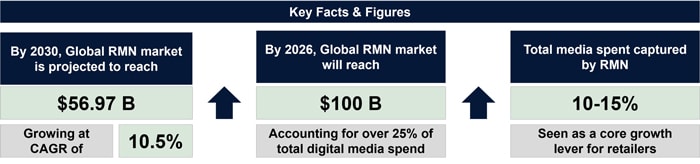
- Analysts forecasts that Global RMN market is projected to reach $56.97 billion by 2030 growing at a CAGR of 10.5%.
- Retail media platforms are evolving their AI capabilities to achieve personalized targeting, creative asset generation, unified attribution and measurements and campaign optimizations.
- Retail media platforms are heading towards self-service platforms powered by AI that will require minimum human intervention for executing and optimizing campaigns.
- Tighter integrations with SSPs and DSPs will enable programmatic advertising, dynamic pricing and RTB (real time bidding)
Introduction
A Retail Media Network (RMN) is a digital advertising ecosystem operated by a retailer or marketplace, allowing brands to advertise directly to consumers within the retailer’s owned channels—such as websites, mobile apps, email, and even in-store displays. Historically, Retail Media Networks were not so popular as today. These came into shape and gained momentum when Amazon launched its AAP (Amazon Advertising Platform) in 2012. This platform targeted Ads on Amazon owned platforms like websites and mobile apps and third-party sites. The success of the AAP led many other retailers to follow in the footsteps and create their own Retail Media Networks. Today many leading retailers have their own RMN platforms like Walmart Connect, Target roundel, Kroger Precision Marketing, Instacart Ads amongst them are a few leading examples.
Retail Media Networks (RMNs) represent the convergence of marketing and commerce, enabling brands to engage consumers directly at high-intent, point-of-sale touchpoints—both online, in-store and offsite. By leveraging retailers’ first-party data and real-time shopper behavior, RMNs empower advertisers to deliver highly targeted campaigns and gain actionable insights from ad impressions to actual conversions. This integration not only enhances personalization but also drives measurable monetization across the omnichannel customer journey.
Market Outlook: Key Growth Forecasts
Retail Media Networks are rapidly emerging as one of the most powerful growth accelerators in the advertising and retail industries. Analysts forecast that RMNs would have generated over $179.5 billion globally in 2025, surpassing traditional TV ad revenue and accounting for nearly 16% of total advertising spend. By 2030, the sector is expected to exceed $300 billion, capturing 20% of global ad revenue. In the U.S. alone, retail media is projected to grow 20% in 2025, outpacing both the overall ad market (4.3%) and retail sales growth (3.7%).
This explosive growth is driven by retailer’s ability to monetize first-party data, deliver closed-loop attribution, and offer high-margin advertising solutions. With over 200 RMNs now operating globally, the landscape is entering a maturity phase where AI-powered personalization, self-serve platforms, and standardized measurement are becoming the norm. As brands shift budgets toward performance-driven media, RMNs are positioned to become central pillars of modern marketing strategy.
Figure 1: Key facts and figures
The value proposition of Retail Media Networks
Retail Media Networks have emerged as high-margin, fast-growing revenue streams for modern retailers. By monetizing their digital and physical shelf space, retailers are transforming into media publishers, offering brands access to highly targeted, data-rich advertising environments.
Key Revenue & Profit Insights
- Multi-Billion Dollar Revenue Streams: Leading retailers are generating billions in annual advertising revenue through their RMNs, with some seeing double-digit year-over-year growth.
- High Profit Margins: Retail media often delivers operating margins significantly higher than traditional retail operations, making it a strategic lever for profitability.
- Alternative Profit Centres: For some retailers, RMNs are part of broader “alternative profit” strategies, contributing hundreds of millions to over a billion dollars in incremental profit annually.
- Ad Revenue Growth Outpacing Core Retail: In many cases, retail media revenue is growing faster than core product sales, driven by increased advertiser demand and improved targeting capabilities.
Major global retailers like Walmart, Amazon, Target across grocery, general merchandise, and e-commerce sectors have capitalized on Retail Media Networks to unlock new revenue streams and boost margins, often reporting multi-billion-dollar gains from their media businesses.
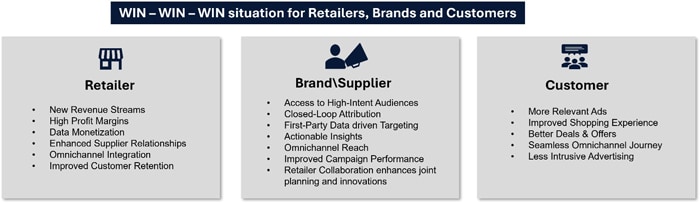
Creating a win-win-win situation
Retail media networks provide a WIN-WIN-WIN situation for Retailers, advertisers and customers. It provides a wide range of benefits for all as depicted in Fig 2.
Figure 2: Benefits of Retail Media Networks
Emerging Retail Media Network Platforms
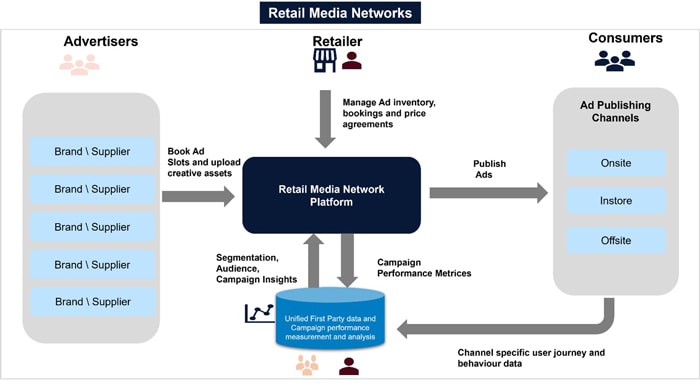
As retail media continues to surge as the latest wave of digital advertising, platforms like Amazon Ads, Walmart Connect ,Zitcha, Criteo, Citrus Ad (Epsilon) are redefining how retailers and brands collaborate to reach consumers at the point of purchase. These Retail Media Network platforms (RMNPs) offer unified, data-driven ecosystems that enable advertisers to activate campaigns across onsite, offsite, and in-store channels with precision and scale. These platforms are purpose-built for omnichannel retail media, empower retailers to plan, deliver, and optimize campaigns through a single interface, integrating seamlessly with media, data, and tech partners. They provide a robust, self-service platform that support Ad booking, Ad serving, Reporting, Analytics, Invoicing and Billing capabilities leveraging first-party data to drive measurable outcomes without relying on third-party cookies. Together, these platforms are helping retailers unlock new revenue streams and enabling brands to enhance visibility, engagement, and conversion in a privacy-conscious, performance-led environment.
Figure 3: Retail Media Networks concept
Challenges solved by retail media network platforms
Retail Media Platforms (RMPs) are rapidly evolving to address several pressing challenges in the digital advertising and retail landscape. Here is an overview of the key challenges they solve:
- Fragmentation of Retail Media Ecosystem
Brands face difficulty managing campaigns across multiple RMNs due to inconsistent formats, metrics, and buying processes. RMPs offer centralized platforms that streamline campaign execution across multiple retailers, enabling unified reporting, standardized metrics, and simplified media buying. - Lack of Online-Offline Integration
Disconnected digital and in-store experiences hinder full-funnel attribution and customer journey continuity. Advanced RMPs integrate in-store digital signage, scan and go devices with online and offsite campaigns, creating a seamless omnichannel experience. - Complexity in campaign execution and manual workflows
Marketers often deal with dozens of media partners, agencies, and platforms, leading to inefficiencies and high operational overhead. RMPs automate Campaign management, Workflows, ad buying, targeting, and reporting—reducing manual effort and enabling real-time optimization. - Limited Access to First-Party Data
With third-party cookies deprecating, advertisers struggle to access quality data for targeting and measurement. RMPs leverage retailer’s rich first-party data (e.g., purchase history, loyalty data, Ad impressions, page views, clicks) to enable precise audience targeting and closed-loop attribution. - Monetization of In-Store Media
Retailers often underutilize in-store assets like digital signage, scan and go applications, digital shelf displays, smart cart devices and POS screens. RMPs help monetize these touchpoints by turning them into dynamic ad inventory, enhancing shopper engagement while generating incremental revenue. Many of the RMPs are now providing OOTB connectors with populate Digital Signage and POS vendors. - Scalability for Mid-Sized Retailers
Smaller retailers lack the scale and tech infrastructure to attract brand ad spend. RMPs enable these retailers to join retail media co-ops or networks, offering aggregated reach and simplified access for advertisers. - Measurement and Attribution Gaps
Brands struggle to measure the true impact of retail media on sales and shopper behavior. Modern RMPs provide real-time analytics, and multi-touch attribution models to demonstrate ROI.
Evolution of Retail Media Networks powered by AI
Retail Media Networks (RMNs) have rapidly progressed from basic on-site banner placements to sophisticated, data-driven ecosystems. As retailers increasingly position themselves as media owners, the integration of Artificial Intelligence (AI) is fundamentally transforming how brands connect with consumers across the omnichannel journey.
- AI in Planning, Targeting & Optimization
AI empowers brands with scenario planning and audience segmentation by simulating budget allocations across RMNs and forecasting campaign outcomes. This enables marketers to optimize media spend and identify the most effective channels for engagement.
AI also orchestrates real-time campaign optimization—adjusting bids, pacing, and creative rotation dynamically across platforms. This ensures budgets are continuously redirected toward high-performing products and placements, maximizing return on investment. - Personalization at Scale
AI-driven personalization is enabling targeted ad experiences at scale. Retailers are leveraging their first-party customer data, often integrated through Customer Data Platforms (CDPs), to deliver personalized ads across both physical and digital touchpoints. These tailored experiences are based on audience segments, shopping behaviour, and contextual signals. - Predictive analytics, real time decisioning
Predictive analytics and real-time decisioning are enabling more precise targeting, ensuring that ads reach the right consumers at the right moment across channels. - Unified Measurement & Attribution
AI plays a critical role in unifying measurement and attribution across channels. By correlating data from various touchpoints, AI enables advanced attribution modelling—helping brands understand which interactions drive conversions and how to allocate spend effectively across the customer journey. - Generative AI in Creative Production
Generative AI is revolutionizing creative workflows, especially for long-tail advertisers—smaller brands or sellers with limited resources. It is now used to:- Generate ad copy with variations based on audience segments and product attributes.
- Create visual assets such as banners, product images, and lifestyle visuals.
- Build personalized landing pages aligned with ad messaging and user intent.
This dramatically reduces creative production costs and accelerates campaign launches, making retail media more accessible and scalable.
The Future of Retail Media Networks
AI is permeating every layer of the retail media ecosystem. Looking ahead, RMNs are expected to evolve into self-service platforms powered by AI, enabling brands and retailers to plan, launch, and optimize campaigns with minimal manual effort. This democratizes access to retail media, empowering advertisers of all sizes to compete effectively.
Moreover, AI is unlocking new monetization opportunities by surfacing high-value inventory and dynamically pricing ad placements based on demand and performance.
As RMNs integrate deeper with commerce platforms and other touchpoints, AI will play a pivotal role in bridging media and retail operations, driving measurable outcomes like sales lift and customer lifetime value.
In the near future, tighter integrations with SSPs(Supplier Side Platforms) and DSPs(Demand Side Platforms) will further enhance the programmatic capabilities of RMNs and Real time biding, enabling seamless access to external demand and supply channels. This will allow retailers to extend their inventory reach, while advertisers benefit from unified audience targeting and cross-platform optimization — all orchestrated by AI.
Bringing Retail Media to life: A strategic and technical perspective
Bringing a Retail Media Network (RMN) to life presents multifaceted challenge for retailers, requiring strategic alignment across technology, data, operations, and monetization. Retailers must lay a strong foundation before activating media capabilities, which includes a set of core activities
- Setting up platform, product inventory, retailer data, supplier data, store info, dashboards for different divisions
- Integrating first-party customer data and audience for personalization
- Mapping ad touchpoint inventory across onsite, instore, and offsite channels
- Defining pricing models for various types of Ads supported
- Defining Ad budgets for suppliers\brands
- Ensuring compatibility with existing ad-serving infrastructure
- Managing brand partnerships and agreements
- Establish robust process for invoicing and billing
- Carve out Real time and post campaign performance reporting and analytics needs
- Complying with privacy and data governance regulations
Similarly, once the foundation is set up for Ad activations there is a separate set of activities required to be done
- Creating seamless ad experiences across channels (e.g., sponsored products, banners with CTAs, brand stores)
- Enabling personalized targeting using audience segmentation
- Collecting and harmonizing omnichannel campaign performance data
- Continuously optimizing campaign performance
In large retail organizations spanning Retail, Wholesale, and B2B divisions, system fragmentation poses a significant challenge. Each division often operates with its own systems resulting in multiple sources of truth for product, supplier, store, and inventory data. Finance and billing processes may differ (e.g., POS systems in Retail vs. invoice-based systems in Wholesale), and analytics platforms can vary widely (e.g., Adobe Analytics vs. Power BI). Additionally, divisions may use different Commerce and MarTech platforms, further complicating integration.
These disparities impact on nearly every capability of a Retail Media Network (RMN)—from ad booking and serving to financial operations and campaign performance reporting. Achieving a consistent and seamless experience for retailers, suppliers, and customers requires careful orchestration across these fragmented systems.
This is where system integrators (SIs) like Infosys play a pivotal consulting role in guiding retailers from retail media strategy formulation through to execution and integration. Infosys brings end-to-end capabilities and partnerships with key RMN platforms and enable seamless transformation across business and technology layers:
- Strategic Consulting: Crafting retail media network (RMN) strategies aligned with business goals, monetization models, and customer engagement objectives.
- Experience Design: Delivering intuitive and engaging ad experiences through advanced UX/UI design tailored for omnichannel environments.
- MarTech Architecture: Designing and implementing audience segmentation, campaign orchestration, and personalization frameworks
- Commerce & Content Platforms: Integrating PIM systems and commerce platforms to support scalable product and media management.
- Omnichannel Experience Solutions: Enabling consistent brand experiences across web, mobile, and in-store channels.
- Data Engineering & Analytics: Building robust data pipelines for performance tracking, attribution, and AI driven actionable insights.
- Integration Architecture: Leveraging middleware, ETL frameworks, and API-led connectivity to unify fragmented systems and ensure cross-functional data flow.
By bridging silos and aligning technology with business strategy, Infosys empowers retailers to unlock the full potential of retail media—driving monetization, personalization, and operational efficiency at scale.
Conclusion
As Retail Media Networks continue to redefine the intersection of commerce, data, and advertising, retailers and brands must evolve beyond siloed strategies to embrace integrated, omnichannel ecosystems. RMNs are no longer just a monetization tool—they are a strategic growth lever, a data-rich engagement engine, and a catalyst for digital transformation.
The next frontier in this evolution is being shaped by AI-powered personalization, predictive analytics, and autonomous media optimization. Retail Media Platforms are embedding AI to dynamically match audiences with content, automate campaign delivery, and unlock real-time insights across the shopper journey. This shift is enabling retailers to move from reactive media planning to proactive, intent-driven engagement.
To fully realize this potential, organizations need more than technology—they need a trusted partner with deep domain expertise, scalable delivery capabilities, and a proven track record in retail innovation.
Infosys brings together:
- Consulting excellence to shape your RMN strategy and operating model
- Global delivery capabilities to implement and scale RMN platforms across markets
- AI, Data, and Analytics expertise to drive intelligent media decisions
- Strategic partnerships with leading RMN platforms to accelerate time-to-value
Whether you are a retailer looking to monetize your digital shelf, a brand seeking precision targeting, or a wholesaler aiming to unify B2B and B2C journeys—Infosys is your partner in building, scaling, and optimizing Retail Media Networks for the future of commerce.
References
- https://adtelligent.com/blog/retail-media-market-outlook/
- Grand View Research – RMN Market Report 2024–2030
- McKinsey – Six Secrets of Retail Media
- BCG – How Retail Media Is Reshaping Retail
- Forrester – The State of Retail Media 2025
- https://thesiliconreview.com/2025/07/retail-media-2025-trends
- https://www.forbes.com/sites/kirimasters/2025/04/24/how-ai-can-solve-retail-medias-growing-pains/
- https://retailboss.co/inside-the-179-5-billion-surge-in-retail-media-networks-for-2025/
- https://www.advanced-television.com/2025/09/05/forecast-retail-media-to-capture-20-of-global-ad-revenue-by-2030/
- https://www.nielsen.com/insights/2025/future-retail-media/
- Total Retail – Challenges and Opportunities of Retail Media
- Forbes – Opportunities and Challenges of Retail Media Networks



Subscribe
To keep yourself updated on the latest technology and industry trends subscribe to the Infosys Knowledge Institute's publications
Count me in!