API, Microservices


Fueling z/OS Digital Transformation with IBM Cloud Data Access
Described here, Cloud Data Access (CDA), a new z/OS component, enables secure cloud storage integration. It simplifies hybrid cloud deployments via RESTful APIs. CDA bridges z/OS and cloud, facilitating data exchange. With secure credentials, it enhances data operations. Though new, CDA offers high potential for mainframe modernization.
Insights
- As a new z/OS feature, Cloud Data Access (CDA) facilitates data exchange, a key component in modernizing z/OS and cloud interactions.
- CDA enables direct cloud storage integration for z/OS applications.
- CDA supports the expanding hybrid cloud model in z/OS environments.
- Practical Proof-of-Concept testing is required to realize its maximum modernization value.
Introduction
Cloud Data Access (CDA) is a critical new z/OS component documented in this paper due to its pivotal role in modernizing mainframe environments. It enables secure, programmatic, and seamless interaction with cloud object storage. CDA's RESTful API abstraction and secure credential management within DFSMSdfp facilitate hybrid cloud deployments, unlocking the scalability and cost-efficiency of cloud resources for z/OS workloads. By bridging the gap between z/OS and cloud object stores, CDA empowers mainframe applications with advanced data archiving, disaster recovery, and analytics capabilities, directly addressing the evolving demands of enterprise modernization.
CDA’s architecture acts as a vital intermediary, facilitating communication between z/OS applications and cloud object storage via RESTful APIs. The integrated secure credential store is a cornerstone of CDA’s design, effectively mitigating the risk of exposing sensitive authentication information within application code.
As a new z/OS technology, this document provides crucial API specifications to expedite early-stage Proof-of-Concept (PoC) development. While empirical validation through extensive production deployments is currently limited, the inherent design of CDA, which simplifies cloud access and ensures robust security, presents a significant theoretical advantage for modernizing z/OS environments. This documentation serves as a foundational resource for developers to explore and evaluate CDA’s potential, ultimately accelerating its adoption in enterprise mainframe modernization strategies.
Strategic Value of CDA
z/OS storage environments are increasingly adopting a hybrid cloud architecture, integrating on-premises disk and tape with cloud object storage. This approach leverages the strengths of both: on-premises storage for performance-sensitive data and cloud storage for backup, archive, and unstructured data. DFSMS components, such as Object Access Method (OAM) and Transparent Cloud Tiering (TCT) already utilize cloud object storage, demonstrating existing integration. Many z/OS clients are implementing this hybrid model to optimize their storage infrastructure. CDA consumes IBM hybrid cloud data management functions, simplifying the integration and management of cloud storage for z/OS applications. This abstraction layer allows applications to leverage cloud capabilities without directly managing the complexities of cloud interaction.
Figure 1. Bird’s-eye View of Hybrid Storage Architecture on System Z
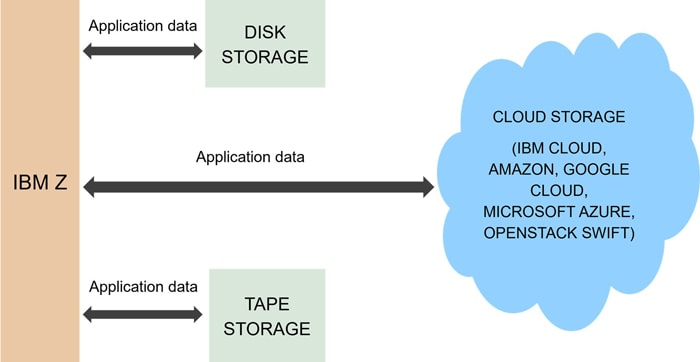
CDA enables z/OS applications to easily exchange data with applications in cloud and distributed environments, a key feature for legacy modernization. This cross-platform data sharing capability allows older systems to integrate with modern applications and services, supporting hybrid application architectures.
Cloud Providers and Authentication Methods Supported
The following S3 compatible cloud providers are supported by CDA:
- IBM Cloud Object Storage
- Amazon S3 Cloud Object Storage
- Microsoft Azure Blob storage
- Google cloud storage
- OpenStack Swift
The following authentication methods are supported by CDA:
- BASIC, TEMPAUTH, KEYSTONE
Authentication Mechanism
CDA provides an ISPF panel-oriented application to help with cloud credential storage. It also allows z/OS programs to invoke CDA APIs, thus allowing cloud provider agnostic interaction with the cloud. CDA uses provider JSON files that describe the details on how to interact with a particular cloud object server. Sample provider files are provided by IBM for common providers, which are customizable. The cloud credentials provided in the panel are encrypted using random encryption keys and are securely stored in IBM Cryptographic Service Facility (ICSF) Cryptographic Key Data Set (CKDS).
Major Components of CDA (End-user Perspective)
Figure 2. Major components of CDA
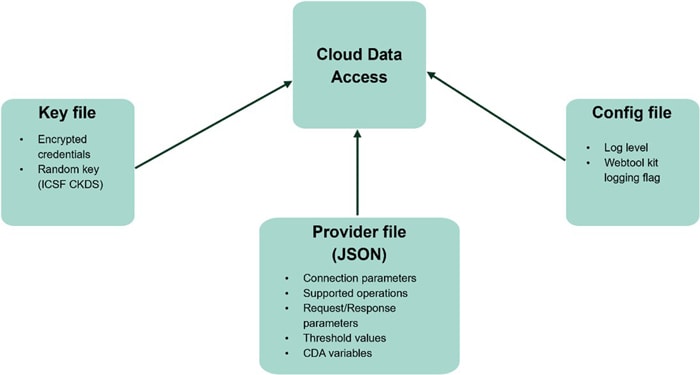
As demonstrated in the above diagram and elaborated upon below, the provider, key, and configuration files represent the principal CDA components relevant to end-users.
1. Provider file
Every cloud provider that is accessed through CDA needs a corresponding provider file. A provider file is a JSON object made up of key names and values. IBM provides sample provider files along with CDA, which can be customized to provide values pertaining to the specific cloud provider. The system expects provider files to reside in one of two locations: the user's ~/gdk/providers/ directory or the default /usr/lpp/dfsms/gdk/providers/ directory.
CDA configuration requires system administrator customization of provider files. These files contain connection parameters, supported operations, request/response parameters, threshold values, and other configuration settings. Provider files also include CDA-specific variables which are known as ‘CDA variables’.
2. Key file
Cloud credentials are securely stored in file named gdkkeyf.json within the user's ~/gdk/ directory. User or System Administrators input these credentials via CDA ISPF panels, which are then encrypted using a random key managed by the IBM ICSF CKDS.
3. Config file
Config file contains some of the configuration details pertaining to CDA/GDK API execution, like “log-level” : “INFO”/”WARNING”/”ERROR”, information on whether web enablement toolkit related logging has to happen or not (“web-toolkit-logging”: true/false) and so on. This file is made available as gdkconfig.json in the ~/gdk/ directory. The options provided in this file can aid in debugging the application.
Pre-requisites
CDA requires z/OS v2.4 or later. Note that z/OS v2.4 and v2.5 support is limited to Amazon S3 cloud storage. Prerequisites include the z/OS Client Web Enablement Toolkit and ICSF. CDA configuration involves several system administrator tasks, including RACF (or equivalent security product) configuration, SSL services setup, provider file customization, and ISPF panel customization. Please refer to the relevant IBM manuals for detailed information.
Pricing/Licensing
Cloud Data Access (CDA) is integrated with z/OS and is not a separately licensed product. It's included as part of the base z/OS offering with DFSMSdfp, starting with z/OS version 3.1.
Processing Thresholds and Performance Benchmarks
Cloud Data Access (CDA) processing thresholds and performance benchmarks are not yet publicly available. Contact IBM support for this information. However, IBM documentation notes that a z/OS Client Web Enablement Toolkit-compliant streaming exit can be used for chunking and sequencing large data transfers. This enables applications to handle very large data volumes within single requests/responses.
z/OS Client Web Enablement Toolkit
CDA leverages the z/OS Client Web Enablement Toolkit's APIs for its underlying functionality. This toolkit allows traditional z/OS programs to interact with modern web services, acting as clients in RESTful web applications. z/OS applications can initiate requests to web servers on z/OS or other platforms. The toolkit provides the following components to simplify client/server interactions for these applications.
- A parser that offers z/OS the ability to parse JSON data from diverse inputs and provides functions to create and update JSON structures
- A z/OS component that adds HTTP/HTTPS protocol support, designed to be consistent with widely used API interfaces
Modes of CDA Usage
- Through CDA APIs – GDK* APIs (Documented below)
- Through CDA batch utility – GDKUTIL (Documented below)
CDA API Details
The list of CDA APIs available for public use are listed in Appendix-1
Programming Languages Supported by CDA APIs
The following programming languages supported by CDA APIs on Z –
- Assembler, C, C++, COBOL
Linkage Conventions and Considerations for CDA APIs
Based on the programming language, interface macro/header file/copybooks as per Appendix-2 must be included in the program as per below table.
The IBM recommended approach for linkage is to use the linkable stub routine GDKCSS from SYS1.CSSLIB while binding the object module.
Please note that there are many environmental considerations that an end-user has to be aware of, like the ones related to OMVS segment for the associated user ID, Impact of z/OS UNIX limit of processes with a POSIX(ON) environment on the number of concurrent connection, z/OS Language Environment Heap runtime option, z/OS Language Environment Runtime Environment REUSE (RTEREUS) option and so on. IBM manuals must be referenced to get detailed information on these.
CDA API Invocation Syntax Format
Please refer to Appendix-3 for sample invocation formats in Assembler, C/C++ and COBOL.
Sample Programs Invoking CDA APIs
CDA provides one or more sample programs in its supported languages. They can be found in SYS1.SAMPLIB with the 3-character ID of GDK. For example, GDKIC1 is a sample C program.
Sample Use Case Ideas Involving CDA APIs
- CDA APIs enable z/OS applications to exchange data with applications in cloud and distributed environments. Careful Proof-of-Concept testing is recommended to determine the suitability of CDA APIs for specific cloud integration and modernization projects.
- CDA APIs facilitate hybrid cloud integration for z/OS mainframe applications, enabling them to participate within a broader cloud ecosystem.
- CDA can enable modern applications to access mainframe data with real-time, low-latency performance.
- There is a potential of integrating CDA APIs into hybrid cloud-based Z DevOps architecture. Automated Data Provisioning of mainframe data to cloud-based development and testing environments could be made possible through the usage of CDA APIs.
- Potential usage in microservices Integration - For mainframe modernization efforts involving microservices, CDA APIs can enable seamless data exchange between mainframe systems and cloud-native microservices. This allows microservices to access and update mainframe data in real-time, facilitating the development of hybrid applications.
- Potential usage in big data analytics - Transferring mainframe data to cloud-based big data platforms for analysis can be achieved through CDA APIs, which can be used to extract and load data into data lakes or data warehouses for further processing.
CDA Batch Utility - GDKUTIL
GDKUTIL, a new DFSMS batch utility included with base z/OS (starting with version 2.5), facilitates data sharing between z/OS and the cloud. It requires no additional hardware or software and can be used to upload or download sequential data. Detailed documentation is available in the DFSMS-dfp utilities manual.
Pre-requisites for GDKUTIL
- Cloud provider configuration – The z/OS system administrator configures the cloud provider connection settings by creating and customizing the "Provider file," as described previously.
- Once the provider configuration is done, GDKUTIL is ready to be invoked.
Excerpts from a Sample GDKUTIL Job:
//SAMPUTIL EXEC PGM=GDKUTIL,REGION=0M
//SYSIN DD *
UPLOAD PROVIDER(S3CLOUD)
/*
//OBJNAME DD *
/mybucket/myreport
/*
//LOCNAME DD *
MY.TEST.REPORT
/*
//SYSPRINT DD SYSOUT=*
//SYSOUT DD SYSOUT=*
In the above example, the sequential file named ‘MY.TEST.REPORT’ is getting uploaded to an S3 cloud bucket. The PS file would get placed in a bucket on S3CLOUD named ‘mybucket’, with an object name ‘myreport’.
Potential Use Cases of GDKUTIL Batch Utility
- GDKUTIL can integrate with DB2 backup processes. DB2 image or flash copy output, stored in sequential datasets, can be uploaded to the cloud using GDKUTIL. This integration supports data replication solutions for enhanced resiliency.
- GDKUTIL can facilitate application data sharing across sysplexes via cloud object storage. This enables secure data exchange with business partners and clients, with access controlled through cloud data management security features.
- GDKUTIL can be incorporated in cloud migration strategies aimed at eliminating recycles for infrequently accessed data, avoiding CPU processing and reduces tape storage resources needed.
- GDKUTIL can be integrated with the batch flow of products like IBM Z Batch Resiliency, where critical backed up data can be moved to PS files and copied over to cloud for enhanced resiliency options.
Conclusion
CDA's integration with DFSMSdfp provides several benefits:
- Data Transparency: CDA presents cloud object storage as a logical extension of the z/OS storage hierarchy, allowing applications to access cloud data using familiar I/O operations.
- Simplified Programming: Developers are shielded from the intricacies of REST API interaction, as CDA handles the low-level communication details. This reduces development effort and promotes code maintainability.
- Enhanced Security: The secure credential store centralizes the management of cloud provider credentials, minimizing the attack surface and preventing accidental exposure.
- Performance Optimization: CDA can optimize data transfers by leveraging techniques such as asynchronous operations and data buffering.
IBM Cloud Data Access APIs and GDKUTIL can potentially be used in various modernization solutions as they provide simple means to integrate system Z environment with cloud and distributed environment. Since CDA is a relatively new addition to z/OS base, CDA based PoCs need to be conducted in the Z environments where the pre-requisites are met and the feasibility of integrating this with various modernization solutions must be explored further before arriving at final solution proposals.
References
Throughout the preparation of this whitepaper, information and insights were drawn from a range of reputable sources, including research papers, articles, and resources. Some of the key references that informed the content of this white paper include:
- IBM documentation on Cloud Data Access – z/OS MVS Programming: Callable Services for High-Level Languages
- IBM documentation on GDKUTIL – GDKUTIL (Cloud Object Utility) Program - IBM Documentation
- Since its initial release, IBM keeps enhancing CDA with various new features, and they can be followed by following the IBM blog series titled “A Game Changing Series Part n - Cloud Data Access (CDA)” (Parts 1 through 7 are released as of now and are available on web.
Appendix-1 – List of CDA APIS
| GDKGET | Retrieve a cloud object |
| GDKWRITE | Write an object to cloud storage |
| GDKDEL | Delete an object from cloud storage |
| GDKLIST, GDKLISTL | List cloud objects |
| GDKMSGTR | Translate a CDA return code into text |
| GDKGETP | List cloud providers |
| GDKKEYSR | Retrieve cloud credentials |
| GDKKEYAD | Store cloud credentials |
| GDKKEYDL | Delete cloud credentials |
| GDKKEYGR | List resources for provider |
| GDKINIT | Initialize a Session |
| GDKTERM | Terminate a Session |
| GDKGEN | Perform a Configurable request |
| GDKVALD | Validate Provider File |
| GDKQUERY | Query available CDA functions |
Appendix-2 – Programming Interface Files
| Programming language | Programming interface file |
|---|---|
| Assembler | Include file GDKKASM provided in SYS1.MACLIB |
| C / C++ | Include file GDKIC provided in SYS1.SIEAHDRV.H |
| COBOL | Include file GDKICOB provided in SYS1.MACLIB |
Appendix-3 – Invocation Syntax Format
| Programming language | Invocation syntax format |
|---|---|
| Assembler | GDKapiservice_name (return_code,parm1,parm2,…) |
| C / C++ | gdkapi_service_name (return_code,parm1,parm2,…) where the gdkapi_service_name is all lower case |
| COBOL | CALL GDKAPISERVICE-NAME USING RETURN-CODE, PARM1, PARM2… |



Subscribe
To keep yourself updated on the latest technology and industry trends subscribe to the Infosys Knowledge Institute's publications
Count me in!