Cloud


Real-time Infrastructure Visualization & Intelligence
This whitepaper explores how Infosys SystemViz powered by Amazon Bedrock and AWS services addresses documentation drift by automating architecture visualization and documentation generation, enhancing governance, compliance, and agility across hybrid IT landscapes.
Insights
- SystemViz automates architecture visualization and documentation using AI.
- Integrates with CI/CD pipelines for version-controlled updates.
- Provides queryable architecture insights for compliance and impact analysis.
- Leverages AWS services like Bedrock, OpenSearch, ECS, and S3 for scalability.
- Improves governance, reduces operational risk, and accelerates release cycles.
Introduction
The technological landscape of any enterprise includes public cloud, on-premises systems, and hybrid environments. Maintaining accurate documentation is challenging due to frequent changes, leading to documentation drift. SystemViz addresses these challenges by making documentation dynamic and automated, improving maintainability and compliance.
Solution Overview
The conventional documentation process follows a well-known yet imperfect pattern: architects develop detailed diagrams during the planning phase, but deviations occur during implementation due to practical constraints. Over time, operational changes further alter the environment, yet updates to documentation are often overlooked due to time pressures and competing priorities. This cycle results in documentation drift, where the recorded state diverges from the actual deployed technology stack.
The SystemViz solution developed by Infosys transforms documentation into a dynamic, living asset for any technology environment. By using the generative AI capabilities in Amazon, including Bedrock and OpenSearch Serverless, the solution automatically analyzes and visualizes configurations from legacy systems, Infrastructure as Code (IaC), container orchestrations, and traditional IT setups.
From data centers to cloud-native architectures, this solution empowers organizations to operate with clarity and agility, fostering innovation while enhancing governance across their entire technology estate. It eliminates manual efforts in documentation management and ensures alignment between deployment reality and its representation in documents by generating deployment diagrams and comprehensive documentation from the deployment artifacts.
Fig 1
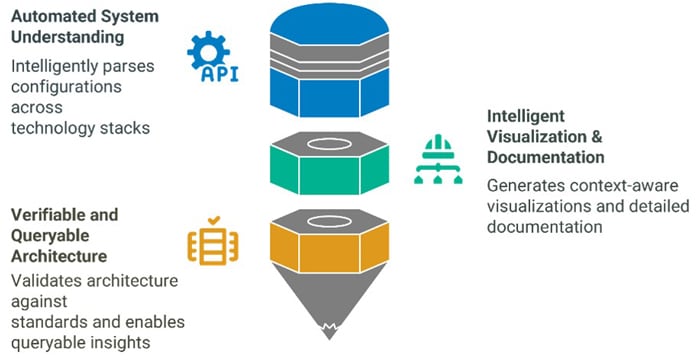
Automated System Understanding
Intelligently parsing configurations across every technology stack, ensuring accurate and up-to-date documents are created without draining technical resources. The AI engine thoroughly analyzes all components, their relationships, and patterns in legacy IT systems, Infrastructure Code, and Kubernetes clusters to provide a complete view of the IT landscape.
Intelligent Visualization & Documentation
AI-Powered Architecture Visualization
Content rich visualizations are generated accurately representing the deployed technology architecture. The intelligent engine creates interactive diagrams automatically mapping the relationships between components and services, which enables powerful drill-down capabilities. These visualizations offer exceptional clarity across diverse environments, allowing teams to comprehend complex architectures quickly and efficiently.
Comprehensive Documentation Creation
Beyond visualization, documentation on components, configurations, data flows, and relationships is comprehensive and detailed. The documents are created in required language (s) with accurate and consistent information which technical teams and business executives can consume in a format suitable for their use.
Version-Controlled Documentation
Integrating with existing CI/CD pipelines, documentation is version-controlled and evolves alongside every deployment change/ release. The code changes are automatically detected, triggering documentation update in line with the release for accuracy, while also maintaining the historical record of architectural evolution.
Verifiable and Queryable Architecture
The determined architecture and design are validated against enterprise-approved design patterns, security posture and adherence to organizational standards, and deviations are highlighted for prompt action in the release cycle. Additionally, the queryable nature of the documentation enables teams to extract specific insights or answer complex questions through a chatbot-like experience about the architecture, aiding teams with a better understanding both for faster development of new capabilities and managing the system.
Solution Architecture
Built as a flexible and extensible solution, it automatically generates visualizations and documents for all technology stack in an enterprise landscape, leveraging AWS technologies like Amazon Bedrock for AI, OpenSearch for RAG and S3 for data management, Step Functions for orchestration, ECS and Fargate for computation, CloudFront for delivery, Cognito for IDAM and Aurora for database needs, ensuring a secure, robust and scalable solution.
Fig 2
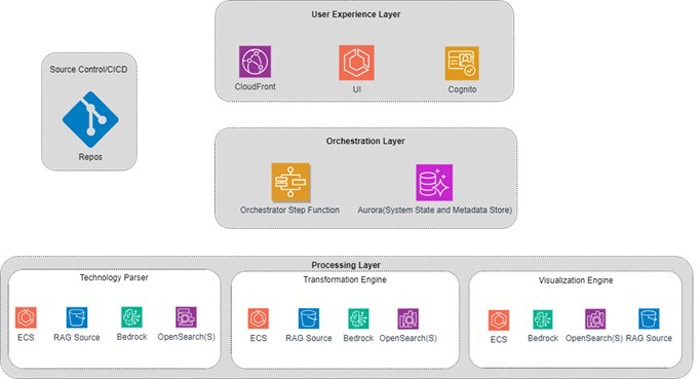
Processing Layer
Intelligent processing with AI and scaling with containerization
Technology Parser
Read the artifacts to generate understanding of the components and the relationship between them, from source code repositories.
- Amazon ECS provides scalable, containerized compute for processing diverse input formats.
- Amazon Bedrock powers the interpretation of various source artifacts and configuration data.
- Amazon OpenSearch Serverless and Amazon S3 forms the RAG system, enhancing parsing with contextual knowledge.
Transformation Engine
Maps the identified components to the technology of the various providers, validates the identified architecture against approved design patterns, and generates intermediary output for final document generation by visualization engine.
- Amazon ECS hosts transformation logic into scalable containers.
- Amazon Bedrock (Claude Sonnet) performs advanced contextual analysis to extract relationships.
- Amazon OpenSearch Serverless and Amazon S3 provide historical context to improve transformation quality.
Visualization Engine
Generate the diagrams and documents, index into the vector database and publish into repository. Also, as source artifacts change, automated processing ensures that vector indexing remains current.
- Amazon ECS runs our containerized visualization services.
- Amazon Bedrock assists in generating optimal diagram layouts.
- Amazon OpenSearch Serverless and Amazon S3 supply reference patterns for consistent visualizations
Additionally, the RAG system plays a critical role across all processing components, for continuously learning from new documentation to improve future outputs.
Orchestration Layer
Manage all processing activities and maintain system state to ensure reliable & timely document generation with complete audit trail of activities performed.
- AWS Step Functions manages the complete workflow, orchestrating the progression through parsing, transformation, and visualization stages.
- Amazon Aurora serves as our system state and metadata store, tracking user configurations, job status, and component relationships.
User Experience Layer
Define the source systems, configure the integration with DevOps pipeline, inspect orchestration activities, and integrate with documents.
- Amazon CloudFront delivers low-latency content to users globally, ensuring fast access to documentation artifacts regardless of location.
- Amazon ECS hosts responsive web UI, providing an intuitive interface for source system setup, viewing, and downloading documents.
- Amazon Cognito enables user authentication and authorization, ensuring secure access to the platform.
Source Control Integration
Source Control Integration - Connect to the defined source of truth of deployment enabling:
- Automatic documentation updates when code changes
- Version control for documentation assets
- Direct linking between code and documentation artifacts
Solution Adoption – An example scenario
A global enterprise with a hybrid IT landscape spanning across on-premises servers, private cloud, and AWS & Azure. With both IaaS-based workloads and microservices-based applications, their current documentation is outdated. This resulted in delays and risks during the planning for any of their new transformation initiatives including a program to migrate the legacy customer relationship management (CRM) system to a modern cloud architecture.
Infosys SystemViz helped in documenting the existing IT landscape comprehensively including the CRM system, to create a pragmatic migration plan handling all integrations properly thereby increasing confidence in execution and reducing program risks.
Solution Walkthrough
Fig 3
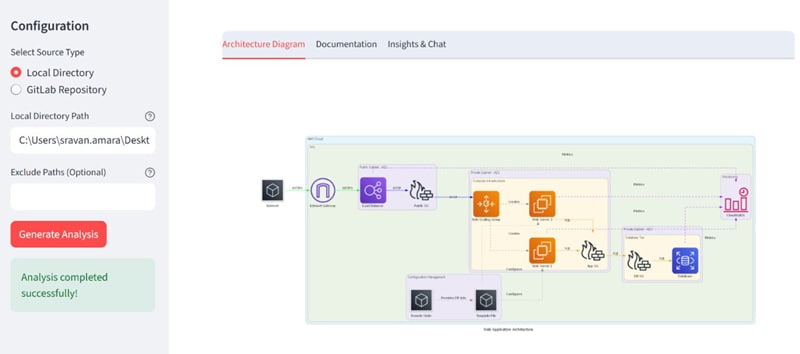
Automated Pipeline mode
SystemViz integrates directly with CI/CD pipelines to maintain automatic synchronization between deployment configuration changes and documentation.
- Code commits in connected repositories trigger SystemViz’ s orchestration components to automatically regenerate diagrams and update technical specifications in line with the changes.
- Integration with GitHub Actions or GitLab CI (extensible to any CI/CD tool) enables seamless incorporation into existing development workflows without manual intervention.
Fig 4
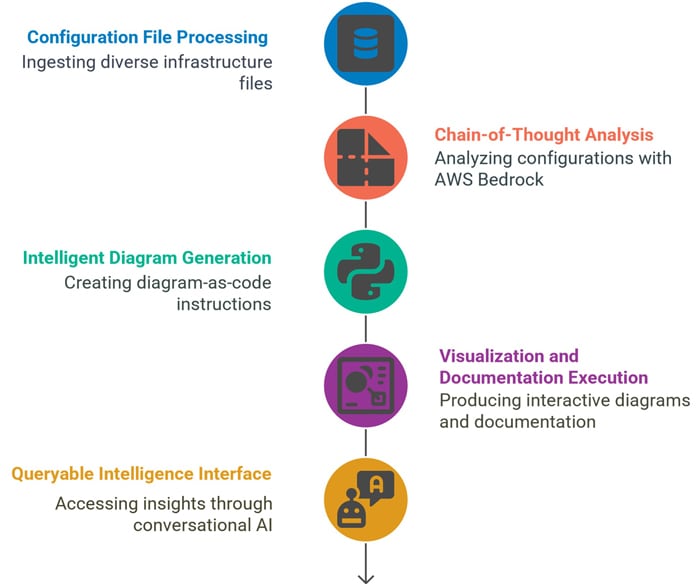
Interacting with the System
Source Configuration
- Repository integration - connects seamlessly with GitHub and GitLab APIs, to select repositories containing configuration definitions which the platform discovers, and the intelligent parsing engine using advanced categorization algorithms to identify and classify configuration definitions across mixed paradigms. Be it, Terraform scripts, CloudFormation scripts, Kubernetes manifests, ARM templates, application configuration files, CI/CD pipeline definitions, and legacy deployment script, to generating comprehensive documentation regardless of technology stack diversity.
- Direct file upload -Same features as above but works with file uploads for smaller systems.
The automated discovery and validation approach gives confidence that entire configuration code has been properly analyzed, be it modern cloud-native deployments, application settings, or hybrid environments containing legacy components, and calls out missing content/ configuration definitions. The validation feedback also flags file compatibility, and parsing errors if any.
Visualizations and Documentation Generation
With sophisticated graph algorithms and intelligent clustering techniques interactive architecture diagrams with contextual logical boundaries such as VPCs, resource groups, namespaces, application domains, or custom organizational patterns are generated.
The multi-perspective rendering system serves diverse stakeholder needs:
- Enterprise architect - high-level architectural abstractions for strategic decision-making,
- Implementation teams - detailed technical & schematics information with comprehensive component visibility,
- Security & Audit - security-focused topologies emphasize compliance controls and data flow patterns for governance requirements.
Richer content is brought into the architecture document with GenAI capabilities that include explanation of design decisions, component interdependencies, security implementations, application configurations, and compliance settings.
With interactive features like seamless navigation between visual diagrams and corresponding documentation sections, standards-compliant markdown document is generated. This enables export and integration with existing documentation platforms, wikis, and knowledge management systems that teams already use.
Query Interface and Enterprise Validation
The conversational AI with graph traversal algorithms enables semantic configuration queries, allowing users to ask intuitive questions like
"What components would be impacted by removing this database?" or "Identify all systems handling PII data?" or "Show me all configurations that reference this API endpoint."
The query engine with contextual understanding of component relationships and dependency chains provides specific component references and optimization suggestions that help technical teams understand impact scenarios and business stakeholders assess change implications.
Verifiable architecture starts with knowledge repository created with enterprise policies, standards & patterns and then continuous validation of derived architecture from configuration definitions. This validation system employs risk-based categorization algorithms powered by AI to identify deviations from defined standards and provides automated remediation suggestions and actionable corrective guidance.
The structured compliance reports are generated appropriately for different audiences—technical teams receive detailed remediation steps, while architecture review boards and compliance teams get executive-level summaries with clear risk assessments and corrective action priorities.
Conclusion
The Impact of SystemViz
Team Satisfaction
- Team Happiness: With reduced time spent mapping and documentation, it helps increase focus on developing new features, business capabilities and even more protective measures.
- Architect Relief: Eliminating tedious documentation maintenance or architecture & technology audits, enables them to work on business value-creating work.
- Operator Peace of Mind: Clearer understanding of the system and security boundaries reduces stress during critical operations.
- Easier Onboarding: New team members gain faster understanding with accurate visualization and documentation. The document's interactive nature helps new members with what-if analysis and improve their system of understanding.
Delivery Performance
- Shortened Release cycles: With easier impact analysis, verification of adherence to architecture and design patterns & standards, inline in the DevOps pipeline.
- Decreased Failures: Better understanding of relationships between components and robust impact analysis reduces incidents due to improper changes.
Operator Experience
- Heightened Confidence: Clear visualization of the deployed IT landscape with components, interactions and security boundaries gives greater confidence to the IT and security team to operate the landscape.
- Faster incident response: Real-time and interactive diagrams significantly reduce time to identify potentially affected components to handle incidents.
- Improved Change Success: Visual impact analysis helps prevent unintended consequences of system changes.
Cost Efficiency
- Reduced documentation effort: Automation eliminates effort in diagram/ document creation and update during both engineering and operation phases.
- Lower Incident Costs: Faster identification translates to reduced impact be it system availability or performance or security.
Security Posture & Risk Reduction
- Enhanced Security Posture Representation (SPR): SystemViz provides clear visualization of security boundaries, segmentation, and access controls, helping teams better understand and improve their overall security posture.
- Visual Compliance Mapping: Automatically highlights resources that may deviate from security to the best practices or compliance requirements.
- Security Zone Visibility: Clearly demarcate security zones and data flow between them to identify potential vulnerabilities.
Auditing and Governance
- Enhanced Governance: Visual representation of infrastructure enables more effective governance and organizational policy enforcement.
- Simplified Auditing: Automatically generated diagrams with required drilldown provide required information to support audit which is comprehensive and efficient.
Evolving the solution
With emerging GenAI tools like MCP Servers from AWS Labs on automated documentation generation for code repositories, the same can be adopted as the technology matures to enhance the capabilities of SystemViz.
We suggest integrating GenAI-assisted SystemViz solution into the software engineering process today to unlock its potential and navigate your technology landscape with confidence, delivering the comprehensive configuration intelligence that modern enterprises require.
References



Subscribe
To keep yourself updated on the latest technology and industry trends subscribe to the Infosys Knowledge Institute's publications
Count me in!