Artificial Intelligence


SDLC Agent Framework
This whitepaper explores the concept of SDLC Agents. It is a novel approach to software development that leverages the power of Generative AI and Agentic AI. These AI agents can generate content, take decisions, and interact with their environment to complete specific tasks within the software development lifecycle (SDLC).
Insights
- The purpose of this paper on SDLC Agent framework is to:
- Introduce the concept: Explain the core principles and underlying technologies of the framework.
- Challenges in Traditional SDLC Workflows: Explain the various challenges in traditional software development lifecycle viz. time consuming, prone to human errors, limited flexibility, scalability etc.
- Motivation for AI driven solutions: Explain how AI driven solutions can help in solving the challenges faced by traditional SDLC workflows.
- Architecture & implementation details: Explain architecture details for SDLC multi agent framework along with various tools and technologies used for its implementation.
- Explore potential applications: Discuss how AI agents can be applied to different stages of the software development life cycle, such as requirements & user stories creation, high level and detailed design creation, code generation, test cases generation, testing, and deployment.
- Analyze benefits and challenges: Evaluate the potential benefits of the framework, such as increased efficiency, reduced costs, and improved software quality. Also, discuss the potential challenges and limitations of such frameworks.
- Future work: Explore opportunities to improve upon the framework like extending agent’s capabilities, continuous improvement of reasoning and decision-making abilities, integration with other emerging technologies etc.
Introduction
Background on SDLC Automation
The Software Development Life Cycle (SDLC) encompasses the structured process of building and delivering software, typically involving stages like planning, design, development, testing, deployment, and maintenance. Traditional SDLCs often involve manual tasks, prone to human error, and can be time-consuming, leading to delays and increased costs. Generative AI can be leveraged to help with automation of these tasks partially or fully.
Challenges in Traditional SDLC Workflows
Traditional SDLC workflows face several inherent challenges:
- Human Error: Manual tasks are susceptible to human error, such as coding mistakes, incorrect configurations, and missed deadlines.
- Time Consuming: Repetitive tasks, like code reviews and testing, can be time-consuming, leading to project delays and increased development costs.
- Lack of Flexibility: Rigid workflows can hinder adaptability to changing requirements and market demands.
- Limited Scalability: Scaling development efforts to meet increasing demands can be challenging in traditional, manually intensive environments.
- Difficulty in Maintaining Consistency: Ensuring consistent quality and adherence to standards across different projects and teams can be difficult to maintain.
Motivation for AI-Driven Solutions
The limitations of traditional SDLCs have driven the search for more efficient and effective solutions. AI-driven approaches offer several compelling motivations:
- Increased Efficiency and Productivity: Automation of repetitive tasks through AI can significantly boost developer productivity and reduce time-to-market.
- Improved Accuracy and Quality: AI-powered tools can help identify and mitigate human errors, leading to higher quality code and fewer bugs.
- Enhanced Flexibility and Adaptability: AI models can learn and adapt to changing requirements, enabling more agile and responsive development processes.
- Improved Scalability: AI can help scale development efforts more effectively by automating tasks and optimizing resource allocation.
- Enhanced Innovation: By taking help of AI to automate mundane or routine tasks, developers can focus on creative and innovative aspects of software development, such as exploring new technologies and developing novel solutions.
Key Characteristics
- Agent-Based Approach: The framework revolves around the concept of utilizing power of AI agents that can perform various development tasks.
- Automation: AI agents can help in automating repetitive and time-consuming tasks, such as code generation, testing, and deployment.
- Efficiency: The framework aims to significantly increase development speed and efficiency through automation.
- Innovation: AI agents can assist in exploring innovative solutions and design patterns, potentially leading to more creative and groundbreaking software.
Insights into Existing Approaches for AI-Driven SDLC
The integration of AI within the Software Development Life Cycle (SDLC) is an emerging field with significant potential to revolutionize how software is built. Several key approaches are currently being explored:
AI-Powered Code Generation:
- Tools like GitHub Copilot and Amazon CodeWhisperer leverage machine learning models trained on massive datasets of code to provide real-time code suggestions and even generate entire code blocks based on developer input.
- Benefits: Increased developer productivity, reduced coding time, and improved code quality through suggestions for better practices and more efficient algorithms.
- Challenges: Ensuring code correctness and maintainability, potential for introducing biases from the training data, and ethical implications of AI-assisted code creation.
Automated Testing with AI:
- AI-powered testing frameworks can automatically generate test cases, prioritize tests based on risk, and identify potential bugs more effectively.
- Machine learning algorithms can be used to optimize test suites and improve test coverage.
- Benefits: Reduced testing time and effort, improved test effectiveness, and earlier detection of critical defects.
- Challenges: Ensuring the reliability and robustness of AI-generated tests, maintaining test coverage as the codebase evolves, and integrating AI testing seamlessly into existing CI/CD pipelines.
AI-Driven Code Review and Analysis:
- Static and dynamic analysis tools powered by AI can identify potential code vulnerabilities and enforce coding standards.
- Machine learning models can analyze code patterns to predict potential issues, such as performance bottlenecks and security risks.
- Benefits: Improved code quality, enhanced security, and reduced technical debt.
- Challenges: Achieving high accuracy in identifying and classifying code issues, providing actionable insights for developers, and ensuring the explainability of AI-driven code analysis results.
Predictive Analytics for Project Management:
- AI can be used to predict project timelines, estimate resource allocation, and identify potential risks based on historical data and real-time project metrics.
- Machine learning models can analyze factors like team experience, project complexity, and external market trends to forecast project outcomes.
- Benefits: Improved project planning and execution, better resource allocation, and reduced project delays and cost overruns.
- Challenges: The accuracy of predictions depends heavily on the quality and completeness of historical data.
Architecture of SDLC Multi Agent framework
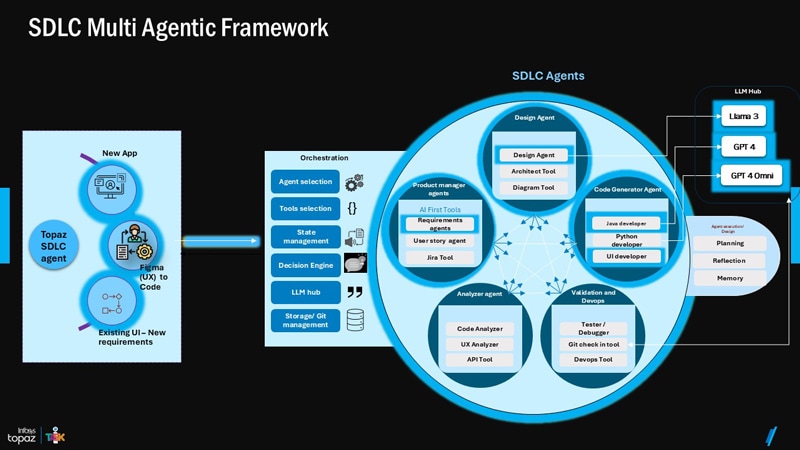
High level architecture of SDLC multi agent framework is represented below –
Figure 1. SDLC multi agent framework architecture
Overview of the multi-agent framework
This framework leverages a distributed approach, employing a collection of AI agents to automate and streamline the software development lifecycle (SDLC). This framework provides a foundation for a highly automated and intelligent SDLC process, leveraging the power of multi-agent AI and LLM technology.
Key Components:
- Planner Agent:
- Responsible for managing the overall workflow.
- Selects the appropriate agents based on the requirements interpreted from the user input prompt.
- Manages the state of the project, tracking progress and dependencies.
- Orchestrates the interaction between different agents and external tools.
- Product Manager Agent:
- Responsible for generating project requirements and user stories.
- Comprises of two sub-agents to achieve these tasks – Requirements Agent & User Story Agent.
- Leverages various LLMs in LLM Hub for generating requirements and user stories based on user input prompt.
- It also has tools for integration with external systems like Jira.
- Design Agent:
- Focuses on the architectural and design aspects of the software.
- Utilizes diagramming tools (e.g., UML, Mermaid) to visualize system architecture, data flow, and user interfaces.
- Leverages various LLMs in LLM Hub for generating initial design concepts, suggesting alternative solutions, and identifying potential design flaws.
- Code Generator Agent:
- Generates code based on requirements, user stories, and design specifications for a particular programming stack (E.g. – MERN).
- Can utilize UI development frameworks like Angular to generate user interfaces based on design mockups.
- Leverages LLM Hub for code generation and code modification.
- Analyzer Agent:
- Performs analysis of existing code to identify areas where changes must be made depending on the user requirements.
- Conducts user experience (UX) analysis to assess the changes required in the user interface.
- Validation & DevOps Agent:
- Handles testing, debugging, and deployment of the software.
- Implements CI/CD pipelines.
- Leverages “LLM Hub” for test case generation, bug prediction, and automated debugging assistance.
LLM Hub Integration:
- The framework comprises of an LLM Hub which is a collection of LLMs available for performing various tasks.
- Some of the LLMs available in LLM Hub are - GPT-4, GPT-4o, Anthropic Claude etc.
- Different LLMs have different levels of capabilities. The framework is designed to choose appropriate LLMs from LLM Hub based on research & experimentation done on their capabilities.
Interaction with External Tools:
The framework seamlessly integrates with various external tools, like:
- Jira: For project tracking, issue management, and agile planning.
- Git: for managing code changes.
AI Tools and Technologies in SDLC Multi-Agent Framework
Various AI tools and technologies have been used in the development of SDLC multi-agent framework. Here's a breakdown of how key AI technologies contribute:
LLMs (Large Language Models):
- GPT-4: A cutting-edge LLM from OpenAI, known for its advanced capabilities in code generation, reasoning, and creative content generation. GPT-4 can be effectively used for complex tasks like architectural design suggestions, advanced code analysis, and sophisticated test case generation.
- GPT-4o & Anthropic Claude: These multimodal LLMs, capable of understanding and generating both text and images. This is particularly valuable for tasks involving visual design, user interface prototyping, and analyzing visual elements within the software.
Custom Fine-tuning and Prompt Engineering:
- Custom Fine-tuning: Adapting pre-trained LLMs to SDLC specific tasks can be done to create Small Language Models (SLMs). This will involve re-training (fine-tuning) the models on relevant datasets (e.g., project-specific code, documentation, design guidelines) to improve their performance and accuracy. SLMs are valuable tools for focused, specific tasks due to their domain-specific training, fine-tuning capabilities, smaller size, faster inference, and enhanced privacy and security.
- Prompt Engineering: Crafting effective system prompts LLMs to elicit the desired outputs. This is crucial for ensuring that agents receive clear instructions and generate accurate and relevant results. In SDLC framework, every agent has a carefully designed system prompt which gives it a specific role to play in the SDLC lifecycle. For example:
- Design Agent: "Generate a UML diagram for a system with the following components..."
- Code Generator Agent: "Write a Python function to..."
- Analyzer Agent: "Identify places where change needs to be made in the following code..."
Implementation Details of SDLC Multi-Agent Framework
Development Process for Each Agent:
- Agent Design:
- Agent roles and responsibilities are defined clearly.
- System prompts for each agent are designed to handle its defined role and responsibilities.
- Communication protocols and data exchange formats between agents are specified.
- Agent capabilities and limitations are determined.
- Agent Development:
- Appropriate AI/ML models are chosen for specific tasks (e.g., code generation, design analysis).
- Agent logic is developed using programming languages (e.g., Python) and agent framework libraries (e.g., LangGraph, LangChain etc.).
- Integration with external APIs and services is done (e.g., Jira, GitHub etc.).
- Agent Testing:
- Each agent was individually tested thoroughly to ensure correct functionality and performance.
- Integration testing is conducted to verify seamless communication and interaction between agents.
Integration with Existing SDLC Pipelines:
- Integration Points: It was identified where in the existing SDLC pipeline the multi-agent framework can be most effectively integrated.
- API Integration: APIs are utilized to connect agents with existing tools and platforms (e.g., Jira, Git, CI/CD systems).
- Data Exchange: Mechanism was established for seamless data exchange between agents and the existing SDLC infrastructure.
- Workflow Integration: Agent actions were integrated into existing workflows, such as issue tracking, code reviews, and deployment.
Details of Agents
Planner Agent:
This is the highest-level planner or supervisor agent which co-ordinates and interacts with the users. It handles the complete workflow for creating a new application or editing an existing application. This workflow is customizable as per organization’s needs and standards.
Following workflow is designed for a new application –
- Store application information
- Generate requirements
- Generate user stories
- Insert the user stories into Jira
- Generate the design document
- Generate test cases
- Generate the code
- Push the code to GitHub
- Deploy the code
Following workflow is designed for editing an existing application –
- Store application information
- Generate requirements
- Generate user stories
- Insert the user stories into Jira
- Generate test cases
- Perform code modification
Requirements Agent:
This agent has the capability to generate software requirements documentation based on input user prompt/requirement. Such type of requirements documentation can be utilized by the software development team. The agent is designed to create requirements documentation with following sections –
- Introduction
- Purpose
- Intended audience
- Scope
- Overall description
- User needs
- Assumptions and software dependencies
- System features and requirements
- Functional and non-functional requirements
- Interface requirements
- System features
The format of the requirements documentation can be customized based on the organization’s needs and standards.
User Stories Agent:
This agent has the capability to generate user stories based on the requirement’s documentation. It can use the requirements documentation created by the requirements agent as input or some custom requirements documentation available already within the enterprise. The agent is trained on few shot examples of existing requirements documentation and their corresponding user stories. This helps it to generate the user stories in a particular usable format. Generated user stories are stored in a document format which can be consumed by the software development team. The format of these user stories can be customized based on organizational needs and standards. The agent also has the capability to upload these user stories to Jira. This is done by creating Agent tools which internally utilize Jira APIs to interact with Jira application. Depending on organization’s needs, this can be customized to interact with some other enterprise products like Azure DevOps etc.
Design Agent:
This agent has the capability to generate high level design and/or low-level design documents based on the requirements and user stories generated by respective agents. The design document covers technical, functional and architectural aspects of the application to be created. The format of the design document can be customized based on organizational needs and standards. Appropriate architecture diagrams are created in relevant sections wherever applicable. The agent is designed to create design documentation with various sections –
- Architecture of the system
- Design of database
- Design of User Interface
- API Design
- Security Considerations
- Performance and Scalability
- Testing and Deployment
Code Generator Agent:
This agent has the capability to generate code for the application based on requirements, user stories and design documentation created in earlier steps by respective agents. The agent is designed to create web applications using following tech stack - Python, HTML, JavaScript, Flask, SQLite3, and CSS. This tech stack can be customized based on project requirements. It comprises of various sub-agents each specializing in its own field like Python developer agent, HTML developer agent, CSS developer agent, JavaScript developer agent. There is an agent for linking all the code generated by various agents.
Code Analyzer Agent:
This agent is responsible for analyzing existing code base and making changes to it based on the input requirements given in requirements documentation, user stories and design documentation. The agent can analyze web applications in MERN technology stack and make changes to it.
Validation & DevOps agents:
This category of agents comprises of various sub-agents who have expertise in their respective fields like creating test cases, checking in code to repositories etc.
- Validation agent has capabilities to generate test cases based on input requirements, user stories and design documentation created in earlier steps by respective agents.
- DevOps agent has capabilities to check-in generated code to code repositories, automatically deploying the code. It can be further enhanced to handle other DevOps tasks like automated testing/debugging, code review, security vulnerability analysis etc.
Memory, Reflection, and Planning for Agents:
Memory:
- Short term memory (STM) mechanism has been implemented in this framework for agents to store and retrieve relevant information at each stage as well as user conversations.
- This in-memory store has been utilized for its simplicity and usability. This helps in persisting in the state of various agents as well as chat conversations.
- Long term memory (LTM) has been utilized to store outputs of each stage (viz., application information, requirements, design, test cases, code etc.) using a more persistent storage mechanism (files in local file system). This can be further customized to use database or object storage depending on the requirements.
Reflection:
- Reflection in SDLC Agents enable them to analyze their own performance and identify areas for improvement. This is done by analyzing past decisions, the reasoning behind them, and the resulting outcomes. Based on the evaluation, the agents adjust their behavior, refine their decision-making processes and enhance their overall performance.
- Various strategies are used to implement reflection in SDLC agents –
- Prompts – Self-reflection prompts are designed to enable agents to review its output.
- Reviewer agents – Agent’s output is fed to reviewer agents for evaluation. Feedback is given back to initial agents, and this helps them to improve further.
- Memory integration – Past actions, decisions and reviews are stored in long term memory. These are then used to identify patterns and avoid repeating errors.
Planning:
Planning in SDLC agentic framework is done through high level planner or supervisor agent. This helps the framework to navigate complex SDLC tasks and achieve specific goals. Currently the framework is designed to plan and execute two types of workflows – one for new creating new application and another for editing an existing application. Planning helps in adjusting the workflow based on user inputs/directions.
Challenges and Limitations
Current Gaps in Agent Collaboration:
- Complex Interdependencies: As the number of agents and their interactions increase, managing dependencies and ensuring smooth coordination becomes increasingly complex.
- Communication Bottlenecks: Inefficient communication protocols or inadequate information sharing among agents can lead to delays, errors, and suboptimal outcomes.
- Conflict Resolution: Handling situations where agents have conflicting goals or generate conflicting outputs requires sophisticated mechanisms for conflict resolution and negotiation.
Scalability Concerns:
- Performance Bottlenecks: As the number of agents and the complexity of tasks increase, bottlenecks can arise, impacting overall system efficiency and responsiveness.
- Resource Management: Managing and allocating resources (e.g., computational power, memory) effectively across multiple agents can be challenging, especially in resource-constrained environments.
- Maintaining Consistency: Ensuring data consistency and avoiding race conditions in a distributed system with multiple concurrently executing agents can be difficult.
Dataset and Model Limitations:
- Data Quality: The quality of data input significantly impacts the performance of AI models and agents. Inaccurate or incomplete data can lead to erroneous outputs and unreliable results.
- Model Limitations: Current AI models, including LLMs, have limitations in terms of reasoning, common sense, and handling complex, nuanced situations. These limitations can impact the accuracy and reliability of their outputs in the SDLC context.
Other Challenges:
- Explainability and Interpretability: Understanding and explaining the decisions and actions of AI-powered agents can be challenging, making it difficult to debug issues and ensure the reliability of the system.
- Integration with Existing Systems: Integrating the multi-agent framework with existing legacy systems and tools can be complex and time-consuming.
Addressing these challenges requires ongoing research and development in areas such as:
- Advanced agent communication protocols: Enabling more efficient and reliable communication between agents.
- Decentralized architecture: Developing more robust and scalable distributed architectures for complex multi-agent applications.
- Human-in-the-loop (HITL): Integrating human review and control into the multi-agent framework to ensure safety and reliability.
By addressing these challenges and limitations, we can unlock the full potential of SDLC multi-agent frameworks and revolutionize the way software is developed and delivered.
Future Work
Incorporating Real-World Datasets:
- Leveraging Datasets like WebSight: Utilizing datasets like WebSight, which contain massive amounts of image and text data, can significantly enhance the capabilities of agents involved in visual design, UI/UX analysis, and image-based testing. This will enable agents to better understand and interpret visual information, leading to more accurate and creative design outcomes.
- Domain-Specific Datasets: Training agents on domain-specific datasets (e.g., code repositories, design guidelines, project documentation) can significantly improve their performance on specific tasks within the SDLC. This can lead to more accurate code generation, better design suggestions, and more effective bug detection.
Extending Agents' Capabilities:
- Specialized Agents: Developing specialized agents for specific tasks within the SDLC, such as security analysis, performance testing, and user research, can lead to more focused and effective solutions. For example, a dedicated security analysis agent could leverage machine learning techniques to identify and mitigate potential security vulnerabilities.
- Multimodal Capabilities: Extending agent capabilities to handle multiple modalities (e.g., text, images, code, audio) will enable them to perform more complex tasks, such as analyzing user feedback from video interviews or generating interactive prototypes.
Continuous Improvement of Memory and Decision-Making:
- Long-Term Memory: Implementing long-term memory mechanisms that allow agents to store and retrieve information from previous projects, design decisions, and code changes can significantly improve their ability to learn and adapt.
- Reinforcement Learning: Utilizing reinforcement learning techniques to train agents to make optimal decisions based on past experiences and feedback can lead to more efficient and effective workflows.
- Explainable AI: Developing more explainable AI systems will allow developers to better understand the reasoning behind agent decisions, making it easier to debug issues and ensure the reliability of the system.
Other Areas of Future Work:
- Decentralized Architectures: Exploring decentralized architectures that can improve the robustness, scalability, and security of the framework.
- Integration with Emerging Technologies: Integrating with emerging technologies to further enhance the capabilities of the framework.
Conclusion
Summary of Findings and Contributions:
- SDLC multi-agent frameworks demonstrate significant potential for automating and streamlining software development processes. By leveraging AI and automation, these frameworks can improve efficiency, enhance code quality, and accelerate time-to-market.
- Key contributions:
- Increased Automation: Automation of repetitive tasks like code generation, testing, and deployment leads to significant time and cost savings.
- Improved Code Quality: Automated code analysis, testing, and design reviews help to identify and mitigate problems sooner, resulting in better-quality programs.
- Enhanced Collaboration: Facilitates better communication and coordination among team members by providing a platform for seamless information sharing and task delegation.
- Increased Innovation: AI-powered agents can assist developers in exploring new ideas, generating creative solutions, and improving the overall quality of software.
How SDLC Agent Framework Differs from other alternatives in market?
The SDLC Agent Framework distinguishes itself from market alternatives such as Curson.AI, Bolt, and Windsurf through several key architectural and functional differentiators.
While Curson.AI emphasizes autonomous software development via self-improving agents, the SDLC Agent Framework prioritizes a modular, multi-agent collaboration paradigm. In this framework, each agent is specifically designed and operates within a distinct phase of SDLC.
In contrast to Bolt, which offers a suite of pre-configured AI-powered automation tools, the SDLC Agent Framework provides a highly customizable environment with robust integration capabilities for existing enterprise systems. This includes seamless connectivity with platforms such as Jira, GitHub, and CI/CD pipelines, facilitating a more tailored and integrated development workflow.
Unlike Windsurf, which is primarily optimized for low-code and no-code development methodologies, the SDLC Agent Framework is engineered to support the complexities of full-scale enterprise application development. It leverages Large Language Models (LLMs), fine-tuned models, and sophisticated prompt engineering techniques to manage intricate software workflows.
Furthermore, the SDLC Agent Framework incorporates memory mechanisms that enable reasoning and reflection across agent interactions. This crucial feature facilitates adaptability and continuous learning over time, a capability that is not a central design tenet of other market platforms.
Overall, the SDLC Agent Framework is specifically tailored to address the demands of large-scale, AI-driven automation within enterprise software development. It achieves this by strategically combining AI reasoning, memory retention, and orchestrated multi-agent collaboration within a structured and phase-oriented environment.
Implications for the Future of AI-Driven SDLC Workflows:
- Shift in Developer Roles: As AI takes on more of the repetitive and mundane tasks, developers can focus on higher-level tasks such as architecture, design, and innovation.
- Emergence of New Roles: The rise of AI-driven SDLC will likely lead to the emergence of new roles, such as AI/ML engineers, data scientists, and AI ethics specialists.
- Continuous Learning and Adaptation: The success of AI-driven SDLC frameworks will depend on continuous learning and adaptation, including ongoing model training, refinement of agent behavior, and integration of new technologies.
- Ethical Considerations: Careful consideration of ethical implications, such as data privacy, job displacement, and algorithmic bias, is important for the responsible development of AI-driven SDLC frameworks.
Looking Ahead:
SDLC multi-agent frameworks represent a significant step forward in the evolution of software development. By harnessing the power of AI and automation, these frameworks have the potential to revolutionize software development, which can lead to increased efficiency, improved quality, and greater innovation. However, it is crucial to address the challenges and limitations, and to proceed with a focus on ethical considerations and human-centered design.
- Continued advancements in AI: Continued research and development natural language processing, computer vision, and machine learning will further enhance the capabilities of AI-powered agents.
- Integration with emerging technologies: Integrating with emerging technologies can further enhance AI-driven SDLC.
- Human-centric design: Prioritizing human-centered design principles will be crucial for ensuring that AI-driven SDLC frameworks are user-friendly, accessible, and enhance, rather than hinder, human creativity and collaboration.
References



Subscribe
To keep yourself updated on the latest technology and industry trends subscribe to the Infosys Knowledge Institute's publications
Count me in!