
Frontier Tech Perspectives

Enterprise AI agents consume representations, including embeddings, structured records, semantic-layer definitions, and graph triples. These representations reside in governed storage, obey security policies, and carry quality guarantees. A companion article described how enterprises produce those representations: ingestion pipelines, unstructured-data processing, synthetic data generation, embedding pipelines, streaming transformations, and multimodal encodings. This article covers the data platform and governance layer: what happens after production. It defines the semantic layer that standardizes business concepts for agent consumption and a data lakehouse that provides unified, governed storage. It covers vector database engineering decisions that determine retrieval performance, data versioning, and schema evolution. It also addresses data security, privacy, and data integrity (covering both confidentiality mechanisms and tampering detection), domain-oriented data ownership through data mesh and data contracts, and data observability. Each component carries a named owner and a primary failure mode. Two companion articles complete the representation supply chain, covering knowledge structuring and storage, and retrieval and knowledge governance.
Keywords: Enterprise AI, data platform, data governance, semantic layer, data lakehouse, vector database, data mesh, data contracts, data observability, data security, differential privacy, schema evolution, data versioning, feature store

A companion article described how enterprises produce agent-consumable representations from raw data. This article answers the next question: where do representations live, who owns them, how are they secured, and how does the enterprise know they remain trustworthy?
The distinction matters because production and platform failures present differently. A broken ingestion pipeline produces an error log. A semantic-layer definition that drifts from its source schema produces silent inconsistency: two agents answering the same business question with contradictory numbers. A vector database with the wrong indexing algorithm produces slow retrieval that degrades agent response times without raising an alert. A data product published without a contract breaks downstream agents when its schema changes without notice.
Platform and governance failures are harder to detect, slower to surface, and often more damaging to trust. This article defines the architectural components that prevent them.
A semantic layer is a governed abstraction that defines business concepts (“revenue,” “active customer,” “coverage limit,” “past-due balance”) consistently across the enterprise. It maps raw data-platform columns and tables to business-level definitions that agents, dashboards, and analytics tools all share [1].
Without a semantic layer, two agents operating on the same data interpret the same column differently. One agent counts canceled orders in “total revenue” while another excludes them. The resulting inconsistency surfaces as contradictory answers to the same business question, a trust-destroying failure pattern.
The semantic layer serves three functions for enterprise AI.
Concept standardization. Every business term carries a single governed definition. The definition specifies the source tables, transformation logic, aggregation rules, and unit of measure. Domain stewards own definitions. Enterprise architects resolve cross-domain conflicts.
Agent-readable metadata. The semantic layer publishes its definitions as machine-readable metadata (descriptions, data types, valid ranges, and relationships) that agents and Model Context Protocol (MCP) servers consume at query time. An agent that asks “What was Q2 revenue for the Europe, Middle East, and Africa region?” receives the governed definition of revenue alongside the number. This metadata enables the agent to explain and defend its answer.
Governance attachment point. Access-control policies and data-classification labels attach to semantic-layer concepts rather than to raw tables. This ensures that a restricted concept (such as employee compensation) remains restricted regardless of which underlying table stores the data. The data-governance team owns policy attachment.
The primary failure mode is definition drift: a source table schema changes, and the semantic-layer definition becomes stale. Automated reconciliation jobs compare semantic-layer definitions against source schemas on a scheduled cadence. The data-platform team owns reconciliation. Domain stewards own definition updates.
The knowledge-store topologies described in a companion article on knowledge representation do not exist in isolation. Most enterprises ground their AI data architecture on a data lakehouse [2]. A data lakehouse combines the scalability of a data lake with the transactional guarantees and schema enforcement of a data warehouse. Open table formats such as Apache Iceberg, Delta Lake, and Apache Hudi provide the storage substrate [3].
A data lakehouse serves as the storage foundation for enterprise AI in three ways.
Unified storage. Structured data (transaction tables, customer records), semi-structured data (JSON event logs, API responses), and unstructured data (document embeddings, parsed text) coexist in the same governed storage layer. This eliminates the need to copy data between separate systems for different AI workloads.
Vector-relational convergence. Standalone vector databases proliferated during the initial retrieval-augmented generation wave [4]. The 2025–2026 trend is convergence: lakehouse platforms now support native vector-embedding columns alongside traditional relational columns within the same query engine. An enterprise stores product descriptions as text, product attributes as relational fields, and product embeddings as vector columns, all in one table. A single Structured Query Language statement queries all three. This convergence reduces data duplication, simplifies governance, and eliminates the join-identity alignment problem that plagues separate vector and relational stores.
Feature-store integration. A feature store manages precomputed, versioned, and governed features for machine-learning and AI workloads [5]. In a lakehouse architecture, feature tables reside in the same storage layer as raw and transformed data. Feature pipelines read from governed lakehouse tables, compute derived attributes (rolling averages, aggregated counts, time-windowed statistics), and publish them for online serving. The AI-platform team owns the feature store. The data-platform team owns the underlying lakehouse tables.
The primary failure mode is governance fragmentation: data engineers create lakehouse tables without registering them in the data catalog, and agents are unable to discover or access the data.
Vector databases are the primary retrieval substrate for enterprise AI. Three engineering decisions determine their performance at enterprise scale.
Indexing algorithms. Among approximate nearest-neighbor methods, hierarchical navigable small world (HNSW) graphs achieve high recall at moderate latency and are a common default index type in major vector databases [6]. Inverted file (IVF) indexes partition the vector space into clusters and search only the clusters nearest the query. They need less memory and build faster than HNSW, and they pair with product quantization for very large corpora. Recall rises with the number of clusters each query searches, at a corresponding cost in latency. Flat (brute-force) search guarantees exact nearest-neighbor results but does not scale beyond small corpora. The AI-platform team selects the index type per workload.
Quantization. Dense embeddings consume significant memory. Product quantization (PQ) compresses vectors by encoding subvectors as codebook references, reducing memory by 16–64x at the cost of recall degradation [7]. Scalar quantization (SQ) reduces each dimension to a lower-precision float. The trade-off is recall versus memory cost per query. At enterprise scale, the indexing and quantization decision is as much a cost decision as a quality one: memory cost determines infrastructure spend, and infrastructure spend determines the cost per retrieval call that the cost and capacity architecture [8] tracks. Recall sets the floor. Among the configurations that clear it, memory cost decides. The AI-platform team tunes quantization parameters against retrieval-quality benchmarks from the evaluation layer and against cost-per-query targets from the cost and capacity architecture [8].
Sharding and replication. Enterprise-scale vector stores shard indexes across nodes by partition key (document domain, tenant, or hash). Read replicas serve query traffic during peak hours. The data-platform team owns infrastructure sizing. The AI-platform team owns shard-key design to ensure that semantically related vectors reside on the same shard for efficient filtered search.
Enterprise data schemas change. The ingestion layer’s “silent source drift” failure mode (described in the companion article on data ingestion) is the symptom; schema evolution management is the architectural response.
Schema registries. A schema registry (such as Confluent Schema Registry or AWS Glue Schema Registry) stores, versions, and enforces compatibility rules for data schemas [9]. Producers register schema changes before publishing. The registry rejects backward-incompatible changes that break downstream consumers, including AI agents. The data-platform team owns the registry.
Table-format time travel. Open table formats (Iceberg, Delta Lake, Hudi) support snapshot-based time travel. Every table write creates an immutable snapshot. The data-platform team rolls back to a prior snapshot when a schema change introduces errors. The AI-platform team uses time travel to reproduce agent behavior against a historical state of the data.
Data versioning for reproducibility. Tools such as lakeFS provide Git-like branching and commit semantics for data lakes [10]. The AI-platform team uses versioned data states to isolate agent experiments, compare retrieval and generation behavior, and reproduce evaluation runs. The data-platform team promotes validated transformations through controlled workflows. Reproducibility requires recording the data version alongside the model, retrieval configuration, prompts, and other relevant runtime dependencies.

Enterprise AI data pipelines handle sensitive content: personally identifiable information, protected health information, financial records, and trade secrets. The data security architecture governs how the enterprise protects that content across the representation supply chain.
Encryption. Lakehouse-native encryption or storage-layer encryption (such as server-side encryption with customer-managed keys) protects data at rest. Transport-layer security protects data in transit on every pipeline hop, from source system to ingestion layer, from ingestion to transformation, and from transformation to knowledge stores. The data-platform team owns encryption configuration.
Tokenization and data masking. Tokenization replaces sensitive field values (social security numbers, account numbers) with surrogate tokens before the data enters AI pipelines. Only an authorized detokenization service, backed by a secured token vault, can map a token back to its original value. Data masking produces realistic but fictitious values for development and testing environments. Both mechanisms prevent sensitive data from reaching embedding pipelines, vector stores, or agent context windows. The data-governance team defines which fields require tokenization. The data-platform team implements the tokenization pipeline.
Row-level and column-level security. Lakehouse platforms enforce fine-grained access policies that restrict which rows and columns a given principal, human or agent, reads. An agent operating under a restricted identity scope (as defined in the identity and access architecture [11]) receives only the rows and columns its scope permits. The data-governance team owns policy definitions. The data-platform team enforces them at the query engine level.
Differential privacy. For analytics and aggregate reporting, differential privacy adds calibrated noise to query results to prevent re-identification of individual records [12]. The AI-platform team applies differential privacy to training data pipelines and aggregate feature computations. The data-governance team defines the privacy budget.
Data residency and sovereignty. Cross-border data transfer restrictions create binding architectural constraints. The EU General Data Protection Regulation (GDPR), Articles 44–49 [13], restricts transfers of personal data outside the European Economic Area without adequacy decisions or approved safeguards. Singapore’s Personal Data Protection Act (PDPA), Section 26 [14], requires comparable protection for data transferred abroad. Australia’s Privacy Act 1988, APP 8.1 and Section 16C [15], hold the transferring entity accountable for overseas recipients. The data architecture addresses these obligations through geo-fenced storage zones in the lakehouse, region-aware replication policies, and ingestion-layer routing that directs data to the correct zone based on classification labels. The data-governance team owns residency policies and maintains the regulatory-obligation register. The data-platform team implements geo-fencing.
Data integrity and tampering detection. The mechanisms above address confidentiality. Integrity requires a separate set of controls. The companion article on data ingestion (section 4.1) covers integrity at the ingestion boundary: hash-based provenance, content-anomaly detection, and adversarial-input screening that intercept threats before content enters the pipeline. The platform layer addresses what happens after ingestion, protecting stored representations from modification, drift, and divergence. Three controls operate at this level. First, immutable audit logs record every write to the lakehouse, and tamper-evident hashing detects unauthorized modifications to stored representations. Second, cross-source consistency checks compare representations derived from different source systems for the same entity; divergences trigger an alert. Third, periodic integrity scans re-verify stored representations against their source-document hashes. The data-platform team owns audit-log infrastructure. The security team owns integrity-scan scheduling and tamper-detection alerting.
Two ownership models dominate enterprise practice.
Centralized model. A central data-platform team owns all ingestion, transformation, and storage. Domain teams submit requests. The central team builds and maintains the pipelines. This model works well in small-to-midsize enterprises. It breaks down at scale because the central team becomes a bottleneck. Domain teams wait weeks for new data products while the central team prioritizes competing requests.
Data mesh model. The data mesh distributes data ownership to the domain teams that produce the data [16]. Each domain team publishes its data as a data product, a versioned, discoverable, self-describing dataset. Every data product carries a defined schema, a service-level agreement (SLA) for freshness and availability, and an accountable owner. Consumers (including AI agents) discover and subscribe to data products through the data catalog.
A data product differs from a raw table in four ways. First, it carries a published schema contract that guarantees downstream consumers will not encounter breaking changes without notice. Second, it specifies an SLA for freshness cadence, availability target, and quality thresholds. Third, it names an accountable owner who responds to consumer issues. Fourth, it registers in the data catalog with semantic-layer definitions attached.
Data contracts formalize the interface between producer and consumer [17]. A data contract specifies the schema (field names, types, nullable constraints) and the SLA terms (freshness cadence, availability target, acceptable null rates). It also specifies the versioning policy (semantic versioning with major/minor/patch) and the breaking-change notification process.
For agent consumption, a data contract is the mechanism that makes a domain’s data reliably agent-ready. The domain team owns the contract. The data-governance team owns the contract standard. Automated contract-testing pipelines validate every data delivery against the contract and reject nonconforming deliveries before they enter the lakehouse.
The primary failure mode is contract staleness. A domain team updates its data product without updating the contract, and downstream agents receive data that conforms to the old contract but carries different semantics.
A data fabric, which is a metadata-driven integration and governance layer, operates alongside the data mesh in many enterprise deployments [18]. The data fabric uses active metadata, knowledge graphs, and AI-assisted pipelines to connect data products across domains without physical data movement. Many large enterprises combine all three patterns. The lakehouse serves as the storage layer, the data fabric as the metadata and integration layer, and the data mesh as the ownership and governance model.
The primary failure mode of the data mesh is sham decentralization: an IT department rebrands its existing teams as “domains” without granting genuine business ownership, decision authority, or accountability. The resulting structure looks like a mesh but operates as a bottleneck with extra naming conventions.
The evaluation layer measures agent output quality. The data architecture measures representation input quality. Five dimensions define it.
Freshness. Every representation carries a timestamp. A knowledge-governance pipeline compares that timestamp against the source system’s last-modified date. Stale representations trigger reingestion. Domain stewards define the acceptable staleness window for each knowledge domain: minutes for market data, days for product catalogs, weeks for policy documents.
Completeness. Coverage-monitoring jobs compare the set of entities in the knowledge graph or vector store against a reference registry of entities the enterprise expects to represent. Missing entities produce retrieval failures that surface as agent hallucinations. The data-platform team owns coverage monitoring.
Consistency. The same entity carries consistent attributes across the knowledge graph, the vector store, and the structured index. Reconciliation jobs detect and flag divergences. The master-data management team owns reconciliation.
Lineage. Every representation traces back to a source document, a source system, and a transformation pipeline version [19]. The observability architecture consumes lineage metadata to support auditability. Standards such as OpenLineage provide a vendor-neutral specification for lineage event capture across heterogeneous pipeline tools [20].
Fidelity. The representation faithfully encodes the meaning of the source. A passage embedding that places an exclusion clause near a coverage clause in vector space misleads retrieval when the chunking stripped the negation context. The retrieval layer returns the exclusion when the agent asks about coverage, a correct retrieval that nonetheless misleads the agent. Fidelity testing requires human review of a sampled set of representations against their source documents. Domain stewards own fidelity review.
Data observability is the operational discipline that monitors the representation supply chain for quality degradation before it reaches agents [21]. Where traditional data quality runs periodic batch checks, data observability monitors pipelines continuously, the same shift that application observability brought to software operations.
Pipeline health metrics. Latency, throughput, and error rates for every pipeline stage (ingestion, parsing, embedding, graph loading) expose processing failures in near real time. The data-platform team owns pipeline health dashboards.
Data drift detection. Statistical monitors compare incoming data distributions against historical baselines. A sudden shift in the distribution of a key field (order values, claim amounts, document lengths) triggers an alert. Drift detection catches upstream source changes that the schema registry does not flag because the schema itself did not change, only the data did. The containment control is scoped agent access: the identity and access architecture [11] restricts which agents consume which data products, so a drifted field affects only the agents within that scope rather than the entire agent population.
Embedding drift detection. The distribution of vectors in embedding space shifts over time as the underlying corpus changes. Embedding drift detection compares the centroid, spread, and density of newly ingested vectors against the existing index. A significant shift signals that the embedding model no longer represents the current corpus well and triggers a reembedding evaluation. Until reembedding completes, the containment control is retrieval-scope restriction: the runtime architecture downgrades affected collections to a fallback retrieval path (structured search or cached results) rather than serving from a degraded index. The AI-platform team owns embedding drift monitors and the fallback routing policy.
Anomaly alerting and incident integration. Every observability signal feeds into the enterprise alerting infrastructure. Data quality incidents route to the data-platform team’s on-call rotation.
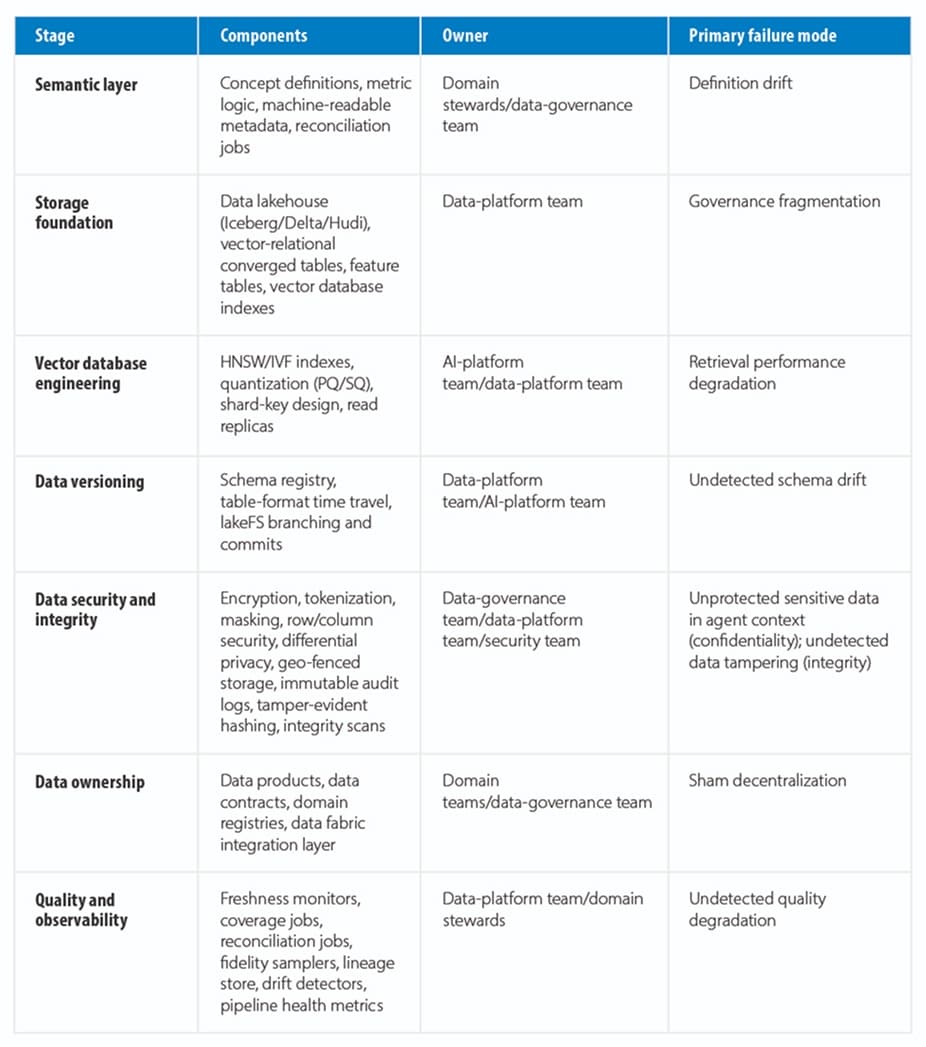
Figure 1 brings the platform and governance components into one view. Each row pairs a component with the team accountable for it and the failure most likely to go unnoticed there. The owner column shows where the operational load falls. The data-platform team appears in five of the seven rows, while domain stewards and domain teams hold the definitions and data products that give the platform its meaning.
Figure 1. Data platform and governance reference model: stages, components, owners, and failure modes
Source: Infosys
This article defined the platform and governance layer: semantic layer, lakehouse, vector database engineering, data security and integrity, data mesh ownership, and observability. A companion article covers the production side: how raw data enters the pipeline and becomes agent-consumable representations. Two further companions cover the knowledge architecture: how enterprises structure knowledge in graphs, ontologies, and knowledge-store topologies, and how agents find, access, and trust representations.

