
Frontier Tech Perspectives

Enterprise AI agents support long-running workflows, tool orchestration, and multiagent collaboration. Most enterprise agent platforms provide retrieval capabilities, but retrieval alone does not deliver persistent memory. Production deployments must preserve execution history, accumulate reusable knowledge, enforce governance policies, and maintain consistent behavior across sessions. This article presents a four-tier memory architecture comprising episodic memory, semantic memory, the session cache, and the context window. A retrieval policy governs promotion across memory tiers using relevance, validity, trust, and budget checks. The model context protocol (MCP) [1] enforces a consistent policy on every agent request. The architecture also incorporates governance controls for retention, supersession, legal erasure, and consistency in shared memory. By separating retrieval from the broader memory life cycle, the proposed architecture provides a production-ready foundation for persistent, governable enterprise AI.
Keywords: Enterprise AI, AI agents, enterprise memory architecture, persistent memory, episodic memory, semantic memory, model context protocol, AI governance
Enterprise AI workflows often span multiple user interactions, requests, and tool invocations. They require execution state that persists across the entire workflow.
A large language model (LLM) is stateless. Model weights capture knowledge learned during training, while the context window supplies task-specific information for a single inference [2]. When a request ends, the model discards that context [3].
Enterprise AI systems therefore persist execution state outside the model. They record observations, intermediate decisions, tool outputs, and outcomes so agents can resume work across sessions. The resulting records support governance, auditing, and operational consistency, and agents access them through retrieval.
Retrieval and memory serve different engineering purposes. Retrieval-augmented generation (RAG) [4] retrieves information from a curated knowledge corpus through a read-only access pattern. Enterprise memory governs the full life cycle of records that agents generate during execution. This life cycle spans append-only event capture, lineage, versioning, retention policies, and consistency controls.
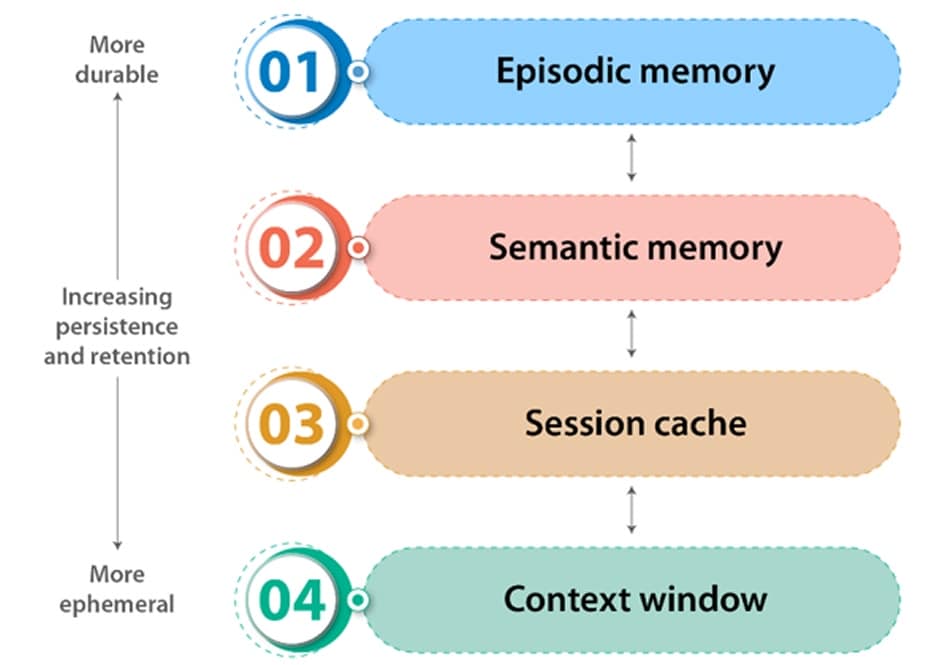
A production memory architecture organizes this information into four specialized memory tiers. Episodic memory records execution history, and semantic memory captures reusable knowledge. The session cache preserves short-lived conversational state, and the context window provides working memory for a single inference.
Episodic memory is the agent's event log. Every agent interaction generates a sequence of timestamped events that records each user request, tool invocation, intermediate decision, and final outcome.
Episodic memory captures these events as immutable records and preserves them for the defined retention period. Once the system writes an event, the record remains unchanged. Engineers reconstruct execution history, investigate incidents, verify decisions, and satisfy audit requirements from this authoritative record.
Episodic memory stores append-only, time-partitioned records indexed by agent, session, case, and timestamp. Production workloads continuously ingest events, while engineers retrieve only a small fraction of records for investigation or replay. The storage architecture organizes this tier around sequential writes, partitioning, and long-term retention to support this access pattern. It keeps episodic memory off the latency-sensitive retrieval path used for interactive agent requests.
Raw episodic records contain more information than an agent can reuse during inference. Semantic memory extracts durable knowledge from those records and stores entities, relationships, preferences, and conclusions in structures optimized for retrieval. Most interactions require only the facts relevant to the current task together with the evidence that supports them.
Semantic extraction forms an explicit stage in the memory pipeline. After a session completes, the extraction process generates candidate facts with a confidence score, an effective timestamp, and a reference to the originating episodes. Source references preserve lineage, allowing engineers to trace every recalled fact back to the events that produced it for debugging, auditing, and model evaluation.
Semantic memory combines two complementary retrieval structures. A vector index retrieves information based on semantic similarity, making it suitable for preferences, observations, and contextual knowledge. Semantic similarity alone cannot distinguish current facts from superseded ones because both remain close in the embedding space. The retrieval layer therefore combines vector search with metadata filters that evaluate entity identifiers, validity periods, and trust levels before returning results.
A knowledge graph retrieves facts that require exact answers and explicit relationships. Typed entities and relationships provide authoritative answers for mandates, entitlements, contractual limits, and similar business facts. Although graph structures require stricter schemas and greater maintenance effort, they provide predictable retrieval where correctness outweighs flexibility.
The retrieval layer selects the appropriate structure for each query. Organizations consolidate relational data, vector indexes, and graph structures within a single platform or distribute them across specialized services. The choice depends on scalability and operational and governance requirements. The architecture remains unchanged regardless of the deployment model.
Semantic memory also depends on a consistent embedding space. Every embedding should record the model identity and version used during generation because vectors produced by different models are not directly comparable. Embedding model upgrades therefore require regeneration of vectors from the original source content to preserve retrieval consistency.
Procedural knowledge specifies how an agent performs work: task workflows, tool-use sequences, and learned strategies. It requires no separate memory tier. Authored procedures reside in system prompts and tool definitions. Procedures distilled from successful executions enter semantic memory as candidate facts, where lineage, trust, and supersession controls govern them.
The session cache holds short-lived state for an active session. It stores recent conversation turns, intermediate tool outputs, and semantic facts promoted for the current case.
The cache resides in memory and serves reads at low latency. Its contents persist only while the session remains active. When the session ends, durable information flows into episodic and semantic memory, and the system discards the rest. This design keeps interactive requests fast without burdening persistent storage.
The context window is the model’s working memory for a single inference. It assembles the system prompt, tool definitions, retrieved memory, and the current request into one bounded input.
Every token in the window incurs cost on each request, and window capacity is finite. The retrieval policy therefore admits only the information the current request requires. The model discards the window when the inference completes, which makes disciplined assembly essential.
The memory hierarchy follows the same engineering principle as traditional computer memory hierarchies: faster storage offers lower latency but higher cost and lower capacity (Figure 1).
Each tier serves a distinct purpose. The context window provides working memory for a single inference and incurs a token-based cost on every request. An in-memory session cache stores short-lived conversational state for active sessions. Semantic memory supports long-term retrieval of reusable knowledge, while episodic memory preserves the complete execution history for auditing, replay, and governance.
Figure 1. Enterprise agent memory hierarchy
Source: Infosys
Information moves through the hierarchy according to the retrieval policy. When a case becomes active, the system promotes relevant semantic facts into the session cache. The next inference assembles only the information required for that request into the context window. Each promotion consumes resources, so the retrieval policy evaluates every candidate before admitting it into the next tier.
The promotion pipeline applies four policy checks:
The architecture also includes a computation cache beneath the context window. Modern inference platforms reuse previously computed key-value (KV) attention states when prompt prefixes remain unchanged across requests [5]. Placing stable content, such as system prompts and tool definitions, before session-specific memory maximizes KV-cache reuse and reduces inference latency and cost.
A customer asks an insurance agent to raise a claim limit. The single request touches all four tiers. Episodic memory logs the request, the policy lookup, and the final decision as immutable events. Semantic memory supplies the customer’s current entitlement and prior preferences as retrievable facts. The session cache holds the conversation turns and the retrieved entitlement while the case remains active. The context window carries only the system prompt, the relevant facts, and the current request into each inference.
The division holds for any workflow. Episodic memory records, semantic memory recalls, the session cache stages, and the context window executes.

Enterprise agents should not access persistent stores directly. Direct database access forces every agent implementation to carry its own retrieval logic, trust policies, validity checks, redaction rules, and write controls. Maintaining identical policy logic across multiple agents increases operational complexity and makes inconsistent behavior more likely.
The MCP provides a standard interface between agents and the memory layer. Agents do not touch persistent stores themselves. They invoke operations such as recall, propose_fact, and log_episode. Before accessing persistent memory, the MCP service evaluates every request against retrieval policy, authorization rules, write permissions, and token budgets. This evaluation ensures consistent governance across all agents.
The MCP service also separates agent logic from storage management. Agents never connect directly to databases because the service performs every read and write on their behalf using centrally managed permissions. Candidate semantic facts pass through a review pipeline before entering shared memory. Validation, deduplication, and policy enforcement determine whether each fact enters the shared knowledge base.
The MCP interface decouples agent implementations from storage technology. Engineering teams can evolve storage engines, indexing strategies, and deployment architectures without modifying agent logic because agents depend only on the MCP interface.
Enterprise memory requires active life cycle management. Unbounded growth increases storage cost, retrieval latency, and obsolete information.
Each memory tier, therefore, applies its own retention policy. Episodic records expire according to regulatory or organizational schedules, while semantic facts lose retrieval priority as confidence declines or newer evidence supersedes them.
Shared semantic memory preserves lineage through supersession. When new evidence replaces an existing fact, the system marks the original record as superseded and links it to its successor. Both versions remain available for audit and historical analysis, while retrieval returns only the current version. This approach preserves the evidence needed to reconstruct an agent's decisions at any point in time.
Legal erasure follows a different workflow. Right-to-be-forgotten requests require physical deletion across every memory tier, including embeddings derived from the deleted content [6].
The deletion process follows lineage references to identify and remove every derived artifact before completing the request.
The remaining controls follow established AI risk-management and data-governance practices [7]. Write permissions remain scoped to individual agents and services. Extraction pipelines classify and redact personally identifiable information (PII) before semantic facts enter shared memory. Read permissions inherit authorization policies from the originating systems, ensuring that agents retrieve only the information those policies allow.
Shared memory introduces consistency challenges that do not arise in single-agent systems. Two agents processing the same case can retrieve different versions of a semantic fact while an update is in progress and continue execution with different assumptions. Without coordinated access, the workflow can produce inconsistent outcomes.
The architecture addresses this problem through three mechanisms. Versioned reads assign a snapshot timestamp to every retrieval, so each task executes against a stable view of semantic memory. The episodic log records the snapshot. Write serialization routes updates for the same entity through a single ordered path, eliminating concurrent write conflicts and preserving a deterministic history. Conflict resolution evaluates competing updates using trust level, effective date, and review requirements before publishing a new semantic fact.
Consistency requirements vary by data type. Business-critical information, such as entitlements, mandates, and financial limits, requires strong consistency so every agent observes the same value. User preferences and other contextual information can tolerate eventual consistency, improving scalability without affecting business correctness.
Enterprise AI memory relies on a small set of architectural principles applied consistently throughout the memory life cycle. Immutable episodic records establish the system of record. Semantic memory converts those records into reusable knowledge while preserving lineage. Retrieval policy governs movement across memory tiers, and the MCP service boundary enforces consistent policy across every agent interaction.
Shared memory maintains correctness through versioning, supersession, and consistency controls aligned with the business significance of the underlying data.
These principles combine established practices from distributed systems, data engineering, and information management into a coherent architecture for persistent enterprise memory. The resulting memory layer supports reliable retrieval, operational governance, auditability, and production-scale agent deployments.

