
Frontier Tech Perspectives

Enterprise AI is moving from isolated assistants to production workflows where model choice, tool use, retries, escalation, and human review create recurring reasoning spend. Existing cost controls are insufficient when similar token volumes can produce different business consequences, especially in architecture review, regulated modernization, incident response, and other high-consequence workflows [1] [2] [3].
This paper presents AI financial operations (FinOps) as an operating discipline for governing enterprise reasoning spend against business outcomes. It introduces decision yield as a workflow level metric, defines routing policy for deterministic checks, smaller models, frontier reasoning, and human ownership, and applies the approach to a higher-order enterprise architecture review workflow.
The illustrative validation uses a six-week modernization window covering 40 architecture decision reviews. The central finding is that decision yield improves when reasoning spend is governed by evidence quality, routing policy, outcome feedback, and accountable escalation rather than by token volume alone.
Keywords: Artificial intelligence financial operations, AI FinOps, decision yield, reasoning spend, agentic AI, enterprise AI governance, architecture review, model routing, cost per outcome, platform modernization.
In a portfolio architecture review for a regulated enterprise modernization, the team had to decide whether a customer-onboarding capability should be extended inside the existing core platform, carved out through a strangler pattern, exposed through an application programming interface (API) facade, or rebuilt as a packaged workflow layer. The AI assistant could summarize requirements, legacy interface maps, API contracts, production incidents, security controls, integration dependencies, performance baselines, and target operating-model constraints, but the architecture board still had to reconstruct the real decision: what trade-offs were considered, which nonfunctional requirements were binding, where migration risk accumulated, which option preserved reversibility, and who owned residual platform risk.
At small scale, AI-assisted review preparation appears to accelerate architecture work. At portfolio scale, the harder problem is whether the answer is decision-grade. The organization may have paid for reasoning, but senior architects still need to turn that reasoning into a defensible decision affecting delivery cost, operational risk, regulatory exposure, and future optionality. The next scarce resource in enterprise AI is the ability to exercise governed judgment.
This paper presents a practical AI FinOps framework for enterprise reasoning governance across three dimensions:
The Frugal Architect made cost a first-class architectural concern and emphasized that cost should be treated as a nonfunctional requirement [1]. The FinOps framework and FinOps for AI guidance extend cloud financial management into AI usage, quotas, tagging, graphics processing unit allocation, cost-per-token visibility, and business-value alignment [2] [3]. Return on AI further reframes AI economics around cost per outcome and the combined cost of human intelligence and token consumption [4]. This paper builds on that foundation but shifts the governed unit from the investment ratio or infrastructure category to a specific business decision inside a workflow.
Decision yield measures whether incremental reasoning materially improves enterprise decision quality. It does not replace return on investment (ROI), return on AI, FinOps for AI, or broader business value metrics. ROI asks whether the investment was worthwhile. FinOps for AI asks whether AI usage is visible, governed, and aligned to value. Decision yield asks whether a specific reasoning step changed the decision, improved confidence with admissible evidence, reduced avoidable rework, or routed risk to the right owner.
A starting approximation of decision yield can be expressed as follows:
Decision yield ≈ (useful decisions + prevented failures + successful escalations) / reasoning spend
The components should be adapted to each workflow. In architecture review, useful decisions may include board-accepted decisions without major rework, hidden dependencies surfaced early, duplicate platform builds avoided, nonfunctional requirement gaps closed before build, or decisions routed to a designated architecture owner for a defensible reason.
For illustration, normalized reasoning-spend units aggregate workflow effort across model calls, token consumption, tool invocations, and retry activity into a common accounting measure. A simple normalization approach assigns weighted units to each activity type based on relative computational cost and operational overhead. Organizations may calibrate these weights according to their model portfolio, tool ecosystem, and governance policies. The values used in this paper are illustrative and are intended to demonstrate the decision-yield concept rather than prescribe a universal accounting standard.
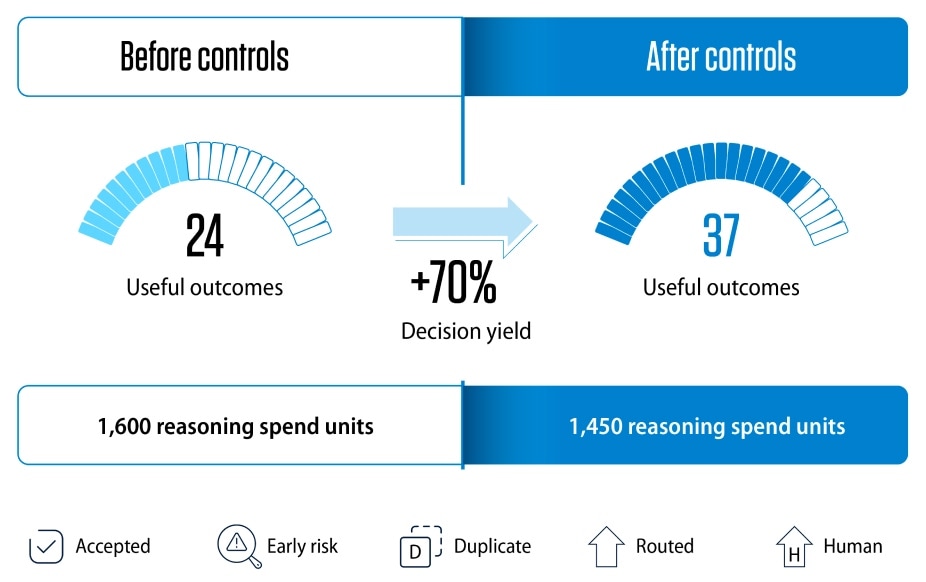
Consider 40 architecture decision reviews in a six-week modernization window. Using the illustrative normalization approach described above, useful architecture outcomes total 24 across 1,600 normalized reasoning-spend units before controls. After controls, useful architecture outcomes total 37 across 1,450 normalized reasoning-spend units. The numerator and denominator shift when reasoning is governed by outcome rather than token consumption alone (Figure 1).
Figure 1. Decision yield improves under outcome-governed reasoning spend
Source: Infosys
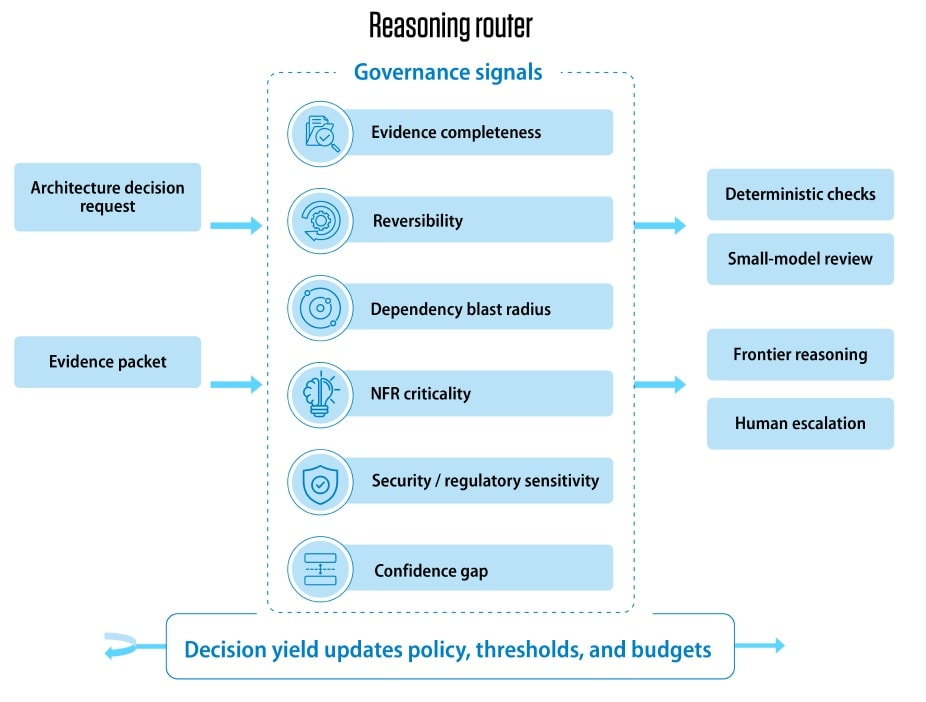
The router sits at the service boundary and runs before any model call. It receives a typed request, retrieves the minimum admissible evidence, computes explicit signals, and chooses one of four paths: deterministic checks, bounded small model review, frontier model reasoning, or escalation to a responsible architecture authority. The router sets the reasoning budget for every model call.
The router scores six signals on a 0-3 scale: evidence completeness, architecture reversibility, dependency blast radius, nonfunctional requirement criticality, regulatory or security sensitivity, and confidence gap. Scores 0–3 use deterministic checks, scores 4-7 use bounded small model review, scores 8-12 use frontier reasoning, and scores 13-18 route to human review and escalation. A separate confidence threshold stops the workflow when confidence falls below an illustrative threshold of 0.72 or when evidence is stale, incomplete, or unapproved. The threshold is illustrative and should be calibrated by organizations based on workflow criticality, historical outcomes, risk tolerance, and governance requirements.
A bank modernizing customer onboarding across retail, small-business, and partner channels receives a score of 13 because data-retention constraints for one partner channel are missing and the decision has high dependency and regulatory sensitivity. The workflow permits capped frontier reasoning to prepare the decision packet, but final approval is routed to the chief architect with required evidence: retention matrix, partner contract control, and rollback plan. The service boundary policy separates deterministic checks, bounded model review, frontier reasoning, and human escalation (Figure 2).
Figure 2. Service boundary routing across deterministic checks, bounded model review, frontier reasoning, and human escalation
Source: Infosys
AI FinOps matters most in regulated, high-throughput, customer-facing, or operationally critical workflows where reasoning cost compounds and errors are expensive. Architecture review, platform modernization, loan adjudication, fraud review, supply-chain risk assessment, claims triage, incident response, and regulated customer servicing are natural candidates. It is usually over-engineered for an internal drafting assistant, bounded brainstorming tool, or low-risk knowledge helper.
At production scale, decision yield changes the optimization conversation. If frontier model usage falls but senior reviewers spend twice as long validating the answer, the saving has merely moved. If latency improves but evidence quality weakens, the team has bought speed by spending trust. If cost per decision falls while false confidence rises, architecture has become more dangerous.
A practical implementation starts with a typed request schema that identifies the decision type, impacted domains, mandatory evidence, risk category, and requested decision outcome. The orchestration layer then builds an evidence packet from approved sources, checks provenance and freshness, computes router signals, and records the path chosen before any large language model (LLM) reasoning is invoked.
The technical rationale is that cost and risk are reduced before generation. Deterministic checks remove standard cases, retrieval constraints reduce context size, cache keys prevent repeated evidence assembly, retry budgets limit loops, and stop rules prevent additional tool calls when the next action cannot change the decision [5]. The final artifact should be a structured decision object containing status, options considered, cited evidence, binding constraints, residual risks, confidence, routing path, and accountable owner.
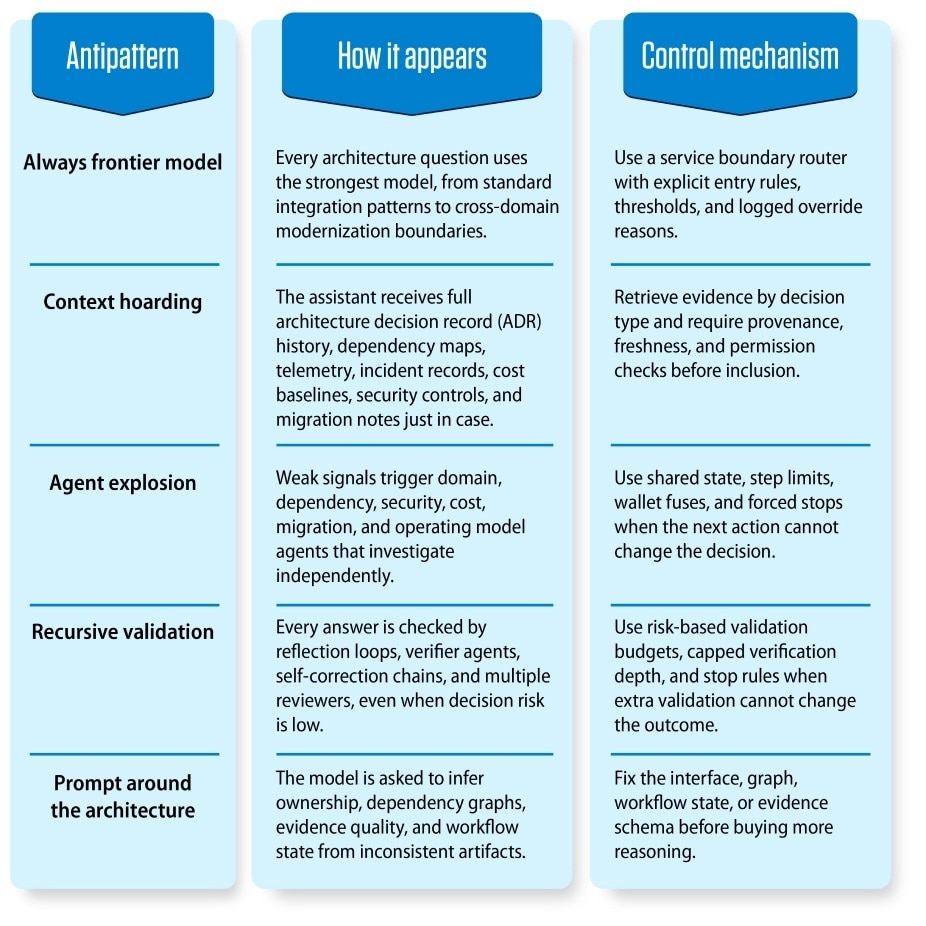
Waste rarely appears as one oversized model call. It appears as a pattern: too much context, too many retries, too many agents, or too much judgment delegated to the model because the surrounding system fails to provide adequate governance, routing, and validation controls (Figure 3).
Figure 3. Antipatterns that inflate reasoning spend and the architectural controls that reduce waste
Source: Infosys
Decision yield is not universally applicable. Workflows with low consequences, low ambiguity, bounded cost, and easily reversible outcomes may gain little from explicit reasoning governance. Organizations with immature architecture governance may also struggle to establish meaningful baselines. Future work should validate decision yield across production workflows, refine weighting models for prevented failures and escalations, and define industry-specific benchmark patterns for routing thresholds.
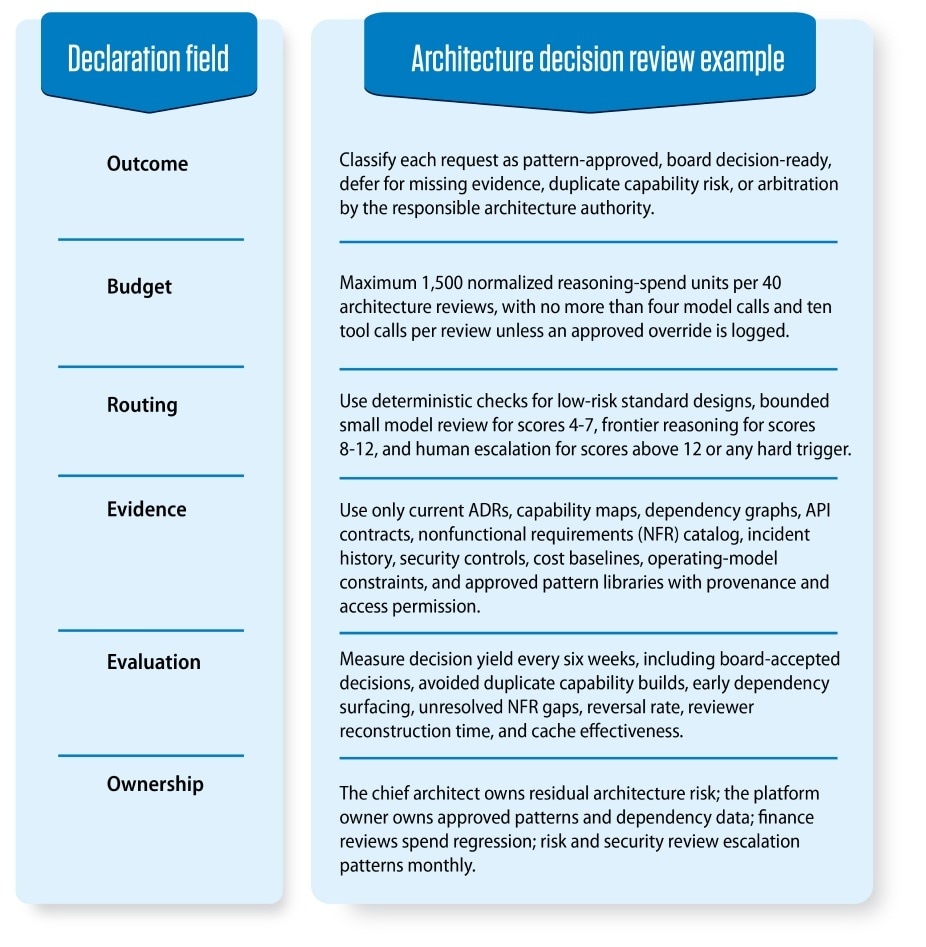
Before a production AI capability scales, it should publish an AI FinOps declaration. This operating artifact lets engineering, finance, product, risk, and operations discuss cost, quality, control, and accountability before adoption turns a small prompt into a recurring operating expense. The declaration table shows how outcome, budget, routing, evidence, evaluation, ownership, and review cadence become explicit governance controls (Figure 4).
Figure 4. AI FinOps declaration fields for architecture decision review
Source: Infosys
The main advantage of AI FinOps is that it converts model selection from an implicit prompt-time choice into an explicit architecture control. Teams gain cost visibility at workflow level, stronger escalation discipline, reusable routing policy, and a clearer separation between machine-generated analysis and human-owned residual risk.
The trade-off is that the framework adds governance overhead and depends on reliable evidence metadata, current architecture records, and accountable ownership. Poorly calibrated scoring can over-escalate routine decisions, while weak evidence governance can make even the best routing policy appear precise without being trustworthy. The design choice is therefore between unmanaged reasoning spend and explicitly governed reasoning capital.
AI FinOps is a discipline for deciding which reasoning is worth buying, which evidence is admissible, which risks must be escalated, and which decisions require accountable ownership. As enterprise AI compresses coding, testing, and delivery cycles, architecture judgment becomes the constrained resource. The organizations that benefit most will be those that treat reasoning spend as governed capital: measurable, routed, justified, and accountable.

