
Executive Technology Strategy
October 2026

Every autonomous action an enterprise agent takes carries a trust bill. Most organizations are paying it without pricing it.
Earlier generations of enterprise AI analyzed, predicted, summarized, and recommended. Agentic systems go further. They plan, decide, call tools, invoke workflows, coordinate with other agents, and act on behalf of users or business functions. That shift creates a new economic problem. Every time an agent is allowed to do something consequential, someone in the enterprise has to decide whether the action is authorized, compliant, explainable, reversible, observable, and accountable. The cost of answering those questions is governance overhead, and in agentic systems it belongs in the production cost of autonomy itself.
The useful question is not, “How much does the model cost?” It is, “How much does it cost to trust one autonomous action?” That question leads to a better economic unit: cost per trusted action.

Most AI business cases start with familiar variables: model cost, infrastructure cost, development cost, productivity gains, and labor savings. All are necessary. None is sufficient for agentic AI.
A chatbot response can be assessed by quality, latency, and user satisfaction. An agentic action brings in a wider set of controls. Did the agent have permission to access the system? Was the tool call appropriate? Was the action within policy? Was the data handled correctly? Was human approval required? Was the outcome logged? Can the action be reversed? Who owns the exception when it was not?
Each of these questions introduces cost categories that rarely show up in a token-based business case: identity and access management for agents, users, tools, and systems; policy checks before actions are taken; human approvals for high-impact decisions; audit trails; evaluation and red-teaming; runtime monitoring; exception management and escalation; rollback and customer recovery; compliance evidence; and versioning of agents, prompts, tools, and workflows.
A workflow that looks cheap at the token level can become expensive once these are included. A workflow with higher model cost can still be economically attractive when governance is automated, exceptions are rare, and controls are reusable.
For regulated enterprises, especially in financial services, this broader model is already implicit in prudential and AI risk expectations such as those articulated by the Australian Prudential Regulation Authority,[1] the Monetary Authority of Singapore,[2] and the European Union.[3] Enterprises that do not price these controls explicitly still pay for them, usually late and unevenly.
Much of what follows draws on established ideas from operational risk and enterprise architecture. Governance-as-tax-and-investment, the depreciation of trust assets, risk-tiered controls, and platform-versus-project funding are all well-worn territory. That inheritance is part of why the framework is credible. What is new is the composition. These economics now dominate the cost of something enterprises are pricing by its inference bill. Nonhuman identity operates on a decision-making scale. Inference turns out to be a small fraction of real cost rather than most of it. Agent registries and evaluation harnesses now apply to nondeterministic actors. And the autonomy frontier is a continuously expandable boundary rather than a fixed line. The ideas are inherited; the composition is not.
Start here: At the next agentic AI approval, ask for the full-stack cost estimate rather than the token cost. An estimate that names only inference and orchestration signals a workflow priced against the wrong unit, with the residual risk exposure left unpriced.

A trusted action is one the enterprise is willing to let an agent execute without a human in the loop, given the evidence available at the moment of decision. That willingness rests on four conditions. The action is authorized, meaning the agent has permission to take it. It is contextual, meaning the agent has the information needed to take it correctly. It is accountable, meaning someone owns the outcome. And it sits within acceptable risk, meaning its consequence is proportionate to the evidence supporting it.
The unit needs a precise definition or the economics get soft. For this framework, one trusted action is one authorized state change or externally observable output that the enterprise would want to log, audit, or govern independently. A three-tool reasoning sequence that produces one refund is one trusted action. A retry that produces the same refund is still one trusted action. A single agent turn that sends an email and updates a customer record is two. In a multiagent handoff, where one agent decides and another executes, the trusted action attaches to the executing agent’s state change, but the accountability chain includes both. Each agent’s contribution needs to be logged and attributable, or the enterprise loses the ability to allocate cost and diagnose failure when something goes wrong.
The economics decompose across four cost categories. Inference and orchestration costs scale per action. Governance and assurance are largely fixed platform investments, amortized over volume. Exception costs are probabilistic, driven by the rate at which actions escalate for human review and the cost of handling each one. Residual risk costs are also probabilistic, driven by the expected frequency and severity of incidents that controls fail to catch. This is a decomposition, not a formula. Its purpose is to force the executive conversation onto the full cost of trustworthy action instead of the visible cost of model execution.
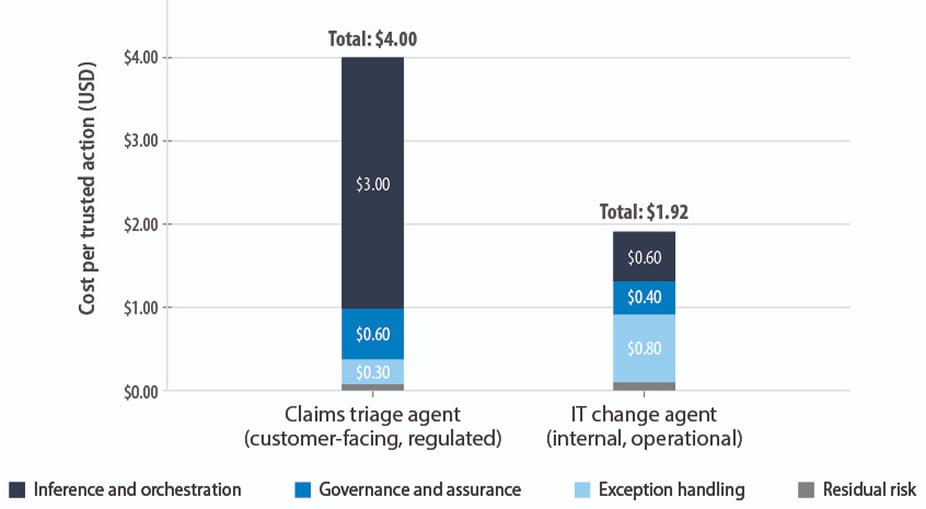
A stylized example makes the four-layer decomposition tangible. Consider a mid-complexity claims triage agent, of the kind common in regulated sectors such as Asia-Pacific financial services, handling 100,000 actions a month. The numbers below are constructed to illustrate the cost stack shape, not drawn from any Infosys engagement and not offered as benchmarks. The point of the example is the ratio between layers, not the dollar total.
Inference and orchestration run around 10 cents per action, or $10,000 a month. A governance and assurance platform built for $180,000 with an 18-month useful life, plus $20,000 a month to run, amortizes to 30 cents per action. A 3% escalation rate at $20 per escalation adds 60 cents. A residual incident rate of one in 10,000, at $30,000 per incident, gives an expected cost of $3.00 per action (one in 10,000 multiplied by 30,000), reflecting the kinds of remediation, regulatory, and reputational exposure that can attach to a customer-facing claims decision in a prudentially regulated environment.
Total cost per trusted action is roughly $4.00. Inference and orchestration are about 2.5% of the real cost. Governance and assurance are 7.5%. Exception handling is 15%. Residual risk is 75%. The visible model and orchestration line item is almost a rounding error against the cost of trust.
A second workflow archetype shows why the mix matters. Consider an IT change management agent handling a similar 100,000 actions a month: preparing routine configuration changes, checking policy compliance, opening change records, and executing only preapproved low-risk actions. Inference and orchestration land close to the claims example at around 12 cents per action. Governance and assurance run much higher, closer to 80 cents, because the IT workflow carries additional workflow-specific controls on top of the shared platform: change-approval orchestration, infrastructure identity federation, and rollback instrumentation that the claims workflow does not need. Exception handling adds around 40 cents; a failed change is cheaper to remediate than a mishandled claim, but not free. Residual risk falls to around 60 cents, because changes are sandboxed, reversible, and confined to predefined runbooks.
Total cost per trusted action is roughly $1.92. The mix is completely different. Governance dominates the internal, operational workflow. Residual risk dominates the customer-facing, regulated one. Cost per trusted action varies by archetype. The shape of the stack, not the total, tells the chief information officer (CIO) where to invest.
Assumptions used in both examples. Volume is 100,000 trusted actions per month. Residual risk per action is calculated as (incident rate) × (per-incident cost); for the claims example, 1/10,000 × $30,000 = $3.00. Per-incident costs are set to reflect the kinds of remediation, regulatory notification, and reputational exposure that can attach to a customer-facing decision under prudential oversight. Governance and assurance costs assume amortization of an initial platform investment over an 18-month period, applied to the first workflow; the IT change example then adds workflow-specific controls on top. All figures are illustrative rather than measured; they are calibrated to produce a cost stack shape that would be recognizable to practitioners in regulated financial services, not derived from a specific engagement. Within this example, the two variables that move the total most are the incident rate and the per-incident cost; changes elsewhere in the stack move the total by cents rather than dollars.
Figure 1. Cost per trusted action varies by workflow archetype
Source: Infosys, illustrative
Note. The numbers are illustrative. The framework applies broadly to enterprise workflows with meaningful compliance, exception, or remediation exposure, though the proportions shift materially by workflow archetype, jurisdiction, control maturity, and how incident costs are estimated.
Start here: Pick one live agentic workflow and count its trusted actions across a single day. A number in the low hundreds means the cost stack is still dominated by fixed governance and needs volume growth to amortize. A number in the tens of thousands means the platform investment is beginning to amortize and the mix should now be studied for optimization.

Governance behaves like a tax on agentic activity. Every control adds cost, latency, or complexity. Not every governance tax is equal.
Productive governance reduces risk, improves reuse, increases trust, and lets agents operate in higher-value workflows. A central agent registry adds onboarding work, but prevents duplicated builds, clarifies ownership, and makes capabilities discoverable across the enterprise. A standard audit schema adds engineering effort, but moves regulated workflows into production with greater confidence.
Deadweight governance adds friction without reducing risk. Duplicate approvals. Manual reviews on low-risk actions. Audit logs no one can interpret. Inconsistent policy checks across business units. Governance boards reviewing every agent as though it had the same consequence profile.
The distinction is where the money is. The right question is not how much governance to apply. It is how much trusted autonomy each dollar of governance enables.
The strongest way to see this is through the autonomy frontier. Every enterprise has one. It is the boundary between what agents are allowed to do today and what they are not yet trusted to do. Summarizing documents, drafting responses, retrieving information, and classifying tickets sit well inside it. Issuing refunds, changing customer records, modifying production systems, approving claims, triggering payments, and making regulated decisions sit beyond it.
The frontier moves. Better identity controls let agents access enterprise tools safely. Policy-as-code (PaC) reduces manual review. Sandboxed execution lowers blast radius. Evaluation harnesses make behavior more predictable. Rollback makes some actions less risky. That is the productive case for governance investment. It is frontier-expanding infrastructure.
And it should be priced accordingly. The governance premium on an action should scale with financial impact, regulatory exposure, customer impact, irreversibility, data sensitivity, operational blast radius, degree of agent discretion, difficulty of detecting failure, and cost of remediation.
Many enterprises misprice this premium in both directions at once. They overgovern low-risk use cases, making simple automations unnecessarily slow. They undergovern high-impact use cases, letting agents call tools or influence decisions without adequate accountability. A risk-tiered governance model corrects both errors: lightweight controls where the consequence is low, stronger controls where the enterprise has more to lose.
Start here: Pull the last three governance additions to any agentic workflow and classify each as productive or deadweight. Two or more in the deadweight column signals a governance program that has drifted from investment to tax and needs a quarterly removal cadence to correct.
Governance arbitrage refers to a durable cost-of-trust differential between firms with comparable model and talent access. It is not a permanent moat. It is a measurable head start.
Two enterprises can use the same foundation models, hire similar talent, and deploy similar agent frameworks. The one with better governance infrastructure will move agents into more valuable workflows faster, at lower risk, and at lower marginal cost. That is governance arbitrage in practice: producing trusted agentic actions more cheaply than competitors on a sustained basis.
Sources of arbitrage include a central registry of approved agents, tools, owners, and versions; standard contracts for agent capabilities and deterministic tools; reusable evaluation harnesses; PaC libraries; preapproved tool permissions; standard identity for nonhuman actors; shared audit and trace schemas; automated evidence generation; common exception and escalation patterns; and reusable human approval patterns.
Build these once and every new agentic workflow avoids paying the full governance cost from scratch. Without shared infrastructure, every team pays a custom trust tax. With it, governance becomes a platform capability, and governance maturity becomes a multiplier of agentic AI return on investment.
Cost per trusted action falls along three curves at once. Volume amortizes fixed governance costs across more actions. Learning drives incident and exception rates down as workflows mature. Platform reuse means each new workflow inherits more controls from the last. Enterprises that get on all three curves early pull away from the ones that do not.
Governance arbitrage is not unlimited. In highly regulated workflows, firms may converge on similar minimum controls because regulators, auditors, and industry norms define the floor. The advantage comes above that floor, in how much of the control environment is reusable, automated, measurable, and embedded into delivery rather than reassembled for each workflow.
Start here: At the next platform investment review, ask how much of the governance stack is reusable across workflows. An answer under 30% shows the enterprise is paying the custom trust tax on every new agent, and the reusable platform layer is where the next investment belongs.
Governance also functions as a balance sheet.
Trust assets lower the cost of future autonomy: proven evaluation results, clean audit trails, stable permissions, low incident rates, certified workflows, reusable controls, clear ownership, tested rollback, reliable observability, and consistent policy enforcement.
Trust liabilities raise it: opaque tool calls, fragmented logs, manual approval bottlenecks, undefined ownership, weak rollback, poor exception handling, inconsistent access controls, undocumented workflow behavior, high override rates, and controls that exist only as manual checklists.
Trust assets depreciate. An evaluation suite from 12 months ago against a model that has since been upgraded is worth less than it looks on paper. Enterprises running multiple models, or switching models mid-workflow, compound the depreciation problem. Each model has its own evaluation history, and cross-model evidence transfers imperfectly. A clean audit history in a workflow that has since expanded scope may be misleading. A policy library built for one set of tools may not transfer cleanly when agents gain access to new systems of record. Human approval patterns decay too, under reviewer fatigue or rising exception volumes. Enterprises should revalue their trust assets on a schedule, especially after model upgrades, tool changes, policy changes, incident reviews, and workflow expansion.
Trust also leverages across business units. A well-governed claims workflow raises the credibility of the next agentic proposal from the same team, and often across teams that share the same platform controls. A business unit with strong controls, visible metrics, and low incident history will be allowed to automate more. One with unclear ownership and weak auditability will face more scrutiny, more approvals, and slower adoption.
Measuring trust in practice needs both outcome indicators and process indicators. Outcomes cover the incident rate for autonomous actions, the exception escalation rate, the human override rate, and the mean time to detect a governance violation. Process indicators cover the percentage of controls that are automated, the coverage of evaluation harnesses against production model versions, and the currency of policy libraries against the tools agents can now access. Outcome indicators show whether trust is holding.
Process indicators show whether the underlying controls are earning that outcome, or whether the enterprise is running on luck. A trust asset with strong outcomes but weak process indicators is depreciating faster than the numbers suggest.
Trust is an operational asset that can be built, measured, spent, and depleted.
Start here: Name three trust assets and three trust liabilities in the enterprise’s current agentic AI estate. Liabilities outnumbering assets means cost per trusted action is on an upward trajectory regardless of what the current dashboard shows, and the balance sheet needs remediation before the next workflow is added.
Enterprises often try to instrument everything, and the resulting metric sprawl obscures the few numbers that change decisions. Three metrics deserve attention, and one belongs on the executive dashboard.
Cost per trusted action, tracked by workflow, is the headline metric. The trend matters more than the absolute number. A number that stops falling as volume grows tells the CIO the governance platform has stopped earning its keep.
One qualification matters during ramp-up. Early-stage workflows show poor unit economics by design. Governance costs land upfront while volume is still low. Incident rates are elevated while the model, tools, and reviewers are still calibrating. Exception handling is inflated by the learning process. A workflow in month two or three should not be judged against a mature workflow’s cost per trusted action. What matters is whether the number is moving down the three curves noted earlier: volume, learning, and platform reuse. A CIO who kills a workflow at month two because the unit economics look bad is likely making the wrong call. The metric matures with the workflow.
Governance yield is the second metric, and it deserves more room than a metric usually gets. Every control has a cost: engineering effort to build, latency added to workflows, cognitive load on reviewers. Yield asks whether that cost is doing work. For each new control, three effects need to be measured. Did it reduce incidents in the workflows it covers? Did it expand the set of workflows approved for autonomous execution? Did it cut approval latency? A useful indicative ratio is:
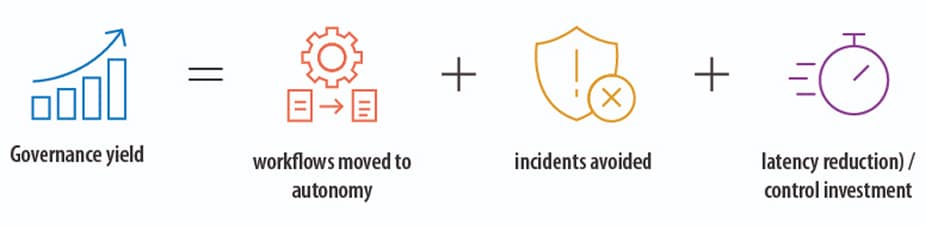
This ratio is directional rather than precise, since the numerator terms are not commensurate, but even a rough calculation forces the question of whether each control earns its cost. A control that scores near zero is a candidate for removal. One with negative yield, meaning added latency without added trust, is the deadweight that the earlier discussion of governance tax warns against.
Exception rate and override rate, read together, are the third metric. Rising exception rates mean the agent is operating outside its safe envelope. Rising override rates mean humans do not trust it. Falling on both means the autonomy frontier is ready to move.
The one for the dashboard is cost per trusted action, monthly, per major workflow, with a rolling 12-month trend. Everything else supports it.
Instrumenting this is less exotic than it sounds. Tag every agent action with a workflow ID and a consequence tier. Allocate platform governance costs to workflows in proportion to action volume, weighted by tier. Book exceptions and incidents against the originating workflow. The tagging is the same tagging the workflow needs for audit anyway. The cost analytics can be layered onto the same instrumentation.
Start here: At the next quarterly business review, ask for cost per trusted action tracked by workflow with a rolling 12-month trend. An empty answer means the metric has not yet been instrumented, and the earlier funding priorities need to be resolved before the metric can do any work.
The responses in this article connect into one operating model: a defined unit of trusted action, a governance investment discipline that separates productive from deadweight controls, a governance arbitrage strategy that treats controls as a reusable platform, a trust balance sheet that tracks assets and liabilities over time, and a metrics program that puts cost per trusted action on the executive dashboard. Together they are the funding blueprint for enterprise agentic AI, not a checklist of pilots.
Funding only pilots produces one-off wins and a growing pile of controls rebuilt from scratch on every project. Funding the underlying infrastructure produces something different: an agent registry that makes capabilities discoverable across the enterprise, a PaC layer that shrinks manual approval, an evaluation harness pool that shortens the path from pilot to production, and instrumentation that lets finance see cost per trusted action alongside its other unit metrics. These are infrastructure investments. The process disciplines that sit on top of them, meaning risk-tiered governance, quarterly deadweight removal, and cross-functional ownership, are necessary but cannot substitute for the infrastructure itself.
Two of these investments compound over time. The governance platform compounds because every new workflow inherits existing controls, reducing the marginal cost of trust. The trust balance sheet compounds because a strong asset history in one workflow unlocks faster approval for the next, especially where they share platform controls. Everything else, including cost model normalization, metric dashboards, and the deadweight removal cadence, remains important but delivers largely linear value. It costs about the same to run in year three as year one, and it does not accelerate the other investments.
The shift is from funding pilots and rebuilding controls each time to funding the trust infrastructure that allows every new workflow to inherit them. The organizations that scale agentic AI most effectively will be those that make the shift first.

