
Frontier Tech Perspectives

Enterprise AI agents reason on representations, including embeddings, graph triples, retrieved passages, and structured records, that encode entities, policies, and relationships an enterprise cares about. A companion article described how enterprises produce those representations through ingestion pipelines, unstructured data processing, embedding pipelines, streaming transformations, and multimodal encodings. This article covers how enterprises structure and store knowledge for agent consumption. It defines the knowledge representation layer. This layer includes knowledge graphs that capture entity relationships as subject-predicate-object triples and ontologies that govern the vocabulary and schema of those graphs. It also includes automated construction pipelines that build graphs at enterprise scale. It then describes six knowledge-store topologies, from standalone vector databases to multistore orchestration, which determine how agents access structured and unstructured knowledge. Each component carries a named owner and a primary failure mode. A companion article covers the retrieval and governance side. It describes how agents find the right representation through agentic retrieval, how the Model Context Protocol (MCP) standardizes access, and how governance mechanisms keep representations trustworthy over time.
Keywords: Enterprise AI, knowledge graph, ontology, knowledge representation, knowledge-store topologies, entity resolution, named entity recognition, GraphRAG, vector database, retrieval-augmented generation, multistore orchestration, OWL, SKOS, SPARQL
A companion article on data ingestion and processing [1] described the first two stages of the representation supply chain: ingestion and representation production. A second companion article [2] described the data platform and governance layer that stores, secures, and governs that data. A companion article on retrieval and knowledge governance covers the last two stages: retrieval and governance.
Between production and retrieval sits the structuring layer that this article covers. Production pipelines generate representations. Retrieval pipelines serve them. But the quality of retrieval depends on how those representations are structured and stored: the ontologies that define their meaning, the knowledge graphs that capture their relationships, and the knowledge-store topologies that determine how agents access them. This structuring layer is logically upstream of production in one important sense: the graph-construction pipeline described in the companion article on data ingestion [1] cannot run without the ontology defined here. The enterprise defines meaning before producing representations.
Three failure patterns illustrate why this layer deserves its own treatment.
First, an agent retrieves a semantically similar but factually irrelevant passage because the vector index contains too much loosely related content, a structuring problem. Second, an agent answers a multihop question with a flat list of retrieved chunks because no structured knowledge graph exists to support relational reasoning, a topology problem. Third, an agent cites a policy document that was superseded two weeks ago because no life cycle process retired the outdated representation, a governance problem addressed in the companion article on retrieval and knowledge governance.

A knowledge graph stores entities and their relationships as subject-predicate-object triples [3]. An ontology defines the vocabulary: the classes, properties, and constraints that give the graph its schema [4]. Together, they provide agents with structured, queryable knowledge that complements unstructured text retrieval.
Three design decisions shape an enterprise knowledge graph for AI consumption.
First, granularity. Agents need entity-level triples (Customer A → holds → Policy B), not document-level triples (Document X → mentions → Policy B). Document-level graphs reproduce the retrieval-dilution problem in graph form.
Second, identity alignment. Every entity in the graph carries a canonical identifier that maps to the same entity across source systems. Without entity resolution, agents receive contradictory triples about what appear to be different entities but are in fact the same customer, product, or contract [5]. The master data management (MDM) team owns entity resolution.
Third, ontology governance. Domain stewards define and version the ontology. Enterprise architects review cross-domain overlaps. A common failure is letting each project team define its own ontology fragment without a shared upper ontology. This produces semantic silos that agents cannot query across.
Ontology design follows a layered pattern. A foundational upper ontology, such as the Basic Formal Ontology (BFO), or a widely adopted vocabulary, such as schema.org, defines domain-independent concepts: entities, events, qualities, and roles. Domain ontologies extend the upper ontology or vocabulary with industry-specific classes and properties. To remain interoperable, they follow a shared set of development principles, including the use of common, unambiguously defined relations [6]. An insurance ontology defines policy, claim, coverage, and exclusion as domain classes. A manufacturing ontology defines product, component, specification, and tolerance.
The Web Ontology Language (OWL 2) is the W3C standard for formal ontology specification [7]. OWL 2 supports class hierarchies, property restrictions, cardinality constraints, and automated reasoning. Simpler taxonomies and controlled vocabularies use the Simple Knowledge Organization System (SKOS) [8].
Ontology versioning follows the same discipline as schema evolution in data architecture. Every ontology change receives a version identifier. The knowledge-governance team reviews backward-compatibility impact before promotion. Domain stewards own ontology content. Enterprise architects own cross-domain alignment and conflict resolution.
Enterprise knowledge graphs do not materialize from manual curation alone. At scale, construction relies on automated extraction pipelines with human-in-the-loop validation.
Entity and relationship extraction. Named entity recognition (NER) models identify entities (people, organizations, products, policies) in unstructured text. Relationship extraction models identify the predicates between entities. Large language models (LLMs) can now perform both tasks [9]. Prompting them with domain-specific ontology constraints helps keep their output aligned with the enterprise schema. The AI-platform team owns extraction model selection and prompt engineering.
Entity resolution. Extracted entities from different source documents often refer to the same real-world entity with different surface forms (“IBM,” “International Business Machines,” “IBM Corp.”). Entity resolution algorithms merge duplicate references into a single canonical entity. The MDM team owns resolution rules. The AI-platform team owns the resolution pipeline.
Triple validation and curation. Automated extraction produces candidate triples. A validation pipeline scores each triple for confidence. High-confidence triples publish directly. Low-confidence triples route to a domain steward for manual review and approval. The curation workflow assigns each triple a provenance record: source document, extraction model version, confidence score, and approver.
Incremental versus full rebuilds. The graph-construction pipeline runs in two modes. Incremental updates process new or changed source documents and add, modify, or retire affected triples. Full rebuilds reconstruct the entire graph from scratch. They are typically needed after a substantial ontology change or an extraction model upgrade, when every previously processed document must be re-extracted to keep the graph consistent. The AI-platform team owns the construction pipeline. Domain stewards own the approval workflow.
The primary failure mode is extraction drift: the extraction model performs well on the training corpus but degrades on new document types, producing low-quality triples that pollute the graph. Precision and recall metrics on a held-out validation set, reviewed quarterly, detect this degradation.

Enterprise AI workloads span a spectrum from open-ended document questions to precise transactional lookups. No single store topology serves every workload. The AI-platform team selects, combines, and orchestrates multiple topologies. Six patterns follow in order of increasing architectural complexity.
A vector database stores document chunks as dense embeddings and retrieves them by cosine or dot-product similarity. This is the simplest retrieval-augmented generation (RAG) topology [10]. An agent issues a natural-language query, the retrieval layer converts it to a query embedding, and the vector database returns the top-k nearest chunks.
This topology works well for homogeneous document corpora where the agent’s questions are semantically close to the stored text. Examples include internal knowledge bases, frequently asked question collections, and product documentation. It struggles when the agent needs exact-match retrieval (a policy number, a contract clause identifier) or when the corpus mixes domains whose vocabularies collide in embedding space.
This topology adds two capabilities to the standalone vector database. Metadata filters narrow the search space before similarity computation. Each chunk carries structured tags (document type, department, jurisdiction, effective date), and the query specifies filter predicates. A cross-encoder reranker then rescores the filtered candidate set for fine-grained semantic relevance [11].
This pattern is a widely adopted enterprise RAG deployment in 2026. It addresses retrieval dilution by constraining the search space and improves precision through reranking. The AI-platform team defines the metadata schema. Domain stewards maintain the tag values. The primary trade-off is latency: reranking adds a second model-inference step to every retrieval call.
A standalone knowledge graph serves structured queries through SPARQL or Cypher. The agent (or an orchestration layer) translates a natural-language question into a graph query, executes it, and returns typed results: entities, relationships, and attribute values.
This topology excels at multihop reasoning. An agent traverses three or four relationship edges to answer “Which active contracts with Vendor X cover services in Region Y under Program Z?” Vector similarity search does not reliably answer that question. The answer depends on the intersection of multiple structured relationships. The limitation is coverage: the graph contains only what the graph-construction pipeline has extracted and a domain steward has approved.
Many enterprise AI workflows require both semantic understanding and transactional precision. An agent answering “What is the current credit exposure for this customer?” needs a real-time balance from the relational database management system (RDBMS). It also needs a contextual summary from the vector store that explains recent transactions or flagged anomalies.
In this topology, a retrieval router examines the agent’s query and dispatches subqueries to the appropriate store. Structured predicates (customer identifier, account number, date range) go to the RDBMS. Semantic predicates (reason for flag, related policy guidance) go to the vector database. The orchestration layer merges both result sets into a unified context payload before the agent generates its response. The AI-platform team owns the retrieval router. The data-platform team owns the RDBMS. The primary failure mode is join-identity inconsistency: the vector store and the RDBMS use different identifiers for the same entity, and the merge produces misaligned context.
Graph-augmented retrieval (GraphRAG) combines the structural reasoning of a knowledge graph with the semantic reach of a vector database [12]. The graph provides entity context (hierarchies, relationships, and community structure) while the vector store provides passage-level content. Two retrieval strategies operate together.
In the first strategy, the retrieval layer queries the knowledge graph to identify relevant entities, then uses those entities as metadata filters for the vector search. This narrows the vector search to passages that mention the entities the graph has already identified as relevant.
In the second strategy, the graph-construction pipeline precomputes community summaries, short text descriptions of entity clusters, and stores those summaries as additional chunks in the vector database. The retrieval layer retrieves both raw passages and community-level summaries. This gives the agent structural context that a flat chunk list does not provide.
GraphRAG is most valuable for large, heterogeneous corpora where the agent reasons across documents. The primary trade-off is construction cost: building and maintaining the graph adds a parallel pipeline to the embedding pipeline.
At enterprise scale, different business domains adopt different topologies. The legal department uses a vector database with metadata filtering. The supply-chain team uses a knowledge graph. The finance function uses a vector-plus-RDBMS combination. A multistore orchestration layer sits above all domain-specific stores. It routes each retrieval request to the appropriate topology based on the agent’s identity scope, the query domain, and the required retrieval mode.
A common pattern combines GraphRAG with an RDBMS: the graph provides entity context, the vector store provides passage-level content, and the RDBMS provides real-time transactional data. The orchestration layer routes structured predicates to the RDBMS and semantic predicates to the GraphRAG pipeline, then merges both result sets.
The AI-platform team owns the orchestration layer. Domain stewards register their stores and declare the query types each store supports. The primary failure mode is routing ambiguity: a query that spans two domains gets routed to only one store, and the agent receives partial context.
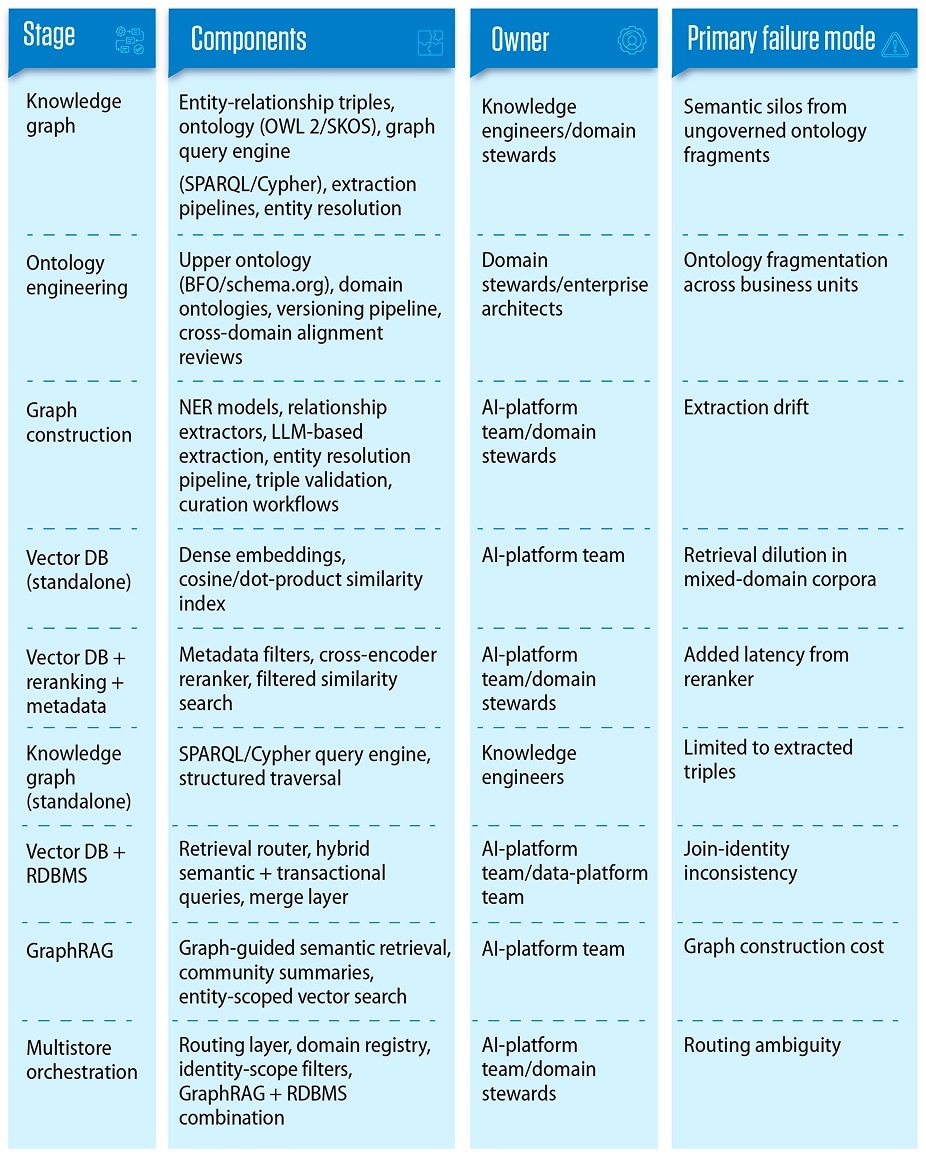
Figure 1 summarizes the knowledge representation stages with their components, owners, and primary failure modes.
Figure 1. Knowledge representation reference model
Source: Infosys
This article defined the structuring layer: knowledge graphs, ontology engineering, graph construction, and six knowledge-store topologies. A companion article covers the retrieval and governance side: agentic retrieval, the MCP, and the governance mechanisms that keep representations trustworthy.

