

Insights
- AI costs have become a boardroom issue overnight.
- Telecom operators are well positioned to become the AI consumption layer enterprises need, with billing infrastructure, sovereign networks, enterprise trust and data assets that hyperscalers cannot easily replicate.
- Opportunities span five monetization lanes: token plans, AI consumption orchestration, sovereign AI, network application programming interfaces (APIs), and AI marketplaces.
- Early action will determine who captures value in the emerging AI economy.
AI costs are growing fast and becoming increasingly difficult to forecast. Uber burned through its entire 2026 AI budget in four months. Its chief technology officer, Praveen Neppalli Naga, said the company was "back to the drawing board" on AI spending. OpenAI CEO Sam Altman says he has heard the same from enterprises everywhere: "My company spent my entire 2026 budget in Q1."
The reason is tokens. A token is the basic unit AI models use to read and respond. Every question asked, every document processed, every line of code generated is measured and billed in tokens. As AI use grows, so does the number of tokens consumed, and so do the costs.
The paradox is that token prices are actually falling, but enterprise AI bills keep rising. Two structural problems explain why. First, each new frontier model release costs roughly twice as much per token as the one it replaced. Second, around 95% of enterprise AI still runs on the most expensive frontier models even for simple tasks that cheaper models could handle. Agentic AI workflows multiply token consumption per task, making per-unit price reductions largely irrelevant to the total bill.
Token consumption is turning AI into a new kind of variable cost — one that grows with every use, is difficult to forecast, and has no clear pricing structure yet in place. That combination is something telecom companies are uniquely positioned to solve.
This is a telecom story
Telecom companies built the infrastructure that tamed every previous surge in consumption. Voice minutes, messaging, mobile data. Each time a new unit of consumption arrived at scale with no pricing structure in place, telecom operators turned it into a manageable, metered and billable service (Figure 1).
Figure 1. Evolution from minutes messages bytes

Source: Infosys
The assets that made that possible are still in place today, and they are exactly what the AI consumption economy needs.
Billing at scale: Telecoms manage millions of billing relationships, metering consumption, applying tiered pricing, consolidating usage across services, and issuing a single trusted invoice. No hyperscaler has built this at consumer and enterprise scale simultaneously.
Enterprise trust: They hold long-term contracts with governments, banks, hospitals, and large enterprises. These relationships are built on performance guarantees, security commitments, and regulatory compliance, and cannot be replicated quickly.
Sovereign infrastructure: Telecom companies own and operate physical networks, data centers, and edge compute within national borders, making them the natural host for AI workloads that cannot leave a jurisdiction. Hyperscalers operate globally while telcos operate locally, and that distinction matters increasingly to regulated industries and governments.
Security and compliance frameworks: They operate under some of the most demanding regulatory environments in any industry. The governance, auditability and data protection standards they already meet are exactly what enterprises need from a provider.
Edge and network: These companies own the physical infrastructure closest to where AI inference needs to happen for low-latency, real-time applications. That proximity is a structural advantage no cloud provider can replicate from a distant data center.
Tokens, and the broader AI consumption, are the new units of consumption arriving at scale, with no clear pricing structure yet in place. The infrastructure needed to solve this problem already exists inside every major operator.
But it is also a familiar trap
Each time a new unit of consumption emerged, telcos built the pipes and someone else built the business on top. It happened with voice. Internet-based apps like WhatsApp and Skype made calls free and telecom operators were left carrying the traffic. It happened with messaging. iMessage and WhatsApp replaced SMS, and again, telcos carried the traffic while others captured the revenue. It happened with cloud computing. Telecoms built the connectivity, but Amazon, Google and Microsoft built the businesses on top.
Tokens risk following the same script. The companies that generate and sell tokens today — OpenAI, Google, Anthropic, Meta — already have direct commercial relationships with enterprises. They set the price. They own the billing relationship. They define how AI is packaged and sold.
Telecom companies are carrying AI traffic today without owning the commercial relationship that sits on top of it. The dynamic is already visible. In 2025, Bharti Airtel offered Perplexity Pro free to its 360 million subscribers for 12 months. With this deal, Perplexity gained India as its largest market by users almost overnight. Airtel gained a promotional perk. The subscriber relationship stayed with Airtel. The AI relationship went to Perplexity.
That same handover is already in motion at industry scale, and faster than it was with voice, messaging or cloud. AI adoption is scaling at a pace those transitions never matched. Goldman Sachs projects global token consumption will multiply 24 times between 2026 and 2030, driven by enterprise AI agents. As that consumption grows, the commercial value accumulates with the AI providers that enterprises pay directly and not with the telecom companies whose networks carry the traffic. The question the telecom industry faces today is whether it will respond differently this time or let the AI economy follow the same pattern as before.
The AI monetization opportunity
Owning the bill alone was never enough. Telecom companies billed for SMS and data and still watched the margin migrate to the platforms above them. The difference this time is the scope of what telcos can own: not just the invoice, but the model access, the usage governance and the sovereign infrastructure that enterprises cannot easily source elsewhere.
Telecoms that act now have a five-lane monetization opportunity: from token plans and AI consumption orchestration to sovereign AI infrastructure, network API services and AI marketplaces (Figure 2). Together these lanes represent a structural shift in how they generate revenue by owning the layer through which enterprises consume, govern and pay for AI.
Figure 2. AI monetization opportunity landscape
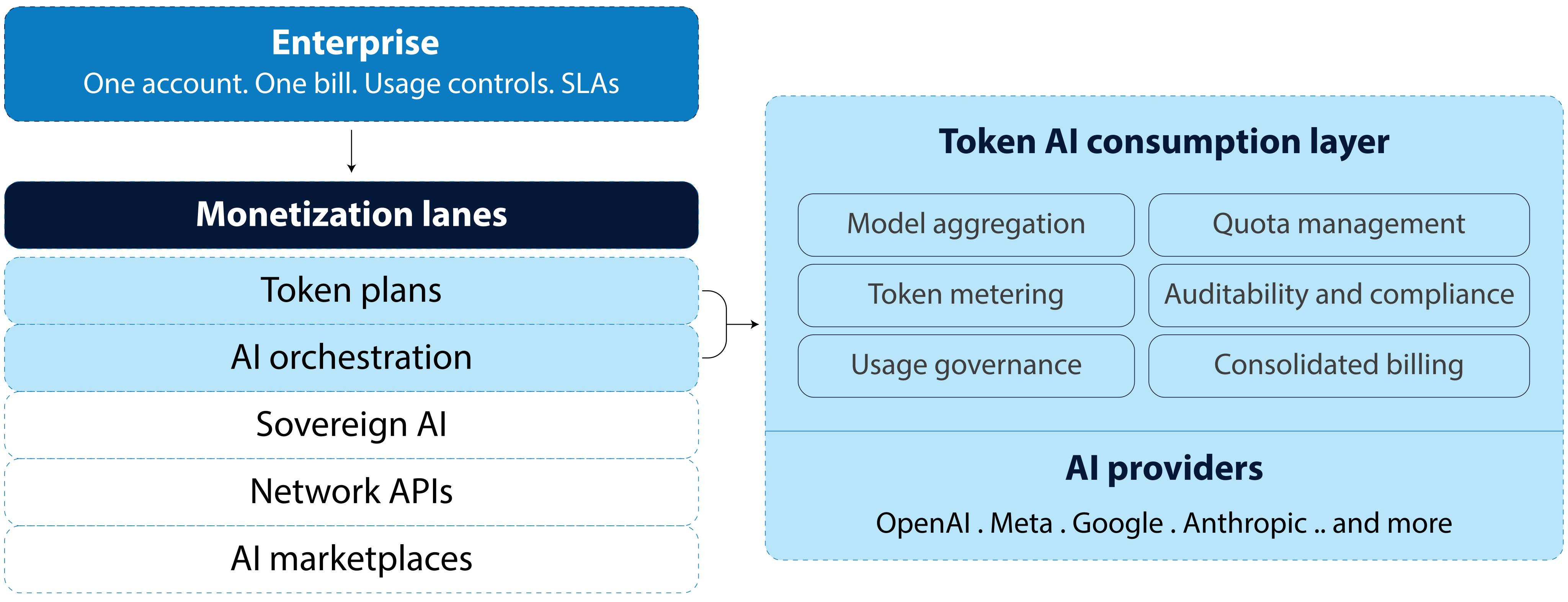
Source: Infosys
Lane 1: Token plans
High token costs are the challenge that companies are already starting to face. And telecom operators, with the infrastructure scale to drive prices down, hold a commercial advantage over hyperscalers whose margins depend on keeping prices up.
Reliance Jio has made that declaration. At Mobile World Congress in Barcelona in March 2026, Jio Platforms’ group chief executive officer, Mathew Oommen, said: "The telecom currency is going to be rapidly changing from minutes to bytes to tokens. We sincerely believe at Jio, we will be one of the first scalable token services providers." Jio's target is the lowest cost per token per watt globally. This ambition rests on two strengths. Its network, data centers and energy assets give it the compute scale to drive AI inference costs down. It is the same playbook it used to make voice free in India and crash data prices to $0.09 per gigabyte. The second is demand. India ranks among the top five countries globally for AI adoption, and Jio's 524 million subscribers give it unmatched distribution scale to make that ambition credible.
Lane 2: AI orchestration
Enterprises face two operational problems with AI consumption — fragmented model contracts and unpredictable costs. Most enterprises today manage separate accounts with OpenAI, Google, Anthropic and others, resulting in multiple invoices and inconsistent usage controls. The telecom company that aggregates multiple AI models behind a single account, with unified billing and usage controls, solves both problems in one move.
China's three state-owned carriers — China Mobile, China Telecom and China Unicom — have already built this. In May 2026, all three launched AI token subscription plans within days of each other. The structure was deliberate and familiar: tiered monthly plans, priced by consumption volume, billed directly to the customer. China Telecom's personal plan starts at $1.40 per month for 10 million tokens, scaling to around $41 per month for 150 million tokens for professional users including developers and small businesses.
What sets the Chinese model apart is the architecture behind it. Each carrier has built a multimodel aggregation platform. China Mobile's mobile model management (MoMA) platform integrates around 300 AI models from partners including Alibaba, Tencent, Huawei and DeepSeek via a unified API. Similarly, China Telecom built Star TokenHub, and China Unicom launched Uniclaw. The customer buys tokens from the telecom company and directs them at whichever AI model they need, switching between providers through a single account, on a single bill. The token itself may be a thin-margin product, but as with mobile data before it, the real commercial value lies in the managed service layer built on top: the aggregation, governance and enterprise relationships that the token plan creates. Emma Mohr-McClune, GlobalData's chief telecom analyst, describes it as telecom companies attempting to gain “pole position for universal, multimodel AI token brokerage and billing.” What makes this a telecom play is the billing infrastructure, regulatory credentials and national network reach that no gateway provider can replicate at this scale.
Also, what enterprises gain from this model is significant: single access to multiple AI models for safe experimentation across providers, usage governed by their own policies, full auditability of AI spend and data residency controls, all through one trusted partner. The opportunity will only grow as agentic AI takes hold, with AI agents running complex multistep workflows that consume far more resources than standard interactions, making consumption management and governance a critical enterprise need.
Lane 3: Sovereign AI
Regulated industries like banking, healthcare, defense, and government need AI that runs on trusted, local, auditable infrastructure. For these industries, the value is in risk reduction. Sovereign cloud offerings from hyperscalers often provide data residency but not full legal isolation. The parent company could still be subject to foreign jurisdiction. Telecom operators, anchored within national borders, already hold the government relationships, regulatory credentials and physical infrastructure to step into that gap.
Telcos across Europe are already moving. Telenor launched a sovereign AI factory in the Nordics that offers enterprises a secure AI cloud service where all data is stored and processed within Norwegian borders, giving regulated industries access to high-performance AI computing without sending sensitive data to foreign cloud providers. In the UK, BT became the first operator to launch a full sovereign AI portfolio, combining connectivity, cloud and AI services delivered entirely within UK borders. Research estimates this could unlock £18 billion ($23 billion) in productivity benefits for the UK economy. Governments investing in domestic AI infrastructure are increasingly turning to operators, whose network and regulatory strengths position them to capture a large share of this emerging market.
Lane 4: Network APIs
Telecom companies own data that no hyperscaler can replicate — subscriber identity, real-time location, device signals, network quality indicators and patterns that flag fraudulent activity. This data has direct commercial value for industries that need to verify identities, prevent fraud, and deliver location-aware services.
The opportunity is to package that data as standardized APIs — services that other businesses can plug directly into their own applications. A bank, for example, can use a telecom operator's network signals to verify that a customer logging in is using their registered device and location, reducing fraud without adding friction. A hospital can confirm a patient's identity. A retailer can personalize an offer based on where a customer is at that moment.
GSMA’s Open Gateway initiative, a global framework that standardizes how telecoms make this data available, now covers nearly 80% of the global mobile market, with 73 operator groups representing 285 networks committed. Banking and financial services leads the demand, followed by media, healthcare, retail and manufacturing.
Lane 5: AI marketplaces
Enterprises need AI that works reliably, complies with local regulations, runs on secure infrastructure and comes with someone to call when it breaks. Hyperscalers can provide the model, but what they cannot always provide is the local infrastructure, the regulatory compliance, the network performance guarantee and the on-the-ground support together in one place. Telecom operators can.
This lane is about telecoms becoming the integrator that brings all of those pieces together, offering enterprises a complete AI service, not just a component. Telcos are already building this. Deutsche Telekom launched the world's first Industrial AI Cloud in Munich in April 2026, a managed platform giving German manufacturers access to large-scale AI computing power, combined with SAP's enterprise software and Deutsche Telekom's sovereign infrastructure, all under one contract and one provider.
Together these five lanes define the full scope of the AI monetization opportunity available to telecom companies. The window across all five is open, but it is narrowing as hyperscalers, governments and enterprises make their AI infrastructure choices.
The telecommunications playbook for the AI era
Token plans are only the first move. The larger, and more durable, opportunity is to build presence across all five monetization lanes. The journey follows a clear sequence: run AI at scale internally, prove the capabilities work, productize them for customers, then scale across the full ecosystem.
The journey requires significant internal investment in AI engineering capability, cloud architecture and solution consulting skills. But telecom companies that build these capabilities in their own operations first will be better positioned to offer them as external services. Three moves define the immediate steps.
Get on the bill
The most defensible position in this AI economy is the invoice. Telecom companies already have billing infrastructure, subscriber relationships and monthly touchpoints with millions of enterprises. The immediate priority is to use that infrastructure to package AI access into structured, tiered token plans — the same way data was packaged a decade ago. An enterprise that pays for tokens through its telecom bill is an enterprise the telco now has a reason to keep. But the bill is the entry point. The opportunity lies in what the telecom company builds on top of it.
Govern the consumption
Beyond billing, enterprises need structure around how AI is consumed. In practice, this would look like a chief information officer setting token budgets by department, automatically routing routine tasks to lower-cost models while reserving frontier models for complex work, blocking access to unapproved AI services, and receiving a single consolidated invoice covering all AI usage across the organization, through the same telco account that already handles connectivity. The goal for a telecommunications company is to become the trusted layer through which enterprises access and govern their AI consumption and to orchestrate across models.
Telecom companies already managing AI at scale in their own operations are best positioned to offer this. By deploying AI across customer service, network operations, software engineering, and enterprise functions, they have developed practical capabilities in consumption management, governance, and cost optimization. Once productized, those capabilities can be extended to retail, small and medium businesses, and enterprise customers, turning internal AI adoption from a productivity initiative into a new growth business.
Go beyond tokens
Telecom companies that build durable positions in the AI economy will be those that move up the value chain from token plans into AI consumption orchestration, and from there into the broader monetization lanes that only telcos, with their combination of infrastructure, trust and reach, are positioned to own.
The window is not permanent, though. The telcos that move now will define telecom's role in the AI era. Those who wait will find that role has already been defined for them.


Token efficiency, or tokenomics, is now a primary design concern in AI deployments. To get ahead, organizations should build a framework of four composable levers, or thinking modes, applied across the agent stack to cut token expenditure without degrading output quality.
- 17 Sep, 2026
- 7 min read
Regulatory change is accelerating and breach costs are rising, yet most institutions still rely on periodic, manual risk assurance. Three structural gaps, spanning visibility, third-party oversight, and governance, leave institutions unable to keep pace. Building risk assurance as a continuous, AI-augmented capability closes these gaps. A four-phase roadmap helps institutions get there.
- 11 Sep, 2026
- 15 min read

The difference between AI work and AI that works lies in the discipline to scale adoption, governance, and value realization
- 10 Sep, 2026
