

Insights
- AI’s promise is real, but quick wins alone do not deliver sustainable value.
- Many companies are held back by disconnected systems, tool sprawl, and workforce challenges.
- Success depends on trusted data, integrated architecture, and effective AI governance.
- A long-term, capability-led approach is the path to AI excellence.
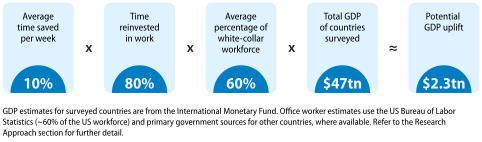
AI promises significant benefits — higher productivity, personalized customer experience, lower costs, improved quality, and better decision-making. Infosys’ AI and the Future of Work research has shown how AI could already be contributing productivity gains of around 8%, with an economic impact equivalent to $1.5 trillion in US GDP and $2.3 trillion among the countries surveyed (Figure 1). However, many enterprises fail to build lasting capabilities that can deliver long-term value.
Although the market buzzes with new AI tools and quick wins, only organizations that commit to a long-term vision build sustainable competitive advantages that compound over time.
Figure 1. AI delivers tangible value
Source: Infosys Knowledge Institute
Roadblocks to AI
Many enterprises fail to realize AI’s potential gains by approaching AI adoption through scattered experiments or short-term innovation projects that don’t build lasting capabilities that can deliver long-term value.
The use case dilemma
As per the Infosys AI Business Value Radar 2025, as enterprise AI moves toward broader scale, only half of AI use cases deliver some or all of their expected business outcomes, while one in five fails to create value or is canceled after deployment. Many AI experiments fail and do not take off or scale up, and early setbacks stall the momentum.
Too many tools, too little clarity
The term “artificial intelligence” includes technologies from robotic process automation to agentic AI, speech-to-text to computer vision, and analytics. Major cloud vendors like Google, AWS, and Microsoft offer many overlapping platforms and generative AI services, further complicating the tooling landscape. As of August 2026, the Hugging Face Hub hosts around 2.9 million models and more than 1 million “Spaces” – interactive applications that allow users to experiment with and showcase machine learning models and tools. Together, the proliferation of tools and vendor sprawl pose a real strategic challenge for executives in making clear, context-aligned AI investment decisions.

Fragmented technology landscape
Decades of technology accumulation have left many organizations with a complex and fragmented landscape of legacy and modern applications. This creates disparate data stores, manual processes, and inefficient information flows that impact the very agility and data access AI requires.
For instance, an Australian mid-size retail group is operating with over 300 software assets, with minimum interoperability, and three distinct e-commerce platforms, each with its own separate customer database. Consequently, a strategic AI initiative to create a unified customer loyalty program — one that can predict behavior and deliver personalized offers — is hobbled from the start. Infosys is working with the organization to transform its underlying operating model, advising the organization to lay the appropriate data and interoperability foundations so it is AI-ready as it builds out its future business capabilities.
Lack of governance
AI is transforming industries, driving innovation, efficiency, and personalization. However, without proper governance, it can also amplify risks such as bias, misinformation, and data breaches. Responsible AI adoption is a strategic imperative that demands leadership, oversight, and ethical alignment.
An Infosys client in the entertainment industry found in its internal audit that 20% of its workforce was using more than 80 AI tools that the company had not sanctioned, resulting in significant data transfers over a few months. This poses security risks and reinforces the need for strict AI monitoring and governance policies to prevent data leakage and unauthorized use.
Decline of traditional workforce models
Current workforce capabilities are increasingly inadequate for AI adoption. Infosys’ Enterprise AI Readiness research found that only 12% of companies are confident that they’re providing employees with enough training opportunities. Competition for scarce AI talent is also intensifying in an already constrained market. A further study found that while 88% of organizations are experimenting with AI, 81% report no meaningful bottom-line gains. The study also highlighted that impact comes from redesigning the business around AI.
These studies reveal that there is a fundamental misalignment between existing organizational structures, skills frameworks, and talent development approaches and AI-driven operating models. The dual challenge of an underequipped existing workforce and scarce specialized talent creates a significant barrier to realizing AI's transformative potential that leaders must address.

A pragmatic path to AI excellence
Organizations must deal with immediate operational challenges such as reshaping the workforce while at the same time doing the groundwork to deliver sustained long-term AI business value:
Set out a long-term vision
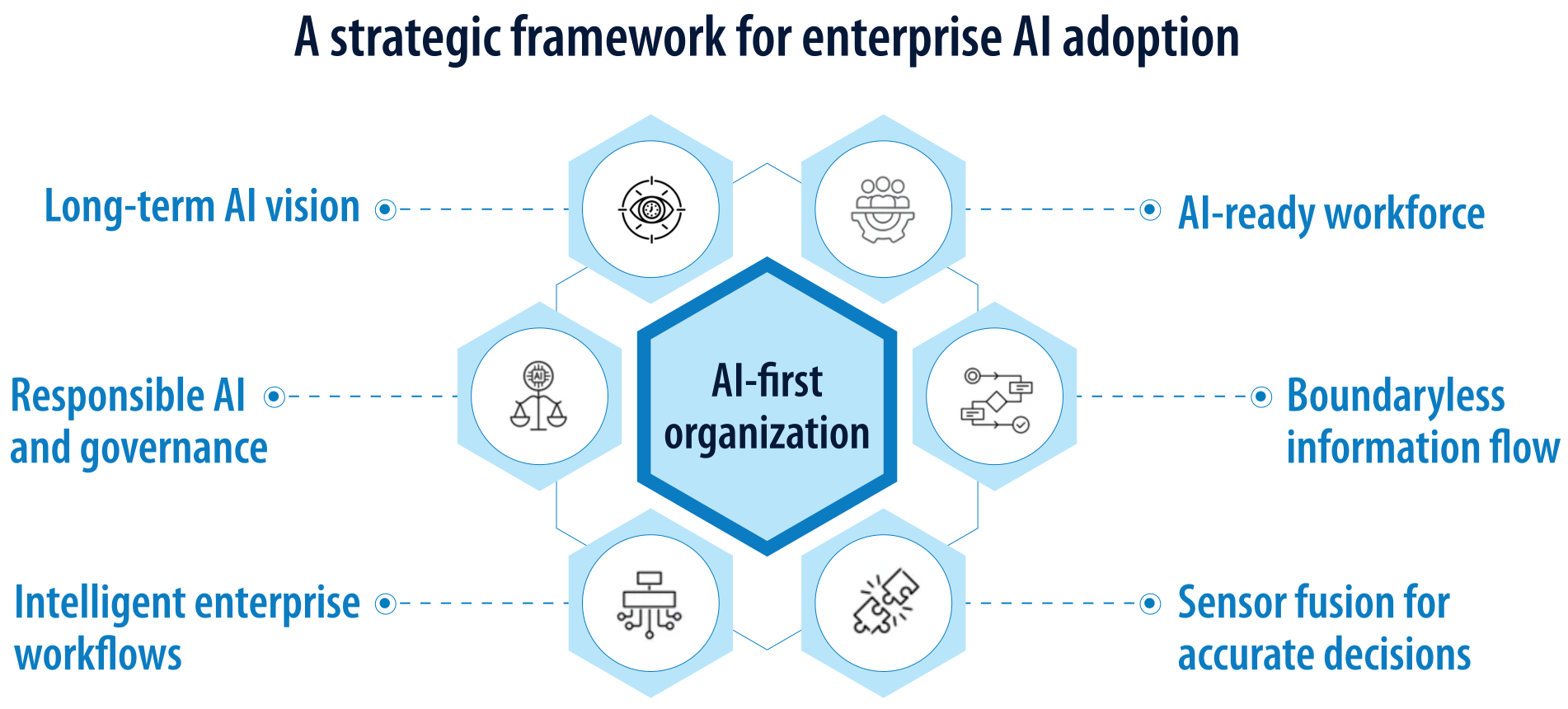
Leaders should articulate a vision (Figure 2) in which AI enables business capabilities, aligns with the enterprise’s strategic objectives, and delivers customer and business value over time. This requires defining where AI will create the most lasting impact, whether improving productivity, enhancing user experiences, or building core capabilities. They also need to ensure that these ambitions are linked to sustainable competitive advantage through well-managed data, integrated architecture, and continuous innovation. Importantly, leaders must remain proactive, recognizing the need to revisit and refine the organization’s strategic objectives in response to rapid advancements and evolving market opportunities.
To drive execution, the leadership must foster a culture of cross-functional collaboration. They must also realign the organization’s operating model to support intelligent workflows. Executives must provide the vision but also establish the platform necessary to realize it. This means ensuring that resources such as funding, talent, and technology infrastructure are allocated to AI initiatives. This requires investing in foundational data infrastructure, upskilling teams in analytics and AI, and prioritizing AI initiatives that align with long-term business goals.
A phased approach, starting with quick-win automation and user experience improvements, and maturing toward integrated enterprisewide AI capabilities, ensures that effective AI is achievable, and will support steady and responsible value creation.
Figure 2. The foundations to realize long-term AI value creation
Source: Infosys Knowledge Institute
Take ownership of AI governance
Boards and executive teams must take ownership of AI governance and embed it into their enterprise AI strategy. This includes defining a clear risk appetite, ensuring regulatory alignment, and embedding ethical principles into the enterprise’s AI strategy. This safeguards reputation, builds stakeholder trust, and ensures AI initiatives are accountable.
Leaders must track the still maturing regulatory landscape and translate it into technical and legal guardrails covering safety, transparency, fairness, privacy, and intellectual property.
Build infrastructure that enables free flow of data
AI depends on good-quality, accessible data, delivered via tools such as microservices and application programming interface (API) gateways. In this model, data is available via model context protocol (MCP) servers that expose secure, standardized endpoints; enterprise service buses that exchange data between separate applications; and stream-processing platforms that analyze data in real time. An online shopper at Bunnings can see up-to-the-minute store stock levels and aisle locations, due to its brick-and-mortar inventory systems feeding data continuously into the e-commerce engine. In manufacturing, sensor telemetry from the production line flows through unified pipelines into AI agents that adjust machine parameters on the fly and notify maintenance teams before failures occur.
Equally vital is governance and master-data management: unified metadata schemas, role-based access controls, real-time data quality monitoring, and audit trails ensure every service and AI agent trusts the information it consumes. Observability layers tie together logs, metrics, and tracing across systems so feedback loops can validate model outputs against changing business conditions.
When architecture and governance align, organizations transform isolated silos into a smooth-running, connected enterprise. AI agents, from customer-service chatbots to supply-chain orchestrators, access the data they need when they need it, to deliver focused, real-time recommendations.

Deploy sensor fusion for accurate decision-making
Once a foundation of unrestricted, high-quality data flow is established, organizations can harness advanced techniques like sensor fusion. Sensor fusion combines data from multiple sources, including cameras, light detection and ranging (LiDAR), and internet of things (IoT) devices. This combination of data from multiple sources powers intelligent, real-time decision-making in complex environments where precise situational awareness is critical for safety and operational efficiency.
Sensor fusion is a promising technology in areas such as fresh-food supply chain, healthcare, and retail. Infosys has implemented sensor fusion across its corporate campuses via a central command center. This system leverages real-time data from a wide variety of equipment and sensors across 149 buildings to drive asset management, security, building performance, and renewable energy optimization.
Build AI agents for accurate decision-making
When data and insights flow smoothly across and around the organization, routine operations are enhanced with proactive decision-making, pattern detection, and continuous improvement throughout the organization. At the heart of this are agentic AI systems that can independently plan, take action autonomously, sense intent, reason through complex scenarios, and adapt to shifting contexts. AI agents can bridge silos and amplify organizational intelligence.
To achieve this, organizations must tune and deploy agentic AI to understand the context, knowledge base, and business rules they work within. This often involves fine-tuning pretrained models or large language models (LLMs) with organizational data and proprietary workflows. Leaders should be building a system of AI systems. Instead of deploying isolated, siloed solutions to solve specific business problems, leaders must develop interconnected core capabilities — strategic, enterprisewide AI systems that deliver compounding value and drive innovation. Achieving this depends on a deliberate, architecture-led approach championed from the top. This ensures that independent AI systems are developed not as one-off projects, but as interoperable components. Crucially, this architecture must articulate how data is captured, pooled, and shared across these systems.

Build an AI-ready workforce
Leaders must make the most of their existing workforce amid a challenging environment for hiring new AI talent. This involves balancing targeted external recruitment with robust internal upskilling.
Infosys combines enterprisewide evangelist networks to guide employees from foundational literacy to technical mastery. It has also deployed AI agents across the enterprise, launching over 200 through its Topaz suite to automate workflows and accelerate decision-making at scale. Canva’s AI Discovery Week mobilized over 5,000 employees through expert-led workshops, exploration sessions, and a hackathon that generated over 330 ideas and logged more than 25,000 learning hours.
Sustainable success hinges on each organization designing a bespoke AI talent model aligned with its strategy, culture, and appetite for change. Long-term AI value depends on architecture-led vision, trustworthy data, embedded intelligence, and responsible governance.


Regulatory change is accelerating and breach costs are rising, yet most institutions still rely on periodic, manual risk assurance. Three structural gaps, spanning visibility, third-party oversight, and governance, leave institutions unable to keep pace. Building risk assurance as a continuous, AI-augmented capability closes these gaps. A four-phase roadmap helps institutions get there.
- 11 Sep, 2026
- 15 min read

The difference between AI work and AI that works lies in the discipline to scale adoption, governance, and value realization
- 10 Sep, 2026

Learn how automated integrity checks and human oversight can help enterprises control AI agent sprawl, reduce duplication, and manage risk at scale.
- 08 Sep, 2026
