

Insights
- Telco service desks are fragmented across teams, channels, workflows, and systems, leaving leaders without a reliable view of workload, cost, and performance.
- A four-pillar maturity framework across intake, effort governance, self-service, and interoperability provides a structured path to harmonization.
- ServiceNow customer service management (CSM) can unify operations while improving effort visibility, manager control, standardized integration, and readiness for agentic AI.
- With the right platform foundation and implementation discipline, telcos can turn fragmented service desks into a unified, measurable service ecosystem.
The telecom service desk has become one of the industry’s most underappreciated pressure points. Leaders are asked to grow business, keep costs flat, and raise the bar on customer experience, all with a service desk that hasn’t grown to match. But inside most telecom companies, a service desk isn’t one single team. Network operations, field engineering, provisioning, billing, and vendor operations each run as a set of independent desks, with their own channels, workflows, and reporting, rarely talking to one another. The result is a blind spot: There’s no single, trustworthy view of workload, cost, or performance across the business for leadership. Without that view, leaders end up making resourcing and investment decisions on instinct and anecdote instead of evidence. And problems don’t surface until the telcos’ customers have already felt them.

Fault lines in the service desk
Four operational patterns occur across telcos and erode leadership’s ability to run the service desk as a single business:
Siloed support teams
Customer care, network operations, field dispatch, and back-office support typically run on disconnected platforms and processes. As cases cross these boundaries, context and performance data fragment with them, leaving leadership unable to see workload distribution, benchmark teams, or identify where resolution slows down.
Business impact: There is no enterprise-wide view of service operations or a reliable basis for capacity or workforce decisions, which can include how to distribute work across teams or locations; how to schedule shifts across time zones, peak hours, and weekends; when to add or reduce staff based on projected demand, or what work to hand to a vendor versus keep in-house.
Fragmented intake channels
Front-office contact channels such as interactive voice response (IVR), chat, and email through which service requests are received typically remain disconnected from back-office resolution workflows. As a result, the context gathered at first contact is lost on escalation, with each issue spawning multiple records across systems. This in turn affects customer experience, as they often have to explain their problem more than once.
Business impact: This creates more work for agents as they reenter customer details, recreate or update cases, verify information again, chase other teams for context, or manually reconcile records across systems. It also leads to inconsistent service level agreement (SLA) measurement and a disjointed customer experience, even when individual agents perform well.
Incomplete workforce metrics
Without unified time and effort tracking across outsourced and in-house teams, telcos cannot accurately measure true handling times. It’s common for a significant share of cases in some telcos to carry no attached handle-time data at all. Infosys found that it was nearly 30% in the case of a US-based telecom company.
Business impact: This makes it harder to plan capacity accurately, spot billing errors, assess performance, provide coaching, and negotiate with vendors by challenging vendor charges, demonstrating missed SLAs, or justifying changes to pricing and contract terms.
Limited manager self-service
Business operations managers typically cannot adjust operational configurations themselves, and rely on IT to make routine changes, such as reallocating agents, adjusting target times, or revising customer communication templates. To protect the stability of the system, telcos typically restrict direct access, leaving even simple changes waiting in IT development queues.
Business impact: The result is a slower operational response, and a business that cannot adapt as fast as the market or the customer requires.

Maturity framework to harmonize telco service desks
A unified service management operating model powered by ServiceNow customer service management (CSM) helps harmonize the service desk and provides leadership with a single view of the work, performance metrics, resource capacity, and outcomes across every desk, to solve those issues, while letting the service desks maintain autonomy in their operations.
Many telcos already use ServiceNow CSM as their core case management platform. Over time, these implementations often drift far from the out-of-the-box configuration — accumulating custom tables, which are new data structures created for specific needs; hard-coded logic or fixed rules written directly into the system that can be difficult to change; and workflow overrides layered on by multiple vendors across successive releases, until the platform can no longer support the harmonized operating model leadership needs.
Steps to harmonize the service desk
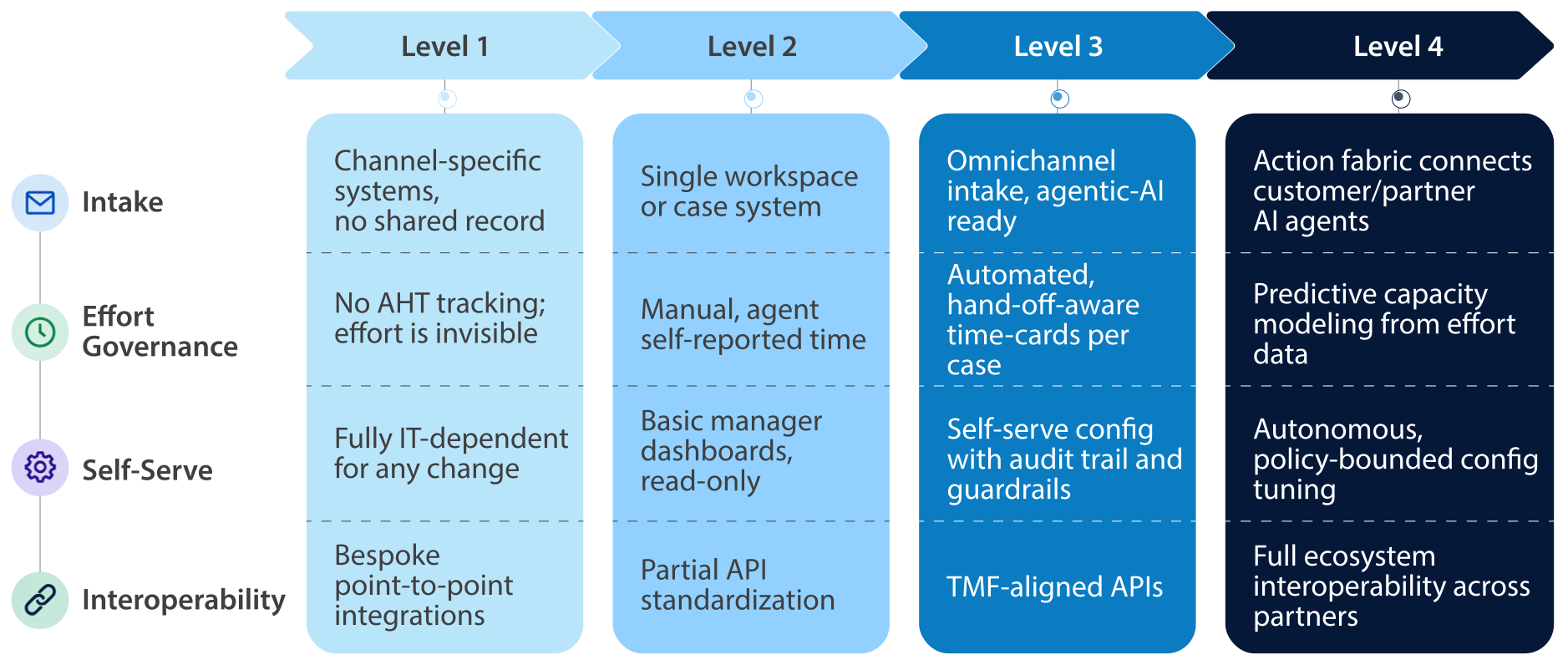
Rather than treat harmonization as a single project, organizations should treat it as a maturity curve (Figure 1) across four pillars: intake, effort governance, self-serve, and interoperability, with four maturity levels across each pillar. This gives operations leaders a way to self-assess where they sit today, independent of any specific vendor or platform.
Figure 1. The maturity curve in service desk harmonization
Source: Infosys Knowledge Institute
Intake: Organizations tend to start with each request channel, such as phone, chat, or email, having its own system and no shared record of customer interactions. As organizations mature, they must ensure that all channels feed into one case system, then into an omnichannel view that's ready to work with AI. In the most advanced telcos, AI agents from both partners and customers can create and update cases directly.
Effort governance: Early on, organizations don’t track how much time and effort each case actually takes, which means there's no average handle time (AHT) data present at all. The first step is to have human agents log their own time manually. From there, time-tracking becomes automatic, as a timecard is created for every case and follows it across every team it touches. Eventually, telcos can use this effort data to predict staffing needs and spot capacity problems before they happen.
Self-serve: Initially, managers need support from IT teams for even small changes. Over time, managers should gain the ability to make changes themselves, with safeguards and an audit trail to track what has changed. In the most mature state, routine changes happen automatically within preset rules and policies, without a person needing to act.
Interoperability: In many cases, systems are connected to other systems via one-off, custom connections. From there, telcos need to start standardizing some of these connections using application programming interfaces (APIs). Further along, telcos must adopt APIs built on shared industry standards set by the TM Forum, making it easier to connect with outside systems. At the highest level of maturity, the telcos’ systems work smoothly with any vendor's or partner's systems, with little custom setup needed.
Each transition up the framework has a distinct focus, and skipping a stage is usually where transformations stall. Telcos need to keep the following in mind while moving from one level to another:
- Level 1 to Level 2: Consolidate intake first, not effort tracking, manager self-serve, and interoperability all at once, to achieve gradual and sustained improvement. Establish a unified single case creation system, where a customer's issue becomes a single case record no matter which channel they used to report it, instead of a separate, disconnected ticket per channel. Implement this before touching effort tracking or manager tooling. It's a visible, contained win, and it stops the continued creation of duplicate records and reduces the need for repeated customer explanations.
- Level 2 to Level 3: Turn on granular timecard capture and centralized reporting. This is where the AHT visibility gap actually closes, making it easily reportable. Timecards now generate automatically for every case. Effort no longer depends on agents remembering to log it, and every case gets captured by default. Pair it with a first, contained manager self-serve pilot on a single desk, so governance and audit patterns are proven before they scale.
- Level 3 to Level 4: Extend self-serve business-wide with full guardrails and audit logging, and complete the interoperability layer. This is also the point to start scoping agentic AI, since the platform foundation is now built on standard, supported APIs rather than custom code. In this stage, Action Fabric, ServiceNow’s framework, allows telcos to connect AI agents directly to ServiceNow, so new AI capabilities can be plugged in safely without breaking existing workflows.

A large North American fiber-optic operator was running over 1,000 support agents across multiple geographies and service desks. But its operations were fragmented, leading to issues such as inconsistent case handoffs between desks, no reliable view of agent effort across more than 1,000 agents, and business managers stuck waiting on IT for routine configuration changes. Infosys applied the four-pillar framework to address these challenges:
Intake: Native intake channels such as email, SMS, and phone were extended via Twilio integration to SMS and social media, including X, Facebook, and Instagram, allowing agents to work from one consolidated interface rather than switching between disconnected systems.
Effort governance: A case-level, hand-off-aware timecard mechanism was implemented, where a timecard is generated automatically for every case, capturing time worked as the case moves across every agent and desk until closure. Because capture was automatic rather than self-reported, it removed the memory problems inherent in manual logging, such as duplicate or incorrect logging of time, and it produced a defensible, audit-ready record. Once this data was normalized into a central data warehouse at the agent, group, or desk level, reporting layers built on tools such as Power BI and Tableau delivered genuine agent performance insight and also flagged areas where the agent needed coaching. Crucially, it gave outsourcing and vendor-management teams a defensible basis for reconciling billed hours against actual, evidenced case-handling effort, rather than invoiced estimates.
Self-serve: A manager workspace was deployed with guardrails and field-level audit logging, extending configuration control to business managers across all desks. It gave control to business managers to change SLA configurations, customer communication templates, user group movements, bulk upload, and to modify these within a few clicks, reducing the turnaround time for simple configurations from weeks to minutes.
Interoperability: Aligning with TM Forum's TMF621 Trouble Ticket API enabled standardized, interoperable data exchange between the harmonized desk and existing business and operations support systems, reducing the bespoke point-to-point integration effort that otherwise accumulates as customer relationship management, billing, and order-management platforms proliferate.
This helped the client move from one level in effort governance, which is largely invisible, self-reported effort, to a higher level that involves automated, hand-off-aware, audit-ready effort data feeding a centralized reporting layer, while advancing the other three pillars in parallel. The result was a measurable improvement in the organization's ability to have information on time, effort, and performance, for any case, on any desk.
Telcos should not undertake this transformation alone. Partnering with technology companies that bring deep platform domain expertise gives telcos a faster, smoother path to an out-of-the-box implementation and helps avoid the customization drift that caused the original fragmentation. A partner with the right domain expertise and implementation discipline is what keeps a harmonization program from becoming the next generation's version of the same problem. By modernizing their service desk using ServiceNow CSM and applying a harmonization maturity framework, telcos can move from a fragmented, desk-by-desk support model to a unified, measurable service desk ecosystem. This closes gaps in effort visibility and gives business leaders direct, governed control over operational configurations without IT dependency.


The next telecom customer may not be human. AI agents are already consuming network services autonomously, and the operators that build the commercial infrastructure to serve them will define the future of machine-to-machine commerce.
- 07 Sep, 2026

Telecom's workforce is AI-ready — yet the organizational strategy, structures, and capabilities to channel that readiness remain underdeveloped. This article examines the gap and sets out what telecom companies must do to close it.
- 27 Aug, 2026
- 5 min read

A unified platform balances business unit autonomy with enterprise-wide integration, governance, and service assurance. deployment.
- 17 Aug, 2026
- 8 min read
