

Healthcare organizations today are working to update their legacy systems and improve their daily operations. These changes are taking place in pharma manufacturing, where reliable, uninterrupted production is critical; in medical device development, where precision and usability matter; and in healthcare networks that must connect teams and facilities spread across different locations.
The case studies that follow show how focused partnerships and the right use of technology can help address these challenges. From ensuring uninterrupted delivery of vital cancer therapies to redesigning surgical tools for better comfort and performance, each example highlights practical steps organizations are taking to improve how they operate and serve patients.
1. Global consumer health leader connects with 1 million HCPs through Infosys-powered digital portal
A global consumer health company that became independent after a corporate spin-off in 2022 inherited a large portfolio of legacy brands — and an immediate challenge.
For decades, the company’s connection with healthcare providers (HCPs), who drive businesses in the healthcare system due to the trust and confidence they enjoy among patients, was built through in-person visits by sales representatives. While effective, this model had clear limitations.
Geographical barriers, demanding schedules, and limited sales representatives’ capacity meant that only about 40% of the global HCP market could be reached consistently.
The company needed a centralized digital portal where HCPs could explore products, request samples, access trusted medical content and personalize their learning paths.
The company partnered with Infosys to lead this transformation with support from other vendors like Veeva, SAP, Adobe, and Salesforce.
Infosys designed an always-on, multilingual, regulatory-compliant digital platform that delivers customized, market-specific content.
The Infosys-built platform helped the company add over 1 million HCPs across more than 65 markets to its network. Its marketing operations became leaner, and costs dropped by 25%.

2. Global pharma company achieves zero SLA misses with Infosys-powered RLT platform
A global pharmaceutical leader that had acquired several companies with radioligand therapy (RLT) manufacturing capabilities globally to make this cancer treatment widely available was facing a major challenge: each acquired entity used its own IT systems and country‑level workflows that didn’t communicate with one another.
RLT is a type of precision medicine that uses a molecule designed to bind to cancer cells and deliver a small dose of radiation directly to the tumor, while limiting harm to surrounding healthy tissues. Each dose is custom‑made for a specific patient and is highly time‑sensitive because the radioactive material loses strength within hours. This makes it essential to produce RLT close to treatment centers or major transport hubs, so patients receive their therapy quickly and safely.
Although the acquisitions gave the company the localized manufacturing capacity it needed, it lacked the ability to track each dose end‑to‑end, manage time‑critical handoffs, or ensure consistent quality across markets. To fix this, it needed a unified digital system.
The company partnered with Infosys, which integrated the acquired biotech entities into its SAP platform. This helped create unified visibility across the entire RLT value chain.
Infosys then strengthened reliability through 11 automation-driven digital solutions. With real-time monitoring, smart native automation, and proactive incident prevention, the platform achieved 100% service level agreement (SLA) compliance and reduced critical incidents by 70%.
An SLA defines the level of service that operations teams must meet. For example, orders must be processed within a defined time and alerts must be addressed within a set window. Critical incidents are events that can disrupt supply chain operations. For example, a failed system interface, a mismatch in order or shipment data, or a process failure in logistics or IT systems. A 70% reduction means Infosys’ automation, monitoring, and integration eliminated most of the causes of severe disruptions.
For RLT, this is essential. Fewer incidents directly translate into more patients receiving treatment as scheduled. When the RLT platform achieved 100% SLA compliance, it meant every single operational requirement was met, no deadlines were missed, and there were no delays in the processes Infosys managed.
3. Retinal therapy start-up achieves 90% precision in ocular drug delivery with Infosys support
Retinal therapy, in which doctors put the medicine directly into the back of the eye, either through a fine needle or via electrodes, needs very high precision. Even tiny movements can affect where the therapy goes, making it critical to keep the eye steady for successful application.
A company specializing in retinal therapy partnered with Kaleidoscope Innovation, an Infosys company with expertise in human-centered medical device development, to design a device that could ensure this. Current tools give surgeons very little room to work, making it hard to keep the eye still.
The company and Kaleidoscope together explored more than 100 design concepts and refined them using advanced 3D printing, machining, and simulated surgical testing.
Two designs emerged — the curved needle device, offering precision and stability with selfequilibrating needles; and the dual plate device, a minimally invasive alternative that requires further validation. To further test their scientific viability, a team of experts simulated electroporation — the process of using electrical pulses to deliver therapy — within the eye while real-world validation came through cadaver labs where ophthalmic surgeons provided feedback.
Devices designed in a curved needle form are also used during surgeries for tissue-cutting because of their maneuverability. Kaleidoscope refined the electromechanical system of the curved needle device for retinal therapy to support broader clinical use. Surgeons described the device as “intuitive, stable, and offering the control we’ve been missing,” confirming its readiness for clinical and manufacturing scale-up.
Impact: A new standard in retinal therapy
The resulting retinal intervention device delivers transformational improvements:
- 98.3% reduction in procedure time — from 45 minutes to 45 seconds.
- 90% improvement in delivery precision.
- Together, these gains streamline clinical operations and lower costs.
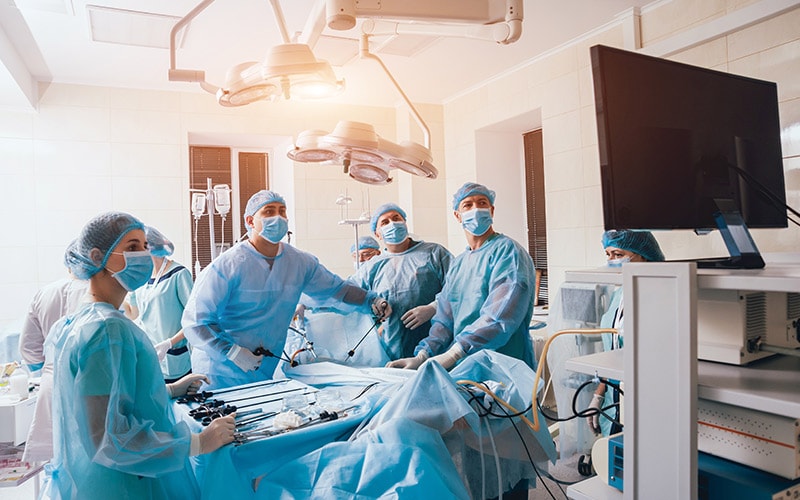
4. Global medtech, with Kaleidoscope support, introduces a device that reduces surgical preparation time by 30%
In laparoscopic surgery, surgeons must act quickly when unexpected bleeding occurs. To do this, they depend on a medical gel delivered through a two-handed tube-and-stick applicator that requires an assistant and high force. Mid-procedure refills are also common, adding strain when time matters most.
A global medtech company partnered with Kaleidoscope Innovation, an Infosys company, to redesign how the medical gel was delivered.
Kaleidoscope began by observing live procedures, interviewing surgeons and nurses, and understanding the pressure they faced when the older applicator slowed them down.
One surgeon summarized the problem clearly: “In trauma cases, seconds can mean survival. The old applicator often required both hands and an assistant, which slowed us when we needed speed and precision the most.”
Over two and a half years, more than 100 ideas were explored and refined through sketches, mechanical concepts, 3D printing, and high-precision prototype molds. The breakthrough came when the researchers developed a compact, single-handed applicator with a trigger plunger mechanism inspired by a simple caulk gun. It allows the surgeon to squeeze a trigger to release the gel with just one hand. The new applicator also provides better ergonomics, targeted dosing, reduced force, and a faster, unified refill system — all while keeping production costs the same as the old design.
Impact: The new applicator delivers meaningful improvements:
- Up to a 30% reduction in surgical preparation time, enabling faster response in emergencies.
- Lower force and better ergonomics, reducing hand fatigue during long surgeries.
- Improved sterility and safety, lowering infection risk.
- More intuitive use, even under high pressure.
For patients, this means quicker intervention and fewer complications. For clinicians, the new device supports surgical performance and improves efficiency at the moments that matter most.


Agentic AI is moving beyond initial pilots and toward production-grade implementations. Here we outline a cloud- and AI-agnostic blueprint to make this important technology work at scale, solving many client pain points along the way.
- 24 Sep, 2025
- 8 min read

Infosys implemented a proactive and efficient customer experience center for a semiconductor client, leveraging advanced ServiceNow capabilities.
- 07 Aug, 2024
- 8 min read

To transform to a future-ready operating model, firms must institute customer-centric, outcome-oriented models, with product thinking, agility, governance, and value flow at the core.
- 19 Aug, 2022
