

Insights
- AI is moving beyond employee productivity into business execution.
- SAP's Autonomous Enterprise brings AI agents, business context, and workflows together to accelerate execution.
- Enterprise readiness depends on trust, context, governance, and technology working together.
- Most organizations will progress gradually from AI assistance to coordination, execution, and orchestration.
- The strongest outcomes will come from aligning AI with business processes, operating models, and decision-making.
Enterprise AI has largely been viewed as a productivity tool, helping employees work faster, automate repetitive tasks, and make better decisions. Increasingly, organizations are exploring how AI can participate in how work gets done across the enterprise.
Enterprises are building AI agents that can coordinate activities, trigger actions, and support increasingly complex workflows. Unlike AI assistants, which primarily respond to user requests and provide recommendations, agentic AI is designed to take actions in pursuit of defined goals within established guardrails.
This reflects a broader shift from AI as a productivity tool toward AI as a participant in operational execution across functions such as finance, procurement, supply chain, and human resources (HR).
The challenge is understanding what it takes for AI to operate reliably within real-world enterprise processes, where decisions, exceptions, controls, and accountability have traditionally been managed by people.
The next phase of enterprise AI
Microsoft's 2026 Work Trend Index found that 49% of Microsoft 365 Copilot interactions support cognitive work such as analysis, problem-solving, evaluation, and creative thinking. These findings suggest that much of today's AI adoption remains focused on augmenting individual work.
Enterprise processes, however, still rely on people to coordinate approvals, evaluate exceptions, apply business judgment, and move work across systems.
As organizations continue to expand their use of AI assistants, many are also exploring how task-specific agents can take on a greater role in coordinating activities, supporting decisions, and executing parts of business workflows. The Infosys AI Business Value Radar 2025 identifies orchestration of AI agents as the most commonly pursued AI use case in its research sample, based on the number of active projects. The report also positions agentic AI as a key driver of enterprise transformation, recommending that it should sit at the center of enterprise AI transformation efforts.
Organizations are evaluating enterprise software differently, assessing how AI-enabled applications can coordinate activities, support decisions, and move work through business processes with less manual intervention. IDC forecasts that by 2030, 45% of organizations will orchestrate AI agents at scale across business functions.
In response, major technology providers, including SAP, Salesforce, Oracle, Microsoft, and ServiceNow, are embedding agentic AI into applications and workflows. A common objective is to move AI closer to the flow of business operations, where work is coordinated, decisions are made, and processes are executed. While their approaches differ, they point toward a common destination: an enterprise where AI agents increasingly coordinate decisions, execute routine activities, and move work across business processes alongside employees.
From an enterprise perspective, three requirements emerge as critical for getting there: context, trust, and control. This is the lens Infosys uses to evaluate agent-led execution across the organizations and technology ecosystems we work with.
SAP's Autonomous Enterprise provides a useful example of how these requirements come together in practice. Because SAP sits at the center of many enterprise processes, it already has visibility into the transactions, workflows, approvals, and business rules that drive day-to-day operations. Finance transactions, procurement workflows, supply chain activities, and HR processes often run through SAP environments, creating an opportunity to embed AI directly into these processes.
SAP's approach also builds on capabilities such as enterprise process data, business object relationships, workflow metadata, and contextual reasoning. These capabilities help AI agents understand how transactions, approvals, business rules, and process steps are connected, providing the context needed to operate within complex enterprise workflows.
In many organizations, work slows down when information, approvals, and decisions are spread across teams and systems.
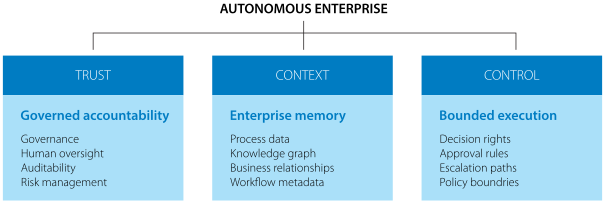
The resulting coordination bottlenecks often delay execution. The objective is to reduce these coordination bottlenecks by helping work move more efficiently across functions. Context, trust, and control are interdependent. Context allows agents to understand business processes, trust determines how much responsibility organizations are willing to delegate, and control establishes the guardrails needed for safe execution. Figure 1 illustrates how these three foundations reinforce one another to enable reliable agent-led execution across enterprise workflows.
Figure 1. Trust, Context, and Control framework for agent-led execution
Source: Infosys
Why context, trust, and control matter
While the vision of AI-powered agents is gaining momentum, making it work inside an enterprise is more difficult than deploying AI tools or automating individual activities. Most organizations are comfortable using AI to answer questions, generate insights, and assist employees with routine tasks. Giving AI a role in decisions and process execution introduces a much higher level of responsibility.
Enterprise processes are shaped by years of accumulated organizational experience. Many decisions depend on information distributed across systems, teams, policies, and operating practices. Enterprise data often exists across multiple applications, workflows, and documentation sources, making it difficult to connect the relationships, dependencies, and historical context that influence day-to-day decisions.
Consider a delayed supplier payment. Resolving the issue could require someone to review a purchase order in one system, check an invoice in another, investigate approval history, contact the supplier, and determine whether an exception should be granted. Much of this work depends on understanding how information, policies, and decisions connect across the organization. This is the type of coordination where organizations are evaluating the role AI agents can play.
Similar challenges appear across enterprise processes. A procurement approval decision could depend on supplier performance, contract terms, spending policies, historical exceptions, business priorities, and regulatory requirements. In finance, month-end close activities often involve reconciliation, policy interpretations, and cross-functional coordination. Much of this context sits outside structured transaction data and has traditionally relied on human judgment and experience.
This helps explain why many enterprises find that deploying AI is easier than scaling it. While the technology itself can be implemented relatively quickly, connecting agents to the business data, process definitions, policies, workflow history, and governance structures that shape enterprise operations, takes considerably longer.
This readiness gap is reflected in Infosys research, which found that only 2% of organizations consider themselves ready across the strategy, governance, talent, data, and technology dimensions required for enterprise AI adoption. These findings highlight how much organizational preparation is required before AI can move from assisting employees to participating in business execution.
These challenges become even more significant as organizations explore agent-led execution. AI agents are expected to coordinate activities, support decisions, and execute portions of business workflows, but doing so effectively requires visibility into process flows, decision rules, prior actions, dependencies, and organizational constraints.
These requirements become particularly important in environments where AI agents are expected to participate across finance, procurement, supply chain, and HR processes. AI agents can participate more actively in these processes when they have sufficient business context and operate within established controls.
Organizations must therefore decide which decisions remain human-led and which can be delegated to agents. A finance team may be comfortable allowing an agent to reconcile routine transactions, while requiring human approval for significant adjustments or policy exceptions. Implementation costs, governance requirements, and operational complexity will also influence the pace at which organizations expand AI into core business processes.
The need for these controls becomes more important as AI systems gain autonomy. Infosys research found that 95% of executives have experienced at least one problematic enterprise AI incident, while 72% of those experiencing damage rated it as moderately severe or worse. These findings highlight why trust, governance, and accountability remain critical as organizations expand the role of AI in business execution.
From AI assistance to autonomous execution
SAP's Autonomous Enterprise assumes that organizations will not move directly from AI assistants to fully autonomous operations. Progress is likely to occur gradually as enterprises determine where responsibility can be delegated to AI and where human oversight remains necessary.
The transition depends on more than technology. Organizations need clear rules defining which activities agents can perform independently, which require human approval, and how exceptions are escalated. As confidence grows, AI can take on a larger role in coordinating activities, executing routine actions, and supporting business outcomes.
Adoption of agent-led execution varies considerably across organizations and follows a familiar curve: innovators move first, fast followers adopt shortly after, and a larger group follows more gradually. Some early adopters are already embedding agents deep into operational workflows, while others continue to evaluate where and how AI can participate in execution. Organizations are at different points on the maturity curve, and the opportunities available to them depend on their current stage of adoption.
Stage 1: AI assists
AI provides recommendations, insights, and task support while humans make decisions and execute work.
Many organizations are already operating at this stage through copilots, assistants, and embedded AI capabilities across enterprise applications.
Stage 2: AI coordinates
AI gathers information, triggers workflows, routes decisions, monitors progress, and identifies next steps. Humans remain responsible for approvals and critical decisions.
For example, an agent might collect information from multiple systems, identify missing approvals, flag exceptions, and route work to the appropriate stakeholder without requiring manual coordination.
This stage depends on an agent's ability to connect information across systems, processes, and decisions so it can determine what action should happen next. SAP's approach relies on capabilities such as the SAP Knowledge Graph, process metadata, and contextual reasoning to provide that visibility across enterprise workflows.
For example, when an agent encounters a delayed supplier payment, the Knowledge Graph helps it connect the supplier, purchase order, invoice, and payment records. Then the process metadata shows where the transaction sits in the workflow and which approvals are pending, and contextual reasoning helps agents interpret relationships between business objects, process status, workflow history, approvals, and relevant business rules so they can determine the appropriate next step within the process. Because these capabilities are embedded within enterprise processes, agents can see how customers, suppliers, materials, orders, approvals, and financial records relate to one another. This allows them to understand where a transaction fits in the overall business process and what needs to happen next.
Stage 3: AI executes routine work

AI handles predefined activities within approved guardrails. Activities such as reconciliation, supplier follow-up, exception monitoring, scheduling, and workflow routing can increasingly be handled by agents, while humans focus on reviewing outcomes, managing exceptions, and enforcing policy.
This stage expands AI's role from supporting work to executing approved process activities within established controls.
SAP's Financial Closing Assistant illustrates how this model is intended to work. The closing assistant is designed to coordinate activities such as reconciliations, journal entries, accrual calculations, and exception resolution across the financial close process, allowing finance teams to focus more of their effort on review and oversight.
Similar patterns are already emerging in other operational domains. For example, Martur Fompak International, a manufacturer of automotive seating and interior systems, uses SAP Business AI to automate material replenishment across manufacturing operations, demonstrating how AI can participate in routine operational decisions while improving production efficiency and supply chain resilience.
At this stage, organizations are likely to measure success through process-specific outcomes such as cycle-time reduction, lower exception volumes, improved process adherence, greater operational efficiency, or faster responsiveness.
Stage 4: AI orchestrates outcomes
At this stage, AI coordinates work across multiple functions, systems, and business processes while humans focus on priorities, trade-offs, governance, and strategic direction.
A supply disruption, for example, could trigger inventory checks, supplier outreach, procurement actions, logistics adjustments, and finance reviews across multiple functions with limited manual coordination. Agents could also prioritize alternatives based on inventory levels, supplier commitments, and delivery requirements before escalating exceptions to human teams.
At the most advanced stage, enterprise systems can participate more actively in coordinating and executing work across functions, connecting decisions and actions across finance, procurement, supply chain, HR, and industry-specific operations.
This direction aligns with Infosys research, which identifies agentic AI as a key driver of enterprise transformation because it enables organizations to reshape business processes, operating models, and technical architectures around more autonomous ways of working.
At this stage, process owners will spend less time coordinating activities across teams and systems, and can devote more attention to managing exceptions, setting priorities, and making strategic trade-offs. Operational work increasingly shifts from manual coordination toward supervision and outcome management.
The pace of progress will depend on factors such as process maturity, governance readiness, data quality, and organizational willingness to delegate greater responsibility to AI. As a result, different functions and enterprises are likely to move through these stages at different speeds.
If this model succeeds, one of the most significant changes will be the redesign of work itself. Employees will spend less time coordinating activities across systems and more time managing exceptions, making decisions, and driving business outcomes. The extent of that shift will depend on how effectively organizations build trust in AI, define operating boundaries, and expand autonomy over time.
Where the vision runs into friction
None of this is without real challenges, and they're worth naming directly rather than folding into a single caveat.
Trust is earned slowly, and incidents set it back quickly. As noted above, a large majority of executives report having experienced a problematic AI incident. Every misstep an agent makes in a live process — a wrong exception granted, a payment misrouted — makes the next expansion of autonomy harder to justify internally, even when the underlying capability has genuinely improved.
Context is expensive to build and easy to overestimate. Out-of-the-box agent capabilities can show value quickly in a pilot, but the real work — and cost — sits in teaching an agent an organization's specific exceptions, informal rules, and historical judgment calls. Organizations that assume this is largely done once a pilot succeeds often stall when scaling to additional processes.
Governance frameworks are still catching up. Fewer than 2% of organizations meet the highest standards of responsible AI maturity in Infosys's research. Decisions about which actions an agent can take independently, and how exceptions escalate, often get worked out ad hoc rather than designed upfront — which becomes a liability as more processes are automated.
Accountability gets harder to trace as orchestration expands. As agents coordinate across more functions at Stage 4, determining who is accountable for an outcome — the agent's designer, the process owner, the approving human — becomes far less clear-cut than in a single-function pilot.
These challenges define the work organizations need to do to scale agent-led execution responsibly.
Prepare for AI-driven execution
Organizations exploring AI-driven execution should begin by identifying where agents can create measurable business value and what conditions are required to support adoption. Process selection, operating readiness, and governance will determine how quickly organizations can scale beyond initial pilots.
Start with high-value business processes
Begin with processes where coordination, approvals, repetitive decisions, and exception handling create significant friction. Financial close, procurement, sourcing, supply chain planning, and service operations often provide practical starting points because the operational bottlenecks are visible and measurable.
Organizations often begin with processes where outcomes can be measured clearly and governance requirements are well understood. This approach aligns with broader AI readiness considerations around strategy, governance, data, and technology.
Build organizational readiness before expanding autonomy
AI agents are only as effective as the processes, data, controls, and decision frameworks around them. Organizations should strengthen process standardization, governance, operating controls, and integration across systems before expanding the role of agents in execution.
Responsible AI capabilities should be built alongside agentic capabilities. Infosys research found that less than 2% of organizations meet the highest standards of responsible AI maturity, underscoring the importance of governance, oversight, and risk management as autonomy increases.
Readiness should be evaluated across dimensions such as process maturity, data quality, accountability structures, integration complexity, and the ability to monitor outcomes consistently.
Adopt autonomy progressively
Most organizations are unlikely to move directly to agent-led execution. The journey will typically evolve from AI assistance to coordination and then to execution within defined guardrails.
Clear ownership, accountability, approval structures, and exception-handling mechanisms should be established at every stage. Early successes can help establish confidence, governance practices, and operating models that support broader adoption.
Contextualize AI to the enterprise
Every organization has unique processes, controls, data structures, and industry requirements. Successful adoption will depend on adapting AI agents to the realities of how the business operates. Out-of-the-box capabilities can provide a starting point, but additional tailoring is often required to reflect enterprise-specific requirements.
Organizations that achieve the strongest outcomes will be those that align AI capabilities with their operating model, decision-making practices, governance requirements, and business objectives. Agents can only be effective when they understand how the organization actually operates, including its decision rules, exceptions, policies, and industry-specific requirements.
Conclusion
As AI becomes more capable of participating in business processes, organizations are increasingly evaluating how responsibility can be shared between people and intelligent agents.
Organizations are progressing through this journey at different speeds, reflecting varying levels of AI maturity, process readiness, and governance capability. While some are focused on AI-assisted productivity and decision support, others are already exploring how agents can coordinate activities and execute portions of business workflows.
The next challenge is determining where agents can safely coordinate activities, execute routine work, and operate within clearly defined business boundaries.
Advancing along this journey requires robust business context, governance mechanisms, and operating controls that enable agents to participate reliably in enterprise processes. Organizations that strengthen these foundations will be better positioned to expand autonomy over time and scale agent-led execution across a broader set of business processes.
Progress is likely to be gradual. Organizations that build trust, establish clear governance, and prepare their processes for increasing levels of human-agent collaboration will be better positioned to expand AI-driven execution. The decisions made today will determine how quickly and confidently they can move beyond AI assistance and into operational execution.


Regulatory change is accelerating and breach costs are rising, yet most institutions still rely on periodic, manual risk assurance. Three structural gaps, spanning visibility, third-party oversight, and governance, leave institutions unable to keep pace. Building risk assurance as a continuous, AI-augmented capability closes these gaps. A four-phase roadmap helps institutions get there.
- 11 Sep, 2026
- 15 min read

The difference between AI work and AI that works lies in the discipline to scale adoption, governance, and value realization
- 10 Sep, 2026

Learn how automated integrity checks and human oversight can help enterprises control AI agent sprawl, reduce duplication, and manage risk at scale.
- 08 Sep, 2026
