

Insights
- Because AI is probabilistic, it can drift, hallucinate, leak data, or rack up costs while looking fine on the surface, posing risks to organizations.
- AI observability closes that gap giving real-time visibility across models, agents, and prompts, and shifting teams from reactive to proactive.
- Building it will take organizations clear priorities, governance standards, the right tools, a dedicated team, and often outside expertise.
AI is moving past the experimentation stage and into large-scale deployment in most large enterprises. Infosys research suggests that 19% of AI use cases now meet all their business objectives. Generative AI tools, autonomous agents, large language models (LLMs), and intelligent automation have progressed beyond isolated pilots and are being woven directly into the systems that run the business. Customer service teams lean on AI copilots to resolve tickets faster developers use coding assistants to accelerate delivery and sales and operations teams rely on AI agents to summarize data, trigger workflows, and make decisions with minimal human oversight, in industries such as financial services, retail, insurance, and telecommunications, to name a few.
But this raises a question that many organizations have not yet answered: once an AI system is live and interacting with real customers, real employees, and real data, how does anyone know it is working the way it's supposed to.
Building AI observability into operations can give organizations some of the visibility needed to ensure AI systems continue to perform as intended after deployment.
Blind spots hiding in plain sight
Traditional software behaves predictably: given the same input, it produces the same output every time. But AI systems are probabilistic by nature: they change as the data feeding them changes, and they can generate different answers to the same question, depending on context, phrasing, or timing. That unpredictability is part of what makes AI powerful, but it also means an AI system can appear to be functioning normally on the surface while potentially drifting off course underneath.
As AI adoption scales across the enterprise, visibility does not automatically scale with it. Traditional monitoring software focuses on infrastructure metrics such as central processing unit utilization, memory consumption, network latency, and application availability. Most organizations can tell you whether a server is up or down, but far fewer can tell you whether their AI models are still giving accurate answers, whether an agent's decisions still fall within approved boundaries, or whether sensitive data is leaking out through a chatbot’s response.
This blind spot creates several categories of risk:
- Quality erosion: LLMs can produce answers that sound confident and coherent but are factually wrong. Left undetected, these errors can shape customer decisions or internal processes long before anyone notices something is off. For example, incorrect troubleshooting advice, leading customers to replace or return products unnecessarily, recommending the wrong product to customers based on inaccurate features or compatibility, or generating inaccurate summaries of contracts, customer complaints, or research, causing internal employees to miss critical details. In 2022, Air Canada's chatbot incorrectly told a passenger that he could book a full-fare ticket for his grandmother's funeral and claim a bereavement discount afterward, even though no such policy existed. The organization was sued by the passenger, and had to pay damages, after a ruling by a tribunal.
- Model drift: AI performance isn't fixed at deployment, and gradual degradations or shifts take place over time as user behavior changes, business processes are modified, source data evolves, or prompt configurations are adjusted. Without a way to track this over time, organizations typically don't notice a decline in accuracy until complaints start piling up, well after the damage is done.

- Compliance and regulatory exposure: Heavily regulated industries such as banking, healthcare, and telecommunications are expected to demonstrate model accountability, explainability, clean audit trails, traceable data lineage, and responsible AI compliance continuously and at any given point in time, rather than treat them as one-time compliance requirements at deployment. Without the underlying visibility to produce that evidence, compliance becomes a guessing game rather than a documented process.
- Security risks: As AI systems get plugged into enterprise applications, internal knowledge bases, application programming interfaces (APIs), and business applications, they open new pathways for prompt injection attacks, unintended data leakage, unauthorized access, and sensitive information exposure, all of which are difficult to catch without monitoring the interactions themselves.
- Escalating costs: Generative AI workloads often carry significant operational costs. Organizations may unknowingly incur excessive token consumption, redundant inference requests, inefficient prompt designs, or overutilized models. These can inflate spending, and without granular visibility into usage patterns, that AI spend is hard to explain or control.

Taken together, these risks point to a single underlying problem: organizations are running increasingly consequential AI systems without vital operational visibility. In fact, AI agent governance remains a major gap, with only 13% of organizations believing they have the right governance in place.
Most organizations can tell you whether a server is up or down, but far fewer can tell you whether their AI models are still giving accurate answers.
Visibility: The new competitive edge
The answer to this is AI observability, which gives organizations continuous, structured visibility into how their AI systems behave in production. The global AI observability market is set to grow from $1.4 billion in 2023 to $10.7 billion by 2033, reflecting a compound annual growth rate of 22.5%. Rapid digital transformation, exponential growth in data, and the need for real-time visibility are fueling this expansion.
Rather than treating monitoring as an infrastructure-only concern, AI observability extends it across the full AI life cycle: models, prompts, agents, data sources, and the humans interacting with all of it.
Implementing AI observability practices has several benefits:
Model performance monitoring: It continuously tracks AI model accuracy, latency, response quality, reliability, and availability to detect issues before they affect the business. Real-estate management software provider AppFolio used AI observability capabilities to monitor the performance, quality, latency, and token usage of its LLM-powered applications. Real-time dashboards and alerts helped the company identify changes in application behavior early, enabling it to improve reliability and support responsible AI practices as it scaled its generative AI solution.
Risk and governance controls: It continuously monitors hallucinations, toxic content, sensitive data exposure, policy violations, and responsible AI compliance to identify and mitigate risks proactively.
Agent and workflow visibility: It provides visibility into agent decision paths, tool execution, autonomous actions, workflow bottlenecks, and business impacts to enable governed AI at scale. It tracks whether responses remain accurate, whether performance is holding steady or slipping, and whether agents are behaving within their intended guardrails. As PepsiCo scaled generative AI and computer vision — an AI discipline that enables machines to extract, process, and interpret information from images, videos, and other visual inputs — across its digital operations, it implemented an observability platform to monitor model performance, evaluate outputs, and strengthen governance. The platform provides end-to-end visibility into production AI systems, helping the company deploy AI at scale with greater confidence. Booking.com has also incorporated AI observability to get continuous visibility into production performance.
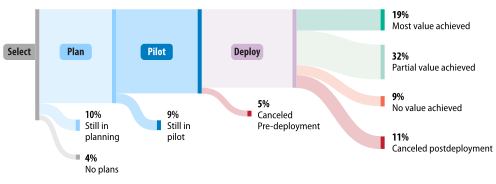
Business outcome measurement: Infosys AI Business Value research shows that 19% of AI initiatives are achieving most, or all, of their objectives (Figure 1). Observability can help track whether AI investments and performance are translating into measurable business key performance indicators, such as customer satisfaction, contact center efficiency, developer productivity, revenue growth, and cost reduction, to demonstrate business value so organizations can act on it.
Figure 1. Not all organizations achieve business value from AI deployments
Source: Infosys Knowledge Institute
As mentioned in the Infosys publication The Live Enterprise, observability in general is a foundational organizational capability. Only by gaining continuous visibility into its own operations can an organization respond to events in real time and, ultimately, automate decisions with confidence.
AI observability gives technology, business, security, and compliance teams a shared, real-time picture of what's happening. This changes an organization's posture from reactive to proactive. Instead of learning about a problem from an angry customer, a failed audit, or a security incident, teams can catch quality degradation, or policy violations while there's still time to act. Observability is also playing an increasingly important role in managing AI costs.
Observability reports on what has gone wrong, but paired with the right governance, it also becomes the foundation for continuously tuning models, refining prompts, managing risk, and informing decisions at the executive level. Hence, leading organizations are moving beyond traditional monitoring and simple AI monitoring, and are creating AI operations (AIOps), where observability becomes a foundation for governance, optimization, and continuous improvement. In fact, 67% of IT decision-makers are likely to move to observability platforms in the next couple of years.
AI observability gives technology, business, security, and compliance teams a shared, real-time picture of what's happening, changing its posture from reactive to proactive.
How to build AI observability
Observability is built through a combination of right priorities, standards, tools, and people. Organizations must make a series of deliberate, consistent moves to get this right.
Start with the workloads that matter most: Instead of trying to instrument everything at once, organizations must prioritize high-impact AI applications such as customer-facing assistants, software engineering copilots, enterprise knowledge assistants, and agents supporting core operational processes. These are the deployments where a lapse in quality or agent governance would be most costly, and where the payoff from observability shows up fastest.
Put governance standards in writing before scaling further: Enterprises need to create agreed-upon definitions of acceptable AI quality, risk tolerance, compliance obligations, and audit requirements. Without these standards articulated up front, monitoring data has nothing meaningful to be measured against, and different teams end up applying inconsistent bars for what counts as "working correctly."
Deploy platforms built to watch the whole AI stack: Effective observability tooling needs to reach beyond model metrics to cover agents, retrieval systems, prompts, and user interactions, and it needs to plug into the security and monitoring infrastructure the organization already relies on. This is what turns raw activity logs into an early-warning system for hallucinations, drift, unsafe prompts, and unnecessary cost.
Build a team that owns AI operations, beyond AI development. Bringing together AI engineers, platform teams, security specialists, risk leaders, and business stakeholders into a standing operations function ensures that what observability surfaces is addressed, whether that means retraining a model, adjusting a prompt, or escalating a compliance concern.

Lean on outside expertise where it accelerates progress: Few organizations have deep, in-house experience across AI engineering, responsible AI frameworks, cloud integration, and operational governance all at once. Partnering with experienced technology and service providers can accelerate the process of building a mature observability capability while reducing the risk of costly missteps along the way.
Infosys deployed a generative AI evaluation and observability platform for a global telecommunications provider, enabling continuous evaluation of approximately 35,000 production interactions per day across AI-generated summaries, knowledge search, and proactive notifications. The platform provides actionable insights into quality, latency, cost, and performance trends while supporting large-scale expansion without requiring changes to the underlying evaluation pipeline. Combined with proven frameworks, governance models, and industry accelerators, such partnerships can shorten the path to production-ready AI operations.
Observability offers organizations the ability to see and continuously understand what their AI systems are doing. As AI becomes further embedded in the processes that run the business, that visibility stops being a technical nice-to-have and becomes the foundation on which trust, compliance, and business value are built.


Regulatory change is accelerating and breach costs are rising, yet most institutions still rely on periodic, manual risk assurance. Three structural gaps, spanning visibility, third-party oversight, and governance, leave institutions unable to keep pace. Building risk assurance as a continuous, AI-augmented capability closes these gaps. A four-phase roadmap helps institutions get there.
- 11 Sep, 2026
- 15 min read

The difference between AI work and AI that works lies in the discipline to scale adoption, governance, and value realization
- 10 Sep, 2026

Learn how automated integrity checks and human oversight can help enterprises control AI agent sprawl, reduce duplication, and manage risk at scale.
- 08 Sep, 2026
