
Insights
- Traditional efforts to optimize marketing processes and boost productivity, often relying on off-the-shelf automation tools, are falling short in the race for speed and scale.
- Agentic AI enables marketing teams to do more with less, transforming productivity and effectiveness amid shrinking budgets and rising complexity.
- Early adopters report agentic AI can halve campaign setup costs and double output without increasing team size, delivering speed with consistency and brand safety.
- Agentic AI’s primary benefit lies in the ability to identify and actively solve workflow bottlenecks, not just execute pre-defined tasks. This elevates AI from assistant to collaborator capable of adjusting strategy dynamically based on real-time data and experimentation.
- As agentic AI automates routine tasks, marketing talent is reallocated to strategic work, requiring new skills, metrics, and cross-functional collaboration.
- Marketing organizations often face setbacks due to lost knowledge and the effort required to duplicate work. By contrast, agentic AI can be trained on past campaign briefs, documents, brand rules, and approval pathways, and so become the brain in the marketing OS.
Marketing teams rarely get a break. They are constantly mastering new communications channels, or adapting to emerging technologies, or deciphering shifting customer needs — or all of the above, all at once.
This current era of marketing combines each of these traditional challenges with new ones: hypercompetition, content overload, and more demanding customer expectations. Marketers must now deliver increasingly personalized, multichannel content faster and without a corresponding increase in resources. Time to market is shrinking while budgets are tightening. Gartner research found that average marketing budgets dropped from 9.5% of revenue in 2022 to 7.7% in 2024 and 2025. This decline is part of a post-pandemic trend: Marketing teams are expected to achieve more with less funding, leading them to rely on AI to make the most of static budgets.
Simultaneously, marketing leaders report they have increasing influence throughout the enterprise, and as a result, face intensifying pressure from the CEO, CFO, and board to deliver growth, according to The CMO Survey. Every marketing dollar demands immediate, measurable return on investment (ROI).
Marketers have relied on digital automation tools to balance competing demands for at least a quarter of a century. Traditional efforts to optimize marketing processes and boost productivity, often relying on off-the-shelf automation tools, are falling short in the race for speed and scale.
Fragmented data and technology and siloed teams hamper agility. Linear, campaign-centric models are too slow and too expensive. And static content can’t keep up with dynamic customer behavior and divided attention spans. With the collision of lower budgets, fewer resources, and exponentially higher complexity, traditional marketing methods are collapsing under their own weight. Teams spend more time, money, and effort to achieve less impact.
Fortunately for marketers, solutions are now available to meet the demands for faster content delivery and deeper personalization. Agentic artificial intelligence (AI) offers a way forward through the strategic use of autonomous systems and human-AI collaboration to overcome marketing workflow barriers.
Marketers, brand managers, and marketing operations teams are identifying real-world challenges they can target with autonomous marketing execution loops that are only possible with agentic AI. When applied strategically, this model accelerates marketing execution and reshapes the economics of marketing effectiveness, creativity, and customer outcomes.
How marketers use agentic AI now
Marketers traditionally relied on AI for rules-based automation and predictive analytics, and more recently, generative AI revolutionized content creation. Now, agentic AI opens a new frontier. It can understand, adapt, and respond intelligently in real time — driving tasks, rather than only supporting them.
Much like traditional and generative AI, which are already embedded in many marketing workflows, agentic AI’s initial impact is improved efficiency. Marketing teams typically spend countless hours on low-value manual tasks that slow their progress. Agentic AI can take on many of those responsibilities, operating autonomously and continuously (Figure 1).
Figure 1. Agentic AI’s automation benefits in marketing

Source: Infosys
Marketers can now use agentic AI to transform these routine tasks into automated loops that execute continuously, freeing marketers to focus on strategic brand thinking, creative direction, and customer insights. In our work with marketing clients, early adopters report that agentic AI cuts time-to-market and campaign setup costs by half, and doubles the output of teams without increasing their size. Crucially, this is not just about speed to market; it is speed with consistency, traceability, and integrated brand safety.
AI: From assistant to collaborator
AI’s efficiency benefits are generally the easiest to achieve and measure, which tends to steer companies toward specific use cases. The Infosys AI Business Value Radar report found that the marketing function trails only IT-related areas in the popularity and viability of AI use cases.
In our research partnership with the Association of National Advertisers, Infosys found that creative development and content production generated the greatest impact from AI in marketing. Nearly three-quarters of marketing leaders identified that use as a top area for value creation. Additionally, CMOs reported last year that their AI initiatives would primarily boost productivity, reduce costs, increase efficiency, and speed up time to market, according to the Infosys CMO Radar report.
While valuable, these productivity benefits are also the easiest for competitors to replicate. Efficiency can quickly become a commodity, making the competitive advantages it offers short-lived.
This is where agentic AI offers a fundamentally new approach. It is not a single silver bullet, but a reframing of what is needed — and what is possible. Agentic AI’s primary benefit lies in the ability to identify and actively solve workflow bottlenecks, not just execute pre-defined tasks. Unlike traditional AI tools that respond only to prompts, agentic AI can analyze entire marketing funnels and operating processes, detect inefficiencies, propose alternative routes, and orchestrate cross-channel activities with minimal human input. This elevates AI from assistant to collaborator capable of adjusting strategy dynamically based on real-time data and experimentation.
The real step change happens when marketers embrace co-creation with AI agents. In classic marketing workflows, ideation is a linear, resource-intensive process: A team brainstorms, circulates drafts, and feedback rounds multiply.
Agentic AI reshapes this process into a system of parallel creativity. Copy agents can generate 50 headline variants instantly. Creative and visual agents mock up layouts that consistently follow brand guidelines. Strategy agents test messaging options based on historical performance data. Human teams no longer start with blank pages.
Marketing is entering a new phase — one defined by evaluation, refinement, and strategic direction. Creativity now compounds through creative abundance, giving rise to an exponential, culturally diverse set of ideas that inspire and build upon one another. This leads to an environment rich with imagination and possibilities.
The talent impact of agentic AI
As agentic AI offers solutions, it also creates significant new challenges. One of the most important is how to reallocate existing talent. AI helps marketers work faster and at greater scale, particularly in content creation and personalization, according to ANA members we interviewed. But it replaces tasks, not people. By automating work such as reviewing creative content, checking brand accuracy, or validating logos, AI frees time and talent for higher-value responsibilities.
This realignment creates white space that must be filled with more strategic work. Many teams now train their members to contribute to brand strategy, strengthen ties with product and sales, improve campaigns, and offer advisory support that builds stronger brand advocacy.
These changes require CMOs and other marketing leaders to think differently about their overall talent acquisition, including how roles are structured and measured. Some traditional job descriptions built around fixed tasks will fade as AI assumes a greater role. Teams will instead emphasize outcomes, cross-functional collaboration, and the ability to adapt quickly as agentic systems evolve.
The same thinking applies to reskilling and upskilling existing teams to ensure they can meet marketing’s new demands. CMOs have told us that data literacy and responsible AI basics are necessary, but they also look for creative judgment and curiosity.
This shift also requires new performance metrics that reward strategic thinking, experimentation, and the ability to guide AI systems effectively rather than simply producing large volumes of work.
In addition, agentic AI is changing how marketing teams work with external partners. Agencies, consultancies, and vendors will continue to play an important role, but the mix of skills and services they provide is changing. CMOs will seek partners to bring deeper expertise in AI governance, orchestration, and integration alongside creativity and industry insight. As more routine production work is automated, the most valuable partners will act as AI strategy accelerators by solving real business problems and moving beyond AI experimentation — helping companies navigate complex AI ecosystems, pressure test ideas, and scale proven solutions.
How agentic AI is changing marketing
Agentic AI collaboration is opening the door to entirely new marketing operating models that improve speed, generate new ideas, and commercialize them with scale, and precision. This structural realignment allows marketing leaders to strengthen two critical areas:
- Brand building attracts customers through trust. It is a long-term investment in the future, driving deep emotional connections and creating intent that establishes customer preference and frequency.
- Product marketing converts existing intent and drives transactions. It is functional and short term.
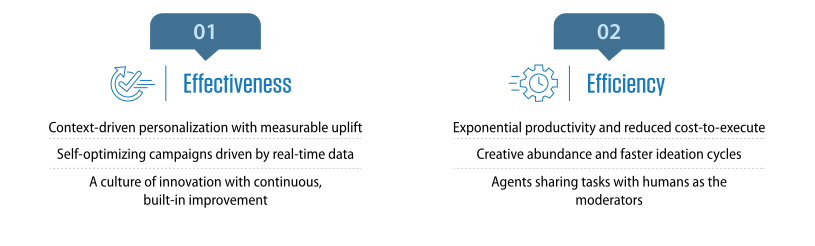
Balancing these two demands requires fundamental reengineering of the marketing supply chain. Marketers must shift from slow, expensive, human-only workflows to an industrialized model that uses AI to deliver context and produces the right asset, for the right audience, at the right time, in the right channel. At that point of delivery, intent and decision come together to trigger action. This approach improves both efficiency and effectiveness (Figure 2).
Figure 2. Benefits of agentic AI co-creation
Source: Infosys
To operate effectively in this environment, companies need an operating model that aligns the CMO and CIO, ensuring clear governance frameworks, strong data discipline, human-in-the-loop accountability, and a mindset shift from control to collaboration and orchestration. Their partnership will determine whether the organization can compete as intelligence and agentic AI move into core marketing and product functions.
Solving marketing workflow problems through agentic AI co-creation delivers the following core outcomes.
Scalable personalization
When agentic AI is fully integrated into workflows, marketers can finally deliver deeper personalization at operational scale. Historically, personalization and content generation have been throttled by production limitations. Content writers can manually write only so many variations of a landing page or email journey. Now, AI agents trained on customer segments, behavioral data, and tone-of-voice rules can generate endless microvariants. Each version is tuned to intent, tailored to customer lifecycle stages, and shaped by cultural nuances.
This ensures that every marketing message delivers with strategic precision, turning mass marketing into millions of tailored experiences. This impact on marketing effectiveness is clear: higher engagement, lower acquisition costs, deeper brand affinity, and increased customer loyalty and lifetime value. With this level of individualized engagement, agentic AI elevates personalization from promise to standard practice.
Self-optimized performance
Marketing’s new agentic AI operating model excels at closing the loop between insight and execution. Today’s marketing analytics often live in dashboards that are disconnected from the broader context of relevance and business growth. AI agents fill this gap by continuously monitoring marketing performance across all channels, detecting signal shifts, and autonomously proposing and implementing adjustments.
Infosys is currently co-developing a self-optimizing marketing engine, or what is essentially an agentic marketing operating system (OS). In this model, campaigns don’t simply launch and expire; they evolve, continuously improving in precision and relevance. Marketing spending can then migrate instantly to top-performing audiences. Underperforming assets rewrite themselves and generate recommendations, allowing marketers to respond in real time. The results are compounding ROI and reduced waste.
Governance and institutional memory
An often underestimated advantage of an AI-led marketing workflow design is improved governance and uniform brand and engagement recall. Today, much of the marketing process knowledge lives in siloed channels and with various internal and external teams. Even worse, sometimes critical information is held by a single person.
This reduces efficiency, especially when employees leave. Marketing organizations often face setbacks due to lost knowledge and the effort required to duplicate work. By contrast, agentic AI can be trained on past campaign briefs, documents, brand rules, and approval pathways, and so become the brain in the marketing OS. It ensures brand compliance by default, flags deviations, and institutionalizes best practices globally. As a result, onboarding is faster; brand trust and quality are more consistent; and human error is significantly reduced.
Cultural shift
In addition to the immediate operational benefits, agentic AI co-creation also drives long-term cultural transformation. Marketing can shift reactive production to perpetual innovation. Experimentation becomes effortless as the cost of testing is reduced. Marketing teams then gain confidence to explore messaging white space, new audiences, and untested channels. AI agents can orchestrate and evaluate performance quickly — making bold ideas easier to test and scale.
This is where we see the biggest human potential: Decision-making becomes more evidence-led and less subjective. Hierarchies begin to flatten as AI empowers junior talent to contribute high-quality strategic work. In short, agentic AI raises both the floor and the ceiling of marketing and its organizational agility and capabilities.
How the enterprise wins with AI
AI has already proved valuable across most marketing activities. However, the marketing benefits extend well beyond the marketing organization. From a leadership perspective, the strategic impact of agentic AI is broad and deep.
- CMOs gain real visibility into resource allocation, cost per output, and forecastable campaign velocity.
- Finance teams receive quantifiable proof of efficiency and marketing effectiveness through clearer ROI attribution.
- Sales teams benefit from integrated collaboration and tighter alignment, as agentic AI systems bridge the gap between marketing narratives and commercial propositions.
- CIOs also benefit as enterprise-grade AI is deployed within a responsible AI governed framework, rather than through shadow usage.
CMOs are aware that agentic AI promises enormous benefits, potentially making AI the transformative technology they expected. That outcome is still just a hope for most. Gartner research found that AI agents are not yet “delivering the promised business performance.” The failures are not purely technology; Overall organizational readiness is a critical factor.
However, there are concrete steps — although not always easy ones — that marketing leaders can take to capitalize on agentic AI’s capabilities.
Shift from AI-led efficiency to agent plus human co-creation. While agentic AI excels at streamlining workflows and reducing manual effort, its true transformative power emerges when humans and AI agents balance the workload for greater productivity. This approach allows each group to do what it does best. AI agents generate diverse ideas, test strategies, and adapt in real time. Marketers provide strategic direction, creative judgment, and cultural context. This partnership makes marketing fundamentally better, not just faster.
Make AI a true strategic collaborator. AI needs to evolve from a back-office tool to a strategic partner that informs high-level decisions and drives innovation. By embedding AI into planning and resource allocation, organizations can anticipate market shifts and act with agility. This approach allows AI to not just save costs but act as a catalyst for growth and competitive advantage.
Use agentic AI to standardize governance processes and knowledge retention. Agentic AI can automate governance workflows and enforce compliance consistently across the organization, reducing human error and ambiguity. By capturing and structuring institutional knowledge, it ensures critical insights are retained and easily accessible for future decision-making. This creates a scalable, transparent framework that strengthens accountability and increases operational efficiency.
Adopt agentic AI to automate marketing microtasks and free up strategic capacity. Agentic AI can handle repetitive marketing work — such as content tagging, campaign scheduling, and performance tracking — at scale. This reduces manual effort and errors, and frees up marketing teams’ bandwidth to focus on strategic initiatives like customer experience and brand positioning. This shift accelerates execution while unlocking creativity and long-term growth potential.
Define new golden metrics. CMOs need measurements that resonate across the C-suite to connect marketing workflows with organizational priorities. These metrics should translate marketing outcomes into meaningful business impact, such as revenue growth, customer lifetime value, and innovation velocity. By aligning marketing performance with strategic objectives, organizations can foster cross-functional collaboration and drive sustainable growth.
Even the most advanced organizations will find the changes required by agentic AI to be daunting. Companies need to transform their operating models, data structures, and training strategies to increase their chances of AI success, according to Infosys research. This new foundation must consider the need for increasing volumes of high-quality data, responsible AI practices, and a continuous fine-tuning of algorithms and processes.
CMOs will do well to remember that the fundamentals of marketing remain the same. It’s just the ways marketers unearth insights and the speed at which they find and commercialize new ideas have changed. AI allows marketing leaders to establish new advantages today.
As organizations embrace this shift, they move from doing marketing faster to doing marketing fundamentally better. The result is more meaningful customer experiences, more resilient operating models, and more scalable brand trust and impact. And in a world where marketing noise is at an all-time high, the future will belong to those who solve smarter — not just shout louder.


Retailers must embrace an AI-first, real-time, unified experience architecture that integrates customer insights, inventory, and omnichannel operations.
- 22 Jan, 2026
- 6 min read

Advanced data, AI, and integrated technologies can empower retailers to proactively detect, predict, and prevent shrink.
- 22 Jan, 2026
- 6 min read

Composable commerce empowers businesses to design loyalty programs that fuel both customer love and the bottom line.
- 12 Dec, 2025
- 11 min read
