
Postcards from the future
Postcards from the future of cloud is a series of articles imagining the state of enterprise technology infrastructure in five years. We describe the future based on tools and frameworks in development today, recognize pitfalls to avoid, and identify tasks to take on now to build the infrastructure for the future. These postcards aim to guide companies in a world where technology and business requirements shift quickly.
Insights
- The purpose of a data center has changed, but its configuration has not kept pace.
- Software and hardware changes have opened up new configurations.
- The power demands of AI data centers will require creative solutions.
- The data center of tomorrow will be dynamic, composable, and unbound by conventional limitations.
What a data center is for has changed. How a data center is composed will soon follow suit.
For two very aligned concepts, the first has shifted much more rapidly than the latter. We believe that will soon change. Enterprise adoption of artificial intelligence (AI) has stoked demand for data center capacity. But more than increased demand for compute, the differentiated nature of that demand will prompt fundamental shifts in the composition and nature of the modern data center. Data centers built for housing mainframes and backing up data files now host applications, support integration across compute environments, and scale dynamically with shifts in demand. That means fundamental changes for data centers.
Data centers will evolve away from large, uniform remote facilities requiring a lot of manual intervention when upgrades or structural changes occur. Rather, the data center of tomorrow will be autonomous and intelligent, aware of its locale and power footprint. It will be dynamic, composable, and unbound by traditional constraints.
Catalysts for change
This change is driven by two arrays of intrinsic and extrinsic factors.
Internal tech drivers come in both the software and the hardware realm. In software terms, advances in AI, improved foundational models and autonomous agents have enabled new capabilities. The result is new ways of managing and thinking about infrastructure and architecture on an end-to-end basis. On the hardware side, advanced graphics processing units (GPUs), composable infrastructure, new materials, liquid immersion cooling, and other coming advances such as neuromorphic chips that mimic human brain function are altering what is physically feasible in electronics and semiconductors.
Outside the technology domain, political shifts, advanced regulation, power and environmental concerns collectively demand different things from data centers. Nation-to-nation regulations on data, financial controls, and AI will require the data center of tomorrow to account for geopolitical data governance and evolving digital sovereignty requirements. New awareness on the location of data centers has also opened discussion on latency, particularly in the context of high-performance applications. The business and political case for having cloud close at hand is getting a new look.
Future AI-focused data centers will pack greater computing power, which leads to increased electricity demands. Leading tech companies Google, Meta, Microsoft, Nvidia, and Oracle are collaborating with the Electric Power Research Institute to experiment with ways to make their power-hungry data centers more flexible and attuned to local power grid demands. AI data centers often feature liquid immersion cooling, which makes them thirsty as well as hungry. Already, newly sited data centers are having impacts on power grids and water tables, which underscores the case for enhanced sustainability in new data center construction.
Resilience goes hand-in-hand with sustainability. And as data centers handle more critical tasks, uptime and quick recovery take on greater importance. While data centers frequently rely on diesel-powered backup generators, modular microgrids offer a longer-term way to bolster reliability and resilience.
Three domains of change
Taken as a whole, these catalysts will lead to many changes. But these changes can be broadly grouped into three domains. The data center of tomorrow is:
- Intelligent and autonomous
- Aware of its location and power consumption contexts, and
- Highly dynamic, composable, and unbounded by traditional constraints.
Intelligent and autonomous
Today’s data centers passively collect petabytes of information on climate, power consumption, compute performance, network activity, physical access, uptime and more.
The data center of the future will act autonomously. Traditionally, this action has most often involved automated processes built to resolve a discrete anomaly. In the future data center, automation, machine learning, and AI will go a step further, from self-correcting to self-healing. Self-healing involves an array of intelligent systems, integrated operations and proactive steps to heal and repair data and network operations ahead of malfunctions and outages. Much of this automatic, correction, repair, and self-healing rely on the discipline of AIOps. In this context, AI reroutes workloads, predicts failures, and dispatches bots for physical repairs.
In addition to sensors, information, and smart autonomy, the data center of the future will come with a digital twin where new ideas, alternate solutions and maintenance projections can be tested. Imagine that an AI agent operating in the data center of a financial institution detects a looming failure in its uninterrupted power system. Armed with that information, the bank reroutes transactions, initiates an automated fix, and avoids monetary losses and a system outage.
In the future, outages will be reduced further. Even in the present, autonomous, intelligent data centers are delivering uptime, power usage efficiency, and performance improvements.
Aware of location
Early data centers were established near the intersection of cheap land and redundant power. The data center of the future will be sited based on a more intricate set of criteria.
The proliferation of sensors, advanced networking, micro data centers, automation, and AI will lead to embedded and invisible data centers driven by performance, latency and control concerns. Advances in edge computing and micro-scale data centers will allow urban real estate to be renewed into compute infrastructure with invisible data centers built into walls, elevators and street furniture. For high-performance uses, data centers will be embedded in businesses that need low latency to achieve their strategy.
For instance, an automaker creating the next generation of personal mobility solutions will be able to embed micro data centers along its assembly line to monitor and automate more and more of the assembly process. This enables instant visual inspection from remote sites and allows better coordination across robotics arrays.
Modular and micro data centers have advantages at the edge, in terms of local control, reduced latency, and avoiding network congestion.
But operating a data center at the edge comes with some different requirements. Conventional size, power, cooling and networking requirements of data center hardware have to be rethought in the context of durability and impact on surroundings and neighbors. And software standards for edge and distributed computing have to be developed. The data center of the future will adhere to additional standards such as those in development at the Kinetic Edge Alliance.
Location-aware and very-nearby data centers will enhance and support high-performance computing apps and be central for advanced AI applications. Direct access copper, a high-speed, short-distance network cable commonly used in data center racks at present, will be used to connect strategically located data centers across short distances. While location and speed may be the original motivators, direct access copper in the data center of the future delivers the added benefit of comparatively low power demands.
Performance and adjacency will not be the only location considerations in future data centers. As nations each adopt their own regulations for data and AI, the data centers of the future will be aware of their locale’s rules. Sovereign compliance will be a requirement that lands at the data center and will allow better governance of federated data and AI solutions that comply with a particular location’s laws. As sovereign AI grows more robust and relevant, companies such as Germany’s Aleph Alpha and the Emirati-backed G42 will play a large role in strategically located regional data centers of the future.
This has value for all enterprises. Public service entities will enjoy the benefit of cloud-native capabilities while complying with governmental standards of data privacy and stewardship. And it will have keen value for healthcare organizations, which must manage rigorous data and compliance standards that vary region to region. For example, an AI model in Paris has been trained in French using localized clinical data that meets that nation’s compliance standards.
Power and responsibility
The role of power in data centers has been top-of-mind for decades. The standard metric of power usage effectiveness (PUE) that gauges power efficiency in data centers has been in place for nearly 20 years. But as AI drives greater demand for high-powered data centers, the question of power (and water) consumption grows more critical.
The biggest opportunity for greater power efficiency in today’s data centers comes in the cooling question. A number of companies have launched collaborations to use liquids, local environments and natural water to cool processors.
For example, Norway’s Lefdal Mine Datacenter was built in a six-story former mine that uses cool local weather conditions and cold fjord water to reduce its cooling costs. Planners and scientists are experimenting with beneficial uses for data center heat by using it to culture algae at the data center site. And Microsoft has experimented with undersea data centers that rely on automation and robotics to manage systems, and found them more reliable and sustainable than conventional data centers.
As data centers consume more of the world’s electricity, it is essential to hold their operators accountable. The data center of the future will come with built-in environmental, social, and governance accountability dashboards, and automations to reduce its carbon footprint. For example, the power-aware and environmentally conscious data center will be able to dynamically migrate workloads to data centers powered by renewable energy that have surplus capacity. In this way, the future data center reports and optimizes its power consumption.
Companies such as Colorado’s Crusoe Energy and Verne Global, which operates in Iceland, Finland, and the United Kingdom, already are combining sustainability and data centers.
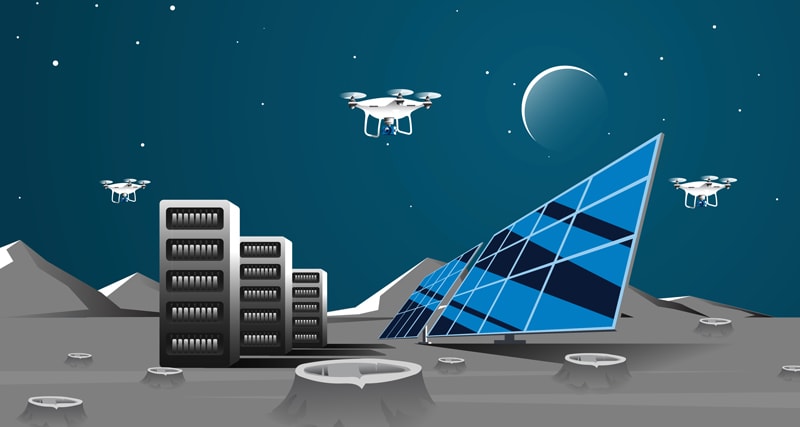
Looking beyond cold places on earth, a Florida company has begun working toward putting a data center on the moon. In March 2025, Lonestar Data Holdings tested and operated a data center unit in lunar orbit. With renewed interest in moon and Mars expeditions, space agencies will be looking for ways to access modern compute capabilities in orbit and on distant planets.
Dynamic, composable, and unbound
Finally, the data center of tomorrow will be dynamic, composable, and unbound by conventional limitations. These are orders beyond the current performance standards of uptime, petaflops, and resilience.
A dynamic data center is capable of more than simply scale up/scale down dynamism. It can reallocate resources to meet changes in demand, network traffic, or energy usage. Further, with AI, automation, and robotic intervention, the data center of the future will be composable, with modular units that can be specified to meet changes in demand and work around failures or outages.
More powerful hardware that can be configured quickly is now possible through open-standard, high-speed interconnects such as Compute Express Link, which enables fast, high-capacity connections across devices. This allows for faster inputs, outputs, and computation, and enables shared access to data in memory across devices. Such a system can accelerate AI and high-performance computing by giving AI systems and GPUs access to information held in central processing units (CPUs) without the need to extract or transfer data to a place where AI tools can be applied.
But this sort of flexible, autonomous data center requires sophisticated, cloud-native architecture, and a minimizing of legacy systems. What’s more, this approach requires a mindset shift away from operations, maintenance and uptime. Instead, data center operations should first focus on product, solution or business value, and what data center composition will help deliver this.
Some enterprises have already begun proving this arrangement. IT teams from a major streaming provider used APIs to request workloads from a self-assembling infrastructure. The task: render three-dimensional video content overnight for use the next day. The streaming company assembled GPU clusters in six different geographies to deliver the 3D video. Once the video shipped, the six-region GPU cluster dissolved.
The same sort of assemble-and-dissolve cluster will be valuable in the AI data center of the future as enterprises unlock the value of industry-specific AI models. Enterprises will be able to rent platform time in an AI foundry slot to fine-tune proprietary AI models and large language models that briefly require exascale levels of computing.
For example, a biotech company looking to simulate protein folding for a new drug was able to reserve 10,000 GPU hours in an AI factory for its work. As part of the deal, the drug developer kept full control of its data and did not lose or share any data.
Quantum leaps
The data center of tomorrow will be the place where enterprises experiment with quantum computing. They will be able to test this mind-bending step-change in digital systems without investing in hardware.
Global transportation and logistics companies are running pilot programs with quantum computing service nodes to optimize delivery routes on a continental scale. Although it is early days, the prospects of efficiency, time savings, and fuel consumption reduction are compelling.
The unbound data center
The present-day data center looks a lot like the one that was first built as an upgrade to the on-premises server closet. The average data center features standardized racks of CPUs and GPUs. It is gauged on capacity, uptime, price, and connectivity.
The data center of tomorrow is a flexible, reconfigurable virtual system that operators or autonomous agents can quickly integrate with different, previously unconnectable systems. It spins up for a specific business purpose and can automatically account for power considerations and local requirements. Most of all, the combination of new hardware, software innovation and new thinking will create a future data center unbound by conventional limitations, standards, and thinking.


AI has moved from pilots to scale. But for telcos, legacy enterprise models are now the real bottleneck to value. Telcos must redesign how they operate, make decisions, and govern value.
- 27 Mar, 2026
- 5 min read

Incremental AI limits progress. The Frontier Telco model introduces an enterprise framework that rearchitects telcos for intent-driven, AI-native autonomy at scale.
- 23 Feb, 2026
- 4 min read

Enterprises are battling artificial intelligence (AI) disillusionment and employee burnout, with many digital transformation projects failing to reach production. The solution? A multiagent AI system that predicts failure weeks in advance and recommends proactive interventions to keep projects in green.
- 18 Dec, 2025
- 7 min read
