
Insights
- Over a third of projects fail to meet their objectives.
- Predicting failure is challenging because organizations rely on difficult-to-synthesize information, have limited pattern recognition across projects, and lack shared intelligence between teams and industries.
- An agentic AI solution provides predictive intelligence by integrating data, thinking ahead, and taking actions when projects are moving in the wrong direction.
- The agentic AI tool set out here has been used by multiple clients and is able to forecast problems six to eight weeks before they happen, with 90% accuracy.
- Organizations managing projects with agentic AI should prove ROI with mission-critical projects first, while running traditional project management tools in parallel for the first 90 days.
Just over a third of digital transformations fail to meet their objectives, according to research. And given that each project costs on average $11 million, it would be wise to understand what goes wrong and how to fix it.
Most projects fail due to technical, resource planning, and compliance challenges, according to Infosys experts. Some projects never get past the scoping phase, and some are pulled in production. Team conflict and strategic ineptitude also play a part, while organizations use outdated strategies and poor benchmarking techniques throughout a project.
There are tools that can help: Asana enables task tracking and team collaboration; Jira manages agile sprints, backlogs, and issues; and Monday.com offers dashboards with automation and integration to improve project oversight, visibility, coordination, accountability, and productivity. These tools help teams plan and execute their tasks. However, such tools are more reactive than predictive. The most critical project failure patterns are ones that aren’t caught early, especially where problems in one domain, such as culture issues, could trigger failures across other domains, such as integrations, or budget drift.
Take a case where a team working on an AI medical device has to deal with relatively sudden changes in the regulatory environment. For instance, in 2024, the food and drug administration (FDA) in the US issued high urgency guidance on how much algorithms could change in both production and post-market product rollout. For many teams, this meant re-architecting machine learning operations (MLOps) and documentation pipelines to match the FDA expectations, with many organizations retrofitting change-control logic and validation reporting within weeks.
In this scenario, the FDA may offer new guidance on a Monday, causing a regulatory trigger that forces the compliance team to push software developers into new workarounds on the product, with deliverables needed by Wednesday of the next week. This stress means that the team works weekend overtime, leading to integration errors when the software is deployed. This is not hypothetical — many integration errors occur under time pressure as tight deadlines mean teams are more likely to delay merging their code and skip adequate testing, as in this example from one developer’s early experience in managing large software projects. In our example, this technical failure is only caught the following Monday, and budget overruns create executive panic within a two-week timeframe. Developers from the team quit due to unsustainable pressure by week three, and the entire million-dollar project fails by week four.
This failure pattern — regulatory, cultural, technical, financial, human capital loss, failure — is invisible to traditional tools. They can flag the declining sprint velocity of the project, perhaps by the third week, but by then the cascade is unstoppable and failure is the most probable outcome.
This example, taken from Infosys experience of working on multimillion dollar integration projects, is just the tip of the iceberg. As AI becomes more widely used, predicting project outcomes becomes more difficult. Organizations have to manage more complex team dynamics, bringing together disparate functions like responsible AI practitioners, product development, and privacy and security experts, all while integrating data from siloed databases and orchestrating multistep processes that introduce more failure nodes. This will be further aggravated by rising employee burnout, customer demand, and competitive pressure.
The problem with predicting failure
Why are existing project tools, methods, and environments not enough, then?
- Insights rely on scattered information that is difficult to synthesize
Data on project failures within a single organization is typically scattered across dozens of disconnected systems. Technical metrics live in Jira and GitHub; team communications are found across Slack and Teams; compliance requirements are available in regulatory databases; and competitive intelligence needs input from analysts. All this data is difficult to synthesize in real time, or compile fast enough to spot patterns when projects are failing. A project manager monitoring sprint velocity in Jira has no visibility that an FDA rule change will create the cultural pressure that triggers the technical failures they see in six weeks. The data exists, but the existing connections are invisible. - Predicting cultural clashes requires deep pattern recognition
If a global project manager criticizes the development team for integration issues in the medical device, there is a chance, however slim, that the executive and team might withdraw from the project. Together with the technical complexity of the workaround, cultural dynamics will start to fray. But understanding the likelihood that this will happen requires analyzing thousands of similar interactions, in specific geographies and in definite contexts. The same combination of cultural stressors behaves differently when budget pressure is more pressing than timeline pressure or technical uncertainty. Generic cultural training provides little actionable guidance for specific situations. - Human monitoring can’t keep up with regulatory changes
The medical device team had to react to an FDA regulatory change that happened suddenly. Similarly, banking projects are vulnerable to sudden revisions from the OCC, the US federal body that monitors banks, potentially impacting dozens of active projects. In 2023 and 2024, the OCC issued guidance on AI and ML use in lending and model risk management. Banks reported needing to adjust governance and model validation quickly. Human compliance teams discover these changes weeks afterwards, during scheduled reviews, by which time the product architect has already made decisions based on outdated requirements. The lag between regulatory change and project awareness creates a failure path that careful planning alone can’t prevent. - Cross-industry learning is impossible without shared intelligence
Organizations operate in silos, unable to learn from failure patterns in adjacent industries. A healthcare technology company will struggle with the same offshore integration problem that a bank solved 18 months ago, but neither can share insights due to privacy concerns. - Compound failures require simultaneous multidomain expertise
Predicting how a regulatory change triggers cultural stress, which then amplifies technical issues, requires omnipotent expertise in compliance law, cross-cultural psychology, software architecture, and organizational behavior. No individual possesses this breadth of learning simultaneously, and assembling expert teams for every project is not economically possible. Traditional consulting provides postmortem analysis after failure has happened but cannot provide real-time integrated intelligence across all domains for hundreds of projects.

An agentic AI solution
What all this amounts to is not having the predictive intelligence to gather data from numerous sources and act on it to make decisions with confidence.
This is a space where agentic AI can excel. By integrating structured and unstructured information, agentic AI systems can reduce uncertainty, and drive swift, confident decisions, as we detail in Tech Navigator: Applying agentic AI to industries.
Infosys has built a multiagent AI system that is trained on enterprise data that continuously watches as projects progress, thinks ahead, and takes actions when projects are moving in the wrong direction.
This integrated, predictive system has been used by multiple clients and has been able to forecast problems six to eight weeks before they happen. It does this using pattern recognition of past failed projects.
This AI system comprises four agents, all managed by a central orchestrator:
- Cultural intelligence agent: Trained on more than 20 years of Infosys global delivery interactions across regions, this agent analyzes emails, chats, and meeting transcripts in real time. When it detects that a project manager is writing increasingly direct criticism to say, a developer, and notices that the developer’s responses are becoming more formal and withdrawn, it predicts with 94% accuracy, according to Infosys estimates, that team conflict will escalate in, say, four weeks. As a mitigation, the agent generates a culturally appropriate communication script for the project manager to use instead.
- Technical failure prediction agent: This agent monitors code commits, sprint velocity, integration testing patterns, and resource allocation across thousands of projects. When the agent sees integration testing slow down at the same time as, for example, a key developer being on vacation, and the architectural complexity matches historical failure signatures, the agent predicts with 87% probability that the project will miss the deadline in six weeks. As an intervention, the agent recommends specific technical workarounds and reallocation of resources.
- Regulatory compliance agent: This agent continuously scans FDA, OCC, GDPR, and industry-specific websites for rule changes. When, in the example above, the FDA updates AI medical device requirements, the agent recalculates risk exposure for all affected projects, updates compliance requirements in Jira, and delivers executive briefings as needed.
- Competitive intelligence agent: This agent uses federated learning - an AI technique where multiple systems collaboratively train a shared model using local data, without sharing the data itself – to benchmark project performance against anonymized cross-industry data. The agent provides specific best practices from successful projects without exposing confidential information, maintaining security and data privacy.
The master orchestration agent coordinates these four agents to predict compound failures, solving for scale, speed, integration, and prediction. For example, when the regulatory compliance agent detects the FDA rule change, it immediately alerts the cultural agent to watch for stress on the team arising from pressure over compliance. That in turn triggers the technical agent to monitor for rushed integration errors, all while the competitive intelligence agent identifies which organizations are handling the same regulatory modification successfully. This integrated intelligence predicts the complete cascade sequence (regulatory change, cultural stress, technical failure, project collapse) with 91% accuracy, according to work we’ve conducted on client sites. And it does this between six and eight weeks in advance, providing coordinated interventions across all four domains simultaneously.
The solution works with such high accuracy due to the similar nature of enterprise projects. Any two projects will share common elements, including global culture, regulatory landscape, integration issues, and budget pressure.
The agentic AI system automatically transfers learnings from previous project successes and failures. In this way, using the solution, every project benefits from the outworkings of thousands of projects across all industries and geographies.
For instance, the medical device project solution of reducing cultural conflict and catching regulatory change in time is a success pattern that is transferred to the agent’s knowledge base, increasing AI's predictive power for future projects with clients.
This federated learning approach means that a bank’s failures will improve a healthcare conglomerate’s predictions, which will in turn help a telco’s global cultural interventions. After 1,000 such projects, the system achieves 96% prediction accuracy because it has used deep learning to uncover a range of industry, geography, and cultural combinations, creating competitive advantage that improves over time.
As another example of the power of this approach, let’s take a compound failure prediction that Infosys worked on with a global consulting organization that was delivering a complex system integration for a Fortune 500 client.
The project was suffering from a range of problems all at once — technical, cultural, and budget-related — creating cascading failures with warning signs unnoticed by traditional tools and project management teams, but present between six and eight weeks earlier than Infosys was onboarded. The Infosys multiagent AI system was able to monitor technical velocity, team communication, budget burn rate, and client satisfaction, and created a compound risk score that predicted cascade failures across multiple dimensions. Timely reprioritization of resources accelerated issue resolution speed by 30% and reduced budget overruns by 25%.
Five recommendations to get started
- Do hard things first: We have found that starting with high-risk or mission-critical projects is more effective than doing things slowly. This enables demonstration of significant ROI before enterprisewide rollout. Given the nature of these projects, it is wise to run the Infosys agentic system in parallel with traditional project management tools for the first 90 days, proving predictions alongside normal processes, without forcing teams to act on AI recommendations. This builds trust through accuracy before full-scale adoption.
- Make teams more culturally aware: Provide project managers with real-time coaching scripts for difficult conversations and train teams to tackle culturally sensitive situations.
- Automate compliance monitoring: Connect the regulatory compliance agent to industry-specific regulations, such as the FDA for healthcare, or OCC for banking, and build a dashboard showing real-time regulatory risk across the project portfolio.
- Establish a predictive project governance model: Replace monthly status review meetings with weekly predictive risk reviews, using agentic AI insights for proactive failure prevention.
- Continuously improve through cross-industry benchmarking: Finally, access recommended best practices from similar successful projects in other industries.
Proactive risk management is just one area where agentic AI systems are working really well. Other areas include autonomous task management, where agents assign work based on expertise; enhanced team collaboration, where agents analyze team communications to improve coordination and clarity, especially for remote teams; and enabling dynamic workflows in areas such as inventory management and even aircraft cost optimization projects.
Agents excel at proactive risk management because they can process large amounts of unstructured, natural language data. They interpret this information in real time and adapt to changes in their environment — something traditional AI systems and automations struggle with. Traditional systems are typically rule-based or rely on predefined models, so they lack the autonomy and adaptive reasoning needed in highly context-dependent situations.
Using the Infosys solution can save time, money, and team morale. Its prediction accuracy of more than 90%, combined with a six-week early-warning window, gives organizations the lead time they need to course-correct and keep projects on track.

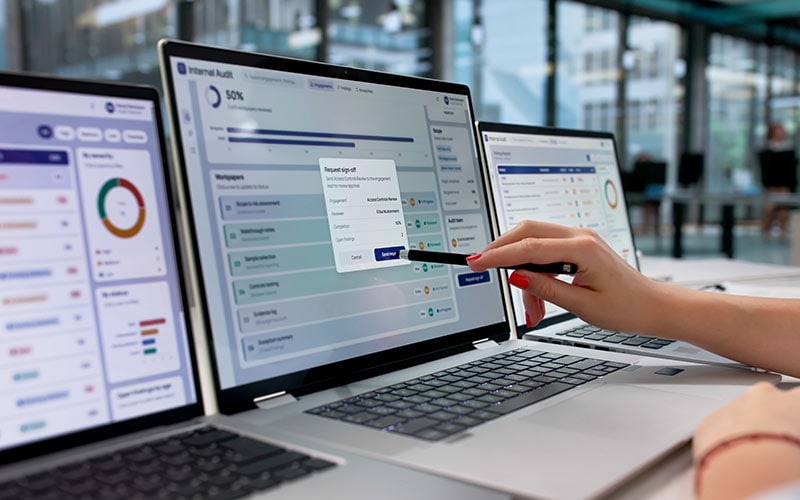
Regulatory change is accelerating and breach costs are rising, yet most institutions still rely on periodic, manual risk assurance. Three structural gaps, spanning visibility, third-party oversight, and governance, leave institutions unable to keep pace. Building risk assurance as a continuous, AI-augmented capability closes these gaps. A four-phase roadmap helps institutions get there.
- 11 Sep, 2026
- 15 min read

The difference between AI work and AI that works lies in the discipline to scale adoption, governance, and value realization
- 10 Sep, 2026

Learn how automated integrity checks and human oversight can help enterprises control AI agent sprawl, reduce duplication, and manage risk at scale.
- 08 Sep, 2026
