
Insights
- Many organizations are pushing for ERP modernization but remain held back by fragmented systems, outdated documentation, and manual decision-making.
- These silos slow transformation, increase customization risk, and reduce the value companies can extract from AI and automation.
- An integrated toolchain — combining Signavio, LeanIX, Cloud ALM, and complementary platforms — creates real-time visibility into processes, architecture, and governance.
- This connected approach enables faster planning, validated architectures, automated clean-core enforcement, and continuous post–go‑live improvement.
- But to fully realize the benefits, CIOs must address organizational barriers such as siloed teams, incomplete data ownership, legacy mindsets, and resistance to clean-core principles.
Modernizing enterprise resource planning (ERP) promises efficiency, resilience, and artificial intelligence (AI)-driven insight, but visibility during the planning phase often remains limited.
Many organizations still rely on manual, fragmented methods to understand their processes, systems, and data. This makes it difficult to assess what is really happening and how well ERP systems are performing. Without foundational clarity, decision-makers struggle to identify where intervention is needed, affecting transformation outcomes.
This raises a critical question: how can organizations create the clarity needed to move forward confidently with modernization?
Modernization without clear visibility
Organizations embarking on ERP modernization typically do so with clear objectives. These should include streamlining operations, improving agility, and creating a stronger foundation for analytics and AI-driven capabilities. Achieving these outcomes, however, depends on an accurate understanding of how existing processes, systems, and data function in real time. Yet, this visibility is often limited.
Insights from the SAPinsider 2025 report illustrate this challenge. The report shows that only 26% of organizations have implemented tools for process discovery and ERP process analysis as part of their S/4HANA transformation planning. These tools provide structured, system-driven insight into how processes execute and how effectively they perform. Their limited adoption indicates that many organizations miss the opportunity to leverage automated visibility when assessing their current ERP landscapes.
The report further states that for about 34% of respondents, modernization plans are driven by the opportunity to re-engineer business processes to correct inefficient or poorly configured processes from prior ERP implementations. However, without structured, system-driven visibility into how processes actually execute or how ERP landscapes perform, organizations risk basing transformation roadmaps on incomplete information.
As a result, important factors such as process variations, bottlenecks, and manual workarounds may not be visible at scale. In addition, system and integration details are often scattered across different documents and tools, making it difficult to maintain a consistent and up-to-date view of the ERP landscape.
This creates gaps at a critical stage of transformation planning. Organizations struggle to establish a reliable baseline to answer questions such as:
- Where do processes diverge most from standard best practices?
- Which inefficiencies or manual interventions have the greatest impact on performance?
- How do existing customizations and integrations influence complexity and future flexibility?
Without structured visibility into processes and systems, prioritization becomes less precise, and design decisions are made with incomplete information. This uncertainty increases the risk of over-customization, longer implementation cycles, and misaligned architecture decisions.
The implications extend beyond ERP modernization. Foundational clarity in processes and data is a prerequisite for organizations that want to scale automation and AI initiatives as part of their SAP S/4HANA transformation. When process execution is inconsistent and data quality varies, organizations face constraints in deploying AI use cases that depend on standardized, reliable inputs.
This is consistent with findings from Infosys’s AI Business Value Radar 2025, which show that only about 20% of AI initiatives currently deliver measurable business value, while many remain in pilot or early scaling phases. Research suggests that inconsistent process execution and poor data quality are among the factors limiting organizations’ ability to scale AI use cases. This, in turn, makes it harder to reduce risk, control complexity, and fully realize the value of modernization efforts.
Fragmentation that slows transformation and increases risk
What begins as a visibility gap can quickly evolve into operational friction across downstream stages of transformation.
1. Baseline assessment and discovery become unreliable
Without a consistent, system-backed baseline that can be reused across teams, transformation planning struggles to move beyond point-in-time assessments. Teams lack a constant point of reference that can be considered as-is state and carried forward into design and execution stages. This makes it difficult to prioritize improvement initiatives or assess progress consistently as the program advances.
2. Architecture planning becomes slow and reactive
As transformation moves into architecture planning, fragmentation introduces additional complexity. Application landscapes, which often span SAP and non-SAP systems, are documented across individual spreadsheets rather than in a centralized, accessible format. Establishing a shared understanding of dependencies, interfaces, and transformation impacts requires significant manual effort and extended alignment cycles. As a result, architecture decisions take months rather than weeks, and risks tied to system interdependencies surface late in the process.
3. Execution and governance rely on manual control mechanisms
During execution, the lack of integration between process design, architecture planning, and project management creates governance gaps. Ensuring that implementation aligns with agreed designs requires manual reviews, committee discussions, and document-based checks. Clean-core principles and customization decisions are evaluated case by case, increasing the likelihood of inconsistencies and introducing long-term technical debt that constrains future change.
4. Outcomes are harder to sustain beyond go-live
These challenges directly affect transformation outcomes. Delivery timelines extend, costs increase, and confidence in decision-making declines. After go-live, organizations often struggle to track whether intended improvements are being realized or to identify where further optimization is needed. Transformation insights remain tied to the project phase and are not systematically reused to drive ongoing improvement.
These downstream challenges can be seen clearly in large-scale transformation initiatives, such as the experience of a major global aerospace manufacturer. The company faced comparable challenges when it set out to establish a new industrialized production capability for next-generation aircraft components at one of its European sites.
The company wanted to maintain clear traceability across requirements, design decisions, risks, testing activities, and release sequencing throughout the transformation. This is because the program operated under tight industrialization timelines, requiring rapid mobilization while simultaneously integrating a complex mix of engineering, manufacturing, and supply-chain systems.
The organization was also adopting fit-to-standard and clean-core principles for the first time, relying on SAP’s standard, built-in business processes instead of heavily customizing the system. This shift introduced new discipline around process design, custom code management, and control of system extensions. At the same time, business and IT teams were transitioning to new agile ways of working across multiple functions, creating additional challenges in coordination, planning, and execution.
With this fragmentation, addressing these challenges consistently was difficult, limiting the ability to scale improvements beyond individual workstreams.
A unified tool chain for governed ERP transformation
To handle the challenges of fragmented planning, slow architecture decisions, manual governance, and unsustainable outcomes, organizations require a different way of running ERP transformation: one that connects insight, design, execution, and continuous improvement across the entire life cycle. This is where the integrated tool chain approach comes into play.
The integrated tool chain approach brings together SAP Signavio, SAP LeanIX, and SAP Cloud Application Lifecycle Management(ALM) into a single, connected transformation backbone. Each tool addresses a specific aspect of ERP transformation that includes understanding how business processes run, visualizing the system landscape, and managing implementation and governance, all while operating on a shared data foundation.
Instead of treating process analysis, architecture planning, and project execution as separate activities supported by disconnected tools, the approach integrates them into a unified operating model. Each tool has a specific role, but they work together using predefined process models, architecture patterns, templates, and roadmaps provided by SAP, reducing the need to start from scratch.
The global aerospace manufacturer leveraged the SAP integrated tool chain, anchored by SAP Cloud ALM, to overcome the challenges faced during the setup of a new industrialized production capability. The integrated tool chain was used throughout the transformation, from the initial process alignment stage through system design, testing, and deployment. Cloud ALM supported life cycle governance, integrated test management, deployment and release governance, and provided visibility across requirements, design decisions, risks, testing activities, and release sequencing. This enabled greater transparency, control, and predictability across the transformation.
Infosys played a pivotal role in driving the program’s consistency and predictability by enforcing standardized system design principles, orchestrating the use of transformation tools, and applying industry-aligned templates across all streams. Through a well-defined decision making framework and a centralized governance platform, Infosys ensured disciplined adoption of standard processes, full traceability of changes, and coordinated execution across teams. This approach significantly reduced design and deployment complexity and enabled more reliable, scalable delivery.
Alignment with the SAP predefined framework
A key strength of the integrated tool chain is its alignment with the SAP Activate framework, a structured, end-to-end method for running ERP transformations (Figure 1). SAP Activate breaks the transformation journey into clear phases, from understanding the current state to operating and continuously improving the system, ensuring that visibility and governance are maintained throughout.
Figure 1: SAP’s integrated tool chain
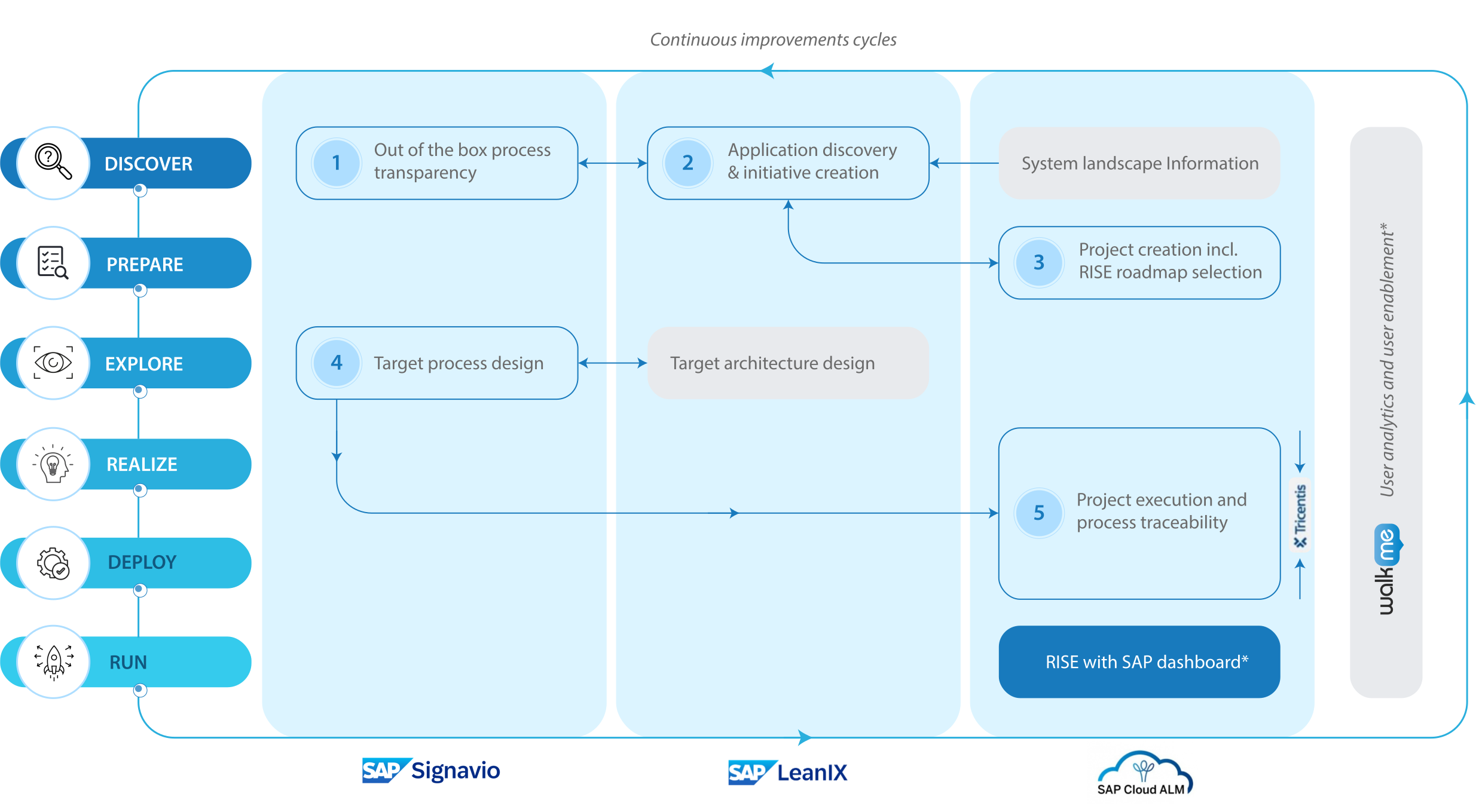
- Discover (understanding the current state): SAP Signavio process insights analyze data from live systems to show how business processes run. The tool uses metrics such as the Best-Run Score to measure how business processes are running against defined standards. This helps identify inefficiencies early, providing a factual basis for deciding what needs to change. It serves as a single source of truth for process design.
- Prepare and explore (designing the future state): SAP LeanIX provides a single, reliable view of the enterprise system landscape, including both SAP and non-SAP applications. Using standardized SAP reference models, organizations can define and validate future architecture, understand dependencies, and assess the impact of change before implementation begins.
- Realize and deploy (building and going live): SAP Cloud ALM supports implementation by coordinating project activities using predefined SAP Activate roadmaps. It connects requirements, system configuration, testing, and deployment, helping ensure that what is built aligns with what was designed and approved.
- Run (operating and improving): After go-live, the tool chain continues to support operations and improvement. SAP Cloud ALM and RISE with SAP dashboards provide ongoing monitoring, enabling organizations to track outcomes, manage changes, and identify opportunities beyond go-live for further optimization.
SAP is further extending the functionality of the integrated tool chain with automation-based tools that reduce the need for manual effort.
- Low user readiness has been a common failure point for SAP transformation programs. To address this, SAP added a digital adoption platform, WalkMe, which improves user adoption by automating user onboarding, and provides in-app, step-by-step training and guidance. The tool analyzes usage data to identify friction points and offers proactive support when needed. The same data can be integrated into LeanIX to help identify underutilized or problematic applications.
- For an automated testing solution, Tricentis has been integrated into the tool chain. The Tricentis integration is embedded by default in the RISE with SAP and GROW with SAP offerings and connects directly with SAP Cloud ALM.
- Change management and compliance have been considered through Klario, which is an AI-powered application. The tool uses AI to evaluate change requests logged in SAP Cloud ALM, generates context-aware blueprints, and provides a guided feasibility score. It also analyzes requests against SAP best practices to provide a clean core compliance score.
How can organizations start building the integrated tool chain?
With the integrated tool chain providing a connected and governed foundation for ERP transformation, the focus shifts from capability to execution.
1. Adopt the integrated tool chain early
Organizations should introduce the integrated tool chain at the start of the transformation rather than after design or implementation decisions have already been made. Early adoption enables real-time visibility into how processes execute, how systems interact, and where inefficiencies exist. This creates a reliable baseline that can be reused across planning, design, and execution. Reducing dependence on point-in-time assessments helps ensure that early decisions are grounded in data rather than assumptions.
2. Establish a single source of truth for enterprise architecture using SAP
Creating a centralized and continuously maintained view of the enterprise architecture is critical to aligning business, IT, and delivery teams. SAP LeanIX can be used to document the current and future application landscape, including SAP and non-SAP systems, integrations, and dependencies. With a shared architectural reference point, organizations can reduce planning effort, accelerate impact analysis, and make more consistent decisions as the transformation evolves.
3. Automate governance and execution control with SAP Cloud ALM
Manual governance processes do not scale well in complex ERP transformations. SAP Cloud ALM should be used as the hub for implementation and governance, aligning execution with SAP Activate roadmaps and predefined quality checkpoints. Automated controls help enforce clean-core principles consistently, reduce the risk of unnecessary customization, and maintain traceability between design decisions, system configuration, testing, and deployment.
4. Extend monitoring and optimization beyond go-live
ERP modernization should be treated as an ongoing process and not a one-time project. After go-live, organizations must continue monitoring processes, system performance, and architectural changes using an integrated tool chain. This supports continuous improvement by making it easier to track outcomes, identify new optimization opportunities, and scale automation and AI initiatives on a stable, well-governed foundation.
Conclusion
SAP S/4HANA offers AI-enabled advantages for organizations. However, realizing these benefits requires a transformation journey grounded in clarity, control, and continuity to drive lasting business and AI value.
Fragmented processes, architectures, and governance can limit the impact of even well-intended initiatives. By adopting an integrated, life cycle-driven tool chain aligned with SAP Activate, organizations can replace disconnected initiatives with a structured approach that connects insight, design, execution, and continuous improvement. This foundation enables organizations to modernize with confidence, scale improvements consistently, and unlock greater value from their ERP investments over time.


The semiconductor industry is navigating rising volatility as AI demand accelerates and supply constraints persist, making integrated, real-time operations on platforms such as SAP S/4HANA critical to aligning planning, manufacturing, and supply chains.
- 24 Jun, 2026
- 8 min read

Enterprise AI delivers the greatest value in SAP when it is embedded directly into SAP S/4HANA workflows using SAP Business AI, Joule, and SAP BTP, so intelligence becomes a secure, governed, production grade capability driving everyday execution rather than isolated pilots.
- 12 May, 2026
- 8 min read

How CPG, retail, and logistics companies can move out of the testing phase and put AI to work at scale.
- 13 Apr, 2026
- 6 min read
