

Insights
- Enterprises are seeing real AI value when it is embedded into core operations rather than run as standalone experiments.
- SAP S/4HANA modernization is creating the foundation needed to operationalize AI at scale.
- SAP tools like Joule and Business AI are lowering barriers and enabling everyday, in‑workflow AI usage.
- Scaling AI requires strong alignment across data, governance, and decision ownership within SAP landscapes.
- Integrating AI directly into SAP processes turns early pilots into secure, production‑grade capabilities.
Enterprise leaders have moved past questioning whether artificial intelligence (AI) can deliver value. Evidence now points to practical impact.
According to the Infosys AI Business Value Radar 2025, nearly one‑fifth of AI initiatives already achieve their intended business outcomes, while another one-third deliver partial success across a global sample of more than 3,000 organizations.
These results confirm that AI is generating tangible benefits across multiple enterprise functions.
However, organizations see the strongest results when AI is intentionally integrated into core business operations and reinforced through clear governance, decision structures, and operating models, enabling intelligence to directly shape how work is executed.
For organizations modernizing their digital foundations through SAP’s next generation enterprise system, SAP S/4HANA, the discussion has shifted. The priority is ensuring that early pilots evolve into capabilities that support everyday execution.
AI adoption meets core system modernization
Most large organizations have now experimented with AI and moved beyond curiosity‑driven pilots. Industry surveys consistently show that a clear majority of enterprises now use AI in at least one area of the business, such as finance, supply‑chain planning, customer service, IT operations, or software development. These early initiatives have demonstrated that AI can deliver accelerated project timelines, have reduced manual effort, and improved productivity.
At the same time, many of these enterprises are in the middle of modernizing their core business systems, particularly through SAP S/4HANA programs. Customer research within the SAP ecosystem indicates that most SAP customers are either already live on S/4HANA or actively implementing it, driven by the need to simplify processes, improve data consistency, and enable scalable operations.
However, for many business leaders, AI initiatives and core system transformation have moved forward simultaneously, often without strong coordination. While SAP S/4HANA provides the foundation required for AI at scale, enterprise surveys show persistent gaps between AI experimentation and operational integration, indicating that AI initiatives are frequently executed alongside rather than embedded into core transformation programs.
From a platform standpoint, SAP’s AI capabilities have reached a stage where adoption is simpler and more practical for everyday use.
The launch of Joule as an AI copilot for both business and IT users, combined with SAP’s decision to make Joule services available at no cost through September 2026, has lowered barriers to entry and encouraged broader experimentation.
As a result, organizations are beginning to apply AI directly within daily operations, embedding it into how users interact with SAP systems. Some customers are already developing Joule based agents to handle routine questions, basic transactions, and in application support, signaling a shift from exploratory trials to operational usage.
AI tooling is also becoming part of how SAP consultants and developers work. Joule for consultants is being used to speed up solution design and configuration tasks, while Joule for developers supports development, testing, and troubleshooting activities. While these tools do not change business processes on their own, they steadily improve individual and team productivity.
In parallel, SAP has continued to expand its embedded business AI capabilities, bringing intelligence directly into standard SAP processes, so users see insights while doing their day‑to‑day work instead of positioning AI as a separate add‑on. The Generative AI Hub is also scaling, providing access to multiple AI models with clearer pricing and the flexibility to switch models over time.
The challenge of scaling
Although many organizations have proven AI value through pilots and proofs of concept, extending those results across the enterprise introduces a different set of challenges.
Moving from isolated success to scaled impact requires changes in data architecture, operating models, and decision ownership — areas that pilots alone rarely address.
A primary constraint emerges from the way enterprise data is organized and owned. In most environments, critical information is split across SAP systems and a landscape of non SAP applications, each governed by different teams, standards, and access models. This fragmentation limits AI’s effectiveness at scale, since insights often depend on cross functional data that can be inconsistent, difficult to reconcile, or delayed. As adoption grows, the focus shifts from selecting individual AI tools to establishing a coherent data strategy that allows SAP native capabilities and broader AI platforms to work together in a coordinated manner.
Governance also becomes more complex once AI influences operational execution. During early experimentation, decisions about validation, approval, and action are typically informal and localized. As AI begins shaping financial forecasts, supply decisions, or customer interactions, the absence of clear accountability creates friction. Enterprises must define who owns AI driven decisions, how outputs are reviewed, and where risk is managed. Without formalized decision rights and controls covering security, compliance, and regulatory exposure, organizations struggle to embed AI into core workflows with confidence.
Strategic alignment further complicates scaling efforts. As AI investments accelerate, enterprises face choices about where intelligence should live and how it should be delivered to users. Some pursue centralized enterprise AI platforms to promote reuse, while others adopt AI services from hyperscale cloud providers to accelerate innovation. These approaches can create tension with SAP centric strategies that focus on embedding intelligence directly within transactional processes. Without architectural clarity, teams risk duplicating capabilities and fragmenting user experiences.
This complexity is amplified by the rapid adoption of AI assisted development tools beyond the SAP ecosystem. Intelligent coding assistants and AI enabled development environments built on large language models have become increasingly attractive to teams working on SAP customizations, particularly where speed and flexibility are critical. While these tools can accelerate build and test cycles, their use outside established SAP delivery frameworks introduces concerns around long term supportability, security controls, version management, and alignment with enterprise standards.
These factors explain why scaling AI requires more than expanding successful pilots. Achieving enterprise-wide impact depends on aligning data foundations, governance models, platform strategies, and delivery practices so intelligence can be applied consistently within core operations.

Operationalize AI within the SAP digital core
Recent SAP S/4HANA cloud programs indicate that AI becomes operationally viable when it is introduced directly into SAP workflows as part of normal execution. Infosys‑led transformation examples show organizations moving selected AI use cases from proof of concept into controlled, production use by integrating AI into areas where work already happens such as planning activities, system conversion efforts, and SAP development support.
One example comes from a global consumer‑goods organization that applied AI‑enabled forecasting within its SAP demand‑planning process during an S/4HANA transformation. By augmenting an existing planning workflow rather than replacing it, the organization reported improvements in short‑term forecast accuracy and reductions in planning effort.
Similar patterns appear in SAP system‑modernization initiatives. During ECC‑to‑S/4HANA migrations, Infosys describes using generative AI to support SAP code remediation and optimization. In a pharmaceutical transformation, AI assisted in automating a significant portion of code‑correction work, reducing manual effort.
Infosys‑led programs also reference the use of AI to assist specific stages of SAP program execution, including data mapping, profiling, and selected governance activities. In these cases, AI functions as a productivity enhancer for standardized and repeatable tasks rather than replacing SAP delivery processes, allowing efficiency gains without introducing operational disruption or new risk.
AI is brought into the SAP digital core primarily through SAP‑native platform capabilities, supported by retrieval‑augmented generation (RAG) where grounding in enterprise knowledge is necessary. RAG enables generative AI to draw directly from trusted organizational sources such as SAP transactional data, business rules, and internal documentation when producing responses. This ensures AI outputs reflect the organization’s specific context and operating standards, making recommendations more relevant for users while strengthening consistency, governance, and auditability.
On the SAP side, SAP Business AI embeds intelligence directly into standard SAP business processes so insights and recommendations appear at the point where decisions are already being made. Joule, SAP’s AI co‑pilot for business users, consultants, and developers, acts as an assistive layer helping people analyze information, complete tasks, and navigate SAP systems using natural interaction. When coupled with SAP‑aligned RAG access to enterprise data, Joule’s guidance is directly informed by the organization’s own systems and policies.
These capabilities are delivered through SAP Business Technology Platform (BTP), which provides the integration, security, and governance foundation needed to combine embedded AI, RAG‑based enterprise knowledge access, and SAP workflows within a single controlled environment. Together, this approach enables AI to operate in a production‑grade manner which is secure, governable, and scalable.
How to make AI a core part of enterprise transformation
To capture this opportunity, organizations must embed AI at the center of enterprise transformation and treat it as a foundational capability. This means planning for AI alongside SAP S/4HANA modernization, process redesign, and operating model changes, so intelligence is designed into how work gets done instead of being added after the fact.
Instead of trying to scale every pilot at once, leaders should take a more deliberate, value led approach. AI initiatives that have already shown measurable impact and are closely tied to critical business processes should move to the front of the line. Areas such as planning, finance, operations, and IT delivery are often strong starting points, particularly where data ownership is clear, standards are established, and teams are already accountable for outcomes.
As these use cases expand, relying on native SAP AI capabilities helps ensure that intelligence is delivered directly through the workflows people already use every day. This approach keeps data, decisions, and controls within the SAP landscape, reduces integration complexity, and makes governance easier to enforce. It allows organizations to scale AI with confidence, turning early successes into durable, production grade capabilities that support long term business transformation.
From experimentation to proven value
By aligning AI with core SAP processes, data governance, and operating models, enterprises can move beyond isolated wins and establish AI as a dependable, production grade capability that delivers measurable value without fragmenting platforms, processes, or accountability.

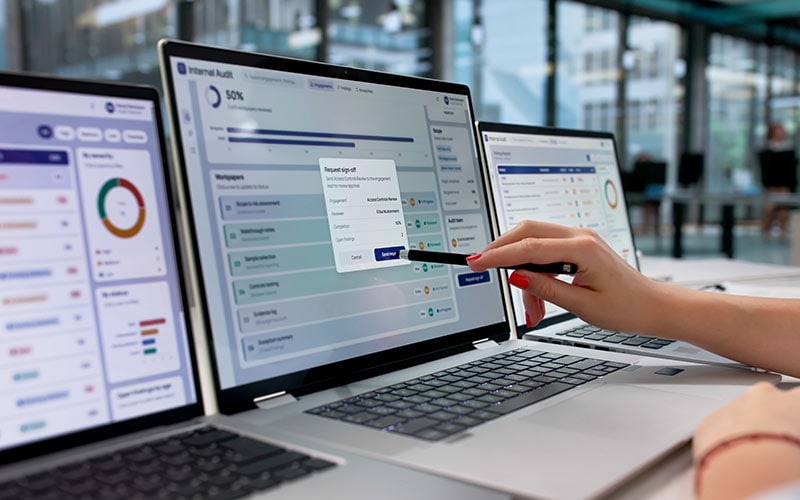
Regulatory change is accelerating and breach costs are rising, yet most institutions still rely on periodic, manual risk assurance. Three structural gaps, spanning visibility, third-party oversight, and governance, leave institutions unable to keep pace. Building risk assurance as a continuous, AI-augmented capability closes these gaps. A four-phase roadmap helps institutions get there.
- 11 Sep, 2026
- 15 min read

The difference between AI work and AI that works lies in the discipline to scale adoption, governance, and value realization
- 10 Sep, 2026

Learn how automated integrity checks and human oversight can help enterprises control AI agent sprawl, reduce duplication, and manage risk at scale.
- 08 Sep, 2026
