
Insights
- Modern fiber networks power smart cities and 5G, yet route planning still relies on traditional geographic information system (GIS) workflows designed for simpler, slower changing environments.
- Static GIS struggles with fragmented data, scalability limits, and poor visibility into real world conditions, leading to delays, rework, and cost overruns.
- GeoAI enables AI driven routing optimized for cost, risk, and constraints, while light detection and ranging (LiDAR) based 3D models validate designs against actual physical conditions before construction.
- Together, GeoAI and LiDAR create a closed feedback loop, with field insights looped back into planning systems, continuously improving planning outcomes and deployment speed.
Modern smart cities run on seamless connectivity, from real-time traffic systems and internet of things (IoT) sensors to 5G networks and cloud-driven public services. The fiber-optic network is the invisible backbone that enables these services to function at scale.
Designing fiber routes has always required careful coordination of physical and regulatory constraints: approved right-of-way corridors, existing underground utility conflicts, civil works boundaries, and splice architecture — the way fiber cables connect. These decisions must also account for real-world conditions, including terrain, land use, and on‑site access. Geographic information systems (GIS) have long supported this process by bringing together location information and descriptive data of network assets on a single map‑based view, transforming fiber planning from a largely manual, drawing-board exercise into a spatial intelligent workflow.
Why traditional GIS is hitting its limits in fiber planning
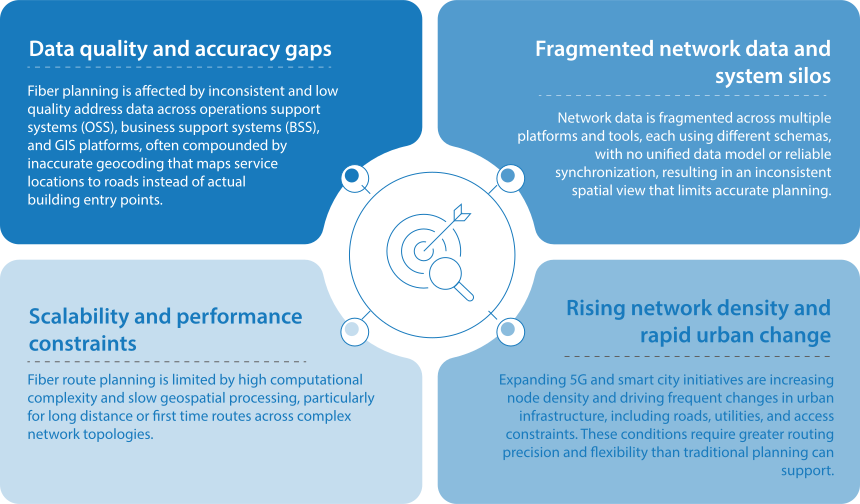
The operating environment has changed significantly. Rising demand for high‑speed connectivity is driving fiber deeper and wider across urban areas, extending networks into last-mile locations and creating complex deployment scenarios. GIS is now expected to support faster decision-making at higher precision, with large-scale optimization in conditions that change continuously. Traditional GIS-based planning approaches, while still foundational, were designed for a slower, less dense network era and struggle to keep pace with today’s demands (Figure 1).
Figure 1. Challenges with traditional GIS-based planning
Source: Infosys
Together, these challenges create cascading impacts across planning, costing, and execution. Inaccurate planning and cost estimates flow from misaligned data, compounding into errors in bills of material and longer planning cycles. Outdated insights slow decision-making and introduce bottlenecks, while operational inefficiencies and rework drive up costs, collectively limiting the ability to deploy fiber networks efficiently and at scale.
A modern approach to fiber route planning: GeoAI + LiDAR
As fiber networks grow denser and more complex, the telecom industry needs planning approaches that deliver unified data, scalable routing, and real-world accuracy. An integrated GeoAI-led model, supported by LiDAR-based 3D model validation, bridges digital planning with field execution.
What is GeoAI? How does it differ from traditional GIS?
GeoAI integrates GIS with artificial intelligence (AI) to analyze and solve spatial problems in environments that are increasingly complex and dynamic. Rather than replacing traditional GIS, GeoAI extends it by embedding AI techniques into spatial workflows. This approach becomes valuable when telecom routing decisions must account for patterns, uncertainty, scale, and continuous change across urban environments and telecom network corridors – ranging from outside plant (OSP) fiber infrastructure deployed in streets and inside plant (ISP) facilities such as in the central offices, data centers and equipment rooms. These are conditions where rule-based or static, data-driven methods struggle to perform reliably. By learning from historical data such as existing fiber routes, network performance and real-world outcomes, GeoAI can generate multiple viable route alternatives, balancing cost, risk, feasibility, and constraints. As a result, fiber planning shifts from selecting a single optimized path to comparing ranked options that adapt to evolving network and urban conditions — something traditional GIS workflows were not designed to do at scale.
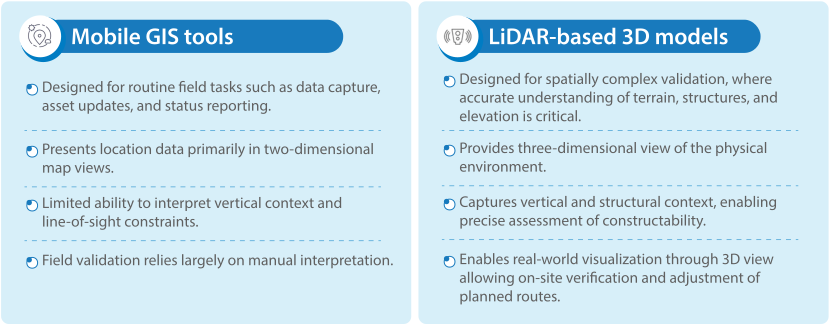
What are LiDAR-based 3D models? How do they differ from mobile GIS tools?
LiDAR is a laser-based technology that captures precise three-dimensional measurements of real-world surfaces and structures. In addition to mobile and terrestrial deployments, LiDAR data can be captured using drones, enabling remote, high resolution site surveys that reduce on site risk and support faster validation in complex telecom environments. Drones detect defects like damaged insulators and cracked poles, and auto-update GIS systems, significantly reducing manual effort and inspection cycles. The data collected translates to a 3D view which provides a highly accurate representation of the physical environment, capturing terrain, structures, and vertical details critical to fiber routes and telecom assets that are difficult to interpret from traditional two-dimensional maps. By mapping fiber pathways from outside corridors into buildings, this richer spatial view enables planners and engineers to assess routes more holistically and deliver more accurate, reliable OSP and ISP designs.
When delivered through mobile devices, LiDAR-derived 3D models allow field engineers to visualize AI suggested fiber paths directly at real-world locations. Teams can validate feasibility on site, identify obstructions or deviations, and make informed adjustments based on actual conditions.
Figure 2. Mobile GIS tools versus LiDAR-based 3D models
Source: Infosys
An integrated GeoAI and LiDAR operational loop
GeoAI and LiDAR-based 3D independently address different gaps in fiber planning and field validation. However, their real value emerges when combined into a closed, operational loop: GeoAI generates intelligent, scalable route options; LiDAR based 3D enables field teams to validate those designs against real-world conditions; and the resulting context-rich feedback is then sent back into planning systems, continuously refining routing intelligence, reducing ambiguity, and minimizing rework (Figure 3).
Although elements of this approach exist today in isolation, a tightly integrated GeoAI-LiDAR feedback loop remains an emerging capability — one that has yet to be widely standardized for telecom fiber route validation.
Figure 3. GeoAI and LiDAR operational loop flow chart

Source: Infosys
Data
Data input
Data sources, including legacy GIS layers, OSS/BSS inventories, computer-aided design (CAD) as built drawings, LiDAR/imagery, and other raw datasets are first ingested into a common processing pipeline. Example: AI analyzes satellite imagery to detect new buildings, solar installations, and obstructions, which then automatically updates the GIS-based network inventories.
Data cleansing
During ingestion, coordinate reference systems, timestamps, and asset identifiers are standardized to ensure data from different sources aligns spatially, reflects the most up‑to‑date network state, and can be reliably matched across systems. This normalization creates a consistent foundation for accurate routing and analysis.
Data conflation
Once data is standardized, an AI‑assisted conflation process resolves geometry and schema conflicts and brings multiple datasets together into a single, reliable network view. This happens through three focused steps:
- Positional alignment: Corrects location errors by aligning network features to their most likely real‑world positions. Example: A fiber splice or cabinet that is mapped to the middle of a road is repositioned to the actual building entrance or sidewalk location where it physically exists.
- Feature and attribute reconciliation: Resolves differences in how the same network asset is described across systems, ensuring a single, trusted set of details. Example: An asset marked as active in GIS but as planned in an OSS system is reviewed and reconciled so all systems reflect the correct status, ownership, and asset type.
- Topology and connectivity validation: Checks that network elements are logically connected in a way that reflects how the fiber network is built. Example: Ensures fiber lines connect to the right equipment endpoints, cable segments form continuous paths, and no links are missing or incorrectly connected in the network design.
Output: Together, the data processing steps produce a clean, governed unified view which acts as a single, trusted spatial foundation accurately representing the network and its physical context in the user interface (UI).
Routing
UI + user input
Users may add planning constraints related to cost, time, and risk. Together, the UI details and user inputs support intelligent routing, enabling planners to confidently define endpoints and constraints before generating optimized fiber route options.
GeoAI optimization
This engine operates on the unified view and user-defined inputs to generate route options through a series of steps:
- Filtering infeasible paths: Excludes routes that cross restricted zones, lack right‑of‑way permissions, or violate engineering constraints, narrowing the solution space to viable corridors.
- Optimizing across multiple objectives: Balances capital expenditure, construction duration, and route risk through multi objective optimization.
- Applying engineering rules: Enforces constraints such as bend radius, joint spacing, clearances, and capacity limits to ensure constructability.
Output: A ranked set of the most viable route scenarios, each with per-segment construction methods, reuse indicators, cost and schedule breakdowns, risk annotations, and a bill of quantities covering materials and permits. This enables planners to compare alternatives and finalize the optimal design.
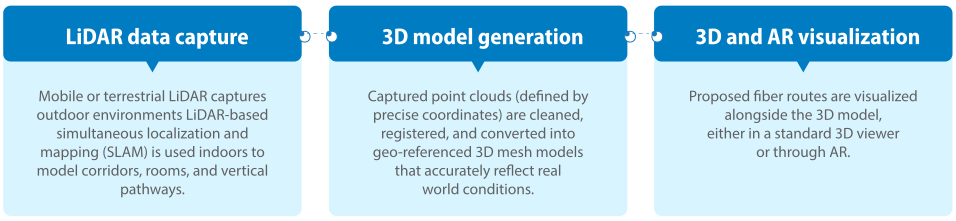
LiDAR-based 3D and optional augmented reality (AR) field validation
The finalized route design is prepared for field validation by generating a 3D representation from LiDAR data (Figure 4).
Figure 4. LiDAR based 3D field validation workflow
Source: Infosys
Field team observations
Field teams validate feasibility in real context, capturing deviations, such as offsets, obstructions, or access constraints, along with pass/fail checkpoints and photographic evidence.
This validation output loops back into two areas: Feedback goes to the unified view, where authoritative spatial corrections are applied and learning goes to the GeoAI optimization model, where penalties and weights are adjusted.
Over time, this feedback mechanism enables a continuous learning cycle, resulting in progressively more accurate, constructible, and cost efficient routes with reduced rework.
The future of fiber network planning in smart cities
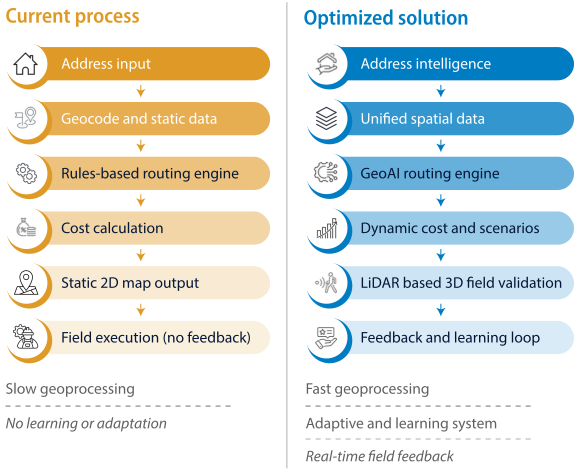
In most deployments today, fiber planning follows a largely linear path, driven by static GIS maps, manual interpretation, and limited field validation. Designs are finalized from point in time data and corrected when issues surface during construction, leading to rework, cost overruns, and delays. The GeoAI and LiDAR based 3D models outlined in this paper replace this reactive approach with an adaptive workflow, where routes are optimized under real world constraints and field validation continuously improves future planning decisions.
Figure 5. Current versus optimized fiber planning approach
Source: Infosys
For telecom operators, the opportunity lies in treating fiber planning as a strategic capability. The operators who invest early in closing the loop among data, intelligence, and field control costs, accelerate deployment, and adapt as cities and networks evolve.
The path forward is incremental and practical:
- Strengthen the data foundation: Consolidate and govern network data across systems — GIS, OSS/BSS, CAD, and field sources. A strong data foundation reduces ambiguity early and enables more reliable downstream decisions.
- Introduce intelligence using GeoAI: Extend traditional GIS workflows with AI driven routing intelligence where scale, uncertainty, and complexity demand it. GeoAI helps planners move beyond static, rule based routing by generating multiple viable route options and optimizing across cost, risk, timeline, and constraints, allowing better informed trade-off decisions.
- Embed real world validation through LiDAR-based 3D models: Incorporate LiDAR derived 3D models into the planning lifecycle to validate designs against actual physical conditions before construction begins. By visualizing routes in true 3D context and, where applicable, through AR in the field, organizations can identify constructability issues early and reduce costly rework.
- Feed learning back into planning cycles: Treat field observations as structured inputs that continuously improve planning intelligence, looping validated updates back into the unified data view and GeoAI models, to refine future routes based on real world outcomes.
Done well, this transforms fiber planning into a living system that becomes more accurate, efficient, and reliable with every project delivered.


Token efficiency, or tokenomics, is now a primary design concern in AI deployments. To get ahead, organizations should build a framework of four composable levers, or thinking modes, applied across the agent stack to cut token expenditure without degrading output quality.
- 17 Sep, 2026
- 7 min read

Regulatory change is accelerating and breach costs are rising, yet most institutions still rely on periodic, manual risk assurance. Three structural gaps, spanning visibility, third-party oversight, and governance, leave institutions unable to keep pace. Building risk assurance as a continuous, AI-augmented capability closes these gaps. A four-phase roadmap helps institutions get there.
- 11 Sep, 2026
- 15 min read

The difference between AI work and AI that works lies in the discipline to scale adoption, governance, and value realization
- 10 Sep, 2026
