

Insights
- As the Middle East shifts from hydrocarbon dependence to AI-driven economies, telecom operators sit at the center of every national digital strategy, owning the connectivity, spectrum, and edge infrastructure that AI depends on to run at scale.
- Telcos own the infrastructure AI runs on but are ceding the platform and intelligence layer to hyperscalers effectively becoming inputs in someone else's product.
- Lower legacy debt, a young digital workforce, and governments acting simultaneously as policy enablers, capital providers, and anchor customers give the Middle East a genuine window to leapfrog western peers.
- Telcos that define the region's AI economy will be those that move from selling bandwidth to owning the layer that governs how enterprise AI operates.

Middle East telcos transformation
Infosys' Anasm and Pallavi Kaur explore why Middle East telcos are poised to lead the region's AI economy and why the window to act is closing fast.
Over the past three decades, the Middle East has pursued economic diversification across multiple cycles: building tourism, expanding financial services, scaling real estate, and developing global trade and logistics hubs. Each wave built capability and reduced dependence on hydrocarbons. The current artificial intelligence (AI) agenda, however, is different in character. Rather than creating new revenue pools within discrete sectors, AI is designed to cut horizontally across every industry, embed across national infrastructure, and compound productivity gains across the economy. It is a foundational capability reshaping every sector, which is why governments across the Middle East are treating it as the organizing logic of national planning itself.
That commitment is reflected in both policy and capital. Saudi Vision 2030 and the United Arab Emirates’ (UAE) National AI Strategy 2031 both place data and AI at the center of economic planning. The UAE has announced plans to move 50% of government services to autonomous AI systems by 2028. Saudi Arabia has formally designated 2026 as the year of AI, with approximately two-thirds of its government workforce already using AI tools daily. Gulf sovereign wealth funds have committed over $100 billion to AI infrastructure, and regional digital‑transformation spending is forecast to grow from $58 billion in 2025 to more than $200 billion by 2031.
As public agencies and enterprises reweight technology budgets toward AI, the infrastructure to power that shift — the data centers, the networks, the computing capacity — has a natural home in telecom operators. Telcos own the connectivity fabric, towers, spectrum, and increasingly the edge compute nodes where AI inference will run at scale, placing them at the center of national digital strategy.
The question is whether today's telcos are built to play that role, or whether they will cede it to others.
The execution gap: AI adoption is wide, but scale remains a problem
Across the region, AI adoption has moved rapidly on the surface. Proofs of concept are widespread, from automated customer care to predictive maintenance and intelligent public services. Yet deployment has remained largely fragmented: isolated pilots that improve narrow workflows without reconfiguring how businesses operate end to end. This is not unique to the Middle East. Infosys research across more than 3,000 companies globally finds that only 20% of AI deployments are delivering on all their business objectives, and that half of all AI initiatives provide only partial value — gains that are real but contained, not transformative. MIT's State of AI in Business 2025 is starker, finding that only 5% of organizations have moved AI solutions into full production. The persistent gap lies between running a successful experiment and transforming how an enterprise operates, and most organizations in the region are still on the wrong side of it.
Telcos ahead on infrastructure, behind on platform leadership
Regional telecom operators have invested heavily in 5G mobile networks capable of high speeds and near-instant response times that AI applications demand, along with fiber and cloud infrastructure, setting the infrastructure pace across Gulf markets. But owning the infrastructure has not translated into capturing the value that runs over it. Platform leadership, the ability to monetize what flows across the network through software, data, and AI services, has largely gone to others. Rather than building that layer deliberately, most operators have bolted AI tools onto existing systems in piecemeal fashion. The consequence is that enterprises turning to AI for their operations are increasingly doing so through hyperscaler platforms, built on top of telco infrastructure but owned by someone else. The data those enterprises generate, the relationships built with them, and the margin they represent flow to the platform owner, not the network provider.

A gap that others are ready to fill
That open space is drawing attention from global technology companies. Hyperscalers, such as Microsoft, Google, Amazon, and Meta, are moving quickly to build AI platforms for enterprises across the region, on their own technology stacks and their own terms. The distinction from what telcos have always done matters here. Telcos have long provided infrastructure for services they do not own, carrying video streaming or e-commerce traffic without controlling those platforms. That model worked because the value was in the content or the service, and the network was simply the delivery mechanism.
AI is different. The platform that orchestrates AI workloads, connecting data, computing power, and applications, is not a delivery mechanism. It is where decisions get made, where data accumulates, and where the most defensible commercial positions are built. At a time when governments across the Middle East are prioritizing keeping sensitive data within national borders and maintaining sovereign control over critical digital infrastructure, allowing that orchestration layer to be built and owned by platforms headquartered overseas is not just a commercial risk. It puts the intelligence infrastructure of the national economy in someone else's hands.
From connectivity to intelligence: the frontier telco model
A connectivity-led utility absorbs infrastructure and energy costs while ceding the monetization and intelligence layer to platform players. That model worked when the product was bandwidth, because bandwidth is a commodity — consumed, billed, and replaced. Intelligence is different. The platform that processes enterprise data and runs AI applications does not simply deliver a service and move on. It learns. It accumulates data, improves its models, and becomes progressively harder to displace. A telco that only provides the underlying network never builds that compounding advantage — the entity that owns the intelligence layer does.
This is the shift that separates what are known as frontier telcos from traditional network operators. Frontier telcos are operators that move beyond selling connectivity to building and owning the software, data, and AI platform layer on top of their networks. Several operators in the region are already on this path. du in the UAE has built a national AI platform that integrates sovereign cloud and AI production tools into a single stack. e& Group has reorganized from a traditional telco into a technology company (TechCo) with AI embedded across more than 400 use cases.
To close this gap, three moves distinguish operators that are making this transition from those that are not.
1. Build the intelligence layer
Frontier telcos establish a horizontal intelligence layer spanning network, cloud, and edge. This intelligence layer has three components. First, a governed data fabric unifies network, IT, and customer data under common standards. Second, machine learning operations pipelines build, deploy, and monitor AI models. Third, an application programming interface (API)-first platform exposes capabilities such as location, identity, and edge compute as services to partners and developers. Security and privacy are designed in from the outset, with zero-trust principles that continuously verify every user and system rather than assuming internal networks are safe, and policy controls that meet sovereign requirements.
2. Rewire the business model
Frontier telcos shift the revenue logic from connectivity to outcomes. They adopt business-to-business-to-X (B2B2X) models — selling AI and network capabilities to business partners who embed them into solutions for their own customers. Pricing evolves from bandwidth to service-level agreements, APIs, and measurable results. In priority verticals such as energy, logistics, manufacturing, healthcare, and public sector, operators co-develop solutions that deliver measurable productivity gains.
3. Win with ecosystems and sovereignty
Frontier telcos partner with hyperscalers on terms that preserve data residency and critical workload sovereignty. They cultivate these ecosystems actively through sandboxes, documentation, and monetization paths, and convene consortia with ministries and regulators to co-design standards for AI assurance and interoperability. For public agencies and regulated sectors such as banking, healthcare, and energy, this combination of local control and verifiable security is difficult for a global platform to replicate quickly. A hyperscaler can build a data center in the region. It cannot, in the same timeframe, replicate the regulatory relationships, institutional trust, and legal standing that a national telco has accumulated over decades of operating critical national infrastructure. That accumulated position is the differentiator.
The Middle East’s structural edge
The Middle East is responding by reimagining telcos as TechCos, evolving from network providers to the digital operating backbone of AI‑native economies. That shift means bringing together infrastructure, data, trust, and sovereignty under a single operating model, and moving from pilots to production-grade AI at scale.
Three structural conditions make this more achievable here than in most other regions. First, Middle East operators carry far less legacy IT debt and organizational inertia than their counterparts in Europe and North America, creating room to move directly from experimentation to AI-native operations. Second, the region has a younger, digitally receptive workforce. Third, governments are actively clearing the path through policy alignment, sovereign capital, and national AI mandates — a combination of enablers that few markets can match.
Sovereignty reinforces this advantage further. For global hyperscalers, questions of data residency and national infrastructure control are constraints to navigate. For a national telco, they are a structural advantage, built on decades of in-country relationships and a regulatory standing that makes them the natural custodian of sovereign AI platforms.
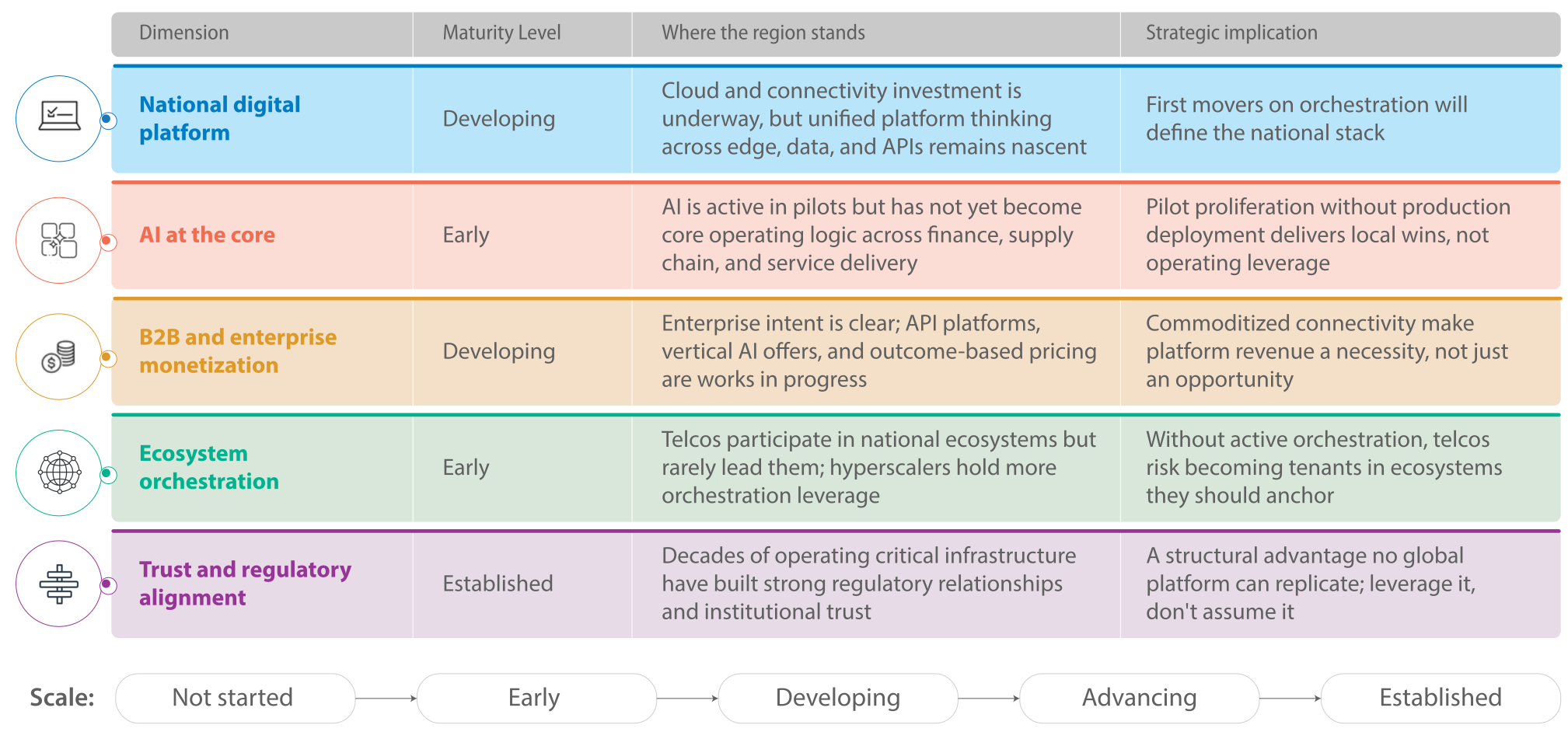
The region's AI maturity profile (Figure 1) reflects both the opportunity and the work ahead. The gaps are the roadmap to platform leadership.
Figure 1. Middle East AI maturity framework
Source: Infosys
Telcos that close these gaps fastest will define the region's transformation.
What Middle East telcos should do now
By 2030, AI is expected to contribute 12.4% of Saudi Arabia’s gross domestic product (GDP) and 14% of the UAE’s GDP. Telcos that capture a meaningful share of that value will be those that move decisively from connectivity-led models to AI-native TechCos. A 12-to-18-month roadmap that commits to production-grade outcomes in two or three priority verticals, such as smart ports, large hospitals, industrial zones, is more effective than a broad transformation that spreads effort too thin.
Own the national AI control plane
The most consequential decision a regional telco can make today is whether it owns the orchestration layer or rents it. An AI control plane governs how data moves, which models process it, and how computing resources are allocated — and whoever runs it sets the commercial terms for every enterprise AI workload in the country. Telcos that cede this layer to a hyperscaler-owned system absorb the infrastructure cost while data, margins, and customer relationships flow elsewhere, weakening both their own strategic position and the region's digital sovereignty. du's National Hybrid AI Platform, which integrates sovereign cloud, hyperscaler graphics processing units (GPUs), and AI production tools into a unified national stack, shows what telco-owned orchestration looks like in practice.
Monetize edge and AI as a platform
Connectivity is commoditized. The next layer of enterprise value lies in sovereign, low-latency AI at the edge, where regulated industries such as energy, finance, healthcare, and smart cities need to operate. Telcos should move beyond bandwidth to offering GPU-as-a-service, inference-as-a-service, and vertical AI APIs that enterprise clients can build on without compromising data residency. Ooredoo Qatar's sovereign AI cloud demonstrates the model, enabling local institutions to build and scale AI under national data laws.
Move from pilots to agentic, autonomous operations
The gap between experimentation and operating leverage is not closed by running more pilots — it closes when AI becomes the core operating logic of the enterprise itself, progressing toward agentic, zero-touch operations, where AI systems execute tasks autonomously across network management, finance and service delivery. stc Bahrain's Evolve 2.0 program, targeting autonomous networks and zero-touch operations, reflects the urgency with which leading operators are pursuing it.
Reorganize around platforms, not functions
Structure determines speed. A telco organized around network functions and siloed business units moves at the pace of its slowest boundary, because every new product requires coordinating across departments built for a different era, each with separate systems and approval chains. A TechCo organized around AI, cloud, data, and API platforms builds capabilities once and reuses them across products, verticals, and markets. The marginal cost of growth falls as the platform matures, making the structure both faster and more commercially productive. e& Group's transformation, with AI embedded across more than 400 use cases, illustrates what platform-led reorganization enables across markets and geographies.
Anchor strategy in sovereign AI ecosystems
The largest AI demand in the region, from governments, energy majors, and national champions, is long-cycle, regulated, and capital-intensive - precisely the conditions that favor telcos. Leading telcos should cobuild the ecosystems that serve this demand rather than treat it as a conventional sales opportunity. Aramco Digital's push into private wireless and edge AI, and Humain’s consolidation of cloud and Arabic large language models into a nationally backed platform signal the scale of sovereign investment available to telcos that position themselves as ecosystem anchors.
The shift described in this article is not a distant aspiration for the Middle East. The capital is committed, the policy frameworks are in place, and the first movers are already demonstrating what is possible. The harder work is execution: moving AI from the margins of isolated automation into the core logic of how telcos make decisions and deliver outcomes end to end.
The path is clear: from AI foundations to agentic operations, from connectivity revenue to ecosystem monetization, and from network utility to digital sovereignty. Telcos that move decisively will reshape the Middle East's AI economy — and their own trajectory.


Token efficiency, or tokenomics, is now a primary design concern in AI deployments. To get ahead, organizations should build a framework of four composable levers, or thinking modes, applied across the agent stack to cut token expenditure without degrading output quality.
- 17 Sep, 2026
- 7 min read
Regulatory change is accelerating and breach costs are rising, yet most institutions still rely on periodic, manual risk assurance. Three structural gaps, spanning visibility, third-party oversight, and governance, leave institutions unable to keep pace. Building risk assurance as a continuous, AI-augmented capability closes these gaps. A four-phase roadmap helps institutions get there.
- 11 Sep, 2026
- 15 min read

The difference between AI work and AI that works lies in the discipline to scale adoption, governance, and value realization
- 10 Sep, 2026
