

Insights
- Most employees don’t expect AI to replace their jobs, as per Infosys research.
- However, over half feel uncertain about whether their jobs will be protected as AI becomes more capable.
- This confidence gap slows AI adoption, as employees hesitate to fully engage.
- Organizations must build trust, transparency, and reskilling to unlock AI adoption, and the technology’s full value.
From headlines predicting mass displacement to internal discussions about workforce restructuring, the fear of AI-driven job loss has shaped employee sentiment across industries. Yet research from the Infosys AI and the Future of Work report reveals that very few employees actually expect significant job losses because of AI. Most workers do not see AI as an imminent threat to their employment. Instead, they hold a more balanced view — recognizing AI’s transformative potential while remaining cautiously optimistic about their place within that future. However, this does not mean employees feel secure. Therefore organizations must proactively address these concerns to build trust in workplace AI and enable successful AI adoption.
Employees largely recognize AI’s transformative potential, while maintaining a measured optimism about their role in an AI-driven future.
The confidence gap
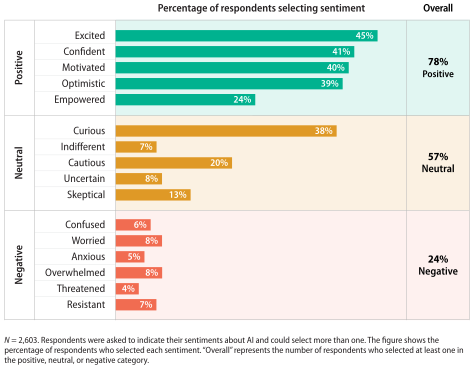
Infosys research shows that employees are optimistic about AI at work (Figure 1): almost 45% say they feel excited, and nearly 40% feel confident, motivated, and optimistic about using it. There is also a high level of motivation to use AI.
Figure 1. Employees are mostly positive about AI at work
Source: Infosys Knowledge Institute
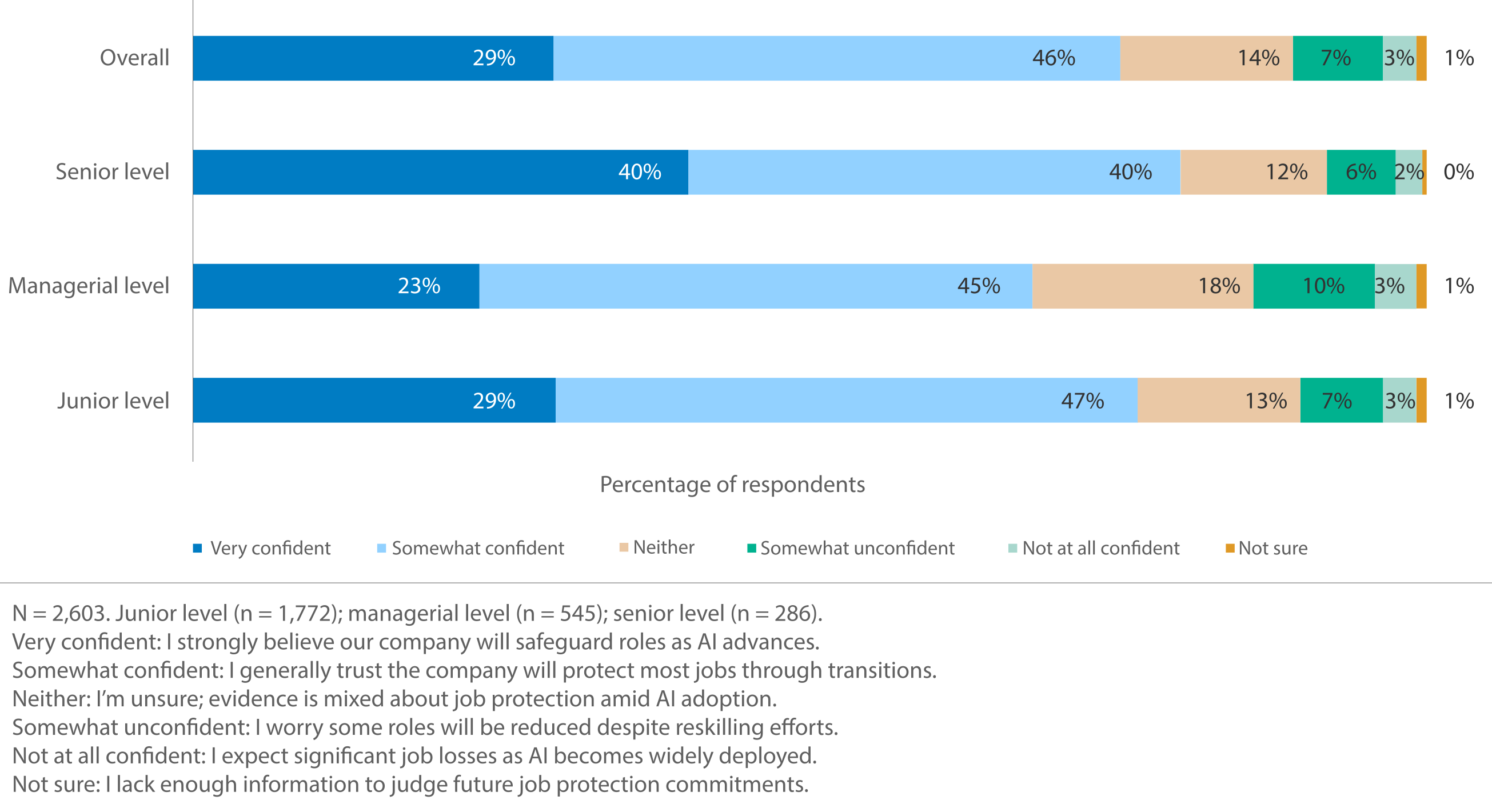
In fact, only 2% of the employees surveyed expect their roles to be eliminated due to AI (Figure 2). But while immediate fears are limited, nearly 25% of the employees surveyed are somewhat unconfident. They are concerned that their roles will be reduced despite reskilling efforts. Almost 45% say they are unsure, citing mixed evidence on AI's impact on job security. Winning over this large undecided group that’s in the middle will be critical for organizations to drive AI adoption.
Figure 2. Not enough job confidence among employees
Source: Infosys Knowledge Institute
Nearly 45% of the employees say evidence around job protection is mixed.
Lack of clear information can leave employees feeling less confident. Employees are not necessarily fearful of losing their jobs today, but they are unsure about what tomorrow might bring — and critically, whether their employers are on their side. When employees are unclear about how AI will affect their roles, they are more likely to engage less, experiment cautiously, and limit their use of AI tools to low-risk scenarios. As a result, adoption could slow down, and organizations might miss out on the full productivity gains AI can deliver.

Security drives adoption
The gap in job confidence is particularly important now, with organizations embedding AI into more functions and everyday work. The Infosys research highlights that employees who feel confident that their jobs are secure are 7% more likely to use AI multiple times a day. When employees feel secure, they lean in, explore new tools, reimagine processes, and actively seek ways to integrate AI into their daily work. They are more willing to invest time in learning, more open to changing established workflows, and more confident in proposing AI-driven innovations.
When that sense of security is absent, employees may use AI sparingly or avoid it altogether, particularly in areas where its application could significantly alter their roles. The result is a slow, uneven adoption curve that limits the organization’s ability to fully realize the benefits of its AI investments. Hence, it’s critical for organizations to actively build and reinforce that sense of security.
How organizations can build confidence
Employees need to believe not just that they can use AI, but that they should — and that doing so will not put their jobs at risk. This requires a shift in focus, from capability building to confidence building, with deliberate actions that address employee concerns and reduce uncertainty.
Build trust through transparency: Organizations must be transparent about how AI will reshape work in concrete, role-specific terms rather than at a high level. Too often, messaging around AI remains abstract. Leaders talk about transformation, efficiency, and innovation, but stop short of explaining what this means for individual employees. This creates a vacuum that employees fill with their own assumptions, often influenced by external narratives about automation and job loss.
To counter this, leaders need to articulate how roles will evolve: Which tasks will be automated, which will be augmented, and what new responsibilities or opportunities might emerge. Importantly, this communication should happen early and often. Waiting until changes are finalized increases uncertainty and erodes trust. Instead, organizations should make sure employees are kept fully informed by sharing what is known, acknowledging what is still evolving, and creating space for dialogue. Transparency might not eliminate uncertainty, but it makes it manageable.

Invest in evolution: A second, equally critical lever is investment in reskilling and upskilling. If employees are to evolve alongside AI, they need access to the tools and training that enable that evolution. As the roles and responsibilities of senior leaders, middle managers, and junior employees differ, AI training must be tailored to their specific needs. Role-based learning paths can help each group build the skills required to apply AI effectively in their day-to-day work.
While understanding how to use AI tools is important, employees also need support in developing new ways of working: understanding human-AI collaboration, interpreting outputs, and applying insights effectively. These investments demonstrate that the organization is committed to its people. However, the design of the programs matters. Generic training modules are unlikely to have the desired impact. Learning needs to be tailored, role-specific, and integrated into daily workflows. It should enable employees to see a clear path from their current role to their future role in an AI-enabled environment. When done well, reskilling becomes a source of confidence and shifts the narrative from “Will I be replaced?” to “How will I grow?”.
Reinforce the narrative of augmentation: Leadership plays a pivotal role in shaping how AI is perceived within the organization. Every message, every decision, and every example contributes to the broader narrative. To build confidence, leaders must consistently reinforce the idea that AI is there to augment, not replace. This means going beyond verbal assurances and demonstrating it in practice.
Organizations should consistently highlight examples where AI has enhanced work by saving time, improving quality, or enabling new capabilities. They must showcase roles that have expanded, not contracted, as a result of AI integration, and celebrate individuals and teams who are using AI to create value.
These stories provide evidence that the organization’s commitment to its workforce is real, and help counteract external narratives that suggest otherwise. For example, the AI&A team at Infosys Consulting introduced several AI champions initiatives where AI innovators and early adopters guide peers and showcase real-world AI use cases through workshops and webinars. Such programs can foster trust, confidence, and excitement around AI by making employees feel more engaged, well-equipped, and comfortable with the changes AI is driving. According to research from Prosci, a change management organization, companies that rely on networks of change agents tend to achieve better change outcomes, with 50% reaching their project objectives versus 41% for those that don’t use such networks.
Create space for dialogue: Finally, organizations must create open channels for employees to ask questions and voice concerns. The Infosys research found that employees who strongly agree that "My company encourages me to speak candidly and without fear of repercussions" are 7% more likely to save more than five hours per week with AI.
Confidence cannot be built through one-way communication alone. Employees need the opportunity to express their anxieties, seek clarification, and engage in conversations about the future of their roles. This requires mechanisms that are accessible, safe, and responsive.
Town halls, Q&A sessions, and digital forums can all play a role, but their effectiveness depends on how they are managed. Avoiding difficult questions or providing vague responses can undermine trust. Leaders must be willing to engage honestly, even when answers are not yet fully defined. Equally important is the need to listen to employee feedback that can provide insights into areas of confusion, misinformation, or concern. This way, organizations can address these proactively, helping to reduce uncertainty and building a more informed workforce.

Confidence: A competitive advantage
As organizations move from experimentation to scale with enterprise AI, the importance of employee adoption will only increase. Technology alone will not deliver transformation — how people use it, integrate it, and innovate with it determines the impact. In this context, confidence becomes a competitive advantage.
Organizations that actively build and reinforce a sense of job security will see higher levels of AI adoption, but also more meaningful use. Their employees will be more engaged, more innovative, and more willing to embrace change. The paradox is clear: while most employees do not expect to lose their jobs to AI, many are still unsure about their future. Bridging this gap is not just a matter of communication but a strategic imperative. Organizations must recognize a simple truth in the age of AI, that building confidence is just as important as building capability.


Regulatory change is accelerating and breach costs are rising, yet most institutions still rely on periodic, manual risk assurance. Three structural gaps, spanning visibility, third-party oversight, and governance, leave institutions unable to keep pace. Building risk assurance as a continuous, AI-augmented capability closes these gaps. A four-phase roadmap helps institutions get there.
- 11 Sep, 2026
- 15 min read

The difference between AI work and AI that works lies in the discipline to scale adoption, governance, and value realization
- 10 Sep, 2026

Learn how automated integrity checks and human oversight can help enterprises control AI agent sprawl, reduce duplication, and manage risk at scale.
- 08 Sep, 2026
