
Insights
- Instead of bolting on technology to traditional ways of working, organizations should build an operating model for the new era of autonomous software, one centered on products and platforms.
- Product-centric value delivery (PCVD) helps teams innovate and scale with AI by identifying high-value use cases, redesigning workflows, and aligning business, functional, and technology teams around shared outcomes.
- Organizations need to think about three linked approaches to rewiring their operating models: How you organize, how value flows, and how quickly it moves.
- Using AI is only effective when the business integrates the technology to drive the transformation. Business holds the domain knowledge to build effective customer journeys while technology provides the product and platform engineering capabilities that let teams deliver features quickly and at scale.
- As organizations progress through different stages of AI and product maturity, the focus shifts from establishing foundational capabilities to creating self-reinforcing systems of innovation and growth to become AI-driven product leaders.

Most large enterprises can now use AI, but only a few can scale it. Scaling AI means moving beyond isolated pilots and use cases to AI that works across the enterprise, with the technology built into everyday workflows and producing measurable business value rather than simply piloting promising demos. On that basis, progress has been slower than the level of investment would suggest.
Infosys’ AI Business Value Radar 2025 found that although spending on AI tools and workflows keeps rising, comparatively few organizations are turning that spend into measurable results. Yet the causes are rarely about the technology: they sit in the operating model itself, and in how work is organized. The shift toward service as a software, where software autonomously performs an end-to-end service and sells the outcome, is changing how value is created, delivered, and paid for, and it asks for a different way of working. Infosys’ work with clients has found that AI does not scale well inside an operating model that was designed for an earlier era.
Instead of bolting on technology to traditional ways of working, organizations should build an operating model for the new era of autonomous software, one centered on products and platforms. Known as product-centric value delivery (PCVD), this approach keeps customer needs at the center while enabling faster problem-solving and value realization.
PCVD helps teams identify high-value use cases, redesign workflows, and align business, functional, and technology teams around shared outcomes.
It also enables people and AI agents to work side by side, supported by shared engineering platforms and the partner ecosystem needed to keep pace with rapid technological change. As such, PCVD is a core element of the Infosys AI-first Value Framework and a foundational capability for the agentic-first enterprise described in Tech Navigator.
Why scaling AI tends to stall
In organizations that struggle to scale AI, the same few foundations are usually missing.
Customer focus is missing: Many organizations have not mapped their customer journeys, or the value streams behind them. Without that map, the workflow redesign that offers some of the larger gains never really begins.
Product thinking is immature: Few teams have learned to build and evolve products while keeping the discipline to experiment. This was true at NatWest before it shifted to a PCVD model where product thinking and quick wins and experimentation were encouraged. Instead of hierarchies that had limited insight into market and customer demands, NatWest offered design thinking workshops to give product teams insight into customers and their needs.
Direction is unclear: Leaders often do not say what outcomes an AI initiative is meant to achieve. In that vacuum, teams reach for their own tools and shadow AI spreads. Instead, Infosys AI Business Value Radar 2025 found that leaders who work to connect their employees with the technology by fully engaging them in AI training, change management, and AI deployment strategies can achieve an increase of 18 percentage points in AI success.
Shared goals and platforms are absent: Where cross-functional collaboration and common OKRs are missing, and where platform engineering is weak, execution slows and both cost and adoption suffer.
Engineering talent isn’t AI-ready: Scaling AI calls for AI-first software engineering and modern delivery skills. According to Rafee Tarafdar, Infosys CTO, it also means having people who understand engineering fundamentals, can break down problems clearly, and identify problems independently. This is hard to hire for, according to ManpowerGroup’s 2026 talent shortage survey, which found that 72% of employers report a difficulty filling AI roles, especially given fierce competition for AI capabilities.
How to scale AI
Organizations need to think about three linked approaches to rewiring their operating models: How you organize, how value flows, and how quickly it moves. None of the three is sufficient on its own.
1. Organize for value
The first step is to think of business and technology capabilities as AI-enabled products and platforms, aligned to customer journeys and value streams. Cross functional teams from across business and technology are then structured for ownership and outcomes, with people and AI agents working together. In practice this means replacing organizational silos with multidisciplinary teams that own outcomes end-to-end and establishing product groups with clear life cycle governance on a shared, product-first platform.
A leading telecommunications operator worked with Infosys to reorganize its AI development into Agile release trains, typically small product teams that include everyone needed to define, build, test, and deploy a solution. This is aligned to three value streams: lead-to-quote, quote-to-order, and order-to-bill. It reported $2.4 million in realized business value, a twofold improvement in portfolio throughput, and a 92% delivery KPI achievement. The gains came from aligning teams to value streams on a product-first platform, with AI delivery accelerators embedded in the work.
2. Govern on flow of value
Good technology will not, on its own, deliver value at scale. Organizations also need a way to make sure the right work gets funded, prioritized, and measured against outcomes that matter.
In practice, that involves replacing top-down planning with shared OKRs that link business goals to team-level delivery, and funding AI initiatives against the value delivered by each product team rather than setting aside a fixed sum for each department. Responsible AI guardrails govern how trustworthy AI solutions are and ensure that missteps do not damage reputations. Live engineering, powered by data and AI-driven analytics, along with AI observability provides real-time visibility and enables faster decisions.
A global investment business anchored its AI transformation in measurable OKRs spanning the customer value chain, from investing to trading, clearing, and servicing. Rather than funding isolated projects, it aligned teams to customer-journey outcomes, which created the accountability and visibility needed to govern AI at scale. Autonomous compliance agents were deployed within that governed framework. The organization reported a 28% improvement in compliance accuracy, a reduction in clearing and servicing operations of between 12% and 18%, and a 15% productivity gain across 36 pods. These are self-sufficient product teams made up of humans and AI agents, with each metric tied back to the OKRs that shaped the original investment decisions.
3. Move at the speed of value
In an AI-enabled organization, speed is a capability that aims to shorten the time between an idea and its impact. This means how quickly work moves from discovery through development and into customers’ hands, without giving up quality, security, or governance.
Three reinforcing layers build that speed. The first is AI-first software engineering, where AI with necessary responsible AI guardrails is embedded in the engineering life cycle to help teams design, build, test, and iterate. Teams are not only enabled on AI as a technology but also on how to embed it in the ways of working. The second is platform engineering, which provides shared, reusable foundations so product teams are not repeatedly rebuilding infrastructure. The third is an agile DevSecOps and site reliability engineering (SRE) foundation, automating secure delivery and operations and monitoring product reliability, so that moving faster does not cost resilience.
A Fortune 100 life insurance provider organized around its client and field-advisor journeys, with product teams comprising humans and agents owning planning, purchase, and claims. Within that structure it deployed AI agents directly into the delivery workflow. Each agent worked inside the team's existing Agile and DevSecOps practices, with agents doing repetitive, well-defined, and low ambiguity tasks, and humans making prioritization decisions and using higher-level judgement for tasks such as approving code commitments. The organization reported that front-end developer delivery accelerated by up to 70%, business process management (BPM) development productivity improved by up to 85%, and time-to-market for new products reduced by 45%.
Done well, these three shifts tend to improve agility, customer-centricity, and the ability to innovate. That can show up in measures such as customer satisfaction, revenue growth, faster product releases, market share, and lower total cost of ownership, and, in some cases, in evolving new business models.
How to bring business and IT together
Leaders need to understand the process that employees and customers go through when they use the technology, rather than judging an AI model by its output and assuming it will work for everyone.
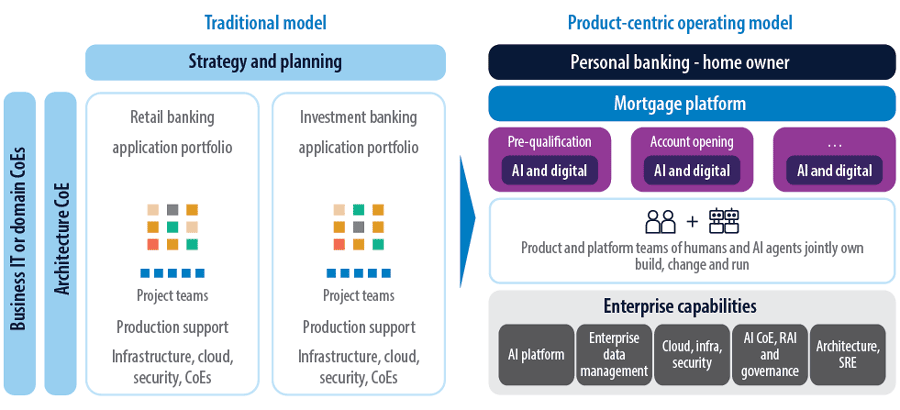
Using AI is only effective when the business integrates the technology to drive the transformation. Business holds the domain knowledge to build effective customer journeys by mapping value streams – making the critical steps in a workflow visible, removing waste and inefficiency, and shaping an experience that keeps people coming back to the product. Technology, for its part, provides the product and platform engineering capabilities that let teams deliver features quickly and at scale, increasingly by using agentic AI to reimagine how business and engineering workflows themselves get done, rather than simply automating pieces of the old process (Figure 1).
Figure 1. The PCVD model brings business and IT together around outcomes
Source: Infosys process engineering
Bringing the two functions together lets an organization track value through real business outcomes such as mean time to deliver and total cost of ownership using the OKR framework.
Governance needs to follow the same logic: AI oversight should tie directly to business outcomes so people can use AI safely and securely, with initiatives prioritized, funded, and scaled based on their expected value and the trust thresholds they meet, rather than on enthusiasm alone. This also changes the role of the product owner or product manager, who can, for example, use vibe coding to accelerate product discovery and opportunity mapping from months to weeks – while leading squads that are themselves evolving into human and AI agent ecosystems, which calls for new full-stack, platform, and AI skills.
The path to an AI-led enterprise
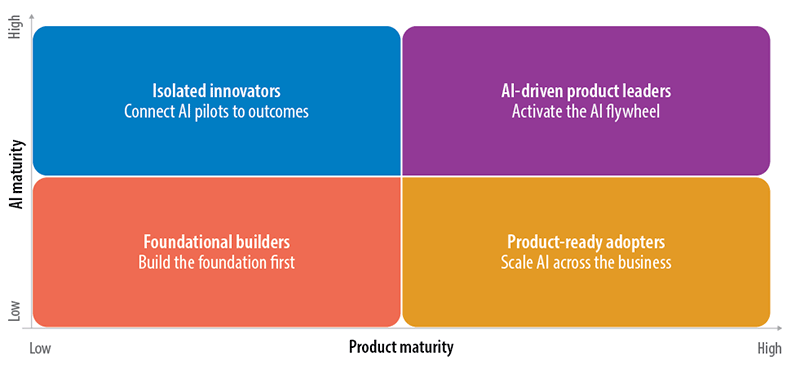
As organizations progress through different stages of AI and product maturity, the focus shifts from establishing foundational capabilities to creating self-reinforcing systems of innovation and growth to become AI-driven product leaders, with high levels of both AI and PCVD capability (Figure 2).
Figure 2. Companies move from foundational builders to AI-driven product leaders as maturity increases
Source: Infosys process engineering
Organizations can use the following guiding principles to scale AI, tailored to their current maturity state:
Foundational builders - establishing the conditions for scalable AI: Organizations at this stage must first create the structural foundations that allow AI initiatives to deliver sustainable value. This means building products, platforms, and outcome metrics before embedding AI. With limited product and AI capabilities, foundational builders should establish data mesh foundations, where each team owns its data while adhering to enterprise-level naming conventions; implement responsible AI policies; and put appropriate governance in place. Start with a low-risk product and use it as an internal proof point to fund broader transformation. The goal is to create a stable foundation where AI investments are connected to business objectives, reducing transformation risk while accelerating enterprise readiness.
Product-ready adopters - operationalizing AI across the enterprise: Organizations with mature product operating models can look at reimagining workflows with AI, prioritizing workflows that are low-risk and high-impact to achieve quick outcomes with confidence. By prioritizing low-risk, high-value AI use cases across value streams, productivity gains are realized before moving into customer-facing capabilities. Product-ready adopters should also build an AI platform layer that enables product teams to consume AI consistently. The goal is to find enterprisewide leverage that drives productivity gains, accelerates innovation cycles, and establishes consistency in AI adoption.
Isolated innovators - converting outcomes from AI experimentation into enterprise value: Organizations with high AI activity but fragmented operating models must identify patterns where AI has already yielded value so that these patterns can scale across workflows and value streams. This means aligning cross-functional product teams to value streams; reorganizing product teams with humans and AI while ensuring product ownership, funding, and joint accountability; and finally, strengthening observability and responsible AI before scaling. The goal is to create a shift from disconnected AI pilots to coordinated, enterprise-level value creation with clear accountability and measurable returns.
AI-driven product leaders - building a scaling, self-reinforcing AI enterprise: At this stage, AI becomes a strategic differentiator and a source of sustained competitive advantage. Organizations that are both product- and AI-centric are good at activating the AI flywheel, where more users generate more data, leading to better models, improved products, and ultimately more users. These companies design product architecture explicitly around this loop and design workflows with agentic AI. Another characteristic of these mature organizations is a shift from AI in products to AI as a platform play, offering AI platform capabilities externally as APIs, embedded features, or innovation partnerships that involve customers directly in product development while creating new revenue streams.
As Alok Uniyal, head of IT process consulting practice at Infosys, notes, AI-enabled digital talent is critical.
AI-driven product leaders either employ or upskill employees to fill full-stack engineering roles that work alongside AI practitioners and platform engineering experts.
Together, they integrate both front-end interfaces and back-end server-side systems, bridging the user experience and the AI capabilities that power it. The goal is an adaptive, learning organization where AI compounds value, accelerates innovation, and creates new growth opportunities: a live enterprise.


AI-powered observability and AIOps help manufacturers turn fragmented OT and IT signals into earlier warnings, faster decisions, and more resilient operations.
- 29 Sep, 2026

Token efficiency, or tokenomics, is now a primary design concern in AI deployments. To get ahead, organizations should build a framework of four composable levers, or thinking modes, applied across the agent stack to cut token expenditure without degrading output quality.
- 17 Sep, 2026
- 7 min read

Regulatory change is accelerating and breach costs are rising, yet most institutions still rely on periodic, manual risk assurance. Three structural gaps, spanning visibility, third-party oversight, and governance, leave institutions unable to keep pace. Building risk assurance as a continuous, AI-augmented capability closes these gaps. A four-phase roadmap helps institutions get there.
- 11 Sep, 2026
- 15 min read
