
Insights
- Speed and cost savings are quickly becoming baseline expectations, so the C-suite now wants evidence that AI improves marketing effectiveness and business value.
- Leading marketers are shifting measurement from campaign-level metrics to business outcomes, using mission-based goals, incrementality testing, and net promoter scores to show what marketing actually contributes.
- AI chatbots now stand between brands and customers, making consistent brand messaging, a presence in communities such as Reddit and YouTube, and companywide ownership of generative engine optimization essential for visibility.
- Governance and human accountability counterbalance AI’s scale. Clear limits on AI use, ethics review, and people responsible for judgment calls protect brands from stereotyping, sameness, and consumer backlash.
- Rising token and computing costs and fragmented tools are marketers’ next concern, and organizations that match model complexity to task complexity and build shared data foundations will scale AI more efficiently.
Marketing leaders feel squeezed on all sides by AI. That pressure is reshaping how they measure value, promote brands, and even determine who counts as the customer.
At the Cannes Lions International Festival of Creativity in June, marketing executives said they are moving past their initial focus on AI adoption. The priorities now are to prove AI’s effectiveness and keep brands distinctive amid a glut of indistinguishable AI-generated content. Marketing teams are also adapting to AI agents that increasingly mediate the relationship between brands and customers.
“Last year the conversations were volume, speed, scale,” one marketing leader said at a roundtable discussion sponsored by Infosys Aster. “And this year, they’re quality and control.”
This article draws on Infosys interviews with marketing and technology leaders from large consumer and B2B companies, and on additional group discussions that took place under the Chatham House Rule.
AI’s next level of value
Marketing leaders at Cannes Lions generally described AI’s benefits as incremental, uneven, or concentrated in isolated use cases, even after several years of rapid adoption.
“I really feel very confident that we’re saving an arm and a leg and a foot,” said Toni Clayton-Hine, CMO of EY Americas. “But I’m not always sure that those are of the same person.”
CMOs are still waiting for the day when fully autonomous, optimized campaigns and one-to-one personalization become the default.
Speed and cost savings remain AI’s clearest benefits in marketing, but leaders say they are rapidly becoming an expectation rather than a differentiator. What matters more in the C-suite is whether AI improves marketing effectiveness and business value.
Claire-Louise Green, vice president of enterprise marketing EMEA at Adobe, said her team reduced the development time of a campaign from three weeks to three days. She said that gives her team — and clients that use the same tools — “spare time back to be more creative, more strategic.”
Because the C-suite already expects those initial benefits, marketing leaders say they must focus more on AI’s effectiveness and on proving its value.
A marketing leader at a major software company described the pressure to demonstrate value in a marketplace flooded with data and signals. This company once had a backlog of roughly a quarter million leads, comparing them to “sawdust sitting on the floor.” Now, AI agents automatically qualify those leads and route them to sales. “It’s not a threat to our team,” she said, describing it as “money that was being left on the table.”
Simon Whitcombe, who leads Meta’s global business group covering its 500 largest partners in the US and Canada, pointed to returns from the platform’s targeting tools. “If you put a dollar into that machine, it spits out $3.82 almost immediately,” he said of Meta’s core ad prediction engine, citing revenue per advertising dollar. And he said that layering on automation tools like Advantage Plus shopping campaigns push that figure to $4.52 in revenue per dollar spent.
Aniz Ruda, vice president of data, insights, and performance marketing at Medtronic, said cost replacement and time savings were responsible for much of AI’s early value. The company replaced some outsourced work and software providers with AI tools and automated routine tasks such as meeting recaps.
Now, the medical technology and device company is building an audience simulation tool to project how content will fare against key performance indicators. Ruda said content tracking starts with engagement. But as the marketing team optimizes content, it needs to measure how that content influences more consequential metrics, such as brand lift and patient volumes.

Measuring success
At South Africa’s Nedbank, group chief marketing officer Khensani Nobanda restructured her team’s performance model to steer away from judging campaigns individually. Her team now organizes around 11 larger “missions” tied to outcomes like growing deposits. “The people who are working on that mission, they don’t get judged by one campaign,” she said. “They get judged by the overall mission outcome.”
Nobanda said she welcomes the new level of scrutiny that comes with her company’s revised marketing approach. If a campaign is not working, AI’s speed allows her team to switch directions quickly, rather than requiring the months that it once took.
At L’Oréal, global head of beauty tech services Nathalie Cabut tracks volume, quality, and conversion, anchored by a close focus on net promoter scores. In 2025, the company logged 120 million uses of its beauty tech services, including virtual try-on and diagnostic tools. But volume without quality is meaningless, she said. L’Oréal also tracks how many people continue with the experience until the end.
For Meta’s Whitcombe, the bigger shift in value is how it gets measured. Meta is now pushing advertisers toward “incrementality,” testing what a marketing message actually changed instead of crediting the last click before a purchase. “It’s not only bringing the CMO along for the ride, it’s really bringing the CFO along for the ride,” he said.
Marketing’s new customer
The struggle for brand exposure is as old as brands. In the internet age, marketing leaders have fought intensely to ensure that people can find their brands online through advertising and search engine optimization (SEO). That is still true, but the barriers that brands must navigate now are thicker and more complex.
Marketers are rushing to shift from SEO to generative engine optimization (GEO) or answer engine optimization. The browser search bar is less important as more customers start their search with an AI chatbot.
Mastercard recently found that its brand was not prominent in AI-driven search results, according to Raja Rajamannar, who was Mastercard’s chief marketing and communications officer for more than a decade. He said the company learned that 40% of the weighting of AI-driven discoverability was based on visibility on Reddit. The company had assumed that Reddit was a platform for “technology nerds and people who are really a little bit on the fringes.”
Rajamannar said the lesson he learned is that the “agenda is now being driven by folks outside of marketing.” He warned that brands that do not catch up will be left behind.
One roundtable participant said most CMOs cannot answer the question: “How is your brand showing up today?”
Jinx Joglekar, CMO of US telecom company Optimum, uses Adobe’s LLM Optimizer to track how the brand and its rivals appear in AI conversations. Consistency is critical because of how these systems work, he said. “If somebody is conversing with ChatGPT and there’s conflicting information, ChatGPT is like, ‘No, unreliable.’ And then they’ll deprioritize it.”
At Canva, Emma Robinson, head of B2B marketing, said every campaign should now be built with large language model (LLM) discoverability in mind. She described employee advocacy as an important amplifier. Robinson also stressed developing a strong presence in communities such as Reddit, Quora, and YouTube because algorithms and citations from those platforms have a significant influence on what LLMs prioritize.
In addition, Robinson said she is introducing new internal metrics — brand visibility percentage and share of voice within LLM answers — as counterparts to traditional B2B metrics like leads, pipeline, and closed bookings.
Search constraints make brand presence more important than it has ever been, Joglekar said. Marketing must now compete for visibility in a much narrower field. In traditional search, there was enough space for many competitors to share a results page. Now, generative AI engines cite only one to three sources per answer, which reduces opportunities, according to Infosys Knowledge Institute research.
To add to the complexity, no single function within a company can own every factor that generative engines evaluate, according to a recent Infosys Knowledge Institute article. This makes GEO a companywide initiative.

Focus on governance
Brand safety drew sharp warnings amid a growing backlash against AI-generated content and risks of serious missteps.
L’Oréal’s Cabut explained that the company’s CEO set a red line early in its AI adoption. The beauty company does not use AI visuals when “proving the efficacy of our products,” she said. “We don’t want to fake anything.”
Beyond that, every AI project at L’Oréal, consumer-facing or internal, passes through an AI ethics board.
Nobanda of Nedbank said her concerns go beyond individual campaigns to the training data. In AI-generated content about Africa, she said, “what gets spat out is basically ... a stereotypical view of what Africa is.” Instead of abandoning AI, she said there need to be more Africans using the tools and providing input.
Prasoon Joshi, chairman of Omnicom Advertising India, said the industry is not discussing often enough the values and ethics that anchor AI. He warned that marketers must use personalization judiciously when consumers are at a vulnerable point. “You’re not a psychoanalyst,” he said. “The consumer has not come to you as a patient.”
Sumit Virmani, global CMO of Infosys, was direct about where he would place the boundary. “Wherever data is involved, autonomous outcomes are welcome,” he said. “But where values and ethics come into play ... it can never be anyone but a human being, which has to be made accountable.”
Executives pointed to early signs of an industry response. One attendee cited a US radio company’s new tagline, “all human, all the time.” Others called for AI content disclosure standards.
The human edge
Agentic AI is expected to offer the next big advance for marketers as it takes on more tasks autonomously. However, several executives said it’s critical that people stay in control of AI outputs. One pointed to the shift from the concept of human in the loop to human at the helm.
Jonathan Adashek, senior vice president of marketing and communications at IBM, framed it as a distinction between tasks and roles. “AI is a voice; it’s an input into topics,” he said. Some roles will change or disappear, while new opportunities will emerge. But Adashek said the human touch will still be involved in much of the work.
Virmani offered a positive take on the marketer’s ability to balance technology and humanity. “AI will only make us do what we do better, faster, more effectively,” he said. “If it’s not, then you’re not using AI the way you should be using AI.”
Even so, some leaders warned that the pursuit of efficiency could gradually strip the human element from marketing. They highlighted the fear that AI-assisted work could become indistinguishable, brand-to-brand, campaign-to-campaign.
Tara Corey, senior vice president of marketing at Optimizely, predicted a resurgence of human-created art, creativity, and storytelling as a correction to AI’s ubiquity. With that in mind, she made a deliberate choice for the marketing platform company’s recent rebrand. Her team chose to work with a human artist while still using generative AI in other ways. “We really wanted to ensure that in this rebrand that we stood out,” Corey said.
Rajamannar said AI will democratize competition. “The entire output is going to look like a sea of sameness,” he said.
“The distinction of any company will come from its creative talent, innovative talent, smart talent all around ... It’s only people who will make the difference.”
The hidden cost of AI
As AI scales, cost is emerging as marketers’ next major concern.
“I don’t think people are as focused on the cost of implementing AI in the organization if they don’t do it right,” Adashek said. “If you just go out and say everybody, go create all the agents you want and go have fun … there’s a big token cost that can come with that.”
He also said expansive, individualized adoption could lead to data silos, in which disconnected tools never communicate with each other.
That warning was repeated at an Infosys roundtable. One executive said her company is rationing graphics processing unit capacity. She added that her company is working to help customers make more rational financial decisions about which model a task actually requires. “We can’t just all be using AI because those tokens are expensive,” she said.
Another roundtable participant described a similar shift toward matching model complexity to task complexity. Her company built a digital wallet that lets customers track AI costs in real time. One customer, for example, “burned through so many credits” running a complex model for simple, boilerplate work.
The talent shift
Technology investments only go so far if the people running them cannot keep pace.
Laura Knebusch, senior vice president of CPG marketing and customer experience at Georgia-Pacific, said talent matters more than restructuring the org chart. “The type of talent that is going to succeed in a world that changes this fast is probably different than the traditional talent we looked for,” she said. Roles will emerge that did not exist a couple of years ago, she predicted, while others fade in importance.
Knebusch argued that AI is only as good as the data and talent behind it, warning that without both, the technology will produce bad recommendations and bad decisions. That means recruiting and developing people differently, rewarding those who lean into change and are willing to operate without an established playbook. “Who’s going to embrace change? Who’s going to step up in times where there’s no answer that we know of?” she asked.
Adashek expects the biggest shift to show up in how people work and what they need to know, including how to collaborate with colleagues using different tools. He noted that the average shelf life of a technical skill is now just under three years. Employees must keep learning, he said, and organizations need to create space for experimentation and failure. One trait he sees becoming more valuable is judgment, since fewer human touchpoints mean each decision carries more weight.
Marketing’s new seat at the table
Leaders described how marketing’s role inside their organizations is starting to expand, a shift that predates AI but has accelerated.
At a roundtable discussion, organizers pointed to a growing disconnect. Technology, finance, and operations leaders have been making multiyear AI investment decisions without marketing in the room.
That concern helped spur plans for a new cross-industry AI leadership and governance body that will include the Association of National Advertisers, the American Association of Advertising Agencies, and the Interactive Advertising Bureau.
Rajamannar built what he calls the “business of marketing” at Mastercard, embedding technology, finance, risk, and human resources leaders directly within the marketing organization. The result, he said, was a “very, very productive partnership” between marketing and those functions.
Victoria Johnson, marketing operations director for the Mercedes-AMG PETRONAS Formula One team, described a similar dynamic where she has a seat at the table for commercial, tech, and marketing decisions. “We look at it from a business perspective, obviously a performance perspective — as we want to win — but also a brand perspective.”
Nobanda of Nedbank described a similar shift from a different angle. When the bank launched a major redesign of its flagship app, she volunteered to sponsor the initiative herself rather than leave it solely to a technology team. Her rationale was that technology projects need a customer lens from the beginning. “I want to show our CEO that this is actually possible,” she said.
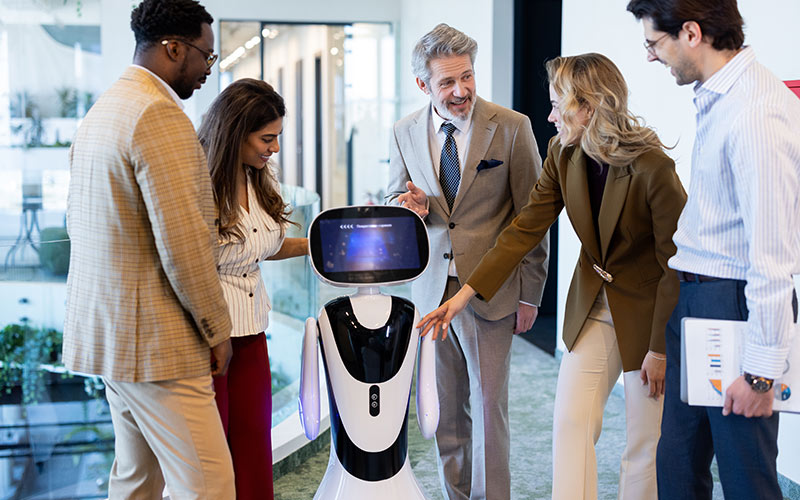
Marketers bring an emphasis on customer needs, brand considerations, and human outcomes in decision-making — elements that technology and finance leaders often overlook, Nobanda argued. Marketers are uniquely positioned to understand how AI affects customers and society. “Do you think the technology guy is thinking about the human element of AI?” she asked.
The future of marketing
When leaders revealed what excites them most about AI’s next phase, the answers went far beyond bigger and better tools.
Rajamannar predicted that the industry is on the verge of what he calls the fifth paradigm or era of marketing, a time when dozens of technological advances converge and force marketers to create new strategies and practices. He said 18 months is a generous time frame for marketers to prepare for what he describes as quantum marketing.
Green of Adobe pointed to the ongoing “renaissance of marketing.”
“It’s a time when marketing has never shown up so strong,” she said. “The pressure is on, but that’s so exciting for marketers.”
Adashek argued many companies are thinking too small, bolting AI onto narrow slices of the function instead of rethinking the whole operation. He described marketing as having three parts — orchestration, art, and science — and said AI needs to touch all three, not just creative, where many companies started.
Joshi explained that marketing is not static, and it never has been. Communication, he argued, does more than reflect cultural change. Brands that merely follow a cultural moment are riding it, while the ones that matter create it.
Knebusch expects that shift to arrive soon. Georgia-Pacific has built its data and process foundations. The next step is agents that surface trends and recommendations for her search, social, programmatic, and creative teams, without making final calls. “If we talk again next year,” she said, “we’re going to be working entirely differently.”


Effective TMOs align people, processes, technology, and data around value realization.
- 26 Oct, 2026
- 8 min read

Advanced AI depends on a small number of governments and businesses that could stop access at any moment. Businesses need a fail-safe sovereignty posture that’s managed as an architectural and risk-management discipline.
- 23 Oct, 2026
- 9 min read

Many enterprises are investing heavily in AI but seeing little return because they are not focusing on how the business is organized. The technology is important, but the operating model around it is even more so. Organizations that build a product-centric, platform-driven operating model can scale AI and foster measurable business value.
- 14 Oct, 2026
- 8 min read
