

Insights
- AI-powered platforms have displaced traditional search as the primary discovery channel: 68% of Google searches now end without a single click.
- Generative engines select sources based on semantic depth, entity clarity, and structural extractability — not keyword rank.
- GEO is an enterprisewide challenge that spans content, technology, data, brand governance, and public relations (PR), which makes cross-functional coordination essential.
- A phased roadmap that secures executive sponsorship and names a GEO lead is critical.
- Sustained AI visibility demands embedding GEO into editorial cycles, product release processes, and brand governance frameworks.
Generative AI platforms have become the primary discovery interface for hundreds of millions of users. But ChatGPT, Google Gemini, Perplexity, and Claude do not return ranked lists of links — they synthesize a single answer and cite only one to three sources. 68% of Google searches now end without a click. AI Overviews are the newest in a long line of search features that help resolve a user’s query without leaving Google. Marketing agencies report that the presence of AI Overviews now reduces the click-through rate for position 1 on online search by ~58%. For enterprises, the link between search rankings, web traffic, and revenue is broken.
Traditional search engine optimization (SEO) is no longer enough. Digital marketers are rushing to add generative engine optimization (GEO) to their daily activities. But GEO is structurally different from traditional search engine optimization in terms of what it demands organizationally. So how can organizations adapt to the new challenges of GEO?
The AI discovery shift has already happened
For two decades, search engine optimization governed digital visibility. Companies invested in keywords, backlinks, and page-speed scores to climb Google's ranked results. That model is now broken.
Generative AI engines have become the primary discovery interface for a new generation of users. ChatGPT reached 800 million weekly users by early 2025. Google's AI Mode has crossed one billion monthly active users globally, with query volumes more than doubling every quarter since launch. These platforms do not present users with a list of links and ask them to choose. They synthesize information from multiple sources and return a single authoritative answer. In that answer, only one to three sources are cited, if any.
68% of global Google searches now end without a click.
For businesses today, reaching the right audience means being the source an AI platform trusts enough to cite when it generates an answer.
How AI answers differ from search
What GEO optimizes
GEO is the discipline of ensuring that digital content is retrieved, recognized, and cited by generative AI systems.
GEO operates in a continuous cycle. A user submits a natural language query to a generative AI platform. The platform's retrieval systems search indexed content using a combination of keyword matching, dense vector search, and hybrid ranking. Candidate documents are scored for authority, extractability, entity relevance, and freshness. The AI reasoning model then synthesizes a response and selects the one to three sources it judges most citation-worthy. Analytics systems measure which sources were cited and under what conditions. That data feeds back into editorial and technical optimization, and the cycle begins again.
A new set of rules
The rules governing inclusion in an AI-generated answer are fundamentally different from those governing traditional SEO. Traditional search rewarded keyword density, backlink volume, and crawlability. These remain necessary elements even as search shifts. But they are not what gets a source cited by ChatGPT, Gemini, or Perplexity. Generative engines select sources based on five different dimensions:
- Semantic depth: Content that demonstrates expertise in a topic and its related concepts instead of surface-level coverage of target keywords.
- Entity clarity: Consistent, unambiguous naming and description of the organization, its products, and its people across the entire digital footprint.
- Embedding quality: How clearly and completely content is represented in the vector databases that AI retrieval systems search when assembling an answer.
- Chunk extractability: How easily AI systems can isolate a self-contained, citable passage from a larger document or webpage.
- Citation worthiness: The overall trust signals that lead an AI reasoning model to prefer one source over another are authorship credentials, original data, consistency of claims, and freshness.
GEO is the latest in the evolution of digital visibility disciplines. The figure below shows what distinguishes GEO from its predecessors and why each prior discipline is insufficient on its own (Figure 1). The five-way comparison includes SEO, answer engine optimization (AEO), AI SEO, large language model optimization (LLMO), and GEO.
Figure 1
| Dimension | SEO | AEO | AI SEO | LLMO | GEO |
|---|---|---|---|---|---|
| Primary objective | Rank pages higher in Search Engine Results Page (SERPs) | Appear in featured snippets and answer boxes | Maintain visibility in AI-enhanced search experiences | Improve LLM comprehension and embedding quality | Be selected and cited in AI-generated answers |
| Core success metric | Rankings, clicks, organic traffic | Snippet and answer box inclusion | Hybrid visibility (search and AI summaries) | Model understanding and retrievability | AI citations, inclusion rate, share of answer |
| Primary target systems | Google, Bing | Google snippets, voice assistants | SGE, AI overviews, AI-enhanced SERPs | ChatGPT, Claude, Gemini (model layer) | ChatGPT, Claude, Gemini, Perplexity |
| Visibility mechanism | Blue links in SERPs | Direct, short answers surfaced by search | Combination of links and AI summaries | Internal model knowledge and retrieval layers | Citations inside AI responses |
| Optimization focus | Keywords, backlinks, crawlability | Question-answer formatting | SEO and AEO adapted for AI contexts | Entity encoding, schema, machine readability | Authority, semantic depth, extractability |
| Content style | Keyword-optimized pages | Concise, factual Q&A | Hybrid (traditional and AI-ready content) | Highly structured, schema-rich documents | Long-form, authoritative, citation-ready |
| Role of structure and schema | Helpful but optional | Important for snippets | Important for AI parsing | Critical for embeddings and understanding | Critical for retrieval, reasoning, and citation |
| Role of authority and trust | Influences ranking via links | Moderate | Increasingly important | Indirect (improves model clarity) | Central decision factor for citation |
| Output type | Ranked search results | Single direct answers | Search results and AI summaries | Improved internal model representations | AI-generated answers with explicit attribution |
| Competitive intensity | High but many ranking slots | Limited per query | Increasingly competitive | Technical and internal | Extremely high (often 1-3 citations only) |
| Primary stakeholders | SEO and marketing teams | SEO and content teams | SEO, content, and AI teams | Data, AI, platform teams | Content, SEO, PR, analytics, AI governance |
| Time horizon | Established, mature | Mature but declining impact | Transitional | Emerging, technical | Emerging, high-impact, strategic |
| Does not optimize for | AI citation behavior | Multisource AI synthesis | Explicit citation selection | Business visibility and attribution | SERP rankings or click traffic |
Source: Infosys
No single team can solve for GEO
The deeper organizational problem is that GEO is not a single-function challenge. It is simultaneously a content problem, a data architecture problem, a brand governance problem, and a technical infrastructure problem.
Businesses are becoming invisible in AI answers not because their content is bad, but because no one function is equipped to optimize across all the dimensions that generative engines evaluate.
Content teams can improve semantic depth and answer capsule structure. SEO teams can fix technical crawlability and schema markups. Data teams can optimize embedding quality and structured data pipelines. PR and communications teams can build external authority signals. Brand teams can enforce entity consistency. But no single function owns all these levers simultaneously, and generative engines evaluate all of them in concert.
The result is a coordination failure. Organizations discover that their AI visibility problems are not fixable by the team they would instinctively assign them to. Marketing cannot solve problems that require engineering. And engineering cannot solve problems that require editorial judgment. The organizations that will win as AI-first discovery increasingly dominates are those that recognize GEO as an enterprisewide capability and govern it accordingly.
A further complication is the competitive intensity of the new environment. In traditional search, dozens of links appear on a results page, and multiple organizations can claim meaningful visibility simultaneously. In an AI-generated answer, a maximum of three sources is cited, if at all. The winner-take-most economics of AI citations make early investment in GEO capability substantially more valuable.
An enterprisewide shift is needed
How the GEO cycle works
The table below traces how a single user query travels through the GEO ecosystem, from prompt submission through retrieval, synthesis, citation, measurement, and re-optimization (Figure 2). Each step represents a point where organizations can intervene in improving citation outcomes.
Figure 2
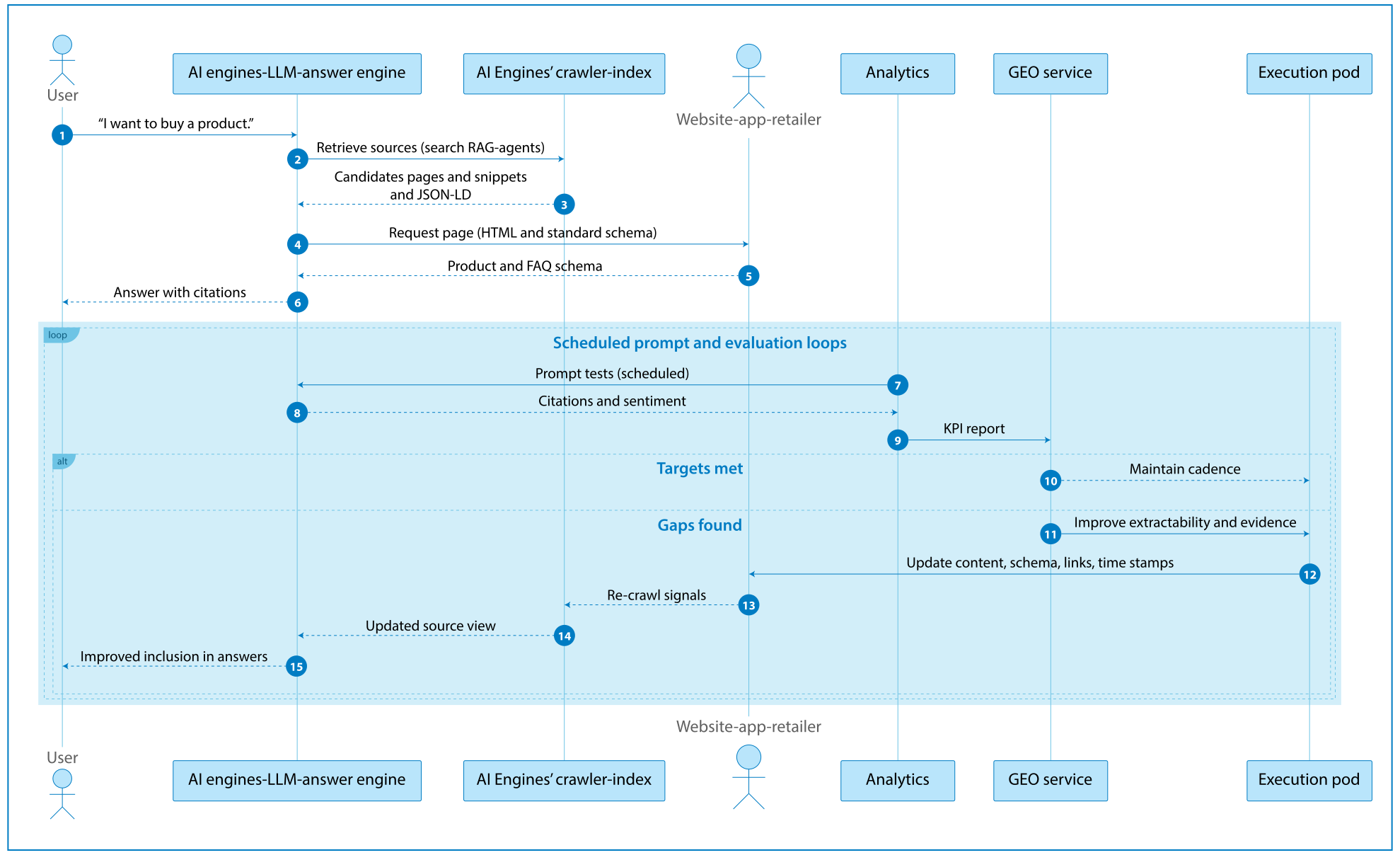
Source: Infosys
Build for both AI and humans
Generative engines consume content through semantic embeddings, vector retrieval, and retrieval-augmented generation (RAG) pipelines. Content optimized purely for human readability will not necessarily perform well in these systems. Organizations need to build for both audiences simultaneously.
The structural requirements are concrete. Content should lead with a 40- to 60-word answer capsule that directly addresses the most likely query intent. Heading hierarchies should be logical and consistent — H1, H2, H3 — with each heading acting as a self-contained descriptive label. Paragraphs should be short, with strong topic sentences and no ambiguous pronoun references. FAQ sections and direct question-and-answer blocks significantly improve extractability. Visible “last updated" time stamps strengthen freshness signals.
Technical foundations matter equally. A clean robots.txt, well-structured XML sitemaps with accurate time stamp data, consistent canonicalization, and comprehensive schema markup — including organization, product, and FAQPage schemas — create the machine-readable signals that AI crawlers depend on to index and rank content.
Essential GEO technical files
Four files form the technical baseline for any GEO program. The table below sets out what each does, whether it is required, and how to implement it correctly (Figure 3).
Figure 3
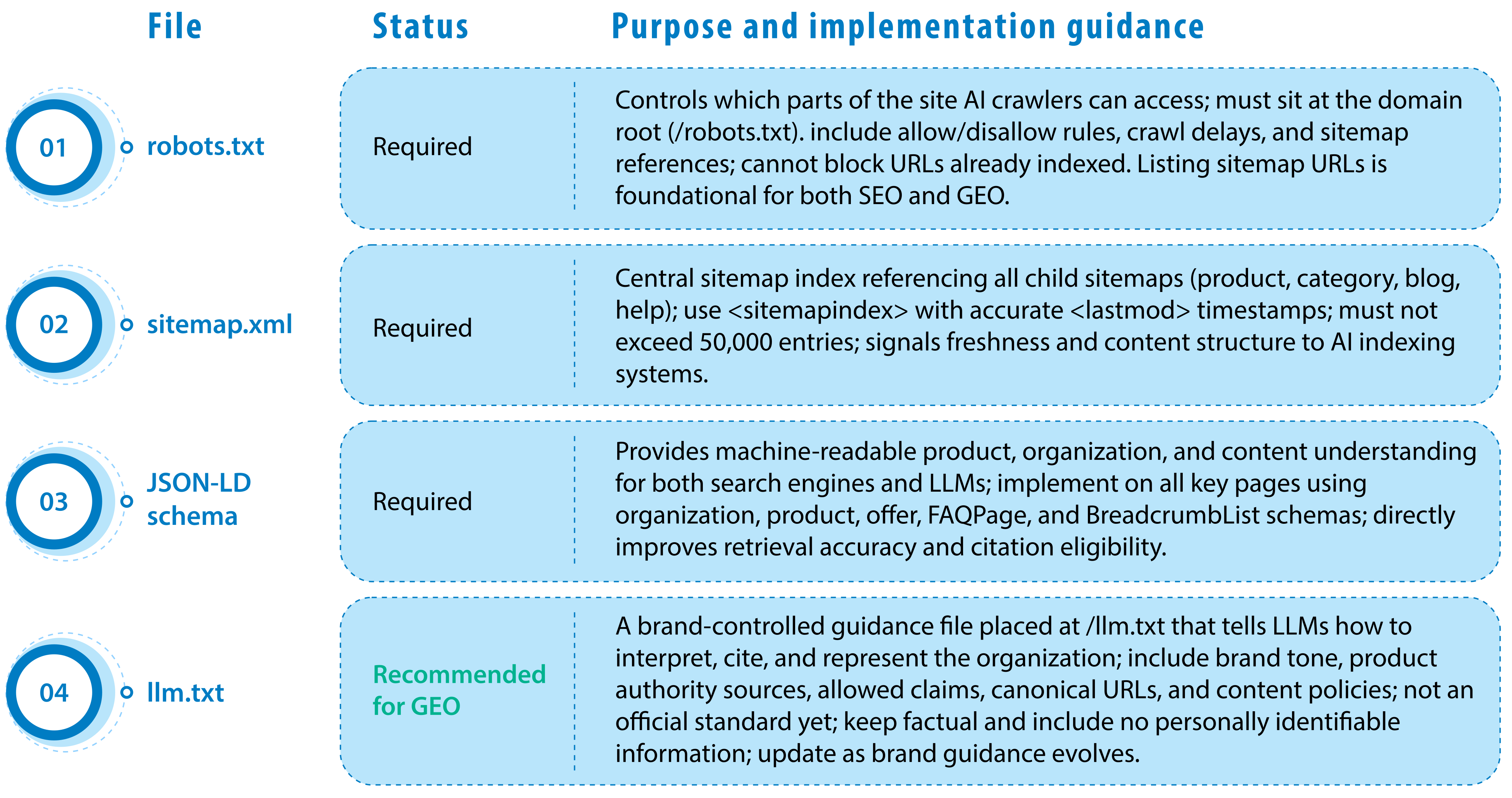
Source: Infosys
Build brand authority
Generative engines evaluate the consistency and authority of brand signals across the entire digital ecosystem: websites, review platforms, press coverage, directories, social content, product listings, and knowledge panels.
As a result, entity clarity is foundational. The organization's name, its products, its leadership, and its areas of expertise must be described consistently and unambiguously across every digital property. Inconsistent naming, like variations in brand name, product name, or spokesperson attribution, creates entity ambiguity that AI retrieval systems penalize.
Authority signals must be built deliberately. Original research, proprietary data, expert commentary, and thought leadership content give AI systems a reason to prefer an organization's content over a competitor's. These assets provide what AI researchers call "information gain," unique content not available elsewhere, which significantly increases citation probability.
Monitor AI visibility
Organizations cannot manage what they do not measure. AI citation behavior is opaque by design. There is no equivalent of a search engine ranking report that shows where a brand appears. Visibility must be constructed through systematic testing: submitting controlled queries across ChatGPT, Gemini, Perplexity, and Claude; recording citation outcomes; and tracking changes over time.
The primary indicator for measuring generative search success is the inclusion rate, the proportion of relevant queries for which the organization is cited. Citation position and coverage depth reveal the quality of citations when they occur.
Model-to-model variance shows whether visibility is platform-specific or genuinely broad-based. Competitor citation analysis identifies topical gaps that represent strategic opportunities.
This monitoring function must be continuous. Generative AI models retrain, update their retrieval indices, and modify citation behavior over time.
A roadmap for enterprise GEO authority
Building GEO capability is a multiphase program that, at maturity, operates as an ongoing business process embedded across marketing, product, technology, and governance functions. The roadmap below provides a structured starting point for organizations at any stage of GEO readiness (Figure 4).
Figure 4
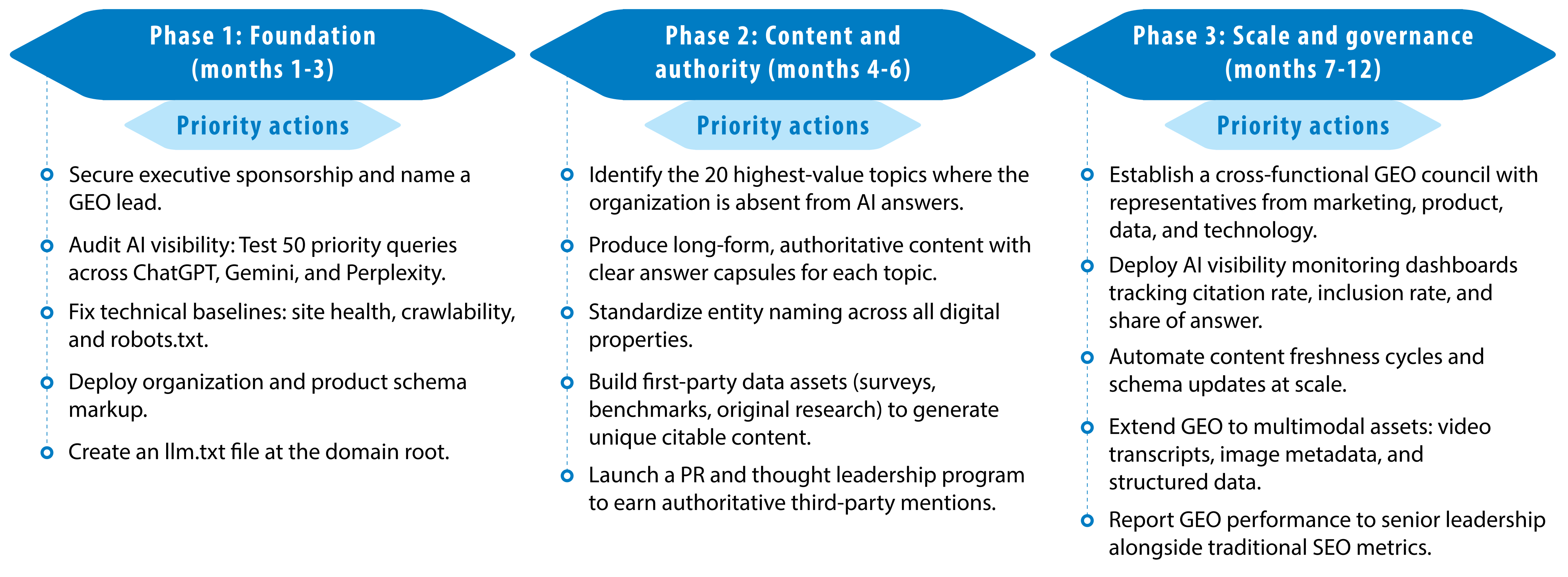
Source: Infosys
The organizational model: Cross-functional
GEO cannot be delegated to an SEO team or a content team. The breadth of optimization levers (content, schema, entity management, PR, technical infrastructure, and AI monitoring) spans too many functions for any single team to own.
The organizational model that works is a cross-functional GEO council with executive sponsorship. The council brings together representatives from marketing, product, data and technology, and communications under a shared mandate and shared KPIs. Executive sponsorship helps ensure that major investments, particularly in original research and first-party data assets, receive the leadership attention and support they require.
The GEO lead role is a new function. It requires a combination of content strategy expertise, technical SEO knowledge, familiarity with AI retrieval systems, and cross-functional stakeholder management skills. Organizations that establish this role early will build institutional knowledge that compounds over time.

GEO is not a one-time exercise
Generative AI platforms evolve continuously. An organization that achieves strong AI visibility through a single content refresh will lose that visibility within months if it treats GEO as a project.
Teams that operationalize GEO gain a sustained competitive advantage in AI-driven discovery. Those that delay risk becoming invisible in the ecosystems where their customers are already looking.
Sustaining AI visibility requires embedding GEO into editorial cycles, product release processes, brand governance frameworks, and technology roadmaps. Content freshness must be maintained through scheduled review cycles. Technical schema must be updated when products or services change. Entity signals must be audited whenever the organization undergoes a rebrand, acquisition, or significant strategic shift.
Looking ahead: Multimodal, multiplatform, and automated GEO
The current frontier of GEO is text-based. However, generative engines are expanding their ability to understand images, videos, and audio. Organizations will need to optimize video transcripts, image metadata, and diagram semantics to ensure AI systems can accurately interpret and reuse nontext assets.
The AI discovery landscape will also become more fragmented before it consolidates. ChatGPT, Gemini, Perplexity, Claude, and Microsoft Copilot each have distinct retrieval architectures, citation policies, and reasoning behaviors. Effective GEO will be multiplatform by design.
As enterprise content portfolios scale to tens of thousands of pages, products, and documents, manual GEO will become operationally impossible. Automation will be required. This includes programmatic content evaluation, automated schema generation, continuous freshness monitoring, and AI-assisted citation analysis. The organizations investing in these capabilities now will have a structural advantage when their competitors are still assembling the team.
For enterprise leaders, GEO will not be optional. They need to determine how quickly the organization can build the cross-functional capabilities, governance structure, and content infrastructure that AI citation authority demands. The organizations that move decisively now, establishing executive sponsorship, closing technical gaps, and investing in original content assets, will earn greater and more durable visibility in AI-generated answers. Those that wait will find the competition for one of the few citation slots increasingly difficult to win.


Regulatory change is accelerating and breach costs are rising, yet most institutions still rely on periodic, manual risk assurance. Three structural gaps, spanning visibility, third-party oversight, and governance, leave institutions unable to keep pace. Building risk assurance as a continuous, AI-augmented capability closes these gaps. A four-phase roadmap helps institutions get there.
- 11 Sep, 2026
- 15 min read

The difference between AI work and AI that works lies in the discipline to scale adoption, governance, and value realization
- 10 Sep, 2026

Learn how automated integrity checks and human oversight can help enterprises control AI agent sprawl, reduce duplication, and manage risk at scale.
- 08 Sep, 2026
