
Insights
- Traditional project management offices (PMOs) focus on delivery rather than sustained business value.
- Transformation management offices (TMOs) bridge the gap by connecting strategy, execution, adoption, and measurable outcomes across the enterprise.
- High-performing TMOs bring together people, processes, technology, and data and value, with AI strengthening insight and decision-making.
- As transformation becomes continuous, mature TMO capabilities can help organizations sustain value, adapt faster, and gain competitive advantage.
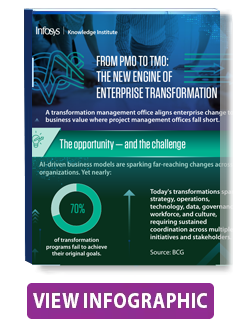
AI-driven business models are sparking far-reaching changes across organizations. Yet research finds that nearly 70% of transformation programs fail to achieve their original goals, indicative of a persistent gap between investment and realized value.
Today's transformations cut across strategy, operations, AI and other technologies, data, governance, workforce, and culture, requiring sustained coordination across multiple initiatives and stakeholders, visibility into enterprisewide progress, and clear value tracking.
This is where many traditional project management offices (PMOs) reach their limits. They excel at governing delivery, schedules, milestones, and execution discipline, but aren't built to connect strategy to execution, coordinate cross-initiative dependencies, or ensure that value lasts after deployment. Meeting the demands of large cross-functional transformations will require an evolution from PMO to the transformation management office (TMO).

Why PMOs struggle
Traditional PMOs are often structured around project delivery and sticking to the schedule, scope, and budget. By prioritizing those aspects, PMOs create a reporting framework that tracks execution instead of measurable business outcomes or value realization.
Other limitations of the PMO approach include limited portfolio-level visibility. While PMOs typically manage program or project portfolios, they do not always provide a holistic view of transformation progress via metrics, or align with strategic priorities. Additionally, change efforts related to the programs are often executed in silos, leading to uneven adoption across the organization and resistance to change.
A potential shortfall of the PMO approach is that enterprisewide governance may be lacking. Transformation initiatives span functions and business units, yet PMO governance mechanisms often remain fragmented. This limits coordination, and slows decision-making.
There are usually warning signs that a transformation has become too complex to manage through project controls alone. It’s when benefits are defined during business case approval, but ongoing measurement or accountability after go-live is inconsistent or absent. Governance, processes, and ways of working vary across programs, resulting in duplicated effort. Also, communications describe individual program changes well, but employees and stakeholders struggle to see how initiatives connect to enterprise strategy and long-term value.
Without a unified approach, initiatives can progress in silos while the overall transformation loses momentum. In many cases, organizations deliver projects successfully but fall short of the intended business impact. That is where a TMO fundamentally differs.
TMO: Connects strategy to business value
A TMO helps close that gap by making sure investments stay focused on strategic priorities, risks are addressed early, and every initiative is tied to measurable business outcomes, providing leadership with a single view across the entire portfolio.
TMOs can use AI to get a clearer picture of risks and value gaps that manual reporting often misses. Lloyds Banking Group is building AI capabilities across its workforce through internal academies, including within change and transformation.
Where a PMO asks whether a project is on track, a TMO asks whether the business is actually better off beyond go-live. AI also gives the TMO more leverage, helping leaders weigh different portfolio tradeoffs and understand where to invest, pause, or shift resources. It enables leaders to stress-test business cases and simulate decisions before committing spending, optimize transformation outcomes in real time, and continuously measure, realize, and sustain value through lasting adoption.
“Transformation doesn't end when you go live. A PMO helps deliver change and maintain business operations, while a TMO ensures the transformation continues to evolve, drive adoption, and deliver sustained business value. The PMO keeps the business running; the TMO keeps the transformation moving forward,” says Anil Menon, business transformation office leader at GlobalFoundries, a client of Infosys Consulting.
What it takes to build a high-performing TMO
Executives report that transformation budgets have expanded by up to two-and-a-half times in the past couple of years. This makes establishing a TMO more critical for these organizations.
To set up an effective TMO for transformation projects, organizations can start with a simple framework built around four connected components that need to work together: people, process, technology, and data and value.

They must execute four distinct steps:
Create leadership alignment: Align leaders around a compelling vision and a clear business imperative for change.
Evaluate transformation readiness: Assess whether the workforce, processes, technology, and value realization capabilities are well-equipped for the transformation.
Build a fit-for-purpose TMO: Ensure the TMO has the right capabilities, governance structures, performance metrics, and clear ownership to deliver results.
Drive strategy through execution: Translate strategy into sustained results through disciplined execution, quick wins, and adoption across the organization.
Infosys Consulting recently partnered with GlobalFoundries, a global semiconductor company, to evolve its PMO into a TMO. A target capability map, built around the four strategic objectives, guided the assessment of current maturity, the design of the future operating model, and the roadmap for long-term transformation.
The four objectives were enterprisewide transformation, continuous improvement, operational efficiency, and value realization.
“Every transformation should start with an honest evaluation of organizational capability. Do you have leaders and teams who understand the business problem and can define the desired outcomes, or are they primarily managing schedules and budgets? Without a clear articulation of the problem to be solved, the organization will struggle to lead the transformation and will instead be forced to react to events as they unfold,” says Menon.

Get the people dimension right
Successful transformations need individuals who possess the mindset, skills, and behaviors needed to navigate complexity and drive change. These skills include holding a multiyear vision while still pushing for visible wins early, being familiar with metrics and dashboards to ask sharp questions and spot when a number is misrepresenting reality, treating setbacks as signals to adjust the approach, and developing the capability of the people around them. A strong TMO standardizes these skills across programs and invests in capabilities beyond traditional program management, such as strategic planning, business acumen, data fluency, AI literacy, change leadership, and stakeholder engagement.
Consistent guidelines and tools across programs drive change adoption and ensure a uniform experience for employees. The TMO is a central link between programs and change management teams, playing a pivotal role in ensuring this consistency. By connecting what is being delivered with how people, processes, and behaviors are expected to change, it helps turn transformation plans into sustainable business outcomes.
Governance to standardize processes
Effective governance across processes and data requires clear ownership, standardized methodology, and data readiness. Clear governance is when anyone in the organization can look at a decision and immediately answer who decided it, based on what process, and what happens if something goes wrong. Fragmented governance limits visibility and increases delivery risk. TMO can leverage AI to automate intake, consolidation, and exception reporting, so governance forums can spend their time deciding instead of gathering information. Having portfolio-level visibility supports proactive risk management and timely course correction before value erodes.

Technology to turn data into actionable insights
Technology such as unified dashboards and data analytics gives teams one reliable source of information to guide and track the transformation. This helps organizations see across every initiative at once, tie each to business value, and stop the business value from getting lost because no one is tracking them. Agentic AI can reinforce this by tracking schedule slippage, flagging dependencies, and drafting decision-ready reporting in real time, not before steering committees. "An organization's greatest responsibility is not simply execution oversight, but ensuring the right questions are being asked about the data, technical solutions, and business decisions that underpin transformation efforts. I want my team to have the capability and confidence to determine where to invest, influence key decisions, and ensure every investment aligns with our strategic objectives," says Menon.
Value realization office to track benefits
A value realization office (VRO) that’s part of a TMO plays a critical role in ensuring that value realization does not end when a transformation program concludes. It provides sustained oversight by tracking, measuring, and reporting business outcomes and return on investment long after implementation, while capturing insights that can be applied to future initiatives. As AI takes over reporting, the VRO verifies that benefits match the business case.
"Business value realization must be continuously monitored. Technology and business processes can become stale over time, and without ongoing measurement, organizations may not realize value is eroding until they are already embarking on another transformation. Value must remain above an acceptable threshold, and when it declines, organizations need the visibility to understand why and respond quickly,” says Menon.
The shift to a TMO
Organizations establish a TMO because the scale, speed, and interconnected nature of modern transformation demand more than what traditional project governance can provide. As organizations pursue enterprisewide, AI-enabled transformation, they need a function that connects strategy, execution, and outcomes in a continuous cycle. A well-designed TMO provides that capability. It turns transformation itself into a repeatable engine for value creation, enabling organizations to move faster, align better, and deliver sustained business impact in a dynamic environment. “As AI accelerates the complexity and pace of transformational changes in organizations, managing transformation will no longer be a program with a start and end date but will become a process of ‘continuous transformation.’ Organizations with mature TMO capabilities for realizing value from transformation will have a competitive advantage," says Olu Adegoke, partner at Infosys Consulting.



Advanced AI depends on a small number of governments and businesses that could stop access at any moment. Businesses need a fail-safe sovereignty posture that’s managed as an architectural and risk-management discipline.
- 23 Oct, 2026
- 9 min read

Many enterprises are investing heavily in AI but seeing little return because they are not focusing on how the business is organized. The technology is important, but the operating model around it is even more so. Organizations that build a product-centric, platform-driven operating model can scale AI and foster measurable business value.
- 14 Oct, 2026
- 8 min read

Organizations must assess their current maturity and define their desired state to determine where to invest, before scaling.
- 06 Oct, 2026
- 8 min read
