

Insights
- AI pilots often fail to scale when organizations lack the capabilities and structure for enterprise-wide adoption.
- An AI capability maturity model helps organizations assess current AI maturity and define where they need to go.
- Five structured workstreams turn maturity goals into clear, accountable actions and funded initiatives.
- A sequenced AI roadmap helps organizations scale systematically and turn AI investment into sustained business value.
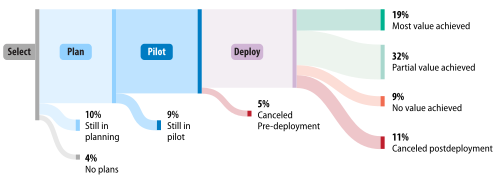
Ask most senior technology leaders whether their organization is investing in AI, and the answer is invariably yes. Ask whether those investments are building lasting competitive advantage, and the conversation becomes more uncomfortable. The pattern is familiar: a promising proof of concept in one business unit, a generative AI pilot in another, a vendor-led automation initiative somewhere else. Each initiative is celebrated at launch and quietly abandoned six months later. Infosys’ AI Business Value Radar shows that 5% of AI initiatives are canceled before deployment and 11% after deployment (Figure 1). The organization accumulates AI experience from experimenting with AI but rarely has the capabilities to scale successful initiatives.
Figure 1. Not all AI initiatives are able to achieve business value
Source: Infosys Knowledge Institute
The root cause is usually the absence of a coherent adoption architecture, which includes a shared understanding of the AI capabilities the enterprise needs to build, a structured way to assess how mature the organization is in each capability and determine an appropriate target, and a plan for sequencing AI implementation activities so that progress compounds. It is challenging for organizations to assess this without a structure in place. Adopting an AI capability maturity model can help organizations understand where they stand in the AI adoption process and where they need to get to.

Why pilots fail to scale
From Infosys’ experience, organizations often invest in standalone AI initiatives while underinvesting in the six capabilities required to scale AI: long-term vision, robust data foundations, governance, modern platforms, workforce readiness, and operating models that embed AI into everyday business processes. Without reusable platforms, standardized governance, executive sponsorship, and organizationwide change management, organizations struggle to extend isolated successes into sustained business impact. As a result, promising pilots remain confined to individual functions, lessons are not systematically shared, and each new initiative starts almost from scratch.
Another common mistake in enterprise AI strategy is treating maturity as a binary, thinking an organization either has AI capability or it does not.
Fill gaps with an AI capability maturity model
An AI capability maturity framework provides a structured approach that can help address these challenges and systematically accelerate enterprise AI adoption.
Before any organization can build a meaningful AI roadmap, it must agree on what it is building toward. There are six core capabilities that every enterprise must develop to generate sustainable, compounding value from AI. These organizational capabilities include a combination of strategy, architecture, governance, data, processes, and people that determine whether AI becomes a durable competitive advantage or an expensive experiment. No single capability is sufficient in isolation. It is the combination, operating as a whole which enables AI to become truly organic to the organization.
Organizations do not need maximum maturity across all six capabilities simultaneously. It is sufficient for them to have the right level of maturity for their strategic context, applied consistently and built incrementally. An AI maturity model helps organizations assess where they stand, identify capability gaps, and prioritize the investments needed to scale AI successfully.
A model such as the 5E maturity model developed by Infosys provides a shared language for this conversation. Each stage represents a meaningful, achievable advance in organizational AI capability, with a distinct strategic focus and a clear set of organizational benefits that justify the investment required to reach it.
Explore: Build evidence through low-risk experimentation
Most organizations begin in a state of curiosity mixed with uncertainty. The explore stage channels that energy productively, through targeted proofs of concept across AI/machine learning systems, generative AI, and automation. The objective is evidence-gathering, including working out which use cases create business value, where data gaps exist, and what level of AI literacy the organization needs to build. The benefit is greater confidence in where and how to scale AI. Organizations that invest properly in this stage avoid the far more expensive failure of committing large-scale resources to the wrong direction. Early wins, however small, can also build confidence and support for the next stages.
Enable: Design the architecture of enterprise AI adoption
Enable is where insights from exploration are translated into a coherent strategic design. Without this stage, organizations find themselves perpetually in the explore stage, running pilots that never mature into production capability. The benefit is elimination of fragmentation of AI initiatives and investments.
Establish: Build structures to make AI adoption sustainable
With strategic direction confirmed, the establish stage is where the organization builds the institutional capability to deliver AI at scale. This is the most operationally intensive stage as it requires genuine organizational change beyond just the technology deployment. An AI center of capability brings standards, expertise, and delivery together in one place. Governance moves from design to practice, with live tooling for bias detection, explainability, and model performance monitoring. Selected pilots are integrated into core business processes, delivering measurable value for the first time. The benefit is acceleration. Each reusable asset, shared standard, and proven deployment pattern created at this stage reduces the cost and time of every subsequent initiative.
Expand: Scale proven capability across the enterprise
Having established a proven foundation, the expand stage shifts the focus from building capability to multiplying it. AI moves beyond early adopter units into new domains, functions, and geographies through a federated model that empowers business units to drive their own initiatives within shared governance and platform frameworks. Machine learning operations and large language model operations practices automate and standardize model testing, deployment, and monitoring, helping organizations deploy models faster and maintain their performance quality in production. The benefit at this stage is compounding. As more functions adopt AI on a shared platform, data quality improves, models become more accurate, and the marginal cost of each new deployment falls. The enterprise achieves a state where AI moves beyond pilots program to become an operational capability that is structurally difficult for less mature competitors to replicate.
Excel: Operate as a system of AI systems
At the excel stage, strategy, governance, operating models, and technology infrastructure form an integrated, intelligent system. Data, models, and agents are modular and composable. Responsible AI is enforced at the platform level, making ethical operation the path of least resistance. The benefit is sustained, enterprisewide value.
Reusable components allow organizations to build and deploy new capabilities faster. As these capabilities are added, they strengthen the wider AI system, helping the organization anticipate and respond to market shifts more effectively.
The gap between where the organization stands today across each capability and where its strategy requires it to be is precisely what the roadmap is designed to close.

The execution engine
A maturity model without an execution mechanism is more of a diagnostic tool than a transformation program. The third dimension of this framework, sitting alongside the six capabilities and the five maturity stages, is five structured workstreams that translate strategic intent into concrete, accountable activity. Together, these three dimensions form a single integrated system: capabilities define what needs to be built, maturity stages define how far it needs to be built, and workstreams define who does what and when to get there.
The five workstreams make ownership clear and avoid the diffusion of accountability that undermines many AI programs.
AI governance and risk: Establishes oversight structures, risk appetite, approval authorities, and board reporting from the first executive sponsor appointment through to systemic risk monitoring at scale.
Responsible AI and guardrails: Embeds ethical principles, bias controls, explainability standards, and human oversight checkpoints into every model and deployment, evolving from manual review processes at the explore stage to platform-enforced safeguards at the excel stage.
Use case life cycle management: Manages the full pipeline from the initial idea through its operational life cycle, deciding whether a use case is worth pursuing, developing and deploying it, tracking whether it delivers the expected business value, and retiring it when it is no longer useful.
AI technology platforms: These build and develop the data, model, and agent infrastructure, from secure sandboxes and cloud services at the explore stage to a modular AI operating system with federated agentic orchestration at the excel stage.
Talent and change management: Develops skills, culture, and human-AI collaboration models across every stage, from initial AI literacy and champion networks through to AI-native organizational structures and continuous reskilling as an enterprise norm.
Each workstream is underpinned by more than 274 specific tasks and activities, each mapped to a maturity stage, a workstream, a priority level, and an organizational owner drawn from existing enterprise roles. These tasks are the raw material from which initiatives are assembled: related tasks within aligned workstreams are bundled into bounded projects that can be funded, resourced, and delivered coherently. Organizations do not need to hire a new team to execute this framework. They need to align the people they already have around a shared architecture of work, sequenced by maturity and structured by workstream.

Infosys has validated this structure through direct enterprise engagement. Facing pressure to stay competitive, a large retail organization in the ANZ region asked Infosys to help it move beyond isolated AI pilots to a scaled, enterprisewide AI capability spanning the board, management, and daily operations. The result was a board-ready case for a funded AI adoption journey, a standardized approach to delivering high-value use cases on common platforms with enterprisewide guardrails, and the foundation for an integrated, scalable system of AI systems that can be sustained over the long term. Rather than prioritizing speed, the focus here was on creating coherence across initiatives, investments, and capabilities. When capabilities, maturity stages, workstreams, and tasks operate as a single system, the organization stops debating what AI is and starts building what AI can do.
Turn tasks into an investment roadmap
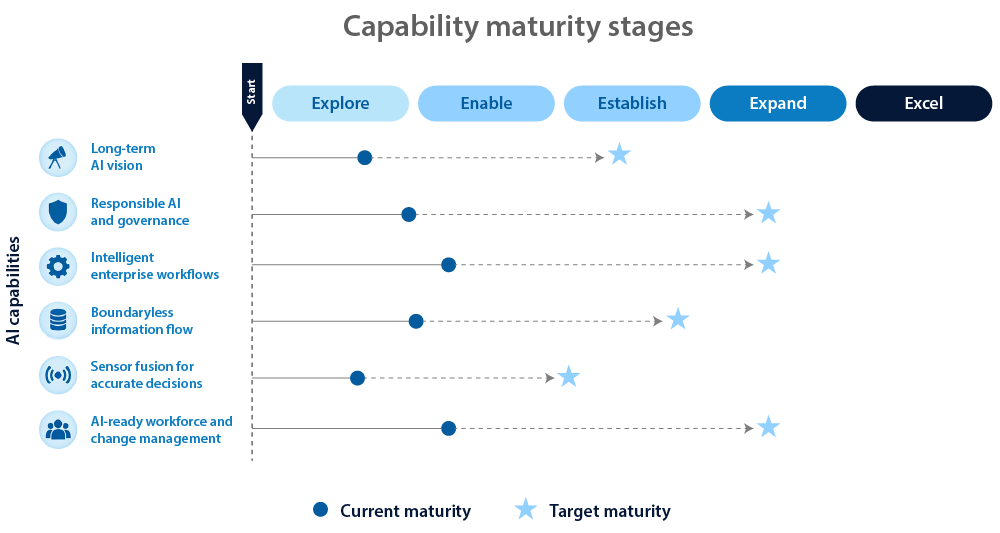
Tasks define the granular work. Initiatives are how that work gets funded, resourced, and delivered. The final step in building an enterprise AI adoption roadmap is selecting 10 to 20 initiatives from the task library, each representing a bounded project with clear deliverables, defined ownership, funding requirements, and an explicit connection to the capability uplift it is intended to achieve. Together, they form a portfolio of funded initiatives that moves the organization from its current maturity state toward its target state (Figure 2). The right number of initiatives is shaped by current maturity, target ambition, team capacity, and funding appetite. These initiatives should be sequenced across quarters so that early initiatives build the foundations on which later ones depend.
Figure 2. Organizations must assess their current and target AI maturity
Source: Infosys Knowledge Institute
Not every organization needs to reach the excel stage across all six capabilities. A focused initiative roadmap built around specific business priorities can generate significant, sustainable value at the establish or expand stages. The discipline is in defining target maturity deliberately, resisting the pressure to skip foundational work, and committing to the rigor of incremental progress, where each completed initiative enriches the intelligence and platform available to the whole enterprise.
The strategic choice
Executive teams face a critical question: Will their AI investments accumulate into lasting advantage or dissolve into a sequence of well-intentioned experiments that never quite scale?
The answer depends on strategy, a clear-eyed assessment of current capabilities, a realistic target maturity aligned with business objectives, and the organizational discipline to execute through structured workstreams. A governed roadmap sequences investments for maximum cumulative impact and gives boards the visibility to fund AI adoption with confidence.



Token efficiency, or tokenomics, is now a primary design concern in AI deployments. To get ahead, organizations should build a framework of four composable levers, or thinking modes, applied across the agent stack to cut token expenditure without degrading output quality.
- 17 Sep, 2026
- 7 min read

Regulatory change is accelerating and breach costs are rising, yet most institutions still rely on periodic, manual risk assurance. Three structural gaps, spanning visibility, third-party oversight, and governance, leave institutions unable to keep pace. Building risk assurance as a continuous, AI-augmented capability closes these gaps. A four-phase roadmap helps institutions get there.
- 11 Sep, 2026
- 15 min read

The difference between AI work and AI that works lies in the discipline to scale adoption, governance, and value realization
- 10 Sep, 2026
