
Insights
- Agents are reshaping how products are conceived, planned, and delivered, positioning AI as more than just a tool in product management workflows.
- Vibe coding is accelerating early validation by speeding prototype creation and experimentation before major investment.
- As AI automates more workflows, product manager and product owner decision rights and expectations increase, alongside intensified accountability.
- AI is moving from product management dashboards to end-to-end enablement, accelerating discovery insights, supporting definition decisions, and reducing execution overhead across the product life cycle.
- To get ahead, organizations should scale impact with a new product-centric operating model and staged maturity roadmap, while prioritising a few high-value use cases, set governance guardrails, upskill teams, integrate AI into core platforms, and measure and broadcast outcomes.
The evolution of artificial intelligence (AI) and AI agents is changing the way digital products are conceived, planned, and delivered. Product managers (PMs) and product owners (POs), traditionally responsible for managing teams and products, now operate in an environment where AI has the potential to become more than just a tool.
Vibe coding, a term used to describe the production of software through natural language prompts, as exemplified by tools such as Replit, Cursor, Infosys Topaz Fabric Viber, and Lovable, increases the speed of prototype creation, while expanding creative bandwidth and accelerating experimentation before investment. It has proved promising in Infosys client implementations.
Netra Chandramohan, a product manager writing on Medium, says: “I view vibe coding as a way to accelerate the part of the work that benefits most from speed: early validation.”
AI systems are also beginning to show emerging capabilities in contextual reasoning and multistep orchestration. Autonomous agents can be used to automate whole product management workflows, including the product definition, design, and development phases, giving rise to evolving PM roles in AI orchestration, supervision, and strategic alignment.
AI is augmenting both PM and PO roles, helping them adapt to changing markets by assisting with data analysis and insights, supporting more informed decisions, and providing faster responses to customer needs.
For example, Infosys Manufacturing is working on use cases such as turning high-volume customer feedback into actionable product roadmaps, and using AI to accelerate operational decisions that influence product strategy.
In paper box manufacturing, AI was used as a decision-support teammate. The AI system assisted with waste and scrap rate modeling, and provided optimal sequencing and timing recommendations for producing the paper boxes. This enabled better coordination across logistics functions, resulting in more productivity and throughput, reduced lead time, and greater speed and reliability for customers. With improved service, customers now order more, increasing data for regional product customization and further logistics efficiencies.

Clout in the organization
Getting AI right will make PMs and POs more important in the enterprise. According to an MIT Sloan Management Review report published in late 2025, 76% of executives say they view agentic AI as more like a coworker that gives employees the freedom to focus on higher-value work, a shift that influences the structure of roles and allocation of decision rights. As AI-augmented and AI-automated workflows become more common, the responsibilities of PMs and POs will in turn shift to higher-level decision-making and product development.
According to Airtable, an AI app building platform that publishes annual predictions for product teams, its 2026 report highlights that 92% of product leaders globally now own revenue outcomes for their business function or product unit, marking a significant shift in the last four years, from just 45% in 2022.
From should-have to must-have
While in the past software systems provided dashboards and alerts for enterprise project management, modern AI systems such as Topaz Fabric Viber can help analyze difficult requirements, reason through product options, generate roadmaps and strategies, detail user stories, and even create prototypes. Infosys Topaz Fabric Viber includes a product discovery tool that informs final product concepts, minimum viable product prototypes, and interactive demos and microsites.
Beyond providing prototypes, data analysis and insight creation, we’ve written how AI plus humans lead to competitive advantage, including faster time-to-market, higher quality outputs, and enhanced operational resilience. As a culture of experimentation, refinement, and then scaling becomes a part of enterprise-wide processes, the organization can build something that customers actually want. As Alok Uniyal, senior vice president of process engineering at Infosys, says in this article, delivering features in short iterations with AI using a minimum viable product-based approach enables organizations to validate customer and market data and then move quickly as needed. This enables the creation of customer journeys that lead to demonstrable business value, as tracked through objectives and key results.
AI and agents then become a way of gathering this data more quickly and acting on it decisively. Instead of cluttered to-do lists that have no bearing on the success of the product, organizations move toward automated, AI-driven workflows that are optimized for strategic value.

A new operating model
However, while some product management surveys show strong AI investment intent, many organizations struggle with fragmented data, uneven team adoption, and unclear ROI baselines. Product teams will also have to improve their governance processes, reduce reliance on aging business support systems that lack AI functionality, and fill skills gaps. McKinsey found that adoption, satisfaction, and ultimately topline growth increase when users can trust the AI’s outputs. Separately, according to Infosys’s own work with clients, many organizations don’t know where AI is best used in different phases of the product life cycle, and product teams struggle to build the necessary influence with senior leadership to onboard the necessary AI vendors.
To move ahead, organizations will require a new product-centric operating model, fast onboarding of vibe coding with appropriate guardrails, and a staged, outcome-driven maturity roadmap for PMs and POs that communicates AI’s importance to leadership.
In this new operating model, the PM and PO become an integral part of product-centric value streams composed of PODs. PODs are small, autonomous, cross-functional teams typically consisting of between five and 10 members, including software engineers, designers, quality assurance specialists, and PMs and POs, all focused on a single product or value stream. These teams have the expertise to deliver complete software features without external dependencies, delivering business value faster.
In our implementations, we’ve found AI can help across all stages of the product life cycle or customer journey, from discovery to definition to development and product iteration.
AI can assist at four key points:
- Insight acceleration during the discovery phase: AI helps synthesize user feedback, market research, metrics, and historical data to highlight trends and opportunities.
- Decision support during the definition phase: AI creates scenario simulations, compares trade-offs, and recommends options, enabling more confident decisions.
- Execution enablement during both the definition and development phases: AI drafts user stories, acceptance criteria, release notes, and product vision statements and opportunity assessments, reducing operational overhead.
- Innovation during both discovery and iteration: AI helps idea generation, journey modeling, and prototype creation using vibe coding, while expanding creative bandwidth and accelerating experimentation.
For example, a global enterprise worked with the Infosys product transformation team to build a new customer experience.
While the organization had clarity on business goals and customer pain points, it struggled to move from ideas to product concepts.
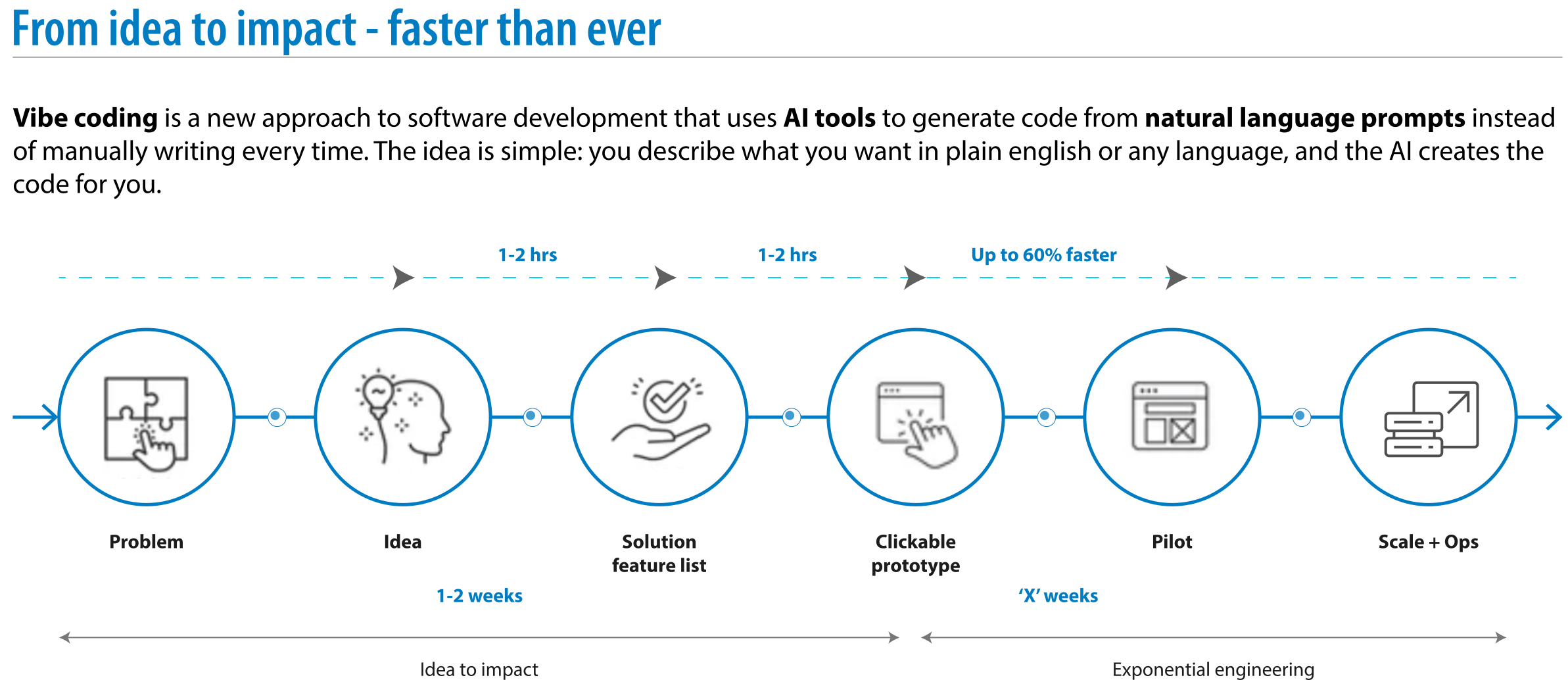
Early-stage design typically required multiple weeks of wireframing, visual exploration, and stakeholder review cycles, delaying alignment and slowing the product strategy. Product definition challenges included transforming high-level concepts into visual representations; long turnaround time for design iterations; misalignment between business, design, and engineering stakeholders; an inability to compare multiple experience directions side by side; and delays in making decisions. The team used vibe coding to quickly generate visual prototypes from natural language descriptions of the required customer experience. Large language models, trained on domain-specific data, were able to convert brainstorming notes and business ideas into visual concepts, before generating multiple options for the customer experience in just a few hours. Also key was AI’s ability to enable rapid comparison of design alternatives.
The approach led to a more than 70% reduction in the time it took to make decisions, though it should be noted that this company was working with mature data and governance processes already in place. Also notable was the higher level of stakeholder confidence thanks to AI allowing the team to explore more concepts in a shorter time. This meant that the time needed to reach clarity was much shorter, improving time-to-value (Figure 1).
Figure 1. Vibe coding increases speed in design decisions
Source: Infosys
An outcome-driven roadmap
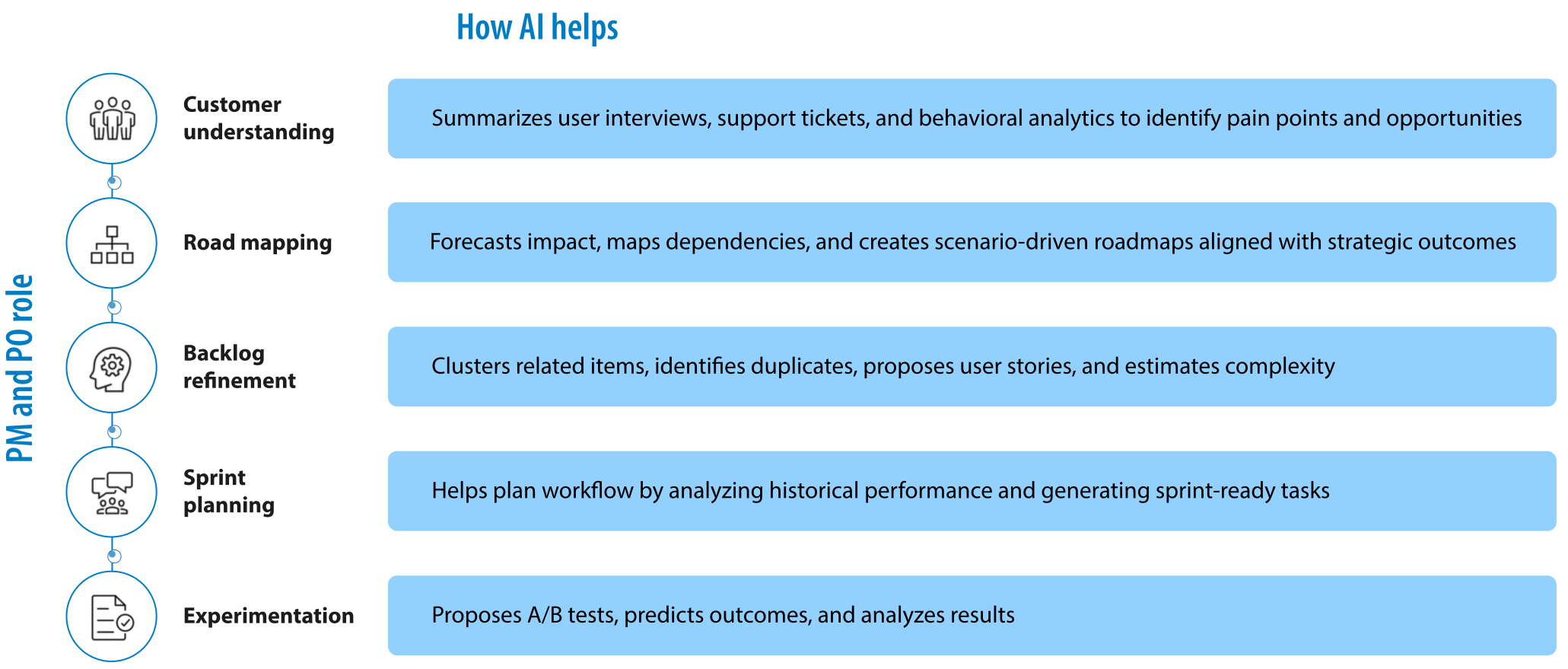
PM and PO responsibilities will continue to evolve as AI is adopted in production environments, moving from manual backlog management and feature development to managing strategy and delivering business value at speed (Figure 2). However, these shifts will require careful change management, clarity of what the AI system can and should do, and what should be left entirely to humans, and redefinition of communication patterns and roles within the team.
Figure 2. AI supports lower-level tasks, freeing PMs and POs to deliver higher value
Source: Infosys
To get to this level of automated workflow, organizations should implement a staged, outcome-driven maturity PM/PO roadmap composed of five stages:
- Prioritize high-value use cases: Identify the two to three workflows where AI delivers immediate uplift. For example, backlog refinement and insight synthesis are good choices to demonstrate visible productivity gains.
- Establish governance for responsible scale: Define transparent AI policies and guardrails so teams can safely adopt automated decision support without slowing experimentation.
- Upskill product teams for AI-assisted workflows: Equip PMs and POs with prompt engineering and workflow‑orchestration skills so they can confidently work with AI tools.
- Integrate AI into core PM platforms: Embed AI capabilities directly into Jira, Azure DevOps, and product analytics systems to ensure AI becomes part of daily execution rather than an external add-on.
- Measure and broadcast impact: Track velocity, decision quality, and customer outcome improvements to validate ROI and build leadership momentum for continued AI scaling.
The last two stages, integrating AI tools into platforms and establishing AI evaluation metrics, are important to ensure the teammate operating model works at scale, and also to persuade senior leadership to get behind further implementations. This will also have the benefit of accelerating timelines and helping to thwart change fatigue by removing blockers and instilling a sense of shared purpose.
A materials quality engineering team that Infosys is working with was struggling with slow material quality diagnosis timelines and limited insights into defect patterns.
Infosys showcased a process optimization platform capable of deep material analysis and predictive defect simulation, providing AI-generated root cause analysis, event timeline generation, and AI-based task assignment.
Integrating the platform will enable PMs to track how imperfections spread throughout a material and how good the material is for a specific purpose, while providing engineers with configurable alert thresholds. Metrics tracked include root cause identification, which was between 50% and 70% faster in the demo, though results vary widely outside controlled scenarios, defect reduction, cross-functional alignment, and operational risk reduction through safe predictive testing. In this way, the quality engineering process can be continuously improved with outcomes aligned to the product roadmap, strengthening product iteration in measurable ways.

The human side of product management
In this new operating model, leaders must communicate the importance of human judgment, creativity, and innovation.
Indeed, AI makes human thinking even more valuable, says Infosys CTO, Rafee Tarafdar. With the rise of agents and automation, execution can be scaled by machines, but designing work and applying fundamental thinking should remain with humans. In simple terms, product owners should focus on understanding problems deeply, while using AI to execute faster. Another skill gaining importance is storytelling. "You must be able to simplify complex ideas and explain them clearly so that even a child can understand”, Tarafdar says. In an AI-driven world, the ability to communicate ideas may matter as much as building them.
To get ahead, organizations should upskill PMs and POs through AI literacy, hands-on training, and workshop exercises that help pair AI insights with human judgment and domain knowledge.
Also, training in data interpretation, AI-human communication, and scenario planning is critical. This last program can be delivered via AI guilds, where PMs and POs can share insights and bring employees together with AI mentors.
With three-quarters of product teams due to invest more in AI in the year ahead, organizations should embrace this shift early to gain a competitive advantage and ensure PMs and POs can work with agents to reshape the product management role for the new AI landscape.

Regulatory change is accelerating and breach costs are rising, yet most institutions still rely on periodic, manual risk assurance. Three structural gaps, spanning visibility, third-party oversight, and governance, leave institutions unable to keep pace. Building risk assurance as a continuous, AI-augmented capability closes these gaps. A four-phase roadmap helps institutions get there.
- 11 Sep, 2026
- 15 min read

The difference between AI work and AI that works lies in the discipline to scale adoption, governance, and value realization
- 10 Sep, 2026

Learn how automated integrity checks and human oversight can help enterprises control AI agent sprawl, reduce duplication, and manage risk at scale.
- 08 Sep, 2026
