

Insights
- AI is becoming part of everyday work, with most employees using it daily and showing strong enthusiasm for it.
- However, organizational support is inconsistent and misaligned with what employees need.
- Gaps in training, tools, clarity, and leadership are slowing broader, equitable adoption.
- Closing this experience gap is critical to remove AI adoption barriers, and scale adoption and impact.
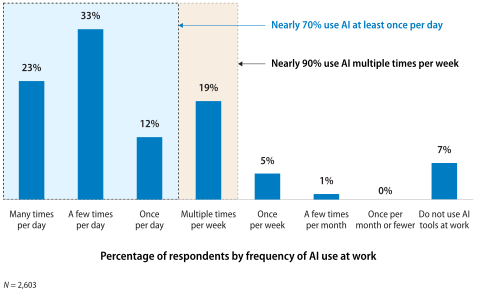
What began as experimentation with an emerging technology is turning into routine for employees. Recent findings from the Infosys AI and the Future of Work report show that nearly 70% of employees now use artificial intelligence (AI) at least once a day (Figure 1). Across industries, office workers are now reaching for AI tools to search, summarize, research, and create content.
Sentiment is also keeping pace: around 45% of employees say they feel excited about using AI at work, while nearly 40% feel confident, motivated, and optimistic. For all the anxiety often associated with automation, concerns about job displacement appear muted, with only a small minority fearing their jobs will be eliminated.
Yet beneath this enthusiasm, organizations are falling short on building the foundational practices needed to support employees in adopting AI. To enable sustained adoption, they need to deliver on the conditions for AI adoption such as regularly upskilling employees, building their trust in AI through transparent communication about both AI’s successes and risks, and fostering an environment of psychological safety.
Figure 1. Employees use AI often at the workplace
Source: Infosys Knowledge Institute
The overlooked gap
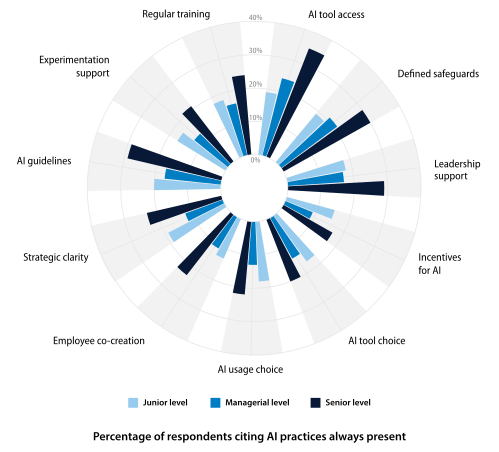
Despite widespread use of AI, organizational support remains uneven. According to the Infosys study, having defined safeguards for AI use, regular training, AI guidelines, and AI tool access are factors that close to 60% of the respondents say are ‘very’ or ‘extremely important’ for them to adopt AI. However, only around 20% say their organizations are always implementing those practices.
Other practices employees consider important include AI usage choice, tool choice, clear AI strategy, and visible leadership support, among others, without which sustained AI adoption is difficult. Among managerial-level and junior-level employees, less than 20% say they are always being provided with these initiatives (Figure 2).
Figure 2. Employees aren’t getting enough support from their organizations
Source: Infosys Knowledge Institute
This is striking not because organizations are inactive, but because their efforts are misaligned with employee needs. It reveals an experience gap between what employees need to adopt AI and how organizations are enabling the conditions to use AI.
There’s a gap between what employees need to adopt AI and if organizations are enabling the conditions to use AI.
This gap shows up in several ways. Access to tools is inconsistent across job levels: 35% of senior leaders say their company always provides access to AI tools, while only 24% of middle managers and 19% of junior workers say it. There is also a clear gap in perceptions of getting leadership support and clear guidelines on AI usage: 30% of senior leaders report they are always provided with well-defined safeguards, compared with only about 20% for middle and junior staff.
Employees need both access to tools and the confidence and clarity to use them effectively. But training is often episodic rather than continuous. Leadership engagement is lagging. Policies on privacy, security, and accountability are either unclear or overly restrictive. While well-defined safeguards are arguably the most important signal, they frequently lag reality.
Organizations also differ in how they incentivize AI adoption: 17% of senior leaders say their company always provides incentives for AI use, compared with just 9% of middle managers and 15% of junior employees.
Such mismatches matter., as they slow adoption and create friction. More critically, they risk entrenching inequality: between senior and junior employees, between early adopters and the rest, and between functions that are AI-enabled and those left behind.
Evidence of this imbalance is already emerging. In some organizations, much of the productivity gains from AI are being captured at senior levels, leaving substantial value unrealized across the broader workforce. It’s imperative for organizations to close this experience gap. AI’s promise lies in the ability to reshape processes, roles, and business models — but that demands scale, and scale demands consistency.
AI’s promise lies in systemic transformation — the ability to reshape processes, roles, and business models.

Playbook for AI adoption
Enterprises need to shift from treating AI adoption as a discrete initiative to embedding it as a core organizational capability. To achieve this, they must take a set of pragmatic, if demanding, steps.
Make training continuous
The first is to rethink their AI training strategy. Too often, organizations approach AI capability-building as a one-off exercise — an onboarding module, a workshop, or a pilot program. This reflects a misunderstanding of the nature of AI itself.
With AI tools evolving, new capabilities are emerging, interfaces changing, and best practices still being defined. In such a context, static training quickly becomes obsolete. Employees do not need a single moment of instruction but ongoing learning. This means embedding AI training into the rhythm of work, through short, frequent sessions; peer learning; hands-on experimentation; and role-specific guidance. It also means recognizing that AI literacy is not uniform, and that different functions will require different depths and forms of engagement. A one-size-fits-all approach to AI training across job levels is also unlikely to succeed. Because senior leaders, middle managers, and junior employees perform different types of work, organizations should design role-specific training that equips each group to use AI confidently and effectively.
Clarity breeds confidence
The second imperative is clarity. Employees may be eager to use AI, but enthusiasm can give way to hesitation in the absence of clear guidelines. Concerns around privacy, data security, and accountability are not trivial. Indeed, 23% of employees cite such concerns as barriers to adoption. Without clear guardrails, employees are left to navigate these risks on their own, and might end up erring on the side of caution.
Organizations must articulate what is possible and what is permissible. This includes defining acceptable use cases, establishing protocols for handling sensitive data, and clarifying responsibility for AI-generated outputs.
Safeguards should enable use, not restricting unnecessarily. The goal should be to create a framework that fosters trust while allowing experimentation and innovation.

Access to tools matters
The third step is ensuring access to the right tools, and doing so without excessive friction. Even the most motivated employees cannot use AI effectively if access is limited or cumbersome. Approval processes that are opaque, lengthy, or inconsistent can quickly dampen enthusiasm. In some organizations, employees resort to using unsanctioned tools simply to get their work done — a workaround that introduces its own risks related to data security, compliance, intellectual property, or audits.
Streamlining access, standardizing toolsets where appropriate, and reducing approval bottlenecks are therefore essential. Equally important is aligning tool availability with the needs of different roles. AI tools should be as accessible and integrated as other enterprise systems.
Additionally, organizations should give employees the flexibility to choose the AI tools, and decide when and where to use them based on what best fits the demands of their roles. It is also important to keep these practices consistent across job levels, so employees at every level can experience the benefits.
Leadership in action
The fourth lever is leadership. In the adoption of any new technology, the behavior of leaders sends powerful signals. Employees take cues from both what leaders say and what they do. If leaders use AI in their own work and share both successes and failures, they legitimize its use across the organization. They also help demystify it, making it more approachable for the hesitant.
Conversely, if leaders remain distant from AI, adoption risks stalling at lower levels. It becomes something employees do despite the organization, not because of it. Effective leadership requires more than endorsement. It calls for participation, transparency, a willingness to experiment publicly, and being role models.
Make communications impactful
Finally, AI strategies, however well-conceived, cannot drive adoption if they are poorly communicated. Employees need to understand what tools are available and why AI matters to the organization in terms of its long-term goals, and how it aligns with broader business priorities. Clear, consistent internal communications helps individuals understand the bigger picture. It also reduces uncertainty, aligning expectations across the organization.
From enthusiasm to execution
Employees are pulling AI into their daily work with remarkable enthusiasm. But there’s a risk of AI adoption not reaching its full potential if the gap between employees’ needs and consistent organizational support isn’t closed. Closing the gap requires sustained focus on training and reskilling programs, policy frameworks, tool access, leadership engagement, and communication strategies. AI’s value lies in enabling people to work better and giving them the conditions to do so.



Regulatory change is accelerating and breach costs are rising, yet most institutions still rely on periodic, manual risk assurance. Three structural gaps, spanning visibility, third-party oversight, and governance, leave institutions unable to keep pace. Building risk assurance as a continuous, AI-augmented capability closes these gaps. A four-phase roadmap helps institutions get there.
- 11 Sep, 2026
- 15 min read

The difference between AI work and AI that works lies in the discipline to scale adoption, governance, and value realization
- 10 Sep, 2026

Learn how automated integrity checks and human oversight can help enterprises control AI agent sprawl, reduce duplication, and manage risk at scale.
- 08 Sep, 2026
