

Insights
- Employees are realizing the value of AI in their work.
- But adoption and confidence vary sharply by job level.
- This organizational divide risks slowing enterprise-wide transformation.
- To address it, companies must move beyond one-size-fits-all approaches and invest in inclusive, role-based enablement, broader access, peer learning, and continuous tracking of adoption.
Artificial intelligence (AI) is moving from being an ambition to becoming part of day-to-day work. Infosys’s AI and the Future of Work research reveals that the overall sentiment toward AI in the workplace is largely positive. Many employees view AI as a tool that enhances productivity and reduces repetitive work. Many knowledge workers are already using AI for search, content creation, and information summary, and report tangible benefits such as time savings and improved focus on higher-value tasks.
For business leaders, this is an opportunity. A workforce that is already receptive to AI reduces one of the biggest barriers to digital transformation: cultural resistance. Yet beneath this encouraging surface lies a more complex reality. A noticeable gap is forming in how senior employees, middle managers, and junior employees engage with AI, and this difference carries consequences for scaling enterprise AI adoption. For truly strategic AI adoption to happen, organizations will need to close this divide with focused initiatives.
A noticeable gap is forming in how senior employees, middle managers, and junior employees engage with AI

The widening gap
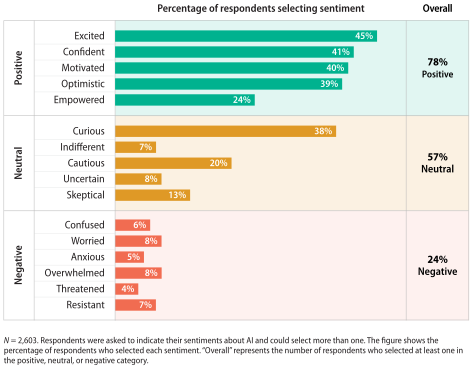
While sentiment toward AI may be broadly positive (Figure 1), it is far from evenly distributed across the organization. There is clear disparity in how senior employees, middle managers, and junior employees experience AI. Our research shows that senior employees are 50% more likely to express positive feelings about AI at work compared to junior employees.
Figure 1. Most employees feel positive about AI at work
Source: Infosys Knowledge Institute
The gap also shows up in how often AI is used. Senior employees use AI tools many times a day — at more than twice the rate of junior staff. Senior employees incorporate AI into daily workflows, often using it multiple times a day to enhance decision-making, problem-solving, and productivity. In contrast, junior employees are less frequent users and more tentative in their engagement.
Confidence levels differ as well. Senior employees have relatively higher confidence that their jobs will be protected as AI becomes more capable, compared to middle managers or junior employees. They are also more likely to find fewer errors in AI outputs. Middle managers, on the other hand, are the AI transition's forgotten layer - they are the least equipped, the least empowered, and the least engaged employees.
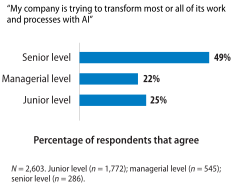
Almost 50% of senior employees agree with the statement that their company is trying to transform most or all of its work and processes with AI (Figure 2), while less than 25% of middle managers agree.
Middle managers are the AI transition's forgotten layer - least equipped, least empowered, and the least engaged.
Figure 2. The gap in transformational strategy
Source: Infosys Knowledge Institute
What’s more, 35% of senior leaders say their company always provides access to AI tools that they need, compared to 24% middle managers and 19% junior employees. Meanwhile, 30% say their company always provides well-defined safeguards for AI, compared to around 20% for middle managers and junior employees.
Left unaddressed, this imbalance can slow enterprise-wide AI adoption. It risks creating a two-speed organization with one group advancing with AI, and another lagging behind — less confident, less equipped, and less engaged.
Need for inclusive adoption
AI adoption cannot be driven solely from the top; it must be experienced consistently across all levels of the organization. To move from pockets of excellence to enterprise-wide transformation, leaders must close this gap and ensure all employees feel supported.
This requires a shift in how companies think about enablement. Instead of treating AI adoption as a uniform rollout, where the same tools, training, and expectations apply to everyone, organizations must recognize the diversity in employee experiences.
The path forward lies in building an inclusive AI adoption strategy and model that meets employees where they are and helps them progress at the right pace. Senior leaders can set ambition, but it is middle managers who must convert strategy into practice — and they cannot do that without genuine tools, targeted AI training and upskilling, and the latitude to experiment.

Equity in AI adoption: Where to start
To close the divide between senior and junior employees and accelerate adoption, companies need targeted, practical interventions:
Tailor AI enablement to different experience levels
A one-size-fits-all AI literacy model is unlikely to succeed. Junior employees require more structured, hands-on support to build confidence and capability. This is because they are earlier in their learning curve and lack the experience, confidence, and context that senior employees have.
Organizations should design tiered schemes: foundational training for junior employees focused on practical, day-to-day use cases; advanced modules for experienced professionals, emphasizing strategic and high-impact applications; and role-specific guidance that shows how AI integrates into actual workflows. The goal should be to move beyond theoretical learning to real, applied usage.
Democratize access to AI tools and use cases
Employees cannot build familiarity or confidence if AI tools are limited to select teams or roles. Organizations should make AI tools widely available across functions and levels, provide curated use cases tailored to different job roles, simplify onboarding, and reduce friction in tool usage.
Equally important is relevance. Employees need to see how AI applies to their work, whether automating routine tasks, improving analysis, or enhancing communication. When AI is positioned as a practical helper rather than a distant innovation, adoption accelerates organically.

Enable mentorship and peer learning
One of the most effective ways to bridge the gap is through peer-led learning. Senior employees already using AI play a critical role in supporting junior colleagues. Organizations can make this part of their organizational culture, and formalize this through mentorship programs that pair experienced users with those less familiar, communities of practice where employees share use cases and workflows, and internal showcases that highlight successful applications of AI.
This approach builds skills and reduces anxiety. Seeing peers use AI in real-world scenarios makes the technology more approachable and less intimidating.
Track adoption and sentiment continuously
Finally, organizations need visibility into how AI adoption is evolving in different areas. Actively tracking usage patterns, employee sentiment, confidence levels, and skill progression can help identify gaps early and plan targeted interventions. Regular feedback through surveys can refine training strategy, communication, and support so that no group is left behind. Organizations must treat AI adoption as an ongoing process rather than a one-time rollout.
Making AI work for everyone
“Realizing the promise of AI requires more than just deploying tools. It demands a workforce that is confident, capable, and aligned across all levels. The disparity between senior and junior employees signals where organizations need to focus to ensure that AI is not just adopted, but embraced universally. To succeed, companies need to build inclusive AI ecosystems, where every employee — regardless of level — has the opportunity to learn, use, and benefit from the technology. In the end, the true measure of AI success is not how widely it is deployed, but how evenly its value is distributed.”


Regulatory change is accelerating and breach costs are rising, yet most institutions still rely on periodic, manual risk assurance. Three structural gaps, spanning visibility, third-party oversight, and governance, leave institutions unable to keep pace. Building risk assurance as a continuous, AI-augmented capability closes these gaps. A four-phase roadmap helps institutions get there.
- 11 Sep, 2026
- 15 min read

The difference between AI work and AI that works lies in the discipline to scale adoption, governance, and value realization
- 10 Sep, 2026

Learn how automated integrity checks and human oversight can help enterprises control AI agent sprawl, reduce duplication, and manage risk at scale.
- 08 Sep, 2026
