

Insights
- Fragmented systems weaken workforce planning by limiting visibility across HR, clinical, and operational data.
- Manual coordination slows care delivery and adds to administrative burden for clinicians and managers.
- A unified workforce intelligence platform can improve forecasting, staffing decisions, and patient flow.
- Transformation requires workflow redesign, clinician trust, and integrated operations.
Rising demand, aging populations, and increasingly complex care models are stretching health systems that still depend on fragmented human resources, clinical, and operational infrastructures. These disjointed environments limit visibility, weaken forecasting, slow patient flow through manual coordination, and intensify administrative burden.
A unified workforce intelligence platform can deliver the structural reset healthcare systems need. It enables organizations to anticipate surges, deploy skills with precision, automate routine tasks, and create a more resilient, coordinated workforce.

The future of healthcare staffing
Health systems today feel like an airport running at peak holiday traffic with yesterday's control tower. The planes — patients — keep coming. The runways — beds, clinics, labs — are almost always full. And the staff work hard to manage it all, but with outdated radar, patchy visibility, and too many manual steps. In aviation, you wouldn’t fix congestion by hiring more pilots. You would redesign the air traffic system, the sensors, prediction models, and communication loops - to keep the movement safe and on schedule.
Healthcare is reaching that same moment. Global demand for care has increased, driven by aging population and economic growth, while the supply of health workers remains constrained. The World Health Organization estimatesa shortage of 14.7 million health workers globally as of 2023. A hiring strategy alone cannot close this gap, just as adding more pilots cannot transform a crowded airfield.
Health systems across North America, Europe, Asia-Pacific, the Middle East, and select low‑ and middle‑income countries need a new control tower for workforce management. One that brings together real-time data, recognizes patterns, anticipates surges, and deploys skills with precision. Although these regions differ in how healthcare is financed, staffed, and regulated, they share the same structural pressures: rising demand, workforce shortages, fragmented systems, and escalating expectations for safety, efficiency, and auditability. A unified, intelligence‑driven operating model applies across all of them.
How fragmented IT systems widen workforce gaps
Poor visibility leads to poor forecasting
Healthcare leaders operate across disconnected systems: HR platforms store workforce records, rostering tools contain scheduling rules, and electronic health records hold demand and acuity signals. Because these systems rarely connect, leaders plan coverage without a unified source of truth, which impedes patient flow.
Duplication and manual work become the default operating model
When systems don’t speak to each other, people fill the gaps. Clinicians and managers spend time reconciling data, calling teams about bed status, and manually coordinating transfers or housekeeping tasks. This leads to delayed care. Much of insurance filing, paperwork to justify a medical procedure or treatment to the payer, is also handled by clinicians manually. Some 93% of physicians report that prior authorization, approval from a health insurer before providing a medical service or treatment, delays patient care, and 82% say it can lead to treatment abandonment.
Rising administrative load erodes clinician well-being
Documentation burden contributes to clinician burnouts. A randomized trial carried out by the University of California, Los Angeles (UCLA) shows that AI can help reduce documentation time, with human oversight essential for accuracy and safety.
New care models outpace old infrastructure
Fragmented IT systems are also slowing the growth of new models for care, for example hospital‑at‑home services. They fail to scale due to uncoordinated logistics, disconnected pharmacy workflows, and unclear escalation pathways.
Build a unified intelligence platform
Health systems can’t manage today’s workforce with disconnected systems or manual coordination. To plan staffing effectively, they need a unified workforce intelligent platform that should integrate HR, clinical, operational, and scheduling systems in real time.
This gives leaders visibility across patient flow, staffing risks, skills, compliance, and overtime, enabling them to act before problems surface.
What the transformation looks like
Global development aid agency unifies HR for 180 countries with Infosys
A leading development aid agency under the world’s largest intergovernmental organization was struggling with fragmented HR systems spread across multiple client agencies worldwide. Recruiting, payroll, compliance, and performance processes differed by region, making it hard for leaders to completely monitor their global workforce.
Infosys built a single, cloud-based human capital management platform that standardized hiring, onboarding, performance, learning, and workforce planning processes across all agencies. The team also built a global payroll solution that supports 165 currencies across 180 countries. The impact was immediate: 20% faster time-to-hire, a 30% jump in employee experience index, and entirely automated hire-to-retire life cycle.
Systemwide redesign yields $69 million in impact
A nine‑hospital system in Arizona faced persistent discharge delays, inpatient congestion, and underutilized surgical capacity across 1,321 beds and 92 operating rooms (ORs). Discharge planning often began too late, support tasks were not prioritized based on which patients needed to move next, and operational teams lacked a single, real‑time view of where bottlenecks were forming.
To address these constraints, the organization implemented an enterprise‑wide patient‑flow optimization platform, embedding its inpatient and perioperative solutions directly into the electronic health record. The system standardized early discharge planning, continuously identified barriers to progression, and sequenced ancillary work to support timely movement. In parallel, perioperative tools predicted unused operating room time, prompted early release, and automatically matched open time with surgeons most likely to use it. This transformation generated $69 million in savings through improved inpatient flow and OR utilization.

What’s required for a successful transformation
Modernizing the healthcare workforce focuses on improving how people experience their work. It requires rethinking roles, processes, and support systems, guided by these five principles:
Test new workforce models in real clinical environments
Workforce changes should be tested in the flow of daily care and not theoretical models. Pilots help refine approaches to flexible staffing, cross-team deployment, virtual care operations, and skill-based assignment before broader rollout.
Validate AI with clinicians from day one
AI earns trust only when clinicians shape it. They must guide predictive staffing assumptions, ambient documentation workflows, and flow logic rules. When clinicians validate the model, adoption becomes natural and safer.
Design experiences that reduce burnout
Technology should lighten the load. Health systems should prototype workflows and mobile experiences that reduce clicks, eliminate duplication, automate repetitive tasks, and present only what is essential. The aim: return time, clarity, and control to the frontline.
Automate compliance and safety requirements
Working time rules, credential checks, and training currency should not depend on manual tracking. Built into scheduling and workforce, these controls ensure safety while reducing managerial burden.
Adopt a platform mindset
Successful systems approach workforce modernization as ongoing work, not a point solution. This means shared data models, integrated planning, scheduling, procurement, learning, and analytics, continuous enhancement, and fostering innovation among clinicians, operational leaders, and technology partners. This is how health systems build a workforce that is predictable, fair, safe, and resilient.
In essence
The workforce crisis reflects gaps in the systems that support care delivery. When health systems bring their data together, redesign their workflows, automate routine tasks, and cocreate with clinicians, they unlock a model of staffing that is more stable, more human, and more capable of meeting rising demand.
The next decade will be defined by how intelligently organizations design the workforce they already have, with interoperable data, predictive intelligence, and platforms built for the realities of modern care.
Note: This is an adapted article from the original published on Open Access Government - The future of healthcare staffing.

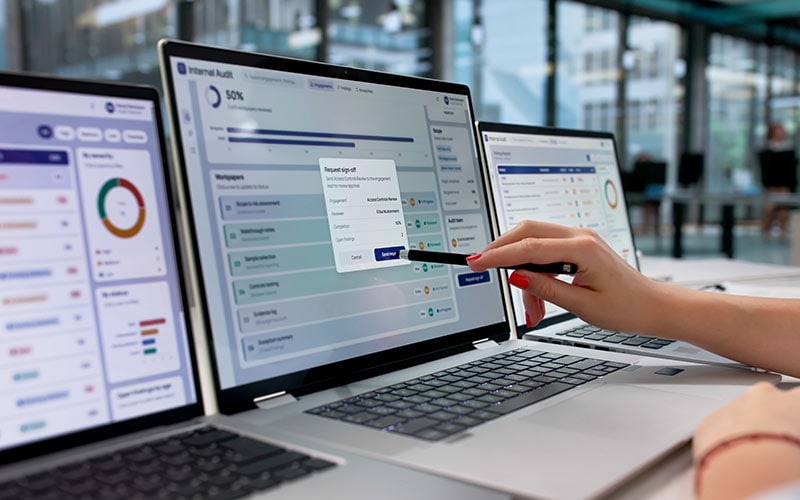
Regulatory change is accelerating and breach costs are rising, yet most institutions still rely on periodic, manual risk assurance. Three structural gaps, spanning visibility, third-party oversight, and governance, leave institutions unable to keep pace. Building risk assurance as a continuous, AI-augmented capability closes these gaps. A four-phase roadmap helps institutions get there.
- 11 Sep, 2026
- 15 min read

The difference between AI work and AI that works lies in the discipline to scale adoption, governance, and value realization
- 10 Sep, 2026

Learn how automated integrity checks and human oversight can help enterprises control AI agent sprawl, reduce duplication, and manage risk at scale.
- 08 Sep, 2026
