

Insights
- European banks pursue a balanced approach. They embed AI into transformation programmes that balance growth, compliance, resilience, and efficiency.
- Strict regulation has become an advantage. Frameworks such as the EU AI Act, GDPR, and DORA push European banks toward a compliance-by-design operating model, lowering their reported concerns about data privacy and security as barriers to adoption.
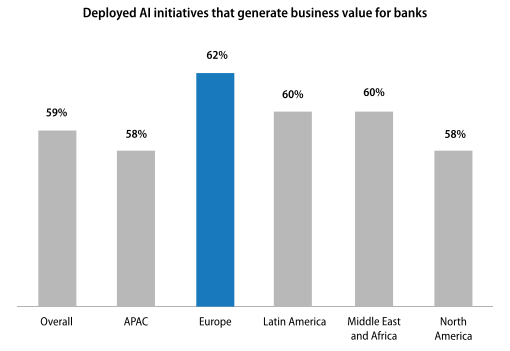
- European banks currently outperform global peers on value, but the lead is temporary. Nearly 62% of deployed AI initiatives in European banks generate more business value than initiatives at banks elsewhere.
- Global competitors scale AI faster and more aggressively. JPMorgan Chase embeds AI across core banking functions such as fraud detection, risk management, and client servicing. Singapore's DBS Bank runs a bank-wide platform supporting more than 1,500 models.
- Five principles guide responsible scaling: (1) Prioritise use cases with measurable value; (2) Move from pilots to reusable platforms; (3) Use cloud selectively rather than defensively; (4) Build compliance into deployment from the start and (5) Measure success by sustained value.
Europe pursues a balanced transformation
AI has become one of the primary tools banks are using to improve productivity and reduce operating costs. As a result, adoption is accelerating rapidly. The total number of AI initiatives tracked across the banks surveyed by Infosys for the Bank Tech Index grew from 56,372 in December 2024 to 63,415 in December 2025, a 12% increase in a single year. Yet much of this activity remains experimental, with banks still working to prove long-term value.
European banks are pursuing a balanced approach. Rather than treating AI primarily as a cost-reduction tool, they are embedding it into transformation programmes that balance growth, compliance, resilience, and efficiency to create sustainable business value.
This more disciplined, enterprisewide AI approach means European banks report lower concerns about data privacy and security as barriers to AI adoption than their global peers. This is likely due to long-established regulatory frameworks and mature data governance practices. They operate under some of the most stringent regulatory regimes, including the EU AI Act, GDPR, DORA, and evolving operational resilience frameworks. These regulations have pushed European banks toward what can be described as “compliance-by-design” operating models.
These strengths position European banks to scale AI responsibly, they need to turn those strengths into a competitive advantage by using regulatory confidence and operational discipline as enablers of broader AI deployment.
Responsible AI adoption must now become scalable
Nearly 62% of deployed AI initiatives in European banks are now generating more business value than their peers globally (Figure 1). The challenge for European banks now is whether their compliance-by-design operating model can scale quickly enough in a market that is moving rapidly toward enterprisewide AI deployment. Responsible AI adoption requires oversight and quality data — and these requirements can sometimes become bottlenecks when scaling.
Figure 1. Europe generates more business value than peers, for now
Source: Infosys Bank Tech Index: Volume 6
The pressure now is to operationalise AI at scale. US banks in particular are increasing investments in enterprise AI platforms, agentic AI, and enterprise - wide productivity transformation. For example, JPMorgan Chase has embedded AI across core banking functions, ranging from fraud detection and risk management to client servicing. In another instance, Singapore’s DBS Bank has built a bank-wide AI platform that supports more than 1,500 models across the organisation. These institutions are moving beyond experimentation and using AI as enterprise infrastructure.
This increases the need for European banks to catch up. The stakes of falling behind are well established. The European Central Bank has noted that the technology sector explains around two-thirds of the productivity gap between the EU and the US, with Europe having been too slow to capitalise on the last major digital wave. The ECB has also warned that the risks of underestimating AI, and falling behind again, are too great to ignore.
European banks are rightly cautious because banking is a high-trust industry where AI introduces significant operational and regulatory risks. AI systems affect credit decisions, fraud detection, customer interactions, compliance monitoring, and cybersecurity. Failures in these areas can quickly become systemic. Research from the European Banking Authority highlights that many banking AI applications fall under “high-risk” categories under the EU AI Act, particularly in areas such as creditworthiness assessment and risk modelling.
This is the tension European banks now face. They are better positioned than many global peers in terms of governance infrastructure, proven use cases, and regulatory clarity. But having a strong foundation is only an advantage if it is used as a launchpad. Global AI initiatives cancelled before deployment increased by 33% year over year at the end of December 2025, reflecting tighter scrutiny of return on investment (ROI). Scrutiny is appropriate, but it must be matched by the organisational capability to move proven initiatives forward at speed. The risk for European banks is that responsible AI adoption becomes trapped in fragmented initiatives, limited productivity gains, or isolated business-unit deployments. While governance and compliance create trust, they can also slow enterprisewide integration if operating models become overly restrictive or fragmented.
Europe's advantage is controlled and cautious AI adoption
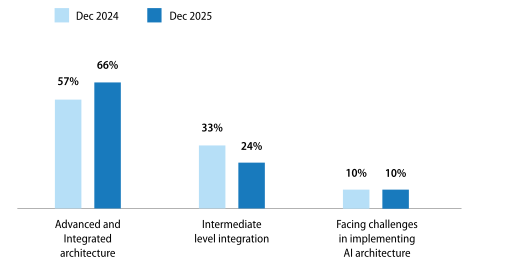
European banks need to accelerate AI transformation within the existing AI capabilities they have built. That means using regulatory confidence and operational discipline as a foundation for broader AI deployment rather than treating governance as a brake on innovation. The data architecture is increasingly ready. Research shows that two-thirds of banks globally now believe their data architecture is equipped to scale AI, up from 57% in December 2024 (Figure 2).
Figure 2. Level of data architecture by proportion of banks
Source: Infosys Bank Tech Index: Volume 6
Compliance is also becoming a competitive differentiator, moving beyond being seen as an operational obligation. Nearly 40% of cards and payments institutions globally identify AI-enhanced compliance and regulatory reporting as the primary use case for AI in modernising payment systems. European banks have a clear advantage in realising value from these use cases. Their mature compliance infrastructure, combined with the transition to ISO 20022, a global standard that enables banks to exchange richer and more consistent payment data, gives them a stronger foundation than peers who are building compliance capabilities from scratch.
Infosys research notes that the banking sector is moving away from experimentation toward enterprise scaling precisely because institutions are demanding clearer ROI, stronger governance, and more repeatable operating models.
The most successful banks are therefore likely to be those that can industrialise AI responsibly rather than deploy it indiscriminately. Europe’s model aligns well with that future.
Build a responsible scale playbook
For European banks, the path forward is a change of pace and how the existing model is operationalised. Five principles guide that shift.
1. Prioritise AI use cases with measurable business value
Banks should focus on use cases where operational, revenue, or productivity impact can be clearly measured. Customer service, cybersecurity, fraud management, software engineering, and employee productivity remain the strongest candidates because they combine high business value with manageable governance complexity. The latest Infosys Bank Tech Index shows that customer service leads, generating the most business value of any function at 22% weighted ranking, followed by sales and marketing at 15% and cybersecurity at 15%. For example, Danske Bank's AI assistant for financial advisors reduced call handling time from six minutes to under one minute. Banks should anchor their scaling programmes to these proven use cases rather than spreading investment across unproven ones.
2. Move from pilots to reusable AI platforms
AI spend across global banking is expected to grow 2.7% in the first half of 2026, as banks move from pilots to scaled deployments. This phase of AI transformation requires standardised enterprise capabilities rather than isolated experiments. Banks should build reusable data pipelines, governance frameworks, monitoring systems, and model management capabilities that allow AI use cases to scale consistently across the enterprise. HSBC, for instance, is moving beyond pilot-led experimentation toward reusable AI infrastructure, building shared AI capabilities that can scale across multiple banking functions rather than remaining confined to isolated business units. The bank already operates more than 600 AI use cases and has equipped over 20,000 developers with AI coding assistants, reporting productivity improvements of around 15%.
3. Use cloud selectively, but not defensively
Selective cloud adoption, while actively managed, remains the right approach for regulated institutions. However, selectivity should not become hesitation. Banks should continue migrating non-core workloads and customer-facing capabilities while maintaining stricter controls for sensitive systems and regulated data. European banks should formalise their cloud segmentation logic: define which workload categories belong in private, hybrid, or public environments, and use that framework to accelerate migration in permitted zones. Private cloud usage growth is projected to reach 31% of cloud environments by 2028. Deutsche Bank is a strong example of controlled cloud adoption. The bank initially migrated non-critical applications to cloud environments before gradually extending cloud capabilities to more strategic systems. Deutsche Bank framed this phased approach around regulatory, security, and data residency requirements.
4. Make compliance part of the scaling model
Governance should be integrated into AI deployment from the beginning. European regulations are the scaffolding that makes responsible scale possible. The ECB has noted that these frameworks create shared understanding and enable coordination that competitors in less regulated markets cannot easily replicate. Explainability, auditability, model monitoring, cybersecurity, and third-party oversight must become core design principles rather than post-deployment controls. Embedding compliance into AI deployment models reduces friction, accelerates approval cycles, and builds the institutional trust that sustains investment. When ING, the Netherlands-headquartered bank, conducted its analysis of the EU AI Act, it found that much of the regulatory framework was already embedded in its existing governance infrastructure. Further, the bank identified 140 specific risks it vets when deploying generative AI systems, but it meant the foundation was already in place. With compliance by design, each new regulatory requirement becomes an extension of existing capability.
5. Measure scale by value
The rise in predeployment cancellations — up 33% year on year — is a sign of increasing discipline, and that discipline is a strength. Success should be measured by sustained business outcomes, productivity gains, operational resilience, customer impact, and risk reduction.
The window is open, for now
European banks have built something genuinely valuable: an approach to AI that delivers measurable results, manages risk systematically, and embeds compliance as a capability. The task now is to convert that maturity into momentum. The model is right. The foundation is ready. What European banks need is the conviction — and the urgency — to scale it.


Regulatory change is accelerating and breach costs are rising, yet most institutions still rely on periodic, manual risk assurance. Three structural gaps, spanning visibility, third-party oversight, and governance, leave institutions unable to keep pace. Building risk assurance as a continuous, AI-augmented capability closes these gaps. A four-phase roadmap helps institutions get there.
- 11 Sep, 2026
- 15 min read

The difference between AI work and AI that works lies in the discipline to scale adoption, governance, and value realization
- 10 Sep, 2026

Learn how automated integrity checks and human oversight can help enterprises control AI agent sprawl, reduce duplication, and manage risk at scale.
- 08 Sep, 2026
