
Foreword
Since the start of 2026, conversations with clients around artificial intelligence (AI) have moved beyond isolated use cases. Banking leaders increasingly see that technology itself is no longer the primary constraint. The greater challenges now lie in change management, workforce adoption, operating model redesign, and the ability to scale new ways of working. Even with today’s AI capabilities, there remains a significant opportunity gap — not in what the technology can do, but in how effectively it is adopted and embedded into day-to-day banking operations. The findings in this edition of the Infosys Bank Tech Index reflect this shift. Banks are leaning in with conviction, but also with discipline. While AI initiatives continue to increase, leaders are far more selective, prioritizing areas where impact is both measurable and sustainable. Increasingly, the focus is on embedding AI as a core operating capability, one that simultaneously improves customer experience, strengthens engineering productivity, modernizes platforms, and enables scale across the enterprise. Customer experience and trust have become central priorities for banks. AI is being applied across contact centers and digital channels to enable hyperpersonalized engagement that helps customers achieve resolutions faster. The impact extends to relationship managers in commercial banking and advisors in asset and wealth management, where AI unlocks richer data and deeper insights, improving productivity and freeing time for client interaction. Underpinning this evolution is continued progress in AI-based software engineering, which accelerates modernization and reduces the complexity that has accumulated over years of incremental change. While still at an early stage, these capabilities have the potential to unlock entirely new business models and revenue opportunities. There are strong indications, for example, that agentic commerce and payments will gain further momentum in the coming months. Our research shows that banks are sharpening their technological choices and becoming more intentional about where and how they deploy AI. We will continue to track these shifts and share insights in the quarters ahead. If you would like to discuss the findings or explore how your organization can accelerate AI-led transformation, we invite you to connect with us.
Key Findings: AI, Cost Optimization, and Growth Priorities in Banking
Banks globally are balancing cost efficiency with innovation and growth. While artificial intelligence continues to drive transformation, competing priorities are shaping how institutions allocate resources and define success.
Cost Reduction vs Innovation: Competing Strategic Priorities
Cost optimization remains a dominant focus for banks, but innovation initiatives—particularly those powered by AI, blockchain, and tokenization—are reshaping long-term growth strategies. Financial institutions are increasingly required to balance short-term efficiency gains with long-term digital transformation.
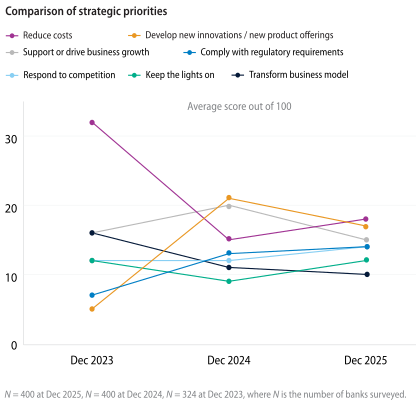
Cost reduction is the top focus: While not at the high recorded in 2023, there was a rise of 3 percentage points from December 2024 (Volume 5), reflecting pressure on teams at large banks.
Innovation and growth remain key priorities: AI innovation is fueling the growth mindset; however, our research reveals new areas of interest such as tokenization.
Transforming the business model remains deprioritized: AI improves efficiency, but new value and strategic advantage are created only when revenue models, customer journeys, and decision rights change.
Perhaps overlapping priorities inhibit clarity: There was a clear distinction in priorities two years ago; however, now leaders are challenged to deliver on multiple objectives simultaneously.
Increasing Scrutiny on AI Investments and Business Value
As AI adoption scales, banks are placing greater emphasis on measurable return on investment (ROI), governance, and business impact. This shift reflects a move toward disciplined execution and accountability in technology initiatives.
AI in Risk, Compliance, and Regulatory Functions
Risk management and compliance remain critical areas for AI deployment in banking. From fraud detection to anti-money laundering (AML), AI is helping institutions improve accuracy, reduce manual effort, and meet increasingly complex regulatory requirements.
Banking Technology Budget Trends and Investment Priorities
Technology spending in banking continues to evolve in response to macroeconomic pressures, cybersecurity threats, and the growing importance of AI. This section examines where banks are increasing investments and why.
AI, Cybersecurity, and Core Technology Spending Trends
Banks are prioritizing investments in AI, cybersecurity, and core technology infrastructure to remain competitive. These investments are essential for enabling real-time processing, improving resilience, and supporting digital banking services at scale.
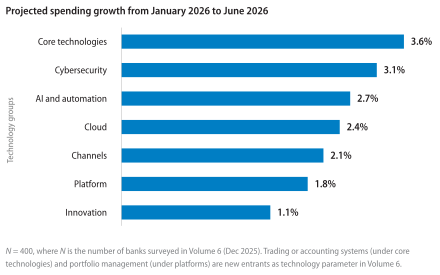
Volatility and macroeconomic trends impact priorities: Spend on core technologies is expected to increase by 3.6% between January 2026 to June 2026 from December 2025. Volatile markets and macroeconomic trends such as increased heavy metal trading are shaking things up. Banks need stronger trading infrastructure to price products accurately, manage real-time risks, and handle larger transaction volumes.
Spend on cybersecurity expected to rise: Cybersecurity spend is rising as banks strengthen their defenses. Escalation in ransomware, AI enabled fraud, and tighter compliance requirements (data protection, resilience, payments security) are forcing banks to strengthen core defenses.
AI and automation spend likely to rise: AI spend is increasing as banks move from pilots to scaled deployments.
Spending growth on the top three areas is expected to outpace inflation: The IMF forecasts global inflation to moderate at 4.4% for 2026 and inflation in the US at 3.2% for the year.
Customer Experience Driving Core Banking Modernization
Customer expectations for seamless digital experiences are accelerating modernization initiatives. Retail banks are investing in real-time payments, APIs, and data-driven personalization to enhance customer engagement and satisfaction.
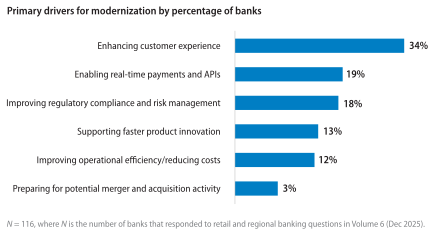
Desire for better experience drives modernization: Over 34% said they wanted to improve customer experience, suggesting that market facing priorities outweigh cost reduction.
Instant payments and risk management follow experience: Banks want to enable real-time payments and APIs and improve compliance and risk management (19% and 18%, respectively). These motivations point to modernization programs designed to enable new services and operating models.
AI in Banking: Business Value, Use Cases, and Adoption Trends
Artificial intelligence is transforming banking operations across customer service, risk management, software engineering, and payments. This section explores how banks are generating value from AI and where adoption is accelerating.
Measuring Business Value from AI Initiatives
Banks are moving beyond experimentation toward value realization, with a growing percentage of AI initiatives delivering measurable business outcomes. This reflects improved governance, clearer use-case prioritization, and better integration into core operations.
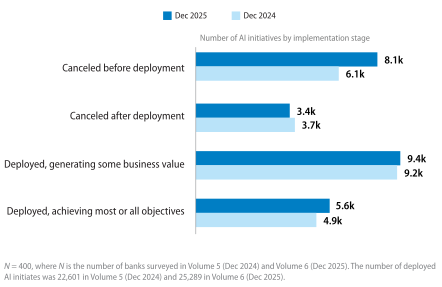
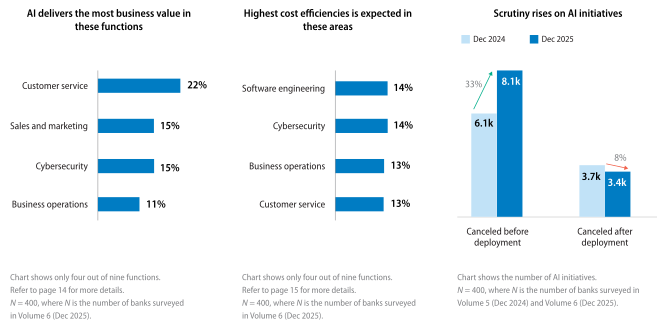
The frenzied experimentation phase is closing: AI initiatives that are canceled before deployment increased 33% indicating that banks have increased scrutiny of return on investment.
Value from canceled after deployed AI downward trend: This reflects the initial phase that encouraged experimentation with AI, at times without a firm grasp on calculating return on investment.
Business value rises: Banks are generating increased business value from their deployed AI initiatives. Nearly 59% of deployed AI initiatives generate business value for banks.
Customer Service as the Leading AI Use Case in Banking
AI-powered customer service solutions, including virtual assistants and automated workflows, are delivering significant cost savings and improved customer satisfaction. These use cases are among the fastest to scale across banking organizations.
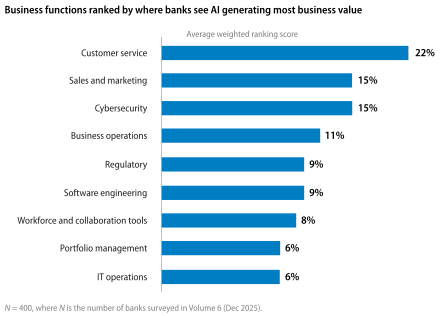
Customer service generates the most business value: Fraud (within cybersecurity) delivered the strongest results in Volume 5. Now gains are found in intelligent virtual assistants, automated service workflows, and personalized engagement. These customer use cases reduce cost to serve, improve satisfaction of more digitally savvy clients, and scale far more quickly across the organization.
Disciplined execution delivers measurable AI results: With disciplined execution, banks are moving fast to apply AI with quantifiable results. Teams are reporting tangible improvements, simplifying customer experience while taking real cost and friction out of the system. Citizens Bank’s AI-powered virtual assistant, CiZi, enhances customer experience by delivering personalized, intelligent support for everyday banking tasks. CiZi enables customers to get answers instantly on everything from account balances and statements to credit-card fees. As a result, mobile app-driven calls into the contact center are down about 44%. Danske Bank, a Nordic bank, deployed an AI assistant to support financial advisors, and the results were immediate. Advisor call time came down from six minutes to less than a minute, with faster responses and higher accuracy, improving customer experience.
AI in Software Engineering and Cost Optimization
AI-driven software development tools are reducing costs and improving productivity, although perceived business value is still catching up. This lag highlights the importance of organizational adoption and change management.
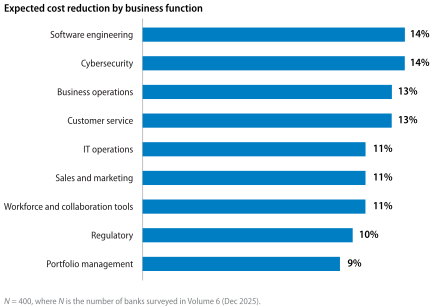
Expected cost reduction and business value go hand in hand: Bankers expect the greatest cost reduction in the same functions they perceive the most value from AI — cybersecurity, business operations, and customer service.
Software engineering is the exception: Bankers perceive less value but expect AI to reduce costs. As developers adopt AI-assisted coding, testing, and automation tools, the unit cost of software engineering is expected to decrease over time. This indicates a lag between adoption and value perception. The tools exist, but widespread institutional uptake and behavior change are still catching up.
AI in Trade Finance, Risk Assessment, and Banking Operations
In commercial banking, AI plays a critical role in risk assessment, fraud detection, and trade finance operations. Technologies such as machine learning and blockchain are improving transparency and operational efficiency.
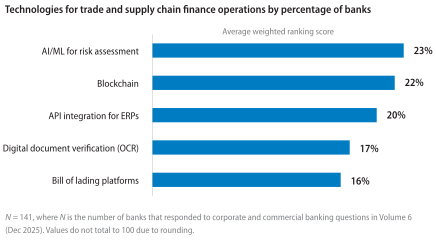
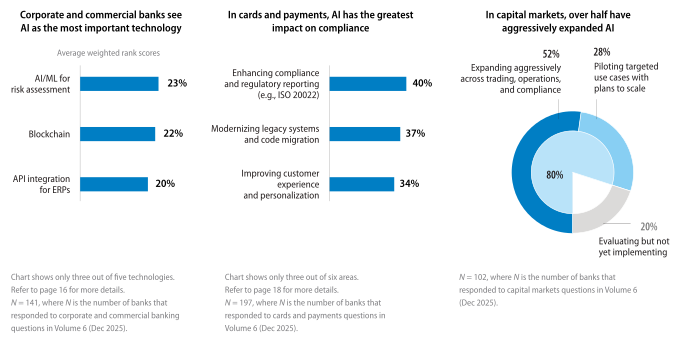
Banks see AI as most critical in their operations: The key area for banks is AI and machine learning (ML) for risk assessment. The technology is used for enhancing credit and counterparty risk, detecting fraud, AML screening, etc. This was closely followed by blockchain, which supports invoice financing, while providing traceability and transparency.
AI Adoption Trends in Capital Markets and Payments
Capital markets and payments providers are rapidly adopting AI to enhance trading, compliance, reporting, and customer experience. The transition to standards like ISO 20022 is unlocking new data-driven capabilities.
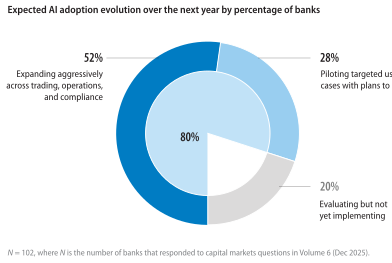
AI is shifting to a norm in capital markets: Over 50% indicated that they are adopting AI aggressively across trading, operations, and compliance. Another 28% indicated that they are piloting targeted use cases and plan to scale. AI to enhance reporting and modernization for payment providers.
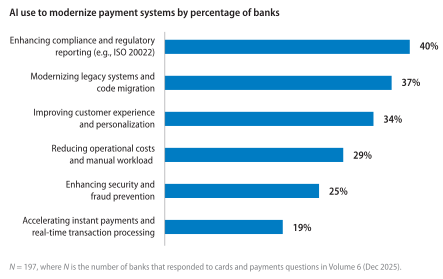
Banks see AI transforming payments compliance: 40% indicated that AI will enhance compliance and regulatory reporting. AI is used most for detecting noncompliance, supporting anti-money laundering (AML) efforts, and screening customers against sanctions lists during onboarding.
AI to unlock insights from ISO 20022: Banks that have moved to ISO 20022 now have richer data. This enables deeper analytics, better model training, and enhanced AI servicing. One instance of AI’s use is in address validation. AI can now convert the unstructured address into a hybrid structured address. ISO 20022 lends itself very well to AI use. Until now, message formats were not rich enough from a data and structure perspective.
AI seen as a key driver of faster code migration and customer experience: Around 37% indicated that AI will speed up legacy modernization and code migration. Nearly 34% said it would help personalize and improve customer experience.
Barriers to AI Adoption: Data Privacy, Security, and ROI Concerns
Despite strong adoption momentum, challenges around data privacy, security, and return on investment continue to slow AI scaling. Addressing these barriers is critical for unlocking the full potential of AI in banking.
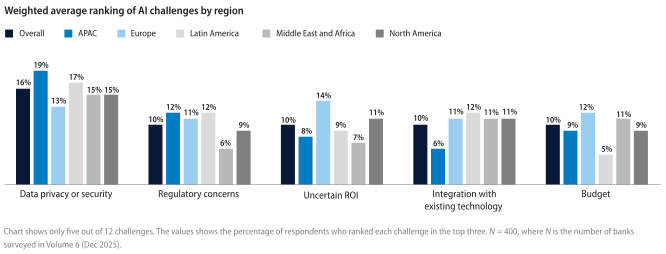
Data challenges persist: Issues around data, including privacy and security, outweigh other barriers, including regulatory and financial concerns. This reinforces the need for robust data protection frameworks, stronger governance, and trustworthy data handling practices to enable responsible AI adoption at scale.
ROI concerns among European banks: This reflects a more cautious approach to scaling AI where measurable value must be demonstrated early. At the same time, European banks are less concerned about data privacy and security than peers. However, the region’s long established regulatory frameworks, such as GDPR, and mature data governance practices give institutions greater confidence to manage data risks. Data readiness concerns give way to challenges of scaling.
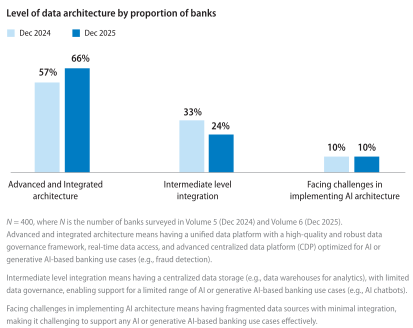
Two thirds of banks believe their data architecture is already equipped to scale AI: This sentiment aligns with the broader trend that data maturity and integration are no longer seen as the primary barriers to AI adoption. However, questions remain around the ability to scale AI simultaneously across multiple business lines.
Cloud Strategy in Banking: Private vs Public Cloud Trends
Cloud computing remains a foundational element of banking transformation. Institutions are adopting hybrid strategies to balance cost, scalability, security, and regulatory compliance.
Private Cloud Growth and Hybrid Cloud Strategies
Banks are increasingly favoring private and hybrid cloud environments to maintain control over sensitive data while benefiting from scalability. This trend is particularly strong in regions with strict data sovereignty requirements.
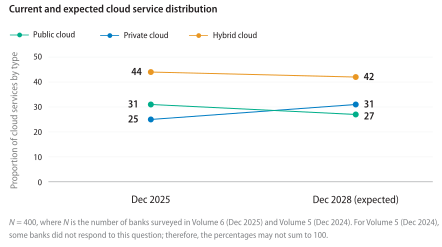
Fit for purpose assessments: Banks are placing each workload on the environment (public, private, or hybrid) that best meets regulatory, costs and risk mitigation requirements. with control, resilience and regulatory compliance.
The balance swings toward private cloud: Usage of private cloud is expected to grow from 25% today to 31% over the next three years, reflecting the need to balance scalability and flexibility.
Public cloud cost is rising: Led by AI and ML compute demand, data-transfer fees, vendor pricing complexity, and unoptimized modernization, while waste from idle or overprovisioned resources amplifies cost escalation in pay-as-you-go models in North America and Europe.
Heightened data sovereignty concerns: Banks across Europe and APAC must keep data within required jurisdictions, avoid foreign access risks, and manage complex multicountry regulations.
AI use in private cloud and SLMs: Banks train on small language models (SLMs) in private environments, where data remains controlled and security risks are reduced.
Challenges in Cloud Migration: Regulation, Security, and Skills Gap
Regulatory constraints, security concerns, and talent shortages remain key obstacles to cloud adoption. Banks must invest in governance frameworks and workforce development to overcome these challenges.
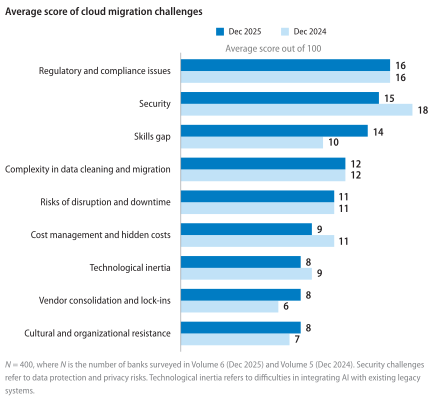
Regulation hinders cloud migration: This is true for all banks, irrespective of size and region, with security challenges and skills gap as the next inhibitors.
Security challenges persist: Although reduced since December 2024, strict compliance standards for sensitive customer data make security one of the top priorities. This underscores the critical need for robust governance frameworks and encryption protocols during migration efforts.
Skills gap emerges as a new top challenge: The skills gap challenge increased by four percentage points from December 2024. This trend is expected to increase in line with private cloud adoption.
APPENDIX
Appendix A: Methodology
The Infosys Bank Tech Index is a semiannual, survey-based research report that indexes technology investment and talent trends across the banking industry. The sixth edition gathers quantitative data from 400 of the largest banks by total assets in Asia Pacific, Europe, Latin America, the Middle East and Africa, and North America. Our survey, exclusive to banks with assets surpassing $10 billion, represents 96%* of this asset pool. This semiannual research gathers insights on technology spending, staffing, and performance from a panel of leading banks. Our executive panelists are key decision makers for their respective banks’ technology investments and talent strategies. Panel respondents will remain confidential to maintain data privacy and ethical considerations. * Based on 750 banks and assets, as of December 2024.
The research looks into the following areas:
- Technology strategic priorities: Current priorities of banks related to growth, operational efficiency and transformation.
- Technology talent: Current technology workforce and expected recruitment for technology roles.
- Technology budget analysis: Current technology budget distribution and expected technology budget distribution.
- AI insights: Percentage of initiatives in each stage of deployment, functions where AI generates the most value, functions where AI reduces costs the most, and improves productivity the most, areas where AI has the most positive impact, business lines where AI is used the most, and challenges to AI adoption.
- Cloud insights: Current cloud strategy and expected cloud strategy, plans to migrate to cloud or use a cloud service platform, and challenges to cloud migration.
As data is gathered in subsequent quarters, this research will provide a dynamic view of the trends, track evolving patterns and help decision makers at banks make informed decisions about technology and talent. In Volume 6, we asked our panel to provide the expected technology spending change, and expected technology recruitment for the first six months of this year, January 2026 to June 2026.
Appendix B: Panel distribution


For retailers, the AI advantage will come from building the organizational muscle that lets employees use AI confidently.
- 09 Sep, 2026
- 6 min read

Retailers must prioritize AI-powered supply chain intelligence, seamless omnichannel experiences, and personalization to drive growth and resilience.
- 08 Sep, 2026
- 15 min read

Companies that tailor their offerings and messaging to evolving consumer priorities will be better equipped to sustain demand as spending becomes more selective.
- 30 Jul, 2026
- 12 min read
