

Insights
- AI is already widely adopted and well-liked by employees, with strong usage, high optimism, and minimal fear of job loss.
- It is saving three to five hours per week and potentially driving close to 8% productivity gains, with time reinvested into higher-value work.
- However, benefits are uneven: senior leaders operate in an “AI bubble,” while middle managers are under-supported and derive the least value, creating a major transformation gap.
- Organizations must democratize access and improve communication to bridge the gap in the workforce and achieve the full promise of AI.
Executive summary
While investment in AI continues to soar, many still doubt its effectiveness, adoption, and acceptance among employees. Our global survey of 2,600 white-collar employees across industries challenges this narrative.

Employees like AI
We find that nearly 70% of employees report using AI daily, and close to 90% engage with it multiple times a week. The mood among employees is also surprisingly upbeat. Around 72% of employees describe themselves as excited, confident, or optimistic about AI. Fears of redundancy are limited: Only a minority expect their roles to disappear in the near term. Instead, workers anticipate a rebalancing — less repetitive labor, more creative and complex tasks. AI is seen less as a rival than as a collaborator.
AI delivers real productivity
This optimism is matched by measurable gains. Employees report saving three to five hours a week through AI — roughly a tenth of their working time. Most reinvest those hours productively, taking on more work, pursuing higher-value tasks, or developing new skills. On this basis, AI could already be delivering productivity gains of around 8%, equivalent to a $1.5 trillion uplift in US GDP, or $2.3 trillion globally.
Senior leaders are in a bubble
Yet, there is a catch. The gains from AI are unevenly distributed. Senior leaders use AI more frequently, have greater access to tools, receive clearer guidance, and enjoy stronger incentives. They save more time, trust the technology more, and are significantly more positive about its impact. In effect, many operate within an “AI bubble.”
Junior employees, while broadly enthusiastic, are more cautious — particularly about accuracy and accountability. They encounter errors more often and feel more exposed when things go wrong. More troubling still is the position of middle managers. Neither as empowered as senior leaders nor as adaptable as junior staff, they are the least supported cohort. They report weaker access to tools, less training, fewer incentives, and limited autonomy over how to use AI. Many lack a clear strategy or understanding of how AI fits into their role. Unsurprisingly, they derive the least benefit from it.
Close the transformation gap
Most concerning is that while nearly half of senior leaders plan sweeping AI transformation, only a fraction of middle managers recognize such change underway. A strategy that is not understood cannot be delivered.
The result is a widening gap between potential and reality. AI is boosting productivity — but not as much as it could. Closing this gap could add further gains, potentially lifting productivity by additional percentage points and unlocking significant economic value. The opportunity cost of inaction is substantial.
The full promise of AI will remain elusive unless organizations close the gap between leaders and their workforce. Senior leaders who break out of their bubble to democratize AI access, better communicate strategy, and provide autonomy to employees to experiment will grab AI’s emerging opportunities and scale them quicker across their enterprise.
Workplace AI is popular and productive

These days, AI is as divisive a topic around the dinner table as it is at the water cooler. Most agree the technology will bring significant changes within society and the nature of work. What exactly will change, the extent of changes, and whether it will be for good or ill is more complicated.
We focused this research on understanding the experience and perspective of white-collar workers in large companies. Through their eyes, we see that employees are surprisingly positive about AI, both in their actual usage and their opinions. Very few feel truly threatened or sidelined.
But we have also identified gaps in adoption, productivity, and support for workers in their AI use. Our research finds that AI is truly embedded at work but that organizations are not maximizing the opportunities offered by this revolution.
AI everywhere, every day
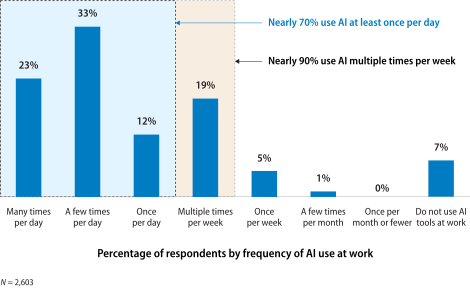
The AI workplace revolution is well underway. If there were any lingering doubts about whether AI has crossed from experiment to everyday tool, this data should dispel them. Across the 2,603 white-collar employees surveyed, nearly 70% are using AI at least once a day, and almost 90% use it multiple times each week. Only 7% say they don’t use it at all (Figure 1). Even acknowledging the typical positive bias in survey responses due to perceived social pressure, the results stand out as strongly favorable toward AI.
Figure 1. Most people use AI regularly
Source: Infosys Knowledge Institute
Adoption varies by industry
It is no surprise that the highest uptake of AI by white-collar workers is in the high-tech sector and semiconductor industry (98% each), followed by telecommunications, financial services, energy, and insurance (96% each), and life sciences (95%).
Each of these industries relies heavily on digital technology and employ large numbers of technologically literate staff for their core products. By contrast, the more blue-collar or physical-product-focused industries, such as industrial manufacturing (88%) and automotive (93%), are trailing.
What is concerning, however, is that our data shows that healthcare (85%) and consumer packaged goods, retail, and logistics (86%) have the lowest uptake of AI at work compared to other industries. These industries contain a mix of professional, highly educated employees alongside blue-collar and more physical roles. However, both industries rely heavily on large volumes of operational, transactional, marketing, and customer data (including health data). One might expect the use of AI to be higher for these companies.
But as we will see later in this report, technology literacy alone is not what determines AI usage and success. There are complex dynamics that influence adoption — and an organization’s demographics, culture, and leadership policies likely play as important a role in AI usage as their industry.
The generation gap
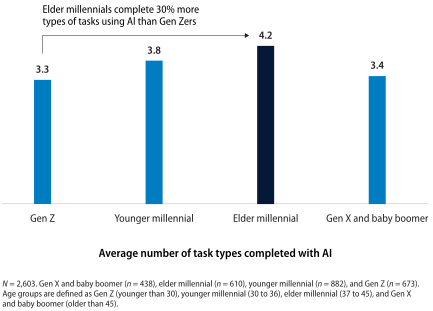
Among the more surprising findings is the generational pattern of AI use. One might expect digital native Gen Zers (ages 18 to 29) to be the most enthusiastic adopters of this technology. However, millennials in general use AI for more types of tasks than their Gen Z counterparts. Interestingly, elder millennials (ages 37 to 45) use AI for nearly 30% more types of tasks compared to Gen Zers (Figure 2).
Figure 2. Elder millennials complete more tasks with AI
Source: Infosys Knowledge Institute
This might not be due simply to a difference in generational mindset. As this report will show, there is a significant gap in AI adoption patterns based on an employee’s seniority, with more senior people using AI more. Elder millennials fit in that sweet spot where they are both generationally acclimatized to digital technologies, as well as potentially senior enough in an organization to have access, authority, and autonomy to use AI for their work.
Search, summarize, create, and more…
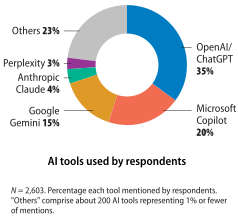
The most common AI uses by white-collar workers are still the ones that first brought ChatGPT to fame in 2022. Search, summarization, and content creation or research are tasks that 45%, 41%, 36%, and 34% of employees hand over to AI, respectively. In line with this, when asked which tools are most utilized, OpenAI’s ChatGPT rises to the top, far ahead of Microsoft’s Copilot in second, and Google Gemini in third (Figure 3).
Figure 3. ChatGPT dominates use
Source: Infosys Knowledge Institute
But a significant number uses AI for a wider range of tasks that reveal growing maturity in the use of AI. Today, the average employee augments 3.7 types of tasks with AI. A significant proportion uses it for customer service communications (26%), predictive analytics (25%), internal communications (25%), process optimization or automation (22%), or schedule management (20%).
Indeed, it’s a sign of how ubiquitous AI has become that these tasks are selected far more often than software development, one area where AI is considered to be the most transformative so far. In our data, only 13% of employees use AI for software development, though this rises to 21% for employees in the IT function — and even higher for senior leaders in IT (32%).
AI feels good
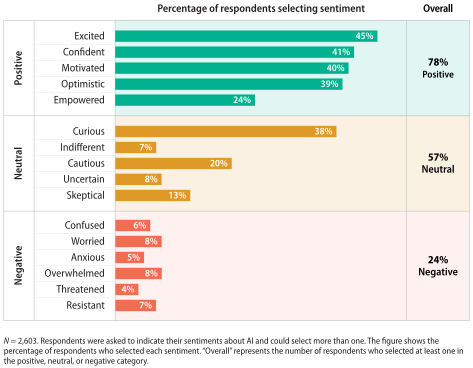
One of the most striking findings of our survey is the sheer positivity of employee sentiment toward AI. Given the volume of apocalyptic media coverage about job displacement, one might expect widespread anxiety and resistance. Instead, our research reveals that about 45% of employees are excited about using AI, while around 40% feel confident, motivated, and optimistic (Figure 4). The skeptics and the fearful are minorities: 20% report feeling cautious, and nearly 15% describe themselves as skeptical.
Figure 4. Most employees feel positive about AI at work
Source: Infosys Knowledge Institute
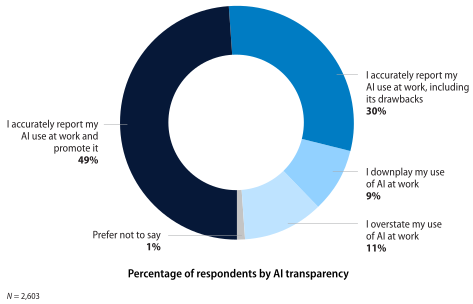
This positivity extends to transparency about AI usage. We found that nearly 80% of employees say they accurately report their AI use in the workplace (Figure 5). Most of them promote their usage, while 30% also focus on the drawbacks of using AI. Less than 10% downplay their AI work, and a similar percentage say they overstate their usage. Overall, employees say they are comfortable reporting their usage honestly.
Figure 5. Most employees are transparent about AI use
Source: Infosys Knowledge Institute
The future is bright
Respondents are also surprisingly optimistic about AI in the near future. When asked about their view of how AI would change their work in the next three years, only 2% expect their role would be eliminated due to AI, while 11% feel that their role would change to one in which their primary responsibility is to review AI.
But the largest portion of respondents say that AI will increase the volume of their creative and complex work. Almost half expect such work to increase, with less than 20% saying this more stimulating work would decrease. In comparison, only 33% feel that repetitive work would increase; 39% say such mundane tasks would decrease. It seems then that the current AI experience is not dampening spirits in the workplace — in the short term or the future. This bucks the trend of many gloomier commentators who predict a workplace rebellion against AI. Our respondents would disagree.
AI and productivity
High levels of AI adoption and optimism only count for so much, however. The real question is whether AI usage delivers a return to the business. In this regard, we can also report some positive insights. We understood what types of benefits employees see coming from their AI usage, and then we calculated how efficiencies delivered by AI would impact business productivity. In terms of pure work throughput, 40% of employees see AI significantly improving the time spent completing tasks.
We find 37% saying it similarly helps them increase outputs and 34% saying it reduces effort. About a third also cite quality or creativity improvements from AI as benefits. Meanwhile, 36% per cent say it has a significantly positive impact when using it for new ideas and innovations; 34% express a similar sentiment about the quality of their work. Just under a third say has a significant positive impact on work accuracy (32%) and job satisfaction (33%).
Time saved, feeling safe
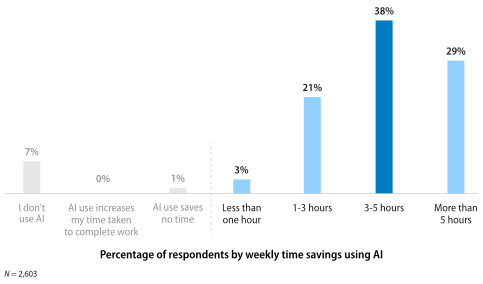
Not only is time saved the most commonly cited outcome, but it is the most tangible benefit to help us understand productivity. Digging deeper, our research found that AI use saves employees a median of three to five hours a week overall (Figure 6). In fact, 29% of respondents said it is saving more than five hours each week.
Figure 6. AI typically saves between three and five hours per week
Source: Infosys Knowledge Institute
Based on this data, we estimate that employees on average are saving about four hours per week using AI. With a standard 40-hour work week, this is a time saving of 10% per person.
An interesting additional finding was one that links AI time savings to that of “psychological safety,” a concept defined by Harvard Business School professor Amy C. Edmondson. Over decades of research, she found that organizations thrive when people feel safe to make mistakes, speak candidly and without fear of repercussions, and share ideas.
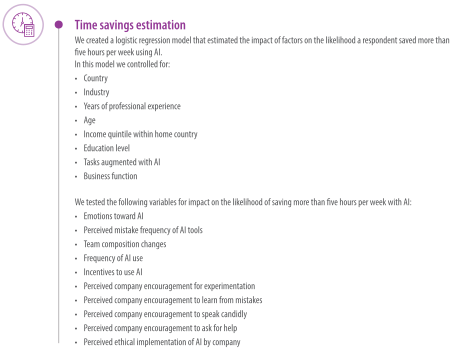
Adapting her psychological safety measure (Edmondson, 1999, ASQ), we found that people who strongly agree with the statement “My company encourages me to speak candidly and without fear of repercussions” are 7% more likely to save five or more hours per week with AI than those who only agree with this statement.
Time savings drive more work
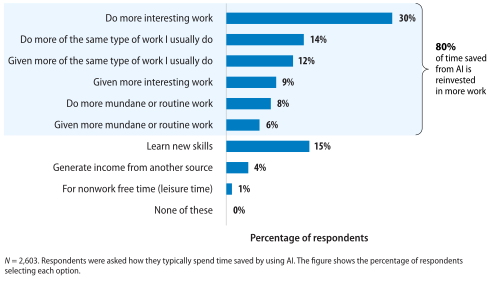
But the crucial question is what happens to that saved time. Do employees use it to slack off, or do they reinvest it in productive activities? The answer, by a wide margin, is the latter. In our survey, nearly 80% of employees said they are doing more work.
The quality of that reinvestment matters too. Employees are not merely doing more of the same with the time saved: 30% of employees choose to do more interesting work; 15% learn new skills, 4% try to get income from another source. Only 1% use it for leisure time (Figure 7).
Figure 7. Employees reinvest time productively
Source: Infosys Knowledge Institute
While employees say that AI has reduced repetitive work, it has also increased the amount of creative and complex tasks. The shift is precisely the kind of work that both employees find more fulfilling, and organizations find more valuable. AI, in this telling, is not replacing human workers. It is augmenting human capabilities.
Also, employees seem to be actively seeking meaningful tasks with time saved, rather than waiting for them to be delegated. The way the reclaimed time is allocated also offers a clear window into shifting priorities and emerging work patterns. The percentage of employees choosing to do more interesting work with the time saved is over three times that of those who are given more interesting work to do.
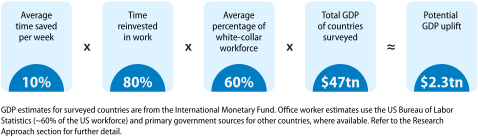
Since 80% of employees are using their saved time to do more work — either voluntarily or involuntarily — and assuming that this new work is as productive as their other work, we can theorize a productivity increase of up to 8%. If we consider this productivity increase uniformly across white-collar workers, it is equivalent to a $1.5 trillion uplift to US GDP alone, and $2.3 trillion for all of the countries surveyed (Figure 8).
Figure 8. Estimating the value of time saved by AI
Source: Infosys Knowledge Institute
AI benefits are not equal

On average, white-collar workers in our survey report optimism, efficiency, and productivity from workplace AI. A deeper look, however, reveals a worrying disconnect between the experiences of senior leaders, middle managers, and junior workers in how they use AI. In general, we found that senior leaders use AI more regularly, save more time using it, and feel more positive and safer when using it.
This suggests that senior leaders — which we define as directors, vice presidents, or the C-suite — are living in an AI bubble. Their access to the tools and training is higher, as are the benefits they can accrue from them. This in turn leads to more trust, more security, and more worryingly, a potentially distorted view of AI adoption and efficacy among the staff below them.
The senior leader bubble
There are several ways in which senior leaders’ experience of AI is much rosier than that of the colleagues over whom they are responsible.
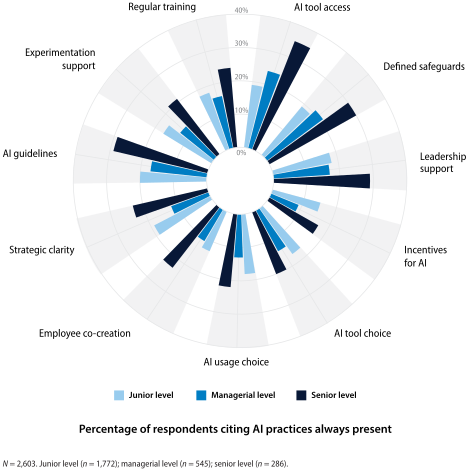
First is access to AI. Our research found that 35% of senior leaders say their company always provides access to the AI tools that they need (Figure 9). This compares to 24% of middle managers and 19% of junior workers.
Figure 9. Senior leaders get more support and incentives
Source: Infosys Knowledge Institute
Second is guidance: 30% say their company always provides well-defined safeguards for AI, compared to about 20% for middle and junior staff. The gap is similar for those who say their company always provides leadership support and clear guidelines on AI usage.
Third is incentives: We found that 17% of senior leaders said their company always provided incentives for AI usage, compared to 9% for middle managers, and 15% for junior workers. When asked if a company has ever offered a financial reward (bonuses or pay rises) 31% of senior managers responded positively versus 23% for junior workers and 24% for middle managers.
Clearly, senior leaders are more likely to have both the means and incentive to confidently access AI at work as compared to other employees. And the data shows that this results in more positive views of AI and significantly higher usage.
More than half — 54% — of senior leaders feel there is nothing that would deter them from using AI at work. This compares to 39% of middle managers and 29% of junior staff. On the other hand, a minuscule 8% of senior managers don’t trust the accuracy of AI compared to 16% and 17% of middle ranking and junior staff.
Similarly, only 8% of senior managers have any moral reservations about AI use at work, compared to 14% of junior staff. And most surprising — perhaps concerning — is that only 10% of senior leaders say they are worried about being held responsible if AI goes wrong at work. The figure is almost double (19%) for junior staff and middle managers.
A productivity blind spot
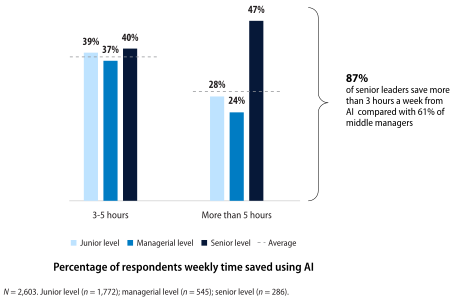
Senior leaders’ greater confidence in AI drives significantly higher usage and more time saved than their junior colleagues, with 81% saying they use AI at least a few times a day, and more than half of those say they use it “many” times a day. This compares with only 60% of middle managers who use AI at least a few times a day, and 50% of junior staff who say the same.
That gap continues when examining the amount of time saved. We estimate senior leaders save an average of 4.62 hours a week, with 47% saying they save more than five hours a week with AI (Figure 10). This compares to middle managers who save only 3.69 hours a week. Only 24% of middle managers save more than five hours a week with AI. Juniors fare slightly better, but still nowhere near the gains senior leaders experience. Juniors save an average of 3.97 hours a week with AI usage, and 28% of them say they save more than five hours a week.
Figure 10. Middle managers generate lowest savings from AI
Source: Infosys Knowledge Institute
The result is that senior leaders are potentially improving their productivity by up to 10%, a full two percentage points more than the average 8% productivity we theorized that workplace AI is delivering. That’s equivalent to a $600 billion GDP gap in the countries we surveyed, assuming that the same productivity levels could be achieved by junior and middle managers in the future.
Of course, these estimates of productivity are meant to be illustrative rather than definitive. Each organization and industry will have a different way of measuring productivity and impact. Our calculations are based purely on time saved being reinvested in work, and an assumption that all future work is as productive as past work. But it is clear that more can be done to spread the benefits of AI more evenly, and perhaps, that senior leaders may not have the visibility or awareness that there is indeed a gap.
Accuracy and risks
There is one last element of the senior blind spot to mention: the efficacy of AI, rather than its productivity. We’ve already shown how senior leaders have a more positive view of AI. One reason may be that they don’t see as many errors in AI as their junior colleagues.
Junior staff are more cautious: 17% do not trust AI results to be accurate, while 18% say AI results contain mistakes “very often,” and 9% say it happens constantly. This compares with 8% of senior leaders lacking trust in accuracy, and only 10% saying outputs contain mistakes “very often.” Only 4% say outputs contain errors constantly.
This could reflect the different types of work that juniors use AI for versus those at the top. Unfortunately, our data is inconclusive on that point. While senior leaders use AI much more than juniors, as stated earlier vis-à-vis middle managers, the pattern of tasks they use AI for is largely the same.
But these differences do highlight another potential disconnect between the top and the bottom of the organization. Senior leaders need to be more aware that their perception of AI working well is not necessarily shared by the rest of their staff, and this alone can be a barrier to wider adoption.
Closing the gap

Bringing the whole organization up to senior leaders’ levels of AI utilization is not just a matter of providing more training, better guidance, or incentives — though certainly these would not hurt. Scaling AI adoption requires a significant operational and organizational transformation that extends through processes and operating models, all the way to culture and strategy. No simple task then. But our data reveals a key that senior leaders can use to unlock this transformation: the humble and much maligned middle manager.
The sagging middle
Many hours have been spent debating the value of the middle manager in large organizations. Regardless of varying opinions on their relevance or role, it’s clear they are getting the worst end of the AI bargain. We defined middle managers as any “first-line, mid-level or senior manager” in our research and found many concerning gaps in their AI experience at work. Regularly they have a poorer experience and perception than senior leaders and often lag junior staff.
Raw deal for middle managers
Middle managers seem not to be given enough incentive to utilize AI. While almost a quarter say that their company offers financial rewards for AI use, only 9% of their companies always provide these incentives. This is significantly lower than the 15% of junior and 17% of senior leaders who say incentives are always provided. But potentially more important is that only a quarter of middle managers say their company provides peer recognition for using AI. Almost 40% of junior and senior staff say they get this peer validation at work. Worryingly, more than a fifth of middle managers say their company does not require them to use AI for work, whereas only 11% of junior staff and senior leaders say the same.
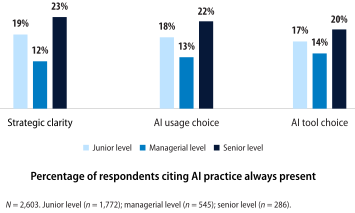
Even if they do not require incentives to use AI, a large proportion of middle managers say they lack direction and autonomy on how and where to use it. Just 12% say that their company provides a clear strategy for AI, compared to 19% of junior staff and 23% of senior staff (Figure 11). Only 16% say their company always provides training. Middle managers are also the most likely to say that their company has not set out any clear benefits to be gained from AI. They are the least likely to say their company provides learning benefits or certifications.
Figure 11. Middle managers lack direction and autonomy
Source: Infosys Knowledge Institute
Autonomy around using AI is an important issue because middle managers play a pivotal role between senior leadership and junior staff. They are the connection between strategy and operations, and as such should be able to have a significant influence over how AI is used.
However, the data is again disappointing. Only 13% of middle managers say they always have freedom to choose when to use AI, and only 14% always have the freedom to choose which AI tools to use. This compares to 22% and 20% of senior leaders. In the same vein, only 13% of middle managers say they are always encouraged to experiment with AI, as compared to 21% of senior leaders. In fact, only 24% of middle managers claim they always have access to AI tools while 35% of senior leaders do.
Lacking belief, lagging performance
Given the lack of support for middle managers, it is unsurprising that this group also feels less engaged with AI, is more worried about their roles, and deliver lower outcomes from it.
Middle managers are most likely to downplay their AI usage — more than twice as likely as senior leaders. More than half of those downplaying their AI use say they do so because they are afraid of being seen as less skilled or capable — this is not surprising given the lack of training and guidance these managers face. Almost a fifth (19%) worry they will be held responsible if AI goes wrong, which is almost twice the proportion of senior leaders who feel the same way.
Middle managers’ worries about job security and responsibility are also on par with junior staff, rather than in line with their more confident leaders. Just over 10% of middle managers are worried about losing their job to AI — similar to the proportion of junior staff but almost double the proportion of senior leaders (6%). In fact, only 23% of middle managers are very confident their company will safeguard their role as AI advances. This compares to 40% of senior leaders and 29% of junior employees.
The result is that this cohort significantly underperforms others in the organization. Middle managers save less time using AI than any other group (Figure 10). They are also the least likely to say that AI helps them with new ideas and innovations. Just over half feel AI supports them this way, in comparison to 69% of junior staff and 53% of senior leaders.
Transformation disconnect
It is clear that senior leaders, not middle managers, still call the shots about AI — despite these decisions emanating from an AI bubble. This problem is most evident when we ask about the transformational effect AI is having on their organization.
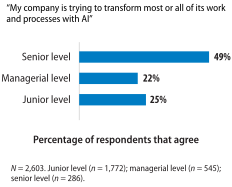
Almost half of senior leaders state that their company is trying to transform most or all of its work and processes with AI. However, less than a quarter of middle managers agree. Indeed, it’s slightly more likely that a junior team member is aware of this transformational strategy (Figure 12).
Figure 12. The strategy gap
Source: Infosys Knowledge Institute
This is the most damning evidence that senior leaders are failing to communicate their vision for the future of enterprise AI. If middle managers are not on board with the transformational vision of top leadership, they cannot reasonably be expected to deliver on it.
And as we set out below, we believe middle managers are the critical link between AI experimentation and scale across the enterprise. They are the connective tissue that can help an organization be more agile — applying lessons from its mistakes and shifting its operating model quickly to grab new opportunities.
Building the future of AI work

The evidence is clear: AI is already embedded in the day-to-day reality of white-collar work and delivering measurable gains in productivity, quality, and employee engagement. And yet, for all its promise, its impact remains uneven. What separates organizations that merely adopt AI from those that truly benefit from it is not the sophistication of their tools, but the clarity and courage of their leadership.
Closing the gap between potential and performance will require senior leaders to rethink not just what they deploy but how they lead. Three priorities stand out.
Prioritize environment over structure
Leaders should resist the temptation to fixate on organizational design as the primary lever of change. New structures, reporting lines, or centers of excellence may have their place, but they are not substitutes for the conditions that enable AI to thrive. What matters more is creating an environment defined by autonomy, agility, and psychological safety.
Employees need the freedom to decide when and how to use AI, the flexibility to adapt workflows quickly as new capabilities emerge, and the confidence that they can experiment without undue risk to their reputation or career. These qualities cannot be engineered solely through formal structures or symbolic support; they must be cultivated through visible leadership behavior, incentives, and culture.
Turn the lights on
Senior leaders are operating in the dark, with little understanding of the adoption patterns of their employees. It’s time to turn the lights on. Leaders must have the courage to face up to the realities of AI adoption and be transparent with their teams across the organization. Much of the current friction — whether it is mistrust, inconsistent usage, or fear of accountability — stems from ambiguity. Employees are unsure what is expected of them, what risks they are allowed to take, and how their use of AI will be judged. Senior leaders, by contrast, often operate with greater clarity and confidence, creating a widening perception gap.
Bridging this requires open, organization wide dialogue: clear articulation of where AI is being used, what good looks like, where the risks lie, and how decisions are made when things go wrong. Transparency won’t eliminate uncertainty, but it will make it more manageable. Done well, it builds trust, normalizes experimentation, and reduces the silent resistance that can undermine even the most ambitious AI strategies.
Lead from the middle
Transformation will not be delivered from the top alone. It must be led through the middle. Middle managers, long seen as a layer to be streamlined or bypassed, are in fact the linchpin of successful AI adoption. They sit at the intersection of strategy and execution, shaping how work actually gets done — and being an important conduit for feedback that leadership can use to refine their course.
Yet, as this research shows, they are currently the least equipped, least empowered, and least engaged cohort in the AI transition. This is a strategic misstep. Rather than treating middle managers as passive recipients of change, organizations should position them as active orchestrators of it — equipping them with the tools, regular role-based training, and authority to experiment, adapt, and scale AI within their teams. If senior leaders set the ambition, it is middle managers who must translate it into operational reality.
In the end, AI will not transform organizations by virtue of its capabilities alone. It will do so through the people who use it — and the conditions under which they operate. Leaders who embrace transparency, empower the middle, and prioritize human-centric ways of working will not only unlock greater productivity, but build organizations that are more adaptive, resilient, and fit for the age of AI.
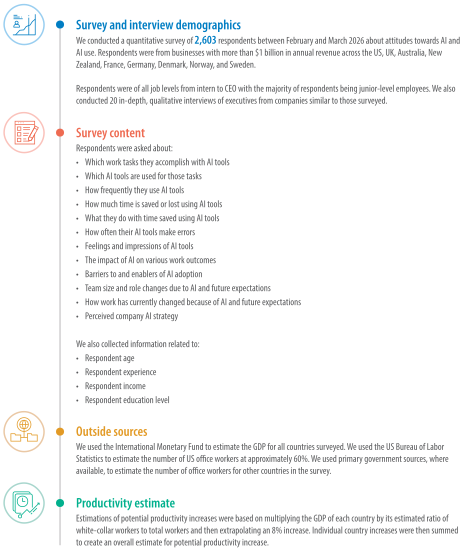
Appendix: Research approach


For retailers, the AI advantage will come from building the organizational muscle that lets employees use AI confidently.
- 09 Sep, 2026
- 6 min read

Retailers must prioritize AI-powered supply chain intelligence, seamless omnichannel experiences, and personalization to drive growth and resilience.
- 08 Sep, 2026
- 15 min read

Companies that tailor their offerings and messaging to evolving consumer priorities will be better equipped to sustain demand as spending becomes more selective.
- 30 Jul, 2026
- 12 min read
