

Insights
- Logistics is shifting from transport-only to a tech-driven, integrated supply chain model.
- Regulatory scrutiny is turning compliance into a strategic priority.
- AI, robotics, and automation are scaling fast to offset labor shortages and boost resilience.
- Reverse logistics, on-demand warehousing, and risk insurance are key growth areas amid rising geopolitical volatility.
Executive summary
The global logistics industry is evolving from a traditional transportation-focused sector into a technology-enabled, data-driven supply chain ecosystem. Logistics providers are increasingly positioning themselves as end-to-end strategic partners, combining transportation with warehouse management systems (WMS) and transportation management systems (TMS), customs and trade compliance, reverse logistics, and real-time supply chain visibility. This shift is driven by growing customer expectations for greater efficiency, resilience, transparency, and service quality.
Market growth is supported by continued expansion of e-commerce, omnichannel distribution, globalization, and international trade, alongside demand for real-time supply chain monitoring and increased outsourcing of logistics operations by multinational organizations. Third-party logistics represented the dominant market segment in 2025 and is expected to remain one of the fastest-growing areas through 2035.
In March, global air cargo demand declined 3% year on year (YOY) due to geopolitical disruption in the Middle East, though overall resilience persisted. Notably, capacity shifted toward the EU-APAC "Silk Road" lanes, diverting away from the Middle East, while global average rates increased 8.7% YOY.
Ocean freight continues to underpin global supply chains, accounting for an estimated 70% of the global logistics market. The competitive landscape includes major global providers such as UPS, A.P. Moller-Maersk, DSV, C.H. Robinson, FedEx, Kuehne+Nagel, GEODIS, and Nippon Express, which are expanding their capabilities across transportation, technology, and integrated supply chain services.
At the same time, the industry faces an increasingly complex operating and risk environment. Urban congestion, fuel-price volatility, geopolitical tensions, workforce shortages, legacy technology, and cyberthreats are placing pressure on cost structures and service reliability. A survey of nearly 1,000 European supply chain professionals found that 78% expect geopolitical developments, tariffs, and shifting international trade policies to affect their supply chains over the next 12 to 24 months, with 72% planning to expand their sourcing into different regions to create more resilient supply chains. Cyber-risk is gaining importance as logistics networks become more digitally interconnected, increasing exposure to data breaches and software supply-chain vulnerabilities.
Against this backdrop, resilience and adaptability are becoming strategic priorities. Organizations are incorporating potential increases in tariffs and changes to trade policy into pricing and cost models while strengthening contingency planning to protect margins and service continuity. Going forward, competitive advantage will increasingly depend on the ability to combine digital capabilities, real-time intelligence, integrated logistics services, cybersecurity, and agile network planning to deliver resilient and customer-centric supply chains.
Financial insights
Market size
The worldwide logistics sector market size was valued at roughly $11 trillion in 2025. Industry projections suggest this figure will climb to nearly $13 trillion in 2026, and will reach nearly $24 trillion by 2035. This represents approximately 8% CAGR from 2026 until 2035, a pace that would double the market's size within a decade.
Online retail continues to reshape how goods move around the world. As more consumers turn to digital storefronts instead of brick-and-mortar shopping, logistics providers are seeing demand for warehousing, last-mile delivery, and fulfillment services.
The growing reach and reliability of high-speed internet connectivity is an enabler. It allows smoother coordination across supply chains, real-time tracking capabilities, more efficient route planning, and stronger integration between retailers, carriers, and consumers, all of which are making modern logistics networks faster and more responsive.
Spend
Companies across the logistics and supply chain landscape are pouring capital into intelligent technologies — AI, robotics, automation systems, and advanced data analytics — as they compete to run leaner operations, cut expenses, and deliver a better experience to customers. Persistent worker shortages across logistics, manufacturing, and warehousing have also made automation increasingly attractive, since machines and robots can keep operating even when human labor is scarce.
Roughly six in 10 warehouses report plans to boost their automation budgets by 20% in 2026 alone, with spending concentrated in robotics, automated guided vehicles, and AI-driven software solutions, as businesses increasingly move from pilot investments of less than $1 million toward commitments of between $5 million and $50 million.
Industry dynamics
Economic environment
The Asia Pacific logistics market had the largest market share in 2025 at 44.5%. Its market size was valued at $5 trillion as of 2025, with forecasts pointing to substantial growth that could push the market to nearly $12 trillion by 2035. This trajectory implies a CAGR of around 9% between 2026 and 2035 — one of the strongest growth rates among all global regions.
The reason is the expansion of the online retail sector across the area. As retail activity intensifies, it generates cascading demand for warehousing, freight movement, and distribution networks throughout the region. This growth isn't happening in isolation, either. Regional governments, especially China and India, have made substantial commitments to upgrading transportation infrastructure — pouring investment into road networks, port facilities, and airport capacity. India is investing more than $65 billion in over 34,000 km of highways under Bharatmala Pariyojana, while Indonesia’s new capital, Nusantara, is driving logistics and port investments in East Kalimantan. China is strengthening links between its western industrial centers and Southeast Asia through the New Western Land-Sea Corridor.
These are also creating the backbone necessary to support the region's expanding logistics demands, making it easier for goods to move efficiently across increasingly interconnected supply chains.
Yet looking at the broader global picture, North America leads the logistics market in 2026, supported by well-developed infrastructure and technology adoption.
Regulatory changes
The logistics industry is entering a period of heightened regulatory scrutiny, with sustainability mandates, evolving trade policies, and stricter customs enforcement reshaping how global supply chains are designed and managed. Regulatory compliance is increasingly moving beyond a back-office requirement to become a strategic consideration influencing sourcing decisions, transportation networks, supplier relationships, and overall landed costs.
In maritime logistics, decarbonization will remain a major long-term priority as the International Maritime Organization (IMO) will continue to implement stricter emissions-reduction measures aligned with its greenhouse gas strategy. The direction of travel toward lower-emissions shipping is expected to increase pressure on carriers and their customers to improve fuel efficiency, adopt cleaner technologies and fuels, and incorporate emissions considerations into fleet and network decisions.
At the same time, customs and trade enforcement is becoming broader and more data-driven. In the US, scrutiny increasingly extends beyond tariffs to areas including forced-labor compliance under the Uyghur Forced Labor Prevention Act, sanctions, country-of-origin verification, valuation, classification, and transshipment. Importers are consequently being expected to demonstrate deeper visibility into their supplier networks and provide stronger documentation on where products and their inputs originate.
Sustainability
The IMO has set ambitious decarbonization targets for global shipping, including a 40% reduction in carbon intensity by 2030 and net-zero emissions by around 2050. Achieving this transition will require significant industry investment estimated at $8 billion to $28 billion annually across alternative fuels, cleaner propulsion technologies, emissions-monitoring systems, and vessel upgrades and retrofits. Companies are focusing on fleet optimization, cargo consolidation, and smarter inventory strategies to reduce waste and unnecessary transportation. These are changes that cut costs and emissions simultaneously rather than trading one for the other. Achieving this depends heavily on data: Connecting operational systems with partner data and visibility platforms allows companies to optimize routes, reduce excess inventory, and minimize empty miles in ways that are measurable and repeatable.
An increasing number of businesses are turning to reusable packaging that’s designed to be returned, cleaned, and put back into circulation.

Trends
Reverse logistics
The global reverse logistics market is pegged at $872 billion in 2025, growing to $936 billion in 2026 and reaching $1.7 trillion by 2035 at a 7.3% CAGR, driven largely by corporate sustainability focus and alignment with UN Sustainable Development Goals.
Seven in 10 shoppers won’t buy from a brand they don’t trust to handle delivery and returns. The same proportion will walk away at checkout if their preferred delivery and returns options aren’t offered. In a further study, more than half of supply chain executives surveyed identified dispositioning as their biggest returns management challenge, with most of the total cost of a return incurred at this stage. By connecting product data with demand forecasts, AI can help determine when returned items should be restocked. It can also use defect history and customer feedback to improve condition checks and quickly route items for refurbishment or recycling. Using AI capabilities such as image recognition and anomaly detection, Two Boxes assesses and processes close to $1 billion worth of returned goods each year across three continents, working with Radial, Stord, Cart.com, and other logistics providers.
Returns are becoming a strategic priority for logistics service providers and is pushing companies to build their reverse-logistics capabilities. Well-managed returns processes help minimize financial losses, while a smooth, low-friction returns experience keeps customers coming back. At the same time, regulatory pressure is pushing companies to stop treating returns as a secondary concern — handling them properly also cuts down on landfill waste and reinforces broader eco-friendly business practices.
Cargo risk insurance
Cargo insurance is going through a period of transformation, shaped by climate volatility, geopolitical risk, and rapid digitization. According to market trends analysis, war risk continues to be a major factor shaping maritime, cargo, and logistics insurance pricing and underwriting conditions. At the same time, there is an increase in demand for comprehensive protection. By coverage type, all-risk coverage now holds the largest share of the maritime cargo insurance market, roughly 57% as of 2026, as businesses increasingly prioritize broad protection for high-value shipments over narrower named-peril policies.
On-demand warehousing
Logistics executives named "warehousing and logistics hubs" as the top infrastructure priority for trade and logistics, chosen by 39% of survey respondents when asked to select their top three investments. The on-demand warehousing segment — flexible, short-term storage rather than long-term leases — is projected to grow from $130.9 billion in 2025 to $149.4 billion in 2026, a striking 14.2% CAGR, rising to $251.3 billion by 2030. Growth drivers include seasonal inventory fluctuations, limited permanent warehouse space, and rising demand for scalable capacity. They particularly benefit small and medium enterprises that can't commit to long-term leases but still need flexible fulfillment capacity during demand spikes. The major players in this segment include Flowspace, Flexe, ShipBob, and Stord.

Technology outlook
AI and automation
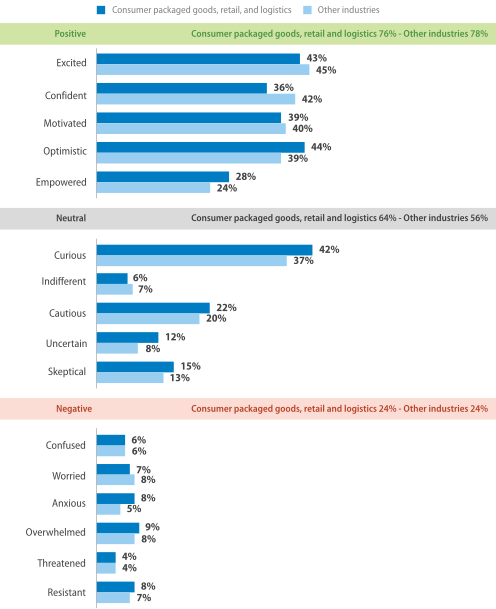
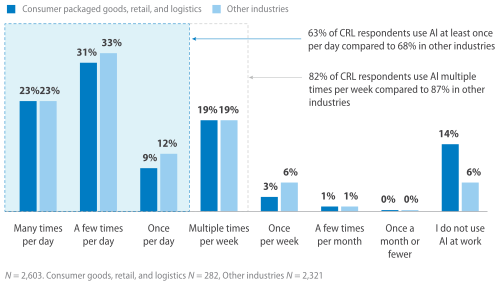
Infosys’ recent AI and the Future of Work research found that employees in logistics, consumer goods, and retail companies report feeling excited, optimistic, and empowered about AI (Figure 1). This could be the reason for a majority of them (63%) reporting that they use AI at work at least once per day (Figure 2).
Figure 1. Logistics employees feel positive about AI
Source: Infosys Knowledge Institute
Figure 2. Most employees in logistics, consumer goods, and retail use AI daily
Source: Infosys Knowledge Institute
By using AI and automation, logistics companies can smooth out operational workflows related to route optimization and fleet optimization, cut down on delays, speed up turnaround times, and even tailor services to individual customer needs.
For instance, a leading global container shipping line — active across more than 150 countries with maritime transport, port operations, and end-to-end logistics — struggled with manually intensive, document-heavy workflows spanning over 80 processes across its APAC and European service centers, particularly around bills of lading, bookings, and freight audit and invoicing. EdgeVerve stepped in with a platform-led, AI-first transformation, unifying over 90 interfaces across over 20 systems into a single orchestration layer. A centralized decision engine digitized more than 8,000 customer-specific policies and embedded 116 country-specific standard operating procedures to ensure consistent, compliant execution worldwide. The result: Automation levels jumped from just 10% to 70% across processes. Freight audit and invoicing turnaround time alone dropped dramatically from 24 hours down to just 30 minutes.
AI-powered container terminal optimization is still in its early days: Most real-world deployments today are limited pilots rather than full-scale rollouts. Even so, AI and advanced optimization tools offer a genuine way forward for tackling the inherent complexity of terminal operations. What sets these systems apart from traditional rule-based approaches is their ability to learn from historical patterns, adjust as conditions change, and get sharper at decision-making over time. By combining historical data with real-time signals, machine learning models can forecast things like vessel arrival times, yard congestion, or potential equipment failures before they happen. From there, optimization engines can run through multiple possible scenarios and pinpoint the actions most likely to boost overall system performance.
For road logistics, using intelligent platforms such as route optimization software and TMS, businesses can merge multiple orders into one trip, use vehicle capacity more efficiently, and pick the most sustainable mode of transport for every shipment.
Hyperautomation or developing a process for automating enterprise automation is also showing up in real deployment numbers, market forecasts, and enterprise adoption targets. Schnellecke Logistics, which serves the automotive sector, automated its invoice-checking process using robotic process automation — saving over 12,000 hours a year, including 60 minutes daily on a single process. The rollout now spans 80 automated processes across 38 areas and six regions, boosting productivity and efficiency company-wide.
Robotics
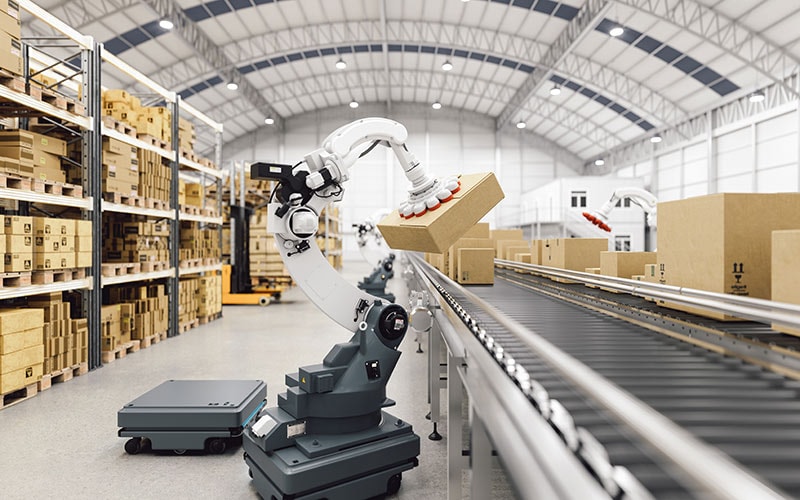
Rising wages combined with shrinking delivery windows are pushing operators to substitute capital for labor, prioritizing robotic systems that can be reconfigured in days rather than months for warehouse automation. Within warehouse automation, picking and packing represented the largest application segment in 2025, accounting for 32.3% of the market. Returns processing, however, is emerging as a high-growth area and is projected to expand at a CAGR of 14.1% through 2031.
Rather than requiring large upfront investment, robotics-as-a-service (RaaS) or subscription-based robotics models let companies convert capital expenditure into operating expense. This is opening the door for mid-tier companies that previously lacked the investment-grade credit needed for traditional automation purchases. Providers handle updates, maintenance, and scaling, letting operations teams focus purely on execution.
Physical AI, or robots that combine AI, machine vision, and autonomous decision-making in a real space such as a warehouse, is growing fast, with the market expected to expand from just $1.5 billion in 2026 to $15.2 billion by 2032 at a CAGR of 47.2%. Physical AI is moving from concept to commercial deployment. This shift marks a turning point for warehouse robotics, where machines are no longer just following instructions, and are starting to think through them.
IoT and digital twins
Companies can put digital twin technology to practical use for both vessels and terminals — running simulations on scenarios like rerouting, berth allocation, and dredging impacts before committing real-world resources. This kind of testing lets businesses spot costly mistakes early, sharpen efficiency, strengthen safety, cut down delays, and reduce operational costs overall. By forecasting how changes will play out, whether that's fuel consumption, congestion patterns, or turnaround times, before deploying infrastructure or resources into complex operations, companies gain sharper resource management and can adapt faster when disruptions hit.
Modern digital twins are a significant evolution from earlier simulation models. Rather than relying on static, predefined scenarios that require manual updates, they continuously ingest real-world data to reflect changing conditions. They can also model complex, interconnected systems, drawing on sensor networks and external data to account for multiple variables simultaneously.
Control tower models
Sitting above core execution systems such as enterprise resource planning, TMS, and WMS, logistics control towers use AI and machine learning to bring together data from those systems and provide a centralized layer for orchestrating operations, improving end-to-end visibility, anticipating disruptions, and coordinating decision-making. It does this through real-time dashboards, smart alerts, predictive ETAs, and exception management that predict disruptions and allow businesses to respond proactively with data-driven planning. For example, the logistics group Maersk deployed a supply chain control tower that uses real-time data to optimize routes and vessel schedules. This has helped reduce costs and improve operational efficiency.
Key takeaways
- The logistics industry must prepare for a landscape characterized by toughening regulations, increased compliance requirements, and the necessity for digital adaptation. Regulatory frameworks are expected to become tighter, making early preparation a competitive necessity rather than a choice. Businesses must invest now in adaptable systems to be able to absorb future mandates without major disruption.
- Ongoing geopolitical tensions and trade restrictions are reshaping global logistics, leading to higher insurance costs and localized demand patterns. This environment requires logistics companies to adapt their operations and strategies to maintain profitability. Scenario planning and real-time risk monitoring are becoming essential tools for anticipating disruptions before they escalate. This kind of proactive risk management is quickly becoming a baseline expectation rather than a competitive edge.
- Businesses will have to find ways to bring resilience into their operations using new technologies and ways of working to combat all the challenges that come their way. From AI-driven automation and robotics to digital twins and predictive control towers, the tools to build this resilience already exist. The differentiator will be how effectively companies integrate them into daily operations.


Retailers must prioritize AI-powered supply chain intelligence, seamless omnichannel experiences, and personalization to drive growth and resilience.
- 08 Sep, 2026
- 15 min read

Companies that tailor their offerings and messaging to evolving consumer priorities will be better equipped to sustain demand as spending becomes more selective.
- 30 Jul, 2026
- 12 min read

Scaling AI adoption demands enterprise-wide transformation across operations, models, and culture.
- 29 Jul, 2026
