

Insights
- Retail growth is shifting from price competition to loyalty, personalization, private labels, and superior customer experiences.
- Digital, mobile, and omnichannel commerce are driving growth, while physical stores remain critical as experience and fulfillment hubs.
- AI, analytics, and supply-chain intelligence are improving efficiency, margins, personalization, and operational resilience.
- Future leaders will balance physical and digital strengths, invest in customer data and AI, and adapt to evolving regulatory and sustainability demands.
Executive summary
The retail industry is undergoing a redefinition of value creation, moving beyond price competition toward differentiated, experience-driven strategies. Retailers are leveraging customer data insights, loyalty programs, exclusive private-label assortments, and elevated service standards to build durable customer relationships. A retailer study found that retailers view improving their private-label products as one of the most important opportunities for business growth, and 36% of the respondents are investing in loyalty programs to create greater value through personalized customer experiences. Consumer research shows that 44% of shoppers are choosing private-label or lower-cost brands instead of well-known brands, potentially seeking comparable quality at a more affordable price.
These reflect a broader industry recognition that in an environment of intensifying competition and commoditized product offerings, sustainable growth depends on cultivating loyalty and emotional connection with consumers rather than competing purely on cost. Investments in supply-chain modernization and data-driven decision-making are reshaping retail operations.
Three primary forces are driving growth. First, the continued expansion of e-commerce and mobile commerce is unlocking new customer segments and sales channels, particularly as digital infrastructure matures across global markets. Second, AI-enabled supply chain optimization is helping retailers improve inventory accuracy, reduce waste, and respond more dynamically to demand fluctuations, translating directly into margin improvement and operational resilience. Third, rising urban middle-class incomes, particularly across emerging markets, are expanding the base of discretionary spending and creating fertile ground for premiumization and category expansion.
Digital and omnichannel integration represents perhaps the most transformative structural shift shaping the industry. Widespread smartphone penetration, combined with increasingly advanced logistics networks, is fueling rapid growth in mobile commerce, social commerce, and quick-commerce formats. Consumers today expect frictionless experiences that bridge digital discovery with physical fulfillment — whether through buy-online-pickup-in-store models, same-day delivery, or integrated loyalty ecosystems that follow the customer across every touchpoint. Retailers that fail to deliver this level of cohesiveness in channels risk losing share to more digitally native or competitors with mature omnichannel presence.
Despite the digital momentum, physical retail remains important. Supermarkets and hypermarkets led global distribution with a 37.4% market share in 2025, underscoring the continued relevance of brick-and-mortar formats for grocery and everyday essentials. Recent research found that 73% of US shoppers say physically seeing and handling gifts helps them imagine how loved ones will enjoy them, while 63% believe they are more likely to discover unique gifts in stores than online.
However, the growth trajectory clearly favors digital channels: online retail is forecast to expand at a 13.3% CAGR through 2031, significantly outpacing traditional formats. This divergence suggests a maturing but still-evolving competitive landscape, where physical scale provides near-term stability while digital capability increasingly determines long-term growth potential. Also, the era of expansion for expansion's sake — opening stores or adding stock-keeping units (SKUs) purely to chase market share — is fading. Retailers are trading the "bigger" mindset for a "better" one: rightsizing store footprints, tightening inventory discipline, and requiring every channel investment to prove a measurable return.
Agentic AI is emerging as a key enabler of modern retail. By 2030, agentic commerce is projected to orchestrate up to $1 trillion in US business-to-consumer retail revenue, while the global opportunity could reach between $3 trillion and $5 trillion. But scaling it securely and profitably requires integrated platforms, robust data foundations, and effective human oversight in terms of governance.
Taken together, these trends point to a retail sector in transition. Organizations that can defend their physical footprint while aggressively building digital and data capabilities are likely to succeed. Investment priorities should center on three areas: deepening customer data and analytics capabilities to power personalization and loyalty; strengthening supply chain intelligence through AI to protect margins amid cost pressures; and building omnichannel infrastructure that meets rising consumer expectations for convenience and consistency.
Cost leadership that competes primarily by operating at a lower cost than competitors and translating that advantage into lower prices and/or better margins is not a sufficient differentiator. The retail market has gradually evolved, particularly over the 2010s and accelerating in the 2020s, so that low prices alone are increasingly easy for competitors to match and easy for consumers to compare. Retailers poised to lead the next phase of growth will be those that treat private-label innovation, loyalty programs, and superior service as core strategic assets while simultaneously capturing the growth available on digital and mobile-first commerce channels, particularly in markets where rising incomes are expanding the addressable consumer base.

Financial insights
Market size
The global retail market continues to demonstrate strong and sustained growth, reflecting evolving consumer preferences, rising purchasing power, and changing shopping behavior. Valued at approximately $28.1 trillion in 2025, the market size is currently estimated to have reached $29.7 trillion. It is projected to expand to around $41.5 trillion by 2031, representing a compound annual growth rate (CAGR) of 6.8%.
This growth is being supported by the continued expansion of traditional macro forces such as e-commerce and omnichannel retail models across global markets. Increasing digital adoption is enabling retailers to reach broader customer segments while providing more convenient and personalized shopping experiences. AI is amplifying this growth by meaningfully improving margins, conversion, and personalization within existing retail. For example, Nike uses AI to turn customer data, including purchase history, fitness activity, and local climate data into tailored product recommendations. With its Nike By You feature, it suggests materials, colors, and styles based on individual preferences and emerging fashion trends. H&M piloted AI chat-based styling assistants that ask about occasion and budget to generate outfit suggestions. It led to a 30% increase in customer engagement and a 15% to 25% boost in online sales.
Spend
Digital and operational transformation have become key priorities for retailers seeking to remain competitive in a technology-driven marketplace. In a global retail study, nearly 50% of respondents indicated that digital transformation and operational transformation are among their key strategic priorities. Leading omnichannel retailers such as Amazon and Walmart continue to strengthen their market positions through investments in AI, faster delivery capabilities, and retail media platforms. These shifts highlight that sustained retail competitiveness will depend on how effectively businesses integrate digital innovation with operational excellence.
Industry dynamics
Economic environment
The global retail landscape shows distinct regional dynamics, with North America representing the largest market and Asia-Pacific emerging as the fastest-growing region. North America accounted for approximately 34.4% of the global retail market in 2025, supported by its mature retail ecosystem, high consumer spending, and widespread adoption of omnichannel commerce. Asia-Pacific is projected to grow at a CAGR of 11.7% through 2031, significantly outpacing the broader market. Growth in Asia-Pacific is being fueled by a large and expanding middle-income consumer base, and rising disposable incomes across key emerging economies. These trends are positioning Asia-Pacific as an increasingly important market for both global and domestic retailers seeking new avenues for long-term growth.
Regulatory changes
Regulators are increasingly requiring retailers to maintain greater visibility into the origin, sourcing, and movement of products throughout their supply chains, increasing the importance of robust data and traceability systems. Governments are taking a closer look at how retailers set prices, communicate discounts, and conduct promotional activities. In Australia, for example, new supermarket pricing regulations are targeting practices associated with price gouging, excessive margins, and potentially misleading promotions. Non-compliance can expose retailers to larger financial penalties as well as reputational risks. As regulatory expectations evolve, retailers will need stronger pricing governance, auditable data, and compliance controls to demonstrate transparency and respond effectively to regulatory inquiries. This is likely to increase investment in technology that provides end-to-end visibility across pricing, sourcing, inventory, and supply-chain operations.
Sustainability
Sustainability regulation is reshaping how consumer goods companies design, package, and sell products worldwide. In the European Union, the new Packaging and Packaging Waste Regulation (PPWR) came into force in February 2025, with general application starting in August 2026, replacing the 1994 directive. Rather than a single flat "65% recycled" mandate, the regulation layers several targets together: member states must cut packaging waste per capita by at least 5% by 2030, 10% by 2035, and 15% by 2040, measured against 2018 levels, while minimum recycled-content requirements for single-use plastic bottles start at 30% by 2030 and rise to as much as 65% by 2040. On top of that, nearly all packaging placed on the market must be recyclable and meet strict design standards, and manufacturers must shrink packaging weight and volume to the minimum needed for functionality by 2030.
In the US, last year, the Securities and Exchange Commission withdrew its defense of its climate disclosure rules, leading to the effective lapse of federal requirements for companies to disclose climate-related risks and greenhouse gas emissions. Recent administrative shifts under the Trump administration have deprioritized ESG regulations. However, sustainability remains commercially relevant despite the regulatory pullback, as it continues to influence consumer preferences and purchasing decisions. Retailers may therefore benefit from investing in sustainability and positioning it as a source of brand value and differentiation.
This will also hold true in Asia where a survey found a clear trend toward sustainable and healthy-living choices, even though affordability remains a strong overriding focus for Asian consumers.

Trends
Retail media networks
Retail media networks (RMNs) are emerging as an important avenue for retailers to monetize customer insights and strengthen engagement with brands. What began mainly as a way for retailers to generate additional advertising revenue has grown into a broader strategic capability. RMNs now bring together advertising, customer data, and shopping experiences across both online and in-store channels, enabling businesses to engage consumers more effectively throughout their purchasing journey. These platforms help brands to reach relevant customer segments based on shopping behavior, purchase history, and intent, while providing greater visibility into advertising effectiveness and sales conversion.
Retail media networks can deliver margins exceeding 50% — far above those of traditional retail — while giving retailers real-time visibility into consumer preferences and enabling them to connect advertising exposure directly to purchase outcomes. This could be the reason retail media is experiencing significant growth worldwide. In 2025, global RMN revenue was forecast to cross $179.5 billion, putting it ahead of traditional television advertising and representing close to 16% of overall advertising expenditure.
This momentum is expected to continue, with analysts forecasting that the RMN revenues could surpass $300 billion by 2030 and account for around one-fifth of global advertising revenue.
Tech cost management
Nearly two-thirds (63%) of technology leaders cite fear of being left behind as a key driver of their organization’s AI investments.
Companies can lose significant money by paying for software, cloud capacity, and tools they barely use. A systematic advisory approach can help retail organizations make smarter technology choices upfront and conduct stronger vendor negotiations. This helps them address decisions related to technology choice early, prevent expensive changes as well as unnecessary technology costs from building up over time, and generate substantial long-term savings.
Infosys Consulting found that a global retail franchise was overspending on enterprise resource planning (ERP) systems, software as a service (SaaS), and software licenses, with the excess IT cost reaching between 4% and 5% of revenue. Many licenses were unused, underused, or poorly managed. Infosys reviewed the client’s platforms, contracts, licensing costs, software requirements, and application landscape to identify the biggest sources of waste. It then removed unnecessary licenses, corrected usage and ownership records, fixed quantity and pricing issues, and introduced more flexible contract terms and price protections. This helped the client reduce unnecessary spending and improve control over its technology investments.
In another engagement, Infosys Consulting helped a global grocery retailer modernize its ERP, improve SaaS adoption, and avoid unnecessary subscription costs. By simplifying IT, strengthening governance, and applying FinOps practices, the company achieved cost savings of between 15% and 20%.
Expansion of quick commerce
Quick commerce (Q-commerce) refers to delivering products especially groceries, food, medicines, and everyday essentials within a very short period, often between 10 and 30 minutes. Retailers achieve this through local fulfillment centers or dark stores, and dense delivery networks. The Q-commerce market worldwide is expected to grow from nearly $200 billion in 2026 to $385 billion by 2034, at an 8.5% CAGR. The major reasons for this expansion are that high population density, busy schedules, and shorter travel distances make rapid delivery particularly viable in large cities. Consumers order through apps rather than visiting physical stores, and expect faster delivery and more convenience. Q-commerce platforms also provide retail brands with a more cost-efficient distribution model by reducing the need for dedicated storage infrastructure, including specialized facilities such as freezers for temperature-sensitive products.
Leading global Q-commerce players include Meituan in China; GoPuff in the US; Delivery Hero and its regional brands such as Glovo across Europe, MENA, and Latin America; Rappi in Latin America; Getir in Turkey; and the rapidly scaling Indian players Blinkit, Zepto, and Swiggy Instamart. India is emerging as one of the world's most competitive Q-commerce markets, as unlike markets where one or two companies dominate, India has a larger number competing aggressively.
For retailers, success in this evolving segment will depend on building efficient fulfillment networks while balancing delivery speed with sustainable economics.

Technology outlook
AI and automation
Executives are setting ambitious expectations for AI, envisioning its widespread adoption across the enterprise. This ambition is being matched by investment. Industry leaders report rising AI spending both within and beyond traditional IT budgets, while projecting AI’s contribution to revenue growth to increase by 133% between 2023 and 2027.
Infosys’ AI and the Future of Work research found that retail employees are likely to be more curious than other sectors when it comes to using AI, and more likely than others to be transparent about AI use at work and promote AI usage.
This study also found that nearly 60% of retail respondents surveyed are using AI at least once per day and 79% are using it multiple times a week.
A majority of retail respondents are automating tasks such as conducting search, summarizing information, creating content, and doing research, through AI. Customer support is another top area they are using it for. Working in partnership with Infosys, KnitWell Group, the US retailer of women’s apparel, developed Engage, an AI-powered platform that enables store associates to deliver personalized customer outreach at scale. Combining customer insights and the business's campaign goals with Infosys Topaz accelerators, the platform generates tailored communications that drive more relevant customer engagement while amplifying store associates’ impact by 10 and 100 times.
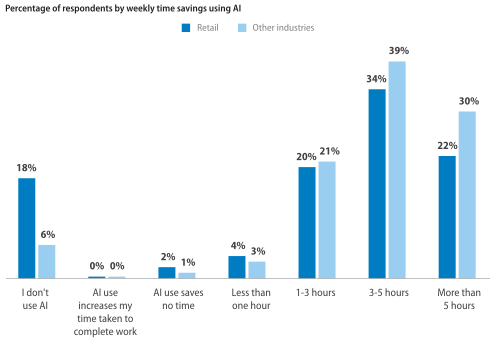
There are benefits to the AI usage as well: 34% of retail employees are saving three hours to five hours a week (Figure 1). In fact 85% of the retail employees surveyed are using the time saved to do more work, which can be theorized as increase in productivity.
Figure 1. Most retail employees are saving three to five hours a week
Source: Infosys Knowledge Institute
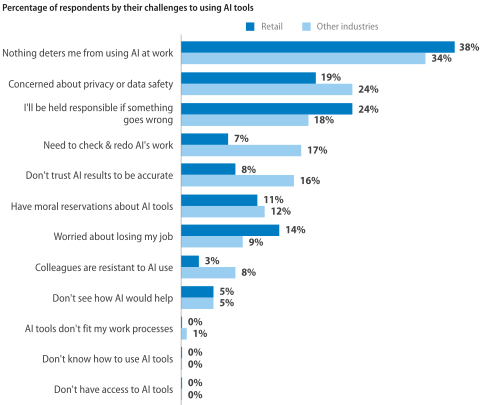
That said, only 38% of retail respondents report that nothing discourages them from using AI at the workplace (Figure 2). Others report barriers to AI usage, in terms of concerns about data safety and privacy, being held accountable for mistakes in AI results, and losing their jobs. It is therefore imperative that organizations address these concerns through the right interventions such as transparent communication, making employees well versed in the guardrails to using AI, and providing guidelines in AI usage, and regular training to make employees more confident about adopting AI. US retail chain Nordstrom has expanded its use of AI-powered chat beyond customer-facing channels, such as its website and call centers, to also support HR and recruitment functions. More than 90% of the retailer’s employees who completed development and enablement training have adopted the technology, highlighting the importance of workforce readiness.
Figure 2. Retail companies must address barriers to employee AI usage
Source: Infosys Knowledge Institute
Retail analytics
The global retail analytics market was valued at approximately $10.4 billion in 2025 and is projected to grow to $12 billion in 2026, reaching nearly $49 billion by 2035, at a CAGR of 16.7% from 2026 to 2035. Growing use of customer behavior analytics that enable retailers to generate deeper insights, make more informed business decisions, and deliver more personalized experiences across omnichannel retail environments is a key driver. For example, Macy’s AI-powered shopping assistant, Ask Macy’s, brings an intuitive and personalized approach to product discovery. Customers can describe what they are shopping for and for what occasion and receive tailored recommendations based on their preferences, purchase history, and occasion. Walmart’s generative AI-powered shopping assistant, Sparky, summarizes reviews, suggests products for specific occasions, and supports customers throughout their purchase journey. Walmart customers who use this feature have been reported building baskets roughly 35% larger than those who don't.
Customer management currently leads the functional landscape, accounting for roughly 30% of the retail analytics market. Market growth is also being accelerated by the adoption of AI-powered demand sensing, agentic AI for autonomous retail operations such as search, advertising, personalization, fulfillment, payments, and post-purchase support, and computer vision technologies that enhance in-store analytics and help retailers minimize inventory shrinkage. With 46% of shoppers willing to order products through AI tools, retailers have an opportunity to use analytics to understand AI-driven shopping behavior, optimize product visibility and recommendations, and deliver more personalized purchase journeys.
Looking ahead, order fulfillment and returns management is expected to emerge as the leading application for retail analytics. This is driven by the growing demand for e-commerce and rapid delivery, coupled with high e-commerce return rates and retailers’ increasing need to minimize return-related losses.
Tech stack security
Attackers are moving across networks significantly faster, with the average time taken to reach other devices after initial access falling from 48 minutes in 2024 to just 18 minutes between June and August 2025. With this, cybersecurity remains a significant concern for retailers. In fact 80% reported cyberattacks over the past year and more than half indicated increased exposure to security threats. Some of the key reasons identified were limited internal IT resources to address evolving cyberattack techniques, employee shortages and high turnover, and the increased reliance on temporary workers during seasonal demand periods.
A retail data breach costs an average of $3.5 million globally, but the damage can extend far beyond the initial financial hit. With 75% of consumers unwilling to shop with companies they don’t trust to protect their data, rebuilding customer confidence can take much longer than resolving the breach itself. Unsurprisingly, retail businesses are looking to invest in tech stack security. A recent study of retail executives found that cybersecurity leads planned technology investment, with 52% expecting to increase spending — outpacing data and analytics at 49% and AI at 42%.

Key takeaways
- Value has traditionally been synonymous with price, but that equation is breaking down. Today's consumers are weighing convenience, speed, personalization, sustainability credentials, and brand trust alongside cost when deciding where to shop. This means "fulfillment" can no longer be defined narrowly as getting a product from warehouse to doorstep. It now encompasses the entire experience surrounding that delivery: how personalized the recommendation was, how transparent the sourcing is, how flexible the return process is, and how well the brand anticipates the customer's needs before they're even expressed. Retailers that compete on price alone risk being commoditized, while those that redefine fulfillment as a holistic value exchange — blending speed, service, and relevance — will capture loyalty and margin.
- The narrative of e-commerce displacing physical stores has given way to a more nuanced reality: Stores are proving resilient, often serving as fulfillment hubs, showrooms, and brand experience centers within a broader omnichannel network. However, the era of growth-at-all-costs expansion, opening stores or scaling SKUs simply to capture market share, is ending. Retailers are shifting from asking "how do we grow bigger" to "how do we grow better," optimizing store footprints, tightening inventory management, and ensuring every channel investment generates a measurable return. Execution excellence in logistics, staffing, technology integration, and customer experience consistency has become the true competitive battleground, replacing sheer scale as the primary differentiator.
- When it comes to the regulatory landscape facing retailers, the EU, US, and Asia are moving in three different directions at once — mandatory and increasingly granular in Europe, deregulating at the federal level in the US, and still emerging and voluntary-led in Asia. There's no single global compliance standard companies can design toward. But consumer preference is filling the vacuum left by regulation. Sustainability remains a purchase driver even without a legal mandate. So, companies that stop investing because compliance pressure is off risk misreading the actual market signal.
- The pace of technological change — AI, automation, personalization engines, inventory platforms — has created a temptation to over-invest defensively, acquiring tools out of fear of falling behind rather than clear strategic need. This has led to widespread "tech sprawl": redundant platforms, underutilized licenses, and vendor contracts that drain budgets without delivering proportional value. Disciplined technology investment requires rigorous evaluation of actual utilization, clear ROI benchmarks before procurement, and periodic audits to retire or renegotiate underperforming tools. Retailers that build this discipline will free up capital to reinvest in the technologies that truly move the needle, while avoiding the margin erosion that comes from paying for capability they aren't using.


For retailers, the AI advantage will come from building the organizational muscle that lets employees use AI confidently.
- 09 Sep, 2026
- 6 min read

Companies that tailor their offerings and messaging to evolving consumer priorities will be better equipped to sustain demand as spending becomes more selective.
- 30 Jul, 2026
- 12 min read

Scaling AI adoption demands enterprise-wide transformation across operations, models, and culture.
- 29 Jul, 2026
