

Insights
- Canada's AI adoption gap is real. 86% of Canadian institutions invest in generative AI, but fewer than 10% have deployed it at scale. Most trail global peers like JPMorgan Chase and Capital One.
- Governance, not technology, is the real barrier. Only half of Canadian banks feel ready to scale AI, versus two-thirds of global peers. Bolt-on compliance stalls projects or gets them cancelled.
- Real-time payments remove the safety net. Once Canada's Real-Time Rail launches, banks must assess fraud and sanctions risk instantly, before a payment completes.
- New regulation raises the stakes. Bill C-12 penalties can reach CAD 20 million or 3% of global enterprise revenue. OSFI's E-23 brings AI and machine learning under strict model risk oversight ahead of a May 2027 deadline.
- RBC proves infrastructure-first governance pays off. Its Lumina platform builds data lineage tracking, privacy checks, and bias testing directly into development. The result: third globally for AI maturity, and a target of CAD 700 million to CAD 1 billion in AI-driven benefits by 2027.
The case for accelerating AI adoption has never been stronger
The Canadian banking sector faces a convergence of forces that are accelerating AI adoption. Geopolitical instability is increasing financial crime risks, while the launch of Canada's Real-Time Rail (RTR) is reshaping payments infrastructure. Together, these developments are making AI a business imperative.
Escalating geopolitical tensions have increased the complexity of sanctions screening and anti-money laundering (AML) operations. Conflicts in Europe and instability in the Middle East have expanded sanctions requirements and heightened scrutiny of cross-border transactions. Traditional rule-based systems struggle to keep pace with rapidly evolving threats, growing transaction volumes, and increasingly sophisticated financial crime. At the same time, compliance teams face mounting alert volumes and resource constraints. AI-powered monitoring and investigation tools are becoming essential to improve detection capabilities and investigator productivity. Leading solutions have demonstrated up to 90% reduction in alert review time compared with traditional approaches, allowing institutions to respond more effectively to emerging risks.
The RTR, expected to launch in late 2026, will offer an alternative to batch-based payment processing with instant, always-on account-to-account transfers. It will also serve as a foundation for Canada's open banking framework. The removal of settlement delays means banks must assess fraud, sanctions exposure, and transaction risk in real time before payments are completed. In its first phase, RTR will enable secure, consent-based data sharing and will eliminate screen scraping; subsequent phases are expected to allow accredited third parties to initiate payments on behalf of customers. As payments become faster and more interconnected, AI-driven decisioning will be critical to managing risk, detecting fraud, and supporting improved customer experiences at scale.
Canada's regulatory landscape is evolving alongside these technological changes. Bill C-12, enacted in March 2026, integrated AML and sanctions compliance into Canada's national security framework and introduced outcome-based compliance expectations, with penalties reaching CAD 20 million (US$ 14 million) or 3% of global enterprise revenue. In parallel, the Office of the Superintendent of Financial Institutions (OSFI) guideline E-23 requires financial institutions to establish enterprisewide model risk management frameworks. The guideline extends oversight beyond traditional risk models to encompass AI-driven decision-making, machine learning (ML) systems, and third-party algorithms.
Although 86% of Canadian financial institutions continue to invest in generative AI, the sector still trails global peers. Fewer than 10% have deployed AI at scale in any business function, with double-digit gaps across several use cases. Research from Evident Insights also shows US peers such as JPMorgan Chase and Capital One leading its AI Index. Beyond Royal Bank of Canada (RBC), ranked third globally, the rest of Canada’s institutions sit significantly further down the maturity scale. This competitive deficit, combined with the demands of RTR and E-23, creates a compelling opportunity for Canadian banks that move to build their AI capabilities.
Why banks struggle to scale AI beyond pilots
The transition from pilot to production remains one of the biggest barriers to enterprise AI adoption. Canadian banks continue to invest heavily in AI, but many lack the architectural and governance foundations needed to scale deployments across the enterprise. According to the Infosys Bank Tech Index, only half of Canadian banks believe their technology architecture is ready to support AI at scale, compared with two-thirds of global peers.
The core issue is a timing gap: AI is being deployed faster than governance can keep pace. Pilots often succeed because they operate in controlled environments with dedicated oversight. Scaling those same solutions across business lines is far more complex, requiring governance, risk controls, and compliance requirements to be embedded directly into AI infrastructure, not added after deployment.
This becomes particularly important in regulated environments. Before an AI model can move into production, institutions must demonstrate clear model validation, explainability, and auditability. If decision-making processes cannot be understood or justified, the model is unlikely to meet regulatory expectations. This growing emphasis on transparency is reflected in industry benchmarks such as Evident Insights, which evaluates banks on how openly they disclose and operationalize responsible AI frameworks.
When governance remains a downstream compliance exercise, projects become trapped in lengthy review and validation cycles. As a result, many AI initiatives struggle to progress beyond pilot stages and face increased risk of cancelation. Data privacy concerns, regulatory uncertainty, and data integration challenges are commonly cited reasons projects fail to scale (Figure 1). Without governance embedded into development and deployment workflows, banks risk creating a growing backlog of promising AI initiatives that never reach production.
Figure 1. Canadian banks more concerned with data privacy than peers
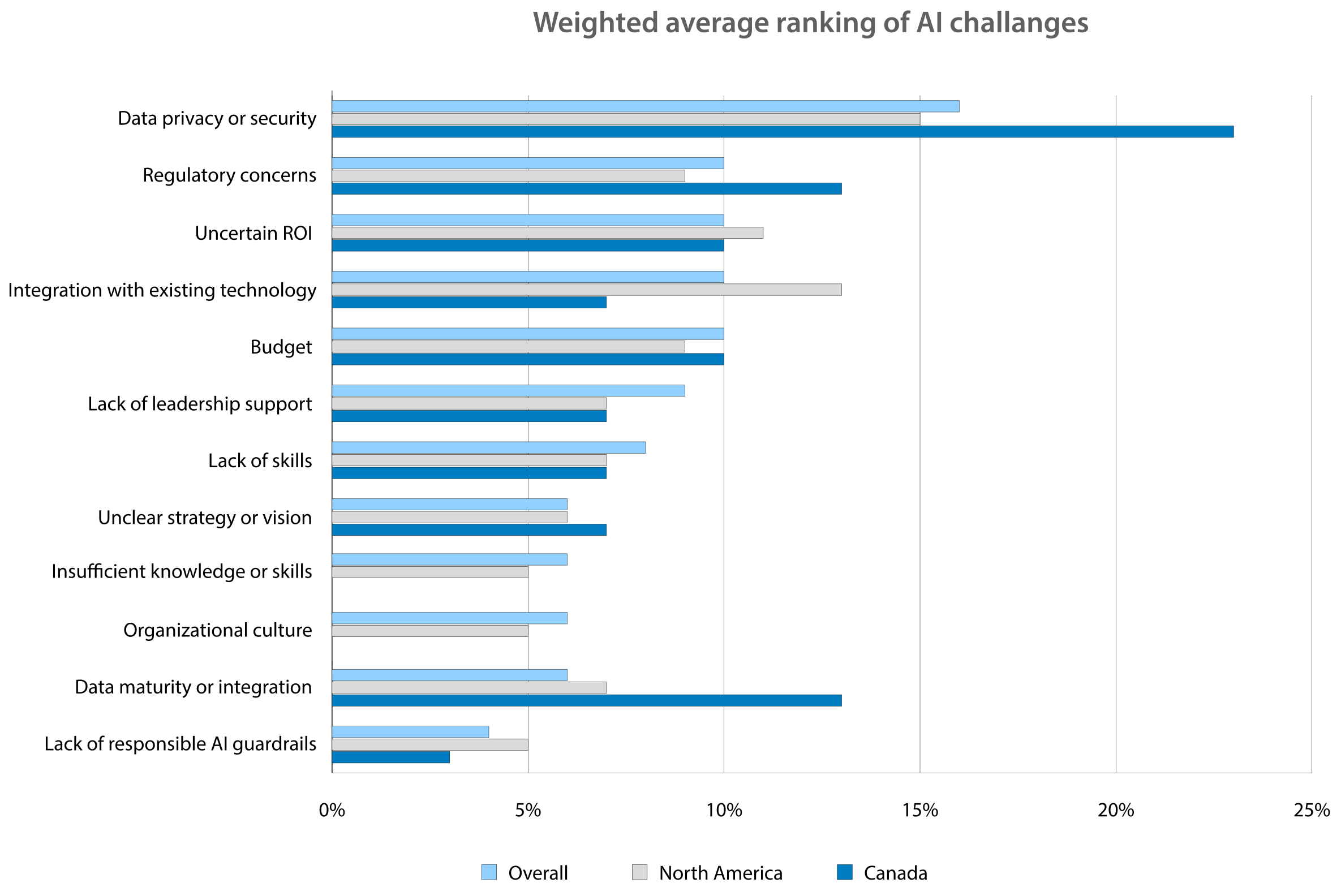
Source: Infosys Bank Tech index: Volume 6
Governance as a catalyst for scalable AI adoption
To close the confidence gap, Canadian banks must demonstrate that AI can scale safely while delivering repeatable financial value. RBC for example proves this is possible, ranking third globally for AI maturity.
RBC has coded automated guardrails directly into Lumina, its enterprise data and AI infrastructure, instead of treating risk management as a post-development checkpoint. This infrastructure-first approach answers the hurdles stalling the industry:
- Automated compliance architecture: RBC's Respect AI program embeds data-lineage tracking, privacy wrappers, and bias-testing directly into the software development life cycle. By automating checks before code is compiled, the bank replaces lagging human audits with real-time, self-documenting compliance.
- Data scale without compromise: Supported by Canada's largest private GPU cluster, Lumina securely standardizes and governs internal data while providing AI teams with the computational capacity to analyze up to 10 billion transactions per minute without exposing sensitive client information.
- The value blueprint: RBC established the Borealis AI Research Institute in 2016 to invest in AI research, talent development, governance, and technology infrastructure. The bank has set an ambition to generate CAD 700 million to CAD 1 billion of AI-driven benefits by 2027. This target is driven by live operational pipelines, including Aiden (AI electronic trading), Aiden QuickTakes (which cuts equity research publication cycles by up to 60%), and Atom, its proprietary financial foundation model. The institution is investing in proprietary technology, productivity in wealth management and partnering with regulators to manage risk.
Canadian banks have an opportunity to build AI differently. Rather than retrofitting governance after deployment, they can embed it into the foundation of their technology platforms. That approach will help them accelerate innovation while meeting rising expectations around resilience, transparency, and regulatory compliance.
– Vivek Dwivedi, Regional Head, Financial Services, Infosys
The shift to dynamic governance
Banks must industrialize responsible AI by embedding trust, explainability, and auditability into design from day one. Three complementary Canadian frameworks provide the roadmap:
- OSFI’s E-23: Mandates strict enterprisewide model risk management. E-23 treats ML drift and black-box opacity as material financial risks, requiring centralized inventorying and board accountability protocols.
- The edge principles: Developed by the Financial Industry Forum on Artificial Intelligence (FIFAI), these define practical responsible AI explainability to enable transparency, high-quality data practices, operational governance, and ethics to prevent consumer harm.
- The agile framework: Published in the FIFAI II report, agile shifts banks away from static annual audits toward real-time risk controls across five pillars — awareness, guardrails, innovation, learning, and ecosystem resiliency.
Aligning with these frameworks early is a commercial necessity. Coded guardrails prevent friction, allowing early adopters to navigate the May 2027 E-23 deadline while avoiding costly mid-development cancellations.
Beyond acceleration: The readiness mandate
As the 2026 RTR rollout accelerates the pace of financial operations, trust remains the industry’s definitive currency. Canadian institutions are uniquely positioned to lead this evolution. An inherent focus on structural discipline, recently reinforced by the rigorous requirements of E-23, provides a distinct advantage for integrating responsible AI at scale.
The path forward requires no new blueprints, as the roadmap already exists through E-23, the edge principles, and the agile framework. Embedding automated guardrails directly into core data infrastructure is essential for ensuring safety, explainability, and trustworthiness in critical banking systems. For institutions that move early, regulatory compliance becomes a durable strategic differentiator.


Regulatory change is accelerating and breach costs are rising, yet most institutions still rely on periodic, manual risk assurance. Three structural gaps, spanning visibility, third-party oversight, and governance, leave institutions unable to keep pace. Building risk assurance as a continuous, AI-augmented capability closes these gaps. A four-phase roadmap helps institutions get there.
- 11 Sep, 2026
- 15 min read

The difference between AI work and AI that works lies in the discipline to scale adoption, governance, and value realization
- 10 Sep, 2026

Learn how automated integrity checks and human oversight can help enterprises control AI agent sprawl, reduce duplication, and manage risk at scale.
- 08 Sep, 2026
