

Insights
- A unified platform brings data, workflows, governance, and AI into one operating foundation.
- It eliminates silos, manual handoffs, and duplicated effort across functions.
- ServiceNow has evolved from an IT tool into an enterprise-wide workflow and AI platform.
- With shared data and embedded AI, organizations can move faster, govern better, and scale transformation.
What does “unified” mean in practical terms – one UI, one workflow engine, one data model, or something else?
Unified means a single user interface with a consistent design system and navigation, and no need to jump between multiple tools. This is what’s termed “experience layer unification.” All the business processes are unified and run through a single orchestration layer, with automated end-to-end cross-functional workflows and no manual handoffs between disconnected systems.
There is one data model: a single source of truth with harmonized data definitions across systems and real-time or near-real-time data synchronization. There’s a single sign-on, centralized governance and compliance, and a shared analytics engine and centralized insights layer. The AI models in it are trained on integrated enterprise data. It has a common data foundation, coordinated workflows, consistent user experience, and centralized governance — working as one coherent system.
A unified platform connects data, processes, experiences, and governance into one cohesive system.

What problem are enterprises trying to solve when they say they want a unified platform?
When enterprises say they want a unified platform, they’re trying to solve the complexity caused by system sprawl, data silos, fragmented workflows, and disconnected customer and employee experiences.
Over time, organizations accumulate multiple tools that don’t talk to each other, resulting in duplicate data, manual handoffs, inconsistent reporting, slow decision-making, and high integration costs. This fragmentation makes innovation harder, governance riskier, and AI initiatives less effective. A unified platform allows them to bring data, processes, experience, and governance together into a coherent operating foundation.
What happens when each function (IT, HR, customer service, facilities, security) buys its own point tools?
In large enterprises, technology investments are often made independently by individual functions to address immediate operational challenges. The cumulative effect is rarely visible until it begins to impact business outcomes. A new employee may wait weeks for essential equipment because onboarding workflows are disconnected across HR and IT systems. Compliance audits can become resource-intensive exercises requiring manual reconciliation of data spread across multiple platforms that were never designed to work together.
As organizations pursue digital transformation and increasingly invest in AI, fragmented service ecosystems become barriers to progress. AI agents — which can answer questions, understand goals, make decisions, and take actions on behalf of a user or business process — and intelligent automation can only make reliable decisions if they have access to complete, accurate, and up-to-date information. They need data from multiple systems to be connected and enriched with context, so they understand what the data represents and how it relates to business processes and decisions. When critical data remains isolated across disconnected systems, AI cannot effectively deliver on its promise of autonomous action, intelligent decision-making, or end-to-end service orchestration.
Organizations that fail to establish a unified service and data foundation risk limiting their ability to capitalize on AI-driven transformation. Addressing this demands a deliberate approach to creating connected processes, shared data models, and enterprise-wide visibility.
How does unification change the employee and customer experience? What are some benefits?
Simply put, people stop having to think about where to go. There’s one place for any request: a software license, a payslip query, a broken chair, a security access card. The request routes itself, progress is visible without chasing, and if something's delayed, you can see why.
When systems are unified, AI tools handle the routine, predictive tools flag what's about to go wrong before it does, and over time, AI agents move from assisting humans to owning entire request types from start to finish. The human role shifts from processing to judgment — handling exceptions, refining policies, improving the system.

Case study
Infosys partnered with an international bank to enhance its employee experience. Powered by ServiceNow, Infosys delivered a unified HR portal that has become the single point of entry for all human resources services. This has eliminated fragmented portals, meaning employees now have an easy self-service portal for a range of queries and activities. Infosys implemented intelligent self-help capabilities, enabling employees to resolve HR queries independently, dramatically reducing case volume and freeing HR teams to focus on higher-value work. The self-help functionality helped the client achieve 85% case deflection. Infosys also configured real-time live chat within the HR portal, ensuring employees receive near-instant responses. This led to 90% of live chats being answered in under 30 seconds.
What is ServiceNow - an IT tool, workflow platform, or enterprise operating layer?
It depends on who you ask. IT will call this an IT service management platform; a chief human resources officer who's rolled it out across HR will describe something completely different. But someone who's watched it run across IT, HR, facilities, legal, and customer service will land on a simpler description: it's the closest thing the organization has to an operating system for how work actually gets done. People don't care which department owns the process; they want it to work and to know where it stands.
Powered by ServiceNow, Infosys delivered a unified HR portal for a client. The employees now have an easy self-service portal for a range of queries and activities.
What ServiceNow means is that the architecture doesn't change from one department to the next; only the configuration and the language do.
That shared engine is also why ServiceNow's AI lands differently from AI bolted onto a single tool. Now Assist runs across the whole platform — the same intelligence that summarizes a messy incident into a clean handover note also drafts an HR resolution, generates a knowledge article from a solved ticket, or writes an agent's reply to the customer. Virtual Agent and AI Search clear the routine before it ever reaches a person. The platform’s next step will involve building directly on it: AI agents will own work throughout the process by triaging, deciding within policy, executing, and escalating only genuine exceptions, with the AI agent orchestrator governing what each agent can do, logging every decision for audit, and managing the handoffs between agents and people. Rather than embedding AI into existing workflows, ServiceNow is becoming the enterprise platform that governs, orchestrates, and manages an organization's AI workforce.
How did ServiceNow evolve from IT service management into enterprisewide service management?
It started with replacing clunky IT ticketing with something cloud-based and actually built for the people using it. But the lasting value was the workflow engine underneath, hardened across some of the most complex IT environments in the world. When organizations asked whether that same engine could run HR service delivery or facilities, the answer was yes — because routing work, enforcing service level agreements, managing approvals, and surfacing knowledge were never IT problems to begin with. That's the realization that turned a tool into a platform: where the domain changes but the engine doesn't.
How does ServiceNow enable workflows that cross departments?
A new joiner arrives and their laptop isn't ready, their access isn't provisioned, their desk doesn't exist yet — not because anyone failed, but because three teams were working from three different queues with no shared visibility. ServiceNow changes that by making the workflow the connective tissue rather than relying on email coordination and goodwill. One request triggers everything across HR, IT, and facilities. Each team sees its tasks. The new joiner sees progress. The manager sees the full picture. The handoffs are in the system instead of in someone's inbox.
AI makes this smarter over time by recommending the right access profiles, flagging delays before they cascade, learning from thousands of runs what consistently goes wrong and feeding that back as process improvement. In the near future, IT provisioning agents will receive a joiner profile, check the access policy, provision the standard stack, and close the task without a human touching a queue. HR agents generate contracts, route them for signature, update records on completion. Facilities agents assign desks based on floor capacity and team location without a coordinator involved. Human effort shifts to the exceptions agents can't resolve and the policies that govern how agents behave. That transition needs deliberate planning now — which decisions require a human, what authority agents are given, how you manage a workforce that's part human and part AI.
Case study
A global life sciences company had siloed systems and inconsistent processes across its global business services functions, creating operational challenges. Its employees were wasting time searching for information related to HR, finance, and so on, and waiting for support from human agents. To solve this, Infosys delivered a unified employee portal built on the ServiceNow AI platform as a one-stop shop where employees can quickly get support.
Infosys enabled employees to independently raise and resolve HR queries through an intuitive self-service experience, reducing manual handling and freeing HR teams to focus on complex, high-value work. As a result, 75% of internal HR requests were self-submitted via AskHR.
Infosys configured AI-driven case summarization within the ServiceNow platform, automating a time-consuming task and enabling support teams to respond faster and more consistently at scale. This led to over 350 AI-generated case summaries every week. By breaking down silos and unifying services onto a single intelligent platform, Infosys enabled faster, smarter, and more consistent employee experiences across the organization.

How does a shared data foundation reduce duplicate records and “multiple versions of the truth”?
A shared data foundation reduces duplicate records by centralizing how core data entities such as customers, products, employees, or suppliers are defined, stored, and governed across the enterprise.
Instead of each system creating and maintaining its own version of a record, data is mastered once using common definitions, unique identifiers, and standardized schemas, and then synchronized or accessed by downstream applications through application programming interfaces (APIs). Built-in data governance rules, validation checks, and deduplication logic prevent redundant entries at the point of creation, while real-time updates ensure that changes propagate consistently across systems. As a result, reporting, analytics, and AI models draw from the same authoritative source, eliminating conflicting dashboards and manual reconciliation, and enabling decisions to be based on a single, trusted version of the truth.
Case study
A global consumer packaged goods company partnered with Infosys and ServiceNow to improve its configuration management database so it could become a reliable source of information about its IT environment – fixing areas where IT assets, applications, or dependencies were not fully visible. The initiative improved visibility into the IT environment through real-time insights, achieved 100% coverage of critical servers, strengthened security and compliance, and improved data quality by fixing over 130,000 records and restoring over 40% of key relationships between IT assets. It also removed duplicate and outdated records, reduced manual effort, and made IT operations more efficient.
A global CPG company partnered with Infosys and ServiceNow to improve its configuration management database so it could become a reliable source of information about its IT environment.

Do departments lose autonomy on a unified platform? How do you preserve flexibility?
Departments don’t lose autonomy. In a well-designed unified model, the enterprise standardizes core foundations such as data models, security policies, integration standards, workflow orchestration, and governance. This ensures consistency, compliance, and interoperability. On top of that foundation, departments retain flexibility through configurable workflows, modular applications, role-based experiences, API-driven extensions, and domain-level ownership of their data and processes.
The key is a “federated within a framework” approach where central teams define common standards and architecture, while business units configure and innovate within those boundaries. This preserves speed and contextual decision-making without reintroducing fragmentation.
What role can system integrators play in building solutions on top of the ServiceNow platform?
System integrators play a pivotal role in transforming how ServiceNow delivers value to customers, through the solutions they build. For example, the Infosys Enterprise Service Management Café (ESM Café) solution provides a standardized “gold” image of ServiceNow based on industry best practices and domain expertise with ready-to-deploy solutions and artifacts that allows customers to build and manage the instance in an accelerated timeframe as compared to spending substantial time and effort to configure and customize. ESM Café solutions help fast-track customer ServiceNow onboarding, enhance user experience and increase user adoption of the Now platform by unifying straightforward portal designs along with many functionalities. In addition, it provides a wide variety of documents such as starter packs, process flows and narratives, training guides, test cases, and data dictionaries.
This helps with accelerated onboarding, increased proficiency, and reduced support needs, along with increased user engagement, improved user satisfaction, and enhanced adoption rates. It also leads to consistency, efficiency, and compliance with standardized processes. Thus, system integrators can help clients realize faster business outcomes and measurable value from ServiceNow investments.

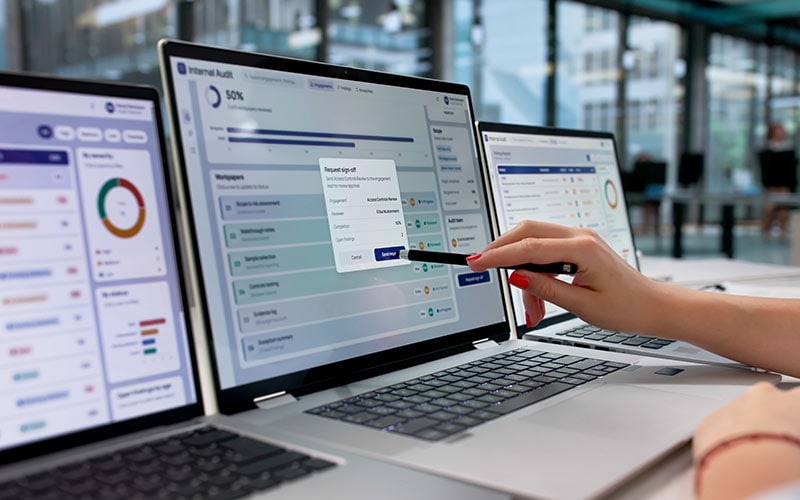
Regulatory change is accelerating and breach costs are rising, yet most institutions still rely on periodic, manual risk assurance. Three structural gaps, spanning visibility, third-party oversight, and governance, leave institutions unable to keep pace. Building risk assurance as a continuous, AI-augmented capability closes these gaps. A four-phase roadmap helps institutions get there.
- 11 Sep, 2026
- 15 min read

The difference between AI work and AI that works lies in the discipline to scale adoption, governance, and value realization
- 10 Sep, 2026

Learn how automated integrity checks and human oversight can help enterprises control AI agent sprawl, reduce duplication, and manage risk at scale.
- 08 Sep, 2026
