
Insights
- Today’s global capability canters (GCCs) are increasingly recognized as AI-first strategic innovation hubs focused on value creation.
- Applying AI to existing processes delivers incremental gains, while redesigning processes around AI unlocks transformational value.
- India’s ability to help businesses’ diversify risk through a “China Plus One” strategy, adds to its attractiveness as a GCC location.
- A GCC's long-term success is determined as much by organizational alignment as by its delivery capabilities.
- Strategy, governance, talent, and AI need to be aligned from day one to achieve strong return on investment (ROI) from a GCC.
Foreword
Global capability centers (GCCs) have emerged as critical enablers of AI transformation for their parent companies. Once viewed primarily as engines for cost reduction and operational efficiency, GCCs are now evolving into AI-first innovation hubs of strategic importance. They are helping enterprises to redesign business processes, accelerate product innovation and development, and critically, embed AI into the heart of business operations. India, with its distinctive combination of talent, engineering expertise, and digital capability, is leading this GCC evolution.
This journal draws together the perspectives and insights of Infosys GCC leaders and implementation experts on the defining ingredients of AI-first GCCs. We explore the evolution of GCCs and how they have grown in capability and strategic significance over the last 30 years and are helping to drive enterprise transformation. We explain what it means to be an AI-first GCC and how AI must be embedded into operating models, governance, and mindset from the outset. India has emerged as the top destination for GCC deployment, and we examine why its unique talent ecosystem underpins this position for innovation and long-term business value. We set out why GCCs must become board-level business units with the appropriate levels of autonomy and authority needed to deliver business value. Finally, we set out a roadmap for successfully building AI-first GCCs in India from strategic, governance, legal, and operational perspectives.
These viewpoints are supported by insights from two unique sources. First, Infosys GCC Conclave, held in Bengaluru in April 2026, drew together many of the industry’s leading thinkers and practitioners to discuss the major themes and trends shaping the evolution of GCCs. Among the topics of discussion were the importance of an AI-first mindset and operating model, and the most effective governance and workforce strategies. The event reflected Infosys’ deep commitment to helping its clients design, build, and run AI-led GCCs.
The second source is the inaugural Infosys GCC Index, which has surfaced new data and valuable insights on AI-first GCCs. The Index represents the most in-depth study of GCCs’ AI effectiveness to date based on input from over 500 GCC leaders in India. The research provides valuable perspective on the best practices of AI-first GCCs and helps to outline how organizations can successfully build and run such centers.
In this fast-evolving market, global enterprises need to ensure they are benefiting from the latest thinking and insights on AI transformation. Infosys is committed to helping organizations flourish through their GCC rollout, and we hope you find this journal a strong contribution to helping you build and evolve your AI-first GCC strategy.

GCCs’ evolution from cost control to strategic AI innovation
For most of their four-decade history, global capability centers (GCCs) had a simple mandate: minimize corporate expenditure. The original captive centers existed to shift back-office work to less expensive locations, and they were largely expected to stay quiet about it.
In India alone, that model is projected to reach $105 billion and employ up to 2.8 million professionals by 2030.
The rise of AI has added fresh momentum to this industry. Enterprise-grade AI is rapidly moving from experimental to operational deployment within GCCs. According to recent research by Infosys Knowledge Institute, AI is now embedded across engineering, operations, risk management, customer engagement, and decision-making. Around 75% of GCC functions are AI-supported, while 31% of business processes are already enhanced by AI.
This has led to a strategic shift in the role GCCs play for their parent companies. They have become innovation enablers alongside their traditional operational role.
As Mitrankur Majumdar, executive vice president and global head of services at Infosys, explained at the Infosys GCC Conclave held in Bengaluru in April 2026: “GCCs are owning outcomes, they have started owning platforms, and they are driving AI agendas.”
As AI scales across global businesses, organizations need talent at scale, strong governance structures, and proximity to core business processes — areas where GCCs have built up significant expertise.
Today’s GCCs are increasingly recognized as AI-first strategic innovation hubs focused on value creation. This represents a complete reinvention of the captive center model. Indeed, GCCs are playing a more central role in shaping business outcomes across the organization.
GCCs as enterprise AI hubs
The new GCC model places AI at the center of operations. Infosys, for example, leads with an AI-first approach within its GCC engagements. This does not mean deploying AI indiscriminately across GCC operations. It means first asking where AI can genuinely help — streamlining business processes, accelerating time to market, or powering cloud migrations — and then building accordingly. AI-driven GCC capabilities begin with digital-first charters that span AI, cloud, cybersecurity, and blockchain. The ambition extends well beyond automation. The goal is to embed intelligence into operations from the outset, making every employee AI literate and equipping GCCs to deliver AI-led outcomes.
As Chandra Vijjhala, president of the American Airlines Tech Hub in India, explained at the conclave: “When traditional GCCs adopt AI it is on top of what they already have, they are bound by the constraints of what already exists today.” He added, “An AI-first GCC, or any organization for that matter, must get away from the constraints and be able to see the blue-sky strategy. Where you are able to see everything in terms of what you bring in from an ‘art of the possible’ perspective.”
Many firms are using GCCs to build internal AI innovation centers that drive adoption across the entire organization. Rather than running disconnected pilot projects, GCCs centralize AI capabilities, creating a single engine of intelligent deployment.
Agentic AI is a particularly large opportunity for GCCs, because it can handle routine tasks autonomously, resolving straightforward issues and keeping headcount requirements lean.
“Agentic AI is going to produce huge, unimagined opportunities for enterprises to scale their enterprise capabilities through AI adoption. It will enable you to unleash the potential of AI for efficiency, release the talent pool for more value-added work and tasks which are otherwise doing routine jobs into accepting AI as a tool, and bring the human-AI interface together to bring new capabilities for GCCs,” said KS Viswanathan, an independent digital transformation advisor and former NASSCOM executive, at the conclave.
GCCs’ innovation heritage
The AI revolution is not the first time GCCs have taken the lead in innovation for their parent companies. Even before the AI revolution, GCCs had begun evolving into genuine research-and-development hubs, bearing responsibility for the full engineering life cycle: product design, platform architecture, deployment, and continuous optimization. The back-office label no longer fits. The breadth of their work reflects the shift. GCCs are developing fraud-detection and risk-modeling tools for financial services firms, alongside predictive maintenance systems and smart supply chain platforms for manufacturers.
Enterprise-grade AI is rapidly moving from experimental to operational deployment within GCCs.
Mercedes-Benz’s Indian GCC sits at the heart of the carmaker’s automotive and digital product development, contributing to driver-assistance systems, telematics, and chassis design. As its managing director and CEO, Manu Saale, said: “There’s a little bit of India in every Mercedes in the world.”
Technology innovation has followed the same path. Centers once tasked with maintaining legacy systems are now building cloud-native platforms from scratch, developing digital twins, and deploying internet of things infrastructure. “Technology is no longer something you just get done in a remote center, it’s a key part of staying competitive, it’s integral to strategy,” said Shrirang Raddi, associate vice president and head of client relations for financial services at Infosys.
Innovation now extends across customer experience, data analytics, and enterprise automation. GCCs are increasingly applying creative thinking to functions once led by headquarters, including customer support, marketing, and business operations. The roster of adopters runs from life sciences to retail banking. Novo Nordisk is using AI at its GCC to accelerate drug launches. Novartis has established a dedicated data science academy. Target and Goldman Sachs have built full-scale GCCs focused entirely on innovation. The transition from cost center to innovation engine is already evident across industries.
From delivery to ownership
The clearest sign of GCCs’ changed role is in decision-making authority. Corporate strategy used to flow in one direction: outward from headquarters, downward to the centers. GCCs followed orders. The mantra used to be “do as directed, don’t ask questions,” said Raddi.
Today, GCCs play an expanding role in enterprise leadership. Across industries, senior global roles are increasingly based within GCCs, and some now carry full profit-and-loss accountability for a business unit. The shift in leadership responsibility has been substantial. GCC heads now command enterprisewide mandates. “You now have scenarios where the risk leader, the operations head who runs the processes, and the technology person who is in charge of building the systems, are all in the same GCC,” said Raddi.
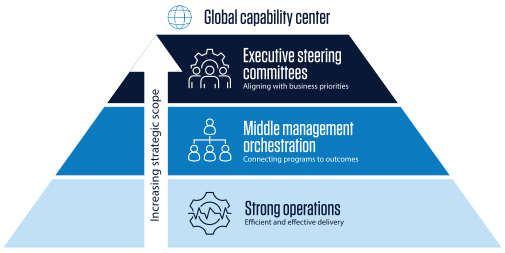
Broader strategic responsibility demands a rethink of governance. Traditional oversight focused narrowly on delivery metrics. Ardhendu Banerjee, strategy and growth leader for the GCC practice at Infosys, described what has replaced it as a “value office,” with GCCs transforming into strategic value creators (Figure 1).
Figure 1. Value office — accountable GCC governance
Source: Infosys
“Governance is now about headquarters tracking how the GCC is contributing to strategic initiatives and aligning that work to long-term corporate objectives. This makes governance accountable,” he said.
In his model, the value office works across three layers: strong operations at ground level, middle-management orchestration to connect programs to outcomes, and executive steering committees that align everything with business priorities.
Accountability has shifted too. GCCs operate with greater accountability for business outcomes, sharing both opportunities and risks with the broader enterprise. They are treated as global peers, exposed to opportunity, risk, and reward. When a GCC owns outcomes, its leaders engage more meaningfully with business strategy and bear genuine responsibility for results.
It is vital that an organization’s cultural environment be suffused within its GCC. This includes areas such as employee onboarding, internal policies, and unique corporate behaviors. “With GCCs running large-scale transformation and innovation programs, they need buy-in from across the business,” said Majumdar. “Employees within the GCC have to be seen as company insiders to gain corporate acceptance.”
India leads on GCCs
The country that gave birth to the first captive center has grown into something far more consequential. India now hosts over 1,800 GCCs.
Scale alone does not explain the country’s appeal. India offers an unusually rich ecosystem: decades of operational experience, a stable political environment, deep talent pools spanning multiple technical domains, a dense network of start-ups, and close links to academic institutions that produce a steady supply of skilled graduates.
Entire production platforms are now built and deployed from India, and many of the world’s largest companies depend on its engineering talent. Indian GCCs increasingly drive global programs and enterprisewide initiatives.
Capability centers in India help companies bring products to market faster, compressing the iteration cycles that once stretched to years. Well-coordinated government support has enabled universities to produce large cohorts of graduates in science, technology, engineering, and mathematics — young, adaptable, and eager for challenges.
More than 500 GCCs in India are now dedicated to AI and machine learning, supported by deep AI expertise and a fertile start-up ecosystem. For any business where AI sits at the center of the transformation agenda — which is to say, most businesses — an India GCC strategy offers a meaningful competitive advantage.
New imperatives
Why should business leaders invest in the next generation of GCCs? Enterprises face a convergence of pressures — sharpening competition, a scarcity of specialist talent, and relentless demands for transformation. The priority has shifted from establishing or expanding a GCC to maximizing its strategic value.
The most forward-looking organizations are treating the new GCC maturity model as a force multiplier that drives global strategy, shortens return-on-investment cycles, and leads innovation across the enterprise.
To get there, AI must be built into the GCC from the inception, with governance frameworks aligned to outcome-based metrics. And GCC leaders must take on higher-level decision-making responsibilities so they can reduce bottlenecks and play a more central role in shaping enterprise strategy.
As engines of growth, performance, and innovation, GCCs are well positioned to address the defining challenges facing businesses today and, in the years ahead. The humble back-office cost center has become something rather more consequential. Technology has always advanced, but rarely this fast. AI is being rolled out across industries as leaders race to shift from experimentation to creating value — a transition that once took decades is now measured in quarters.
For the insurance industry, the challenge is particular. The industry is built on long-established processes, risk controls, actuarial judgment, and regulatory trust. Yet AI adoption has outpaced that of personal computers, the internet, and smartphones combined. Integrating the fast new technology into this seasoned, structured industry requires a deep understanding of both.
As you will read in our second Infosys Insurance Journal, insurers are using AI now, and looking for ways to scale it, improve efficiency, and increase productivity. Generative AI tools have the potential to offer new solutions to fast-changing challenges that insurers already face. These challenges include climate change, demographic shifts, and geopolitical uncertainty.
As is true with all transformational technologies, existing industries must retool and alter incumbent processes to achieve real value. Insurers and software specialists are finding AI valuable for digital modernization, but this effort must include worker reskilling and retraining. The goal is to merge the best longstanding practices with the proper use of modern technology. AI, of course, must be integrated responsibly and comply with existing regulations. This must be done at a time when new rules and requirements for AI remain in flux.
And finally, insurance executives and their boards expect great things from AI very soon. Insurers must develop ways to measure their return on AI investment that keeps insurance core functions at the heart of decision-making.
The future of AI in insurance will be driven by talent and token economics, where scarce high-quality talent defines how to make AI effective, and token economics determines how to keep it economic. Together, these dual forces will shape the pace of innovation and the sustainability of AI adoption.
AI may yet buck the trend of slow transformation as enterprises race to implement it. But measurable value still requires time and hard work. Insurance executives must begin now to convert early AI use into measurable, responsible productivity gains.

The AI-first mindset behind successful GCCs
AI is driving rapid change across business and the wider economy.
But organizations that take an AI pilot to production are not always guaranteed success. Most AI initiatives start as siloed experiments that may provide incremental gains but don’t fundamentally change the business.
To give itself the best chance of success, an organization must adopt an AI-first mindset built into company strategy rather than viewing AI as an add-on. However, this shift can be difficult for established large businesses, most of which have yet to embed AI across their people and processes.
To address these challenges, large businesses are increasingly turning to global capability centers (GCCs). As companies look beyond cost savings to the value these centers generate, many are embedding AI into operations from day one, enabling organizations to reap the rewards of enterprise AI much faster.
Limitations of AI pilots
AI adoption has been relatively rapid in the business environment, but many organizations have yet to unlock its full benefits. Enthusiasm for AI has led to a surge in pilot projects, but organizations often struggle to scale these pilots across the enterprise. Infosys AI Business Value Radar 2025 reports that about one in every four AI initiatives is still in the pilot or planning stage and another 16% are getting canceled before or after deployment.
Meanwhile, only half of AI projects are successful. Implementation times can be lengthy and most projects take up to eight months to move an AI prototype into production.
Introducing AI is complicated. Enterprises are typically stretched thin. They must deal with technical debt, increased regulation, customer pressures, and growth simultaneously.
Getting AI into production comes with its own set of difficulties. Data must be clean and reliable. Guardrails need to be in place to prevent AI systems from causing financial, reputational, or legal damage. And implementing AI directly within an existing technology landscape without proper consideration of these factors can destabilize operations.
The complexity of integrating AI into existing systems, difficulties in setting up governance structures, and failure to establish a clear return on investment can all limit the success of AI pilot projects.
The AI-first GCC philosophy
The appeal of AI’s capacity to accelerate automation and reshape knowledge work has moved it to center stage. And agentic AI — autonomous agents that can fulfill complex tasks — is changing the landscape even faster. The AI-first GCC model is becoming central to AI value delivery. From the Infosys perspective, AI-first does not mean automating every process through technology. Instead, it means designing a GCC around AI, ensuring a dedicated team is in place to assess which capabilities are being built and how AI can be integrated.
“The point is to see where businesses can sensibly and usefully introduce AI-led innovation into the enterprise IT landscape,” said Padma Kumar, associate vice president and GCC solutions head at Infosys.
In this scenario, so-called deterministic tasks are handled by AI agents. These tasks follow clear, rule-based logic, producing predictable outcomes when provided with the same inputs. A good example is the use of AI agents for application maintenance. Such agents can resolve IT incident tickets automatically, helping reduce reliance on human intervention.
Freed from such time-consuming tasks, human workers take on the roles of auditors and overseers of AI outputs. They can focus more on higher-value tasks, such as new product design, service improvements, or enhancing customer experience.
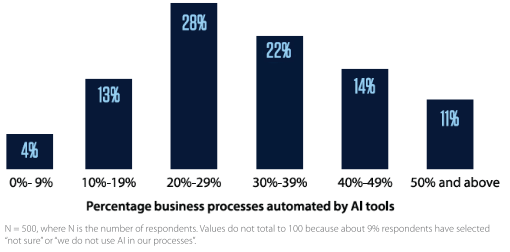
GCCs already appear to be making progress. The Infosys AI-first GCC Index (Volume 1, 2026) suggests that AI integration is materially reshaping operations. On average, 31% of business processes and tasks are now enhanced or automated by AI. While this marks significant progress, it also underscores the opportunity ahead (Figure 2).
Figure 2. The process automation opportunity
Source: Infosys
This is reflected in financial allocation. According to the survey, on average, between 15% and 20% of GCC operating budgets are now dedicated to developing AI initiatives that can transform business processes.
Faster market adaptation
An AI transformation strategy must be carefully considered. The use of AI should be a driving force rather than an afterthought. Instead of layering AI onto existing processes, enterprises and their GCC partners should apply an AI-first mindset when setting up new capability centers. This means bringing together AI platforms and agents, then building AI into the fabric of the GCC.
At a recent Infosys GCC conclave attended by industry leaders, Mitrankur Majumdar, executive vice president and global head of services, Infosys, explained what being AI-first meant. “There are two ways to apply AI: one is to keep the process as is and apply AI on top, and you’ll see incremental value from it,” he said. “But there’s another way to think about it. You completely redesign the process and then apply AI on top. That has a major improvement. That is the difference between AI-augmented and AI-first. We believe that redesigning the process is the way to go… And that is what creates the maximum impact of AI.”
Speaking at the same event, Chandra Shekar J, head of cloud orchestration, Philips, agreed. “When you try to redesign the complete process, that’s when we can get the total benefit of the AI. It means that instead of reaping from 5% to 10%, we can go maybe even up to 60% to 80%.”
New technology adoption means taking on new ways of working, according to Bal Shukla, chief technology officer and senior partner for financial services at Infosys. “When you’re on a running train, it’s very difficult to change the chassis without disrupting something that could have a massive impact on the rest of the business,” he added.
Enterprises are increasingly looking to combine human capability alongside digital agents. “We are seeing a change in what customers now want,” said Vishwanath Taware, vice president, strategic technology group at Infosys. “Instead of asking for 3,000 people for their GCC setup, they’re asking for 2,000 people and 1,000 AI agents. That’s a drastic shift from just four months ago.”
Safe and sustainable AI
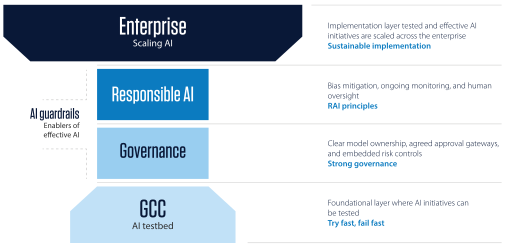
AI-first GCCs play a strategic role for organizations looking to adopt and use the technology. Shukla likens setting up an AI GCC to a runway where an organization can fail fast by trying out what works and what doesn’t. This means that those running the GCC can quickly learn what is best for the organization. In this model, businesses create a testbed environment for enterprise AI development (Figure 3). This creates durable foundations and important guardrails before AI is rolled out across the enterprise.
Figure 3. GCC, the testbed for scaling AI across the enterprise
Source: Infosys
Those guardrails need to include strong governance from the outset. Moving AI from pilots to production requires clear model ownership, agreed approval gateways, and embedded risk controls. Responsible AI principles need to be adopted and built into all workflows. These principles need to include bias mitigation, ongoing monitoring, and human oversight. When integrated early, governance becomes an enabler of effective AI.
Successful AI-first GCCs distinguish themselves through execution and organization. The Infosys AI-first GCC Index finds that GCCs with clearly defined AI roles and career pathways are 19% more likely to deliver improved outcomes, highlighting the importance of organizational design alongside technology adoption.
For organizations wanting to adopt AI within an existing GCC framework, a good approach is to establish a dedicated AI Center of Excellence (CoE). The CoE functions as a joint development structure that helps reduce risk and cost.
This model is not one where consultants deliver recommendations and walk away. “Retrofitting AI into an existing GCC requires robust codevelopment between the client company and the partner,” said Kumar. “Subject matter experts from the business sit alongside partners to identify priorities, define use cases, and determine how AI solutions can be deployed safely and at scale.”
The right AI skills
Having the right AI skills and experience is another important consideration when setting up a GCC. India, with its huge AI talent pool and expertise, provides a solid base for such a setup. It is already home to 500 GCCs dedicated to AI, helping take projects from pilot to enterprisewide rollout.
In some organizations, AI is already deeply embedded operationally. “Our GCC is an AI center of excellence — 60% of the people are working on AI,” noted one executive in the Infosys AI-first GCC Index.
Beyond talent, many GCC partners increasingly offer ready-made, integrated platforms that support AI development. These environments help businesses to control their AI investment because licensing and partnership agreements for AI tools and infrastructure are built in. For example, partnerships with leading hyperscalers and semiconductor manufacturers help keep overall investment manageable. The right talent, combined with scalable infrastructure, helps GCCs build a sustainable foundation for AI-first transformation.
The structure of AI teams is critical. GCCs that appoint AI champions, establish dedicated AI teams, and align incentives are significantly more likely to achieve meaningful outcomes (+7%, +5%, +4% respectively), according to the Infosys AI-first GCC Index.
“Businesses need to feel confident that they can begin their AI journey with ease,” said Ardhendu Banerjee, strategy and growth leader for the GCC practice at Infosys. “Building the right AI skills into a GCC enables organizations to build long-lasting value, drive higher productivity, and significantly elevate the overall digital experience.”
Scale across the business
The real test of AI-first GCCs lies in whether they can translate experimentation into impact — a change already visible across many sectors.
The banking and financial services sector was quick to use GCCs for AI development. These early adopters use AI to support fraud detection, model credit risk, and manage regulatory reporting. “The companies that rode the first wave of AI development have been very successful,” said Vishwanath Taware. “Businesses can follow the learnings from these trailblazers to understand how to create an AI-led GCC lab.”
Citizens Bank offers a good example of how an AI-first innovation hub can scale AI capabilities across a business. The bank’s hub uses AI to increase operational efficiency and resilience — and speed up the launch of new digital banking products and services for its retail and commercial customers. “The creation of an AI center of excellence at Citizens Bank is being used to transform the entire organization,” said Mitrankur Majumdar. “This elevates the role of its GCC from mere experimentation site to one that embeds AI into the bank’s entire operating model.”
In retail, AI engines embedded within GCCs forecast demand and optimize pricing dynamically. UK supermarket chain Tesco uses its India-based GCC to monitor refrigerators and assess when they need replacing. Controlling refrigerator temperatures has already saved the firm millions by preventing food spoilage.
Other examples span the manufacturing and industrial sectors, such as predictive maintenance systems that monitor machinery performance and flag failures before downtime occurs, reducing operational risk and cost. Human resources departments use AI tools to screen candidate profiles and match skills to roles — processes that originated in GCCs.
Key components
When considering how to build AI-first GCCs, it’s important to understand that it is not just about tools. It is about architecture, governance, mindset, structure, and talent. Businesses should build GCC capabilities around intelligence so that automation, analytics, and human expertise function as part of an integrated operating model.
An established ecosystem is of vital importance. This should comprise multiple partners, such as IT service providers and cloud providers. Linking with an ecosystem of AI startups and academic institutions close to the GCC can help in AI project development. Universities are also a source of fresh AI talent.
Speaking at the Infosys GCC Conclave, Satya Sudhir Dhulipala, vice president and GCC practice head, SLB, underlined the importance of collaborative AI ecosystems rather than enterprise development in isolation. “I think we are at a place where no one organization can do everything by ourselves or by themselves,” he said. “I think partnering with the external ecosystem is a very important part of how we end up operating… Thinking that a GCC could do everything by itself will only lead to pitfalls.”
It is also important that AI development does not take place in isolation. Rather, it should be handled in tandem with enterprise headquarters. In that sense, the GCC should act less like a satellite team and more like an embedded transformation engine — one designed to help companies move faster without breaking what’s already working.
In practical terms, AI-first means ensuring the GCC is value-delivery centric. AI needs to be woven into workflows, development, and governance structures from the very start. This helps support the desired hybrid human-plus-digital worker environment.
As AI moves from experimentation to enterprisewide deployment, GCCs will play a central role in ensuring safe and secure implementation. Businesses should build GCC capabilities around intelligence so that automation, analytics, and human expertise come together to drive consistent business value.

India’s edge in AI-first GCCs
Global enterprises face multiple challenges: How do they modernize and innovate while protecting profit margins? And how will they benefit from the AI revolution when technology-skilled people are in short supply?
The numbers suggest that most are not ready — an Infosys survey of 1,500 companies found that 57% lack readiness for AI, with only 21% admitting their workers have the knowledge to adopt AI.
Global enterprises face multiple challenges: How do they modernize and innovate while protecting profit margins? And how will they benefit from the AI revolution when technology-skilled people are in short supply? The numbers suggest that most are not ready — an Infosys survey of 1,500 companies found that 57% lack readiness for AI, with only 21% admitting their workers have the knowledge to adopt AI.
The global capability center (GCC) model is helping businesses address these challenges. Over the past few years, GCCs have become value creators and innovation hubs.
Indian GCCs have come a long way in the last 30 years, evolving to the point where strategic business functions are now run out of centers based in the country. But one of the country’s biggest advantages is its AI-first mindset. Another key advantage is the vast AI talent resources in the Indian workforce that can help organizations industrialize AI across the enterprise.
Challenges to business
In Europe and the US, growth has seen a marked slowdown. Inflationary wage pressures and increased capital costs add further strain. Compliance and regulatory costs add to fiscal demands. And important transformation projects must be funded from limited financial reserves.
Businesses must also get new products to market faster. Customers are becoming increasingly demanding, expecting not only better products but also faster release cycles. Scant talent availability across advanced engineering, AI, cybersecurity, and cloud has become a big problem in developed markets. Even organizations with deep pockets cannot simply spend their way out of the issues they face.
While enterprises are keen to develop AI-first roadmaps, they find themselves constrained in their ability to execute them at speed and at scale. In choosing where to locate a GCC, businesses consider cost advantages or targeted incentives — often provided by countries with a smaller concentration of GCCs than India. This can cause myriad problems.
Alternative locations lack talent density, leadership maturity, and skills depth, making scaling difficult. Their often-limited ecosystems increase operational risks. They also offer fewer sector specializations than India.
India leads on GCCs
India is home to 53% of the world’s GCCs, numbering more than 1,800 capability centers out of an estimated 3,200 worldwide, with a market size of almost $65 billion. By the end of the decade, India is set to be home to over 2,200 centers generating $100 billion in annual revenue and employing 2.8 million professionals.
GCCs in India have evolved from being about cost reduction and headcount alone into centers that offer quality and value at scale, deep industry knowledge, and operating maturity that no other geography can replicate.
Businesses are ceasing to set up GCCs for simple, predefined tasks. Instead, the Indian GCC ecosystem today supports wider business and AI transformation and is responsible for driving innovation programs.
Organizations increasingly use GCCs to advance AI adoption across the business and drive research and development (R&D). GCCs also provide key human resources support, data analytics, and high-level customer support services.
A mature ecosystem
One of the key advantages of basing a GCC in India is systemic: the country has a vast tech talent pool. with one of the world’s biggest concentrations of science, technology, engineering, and mathematics graduates. It also has an abundance of mature leaders and a wealth of young, digitally skilled professionals. Companies basing their GCC in India can draw on this large talent base and on decades of international business experience.
At a recent GCC leadership panel hosted by Infosys and the Financial Times in London, one panelist explained, “Cost opens the door — but the talent and capability we have in India smashes that door and helps us deliver with far better quality and standards.”
Talent concentration remains a decisive factor. As one executive noted in the Infosys AI-first GCC Index (Volume 1, 2026), based on a survey of 500 GCC leaders, “You cannot set up a GCC in smaller or emerging locations — you need established hubs like Bengaluru or Hyderabad or NCR because of the talent ecosystem.”
“India offers deep expertise in niche domains, including AI/generative AI, semiconductor design, cybersecurity, cloud engineering, aerospace R&D, digital manufacturing, advanced analytics, and product engineering. We have the world’s third-largest startup ecosystem and a strong network of leading engineering and technology institutions, including the IITs, IISc, and other top universities,” said Biswa Prateem Das, solution architect for the GCC practice at Infosys.
Setting up a GCC in India is also strongly supported at national and state levels. India permits 100% foreign direct investment for technology and R&D setups, while special economic zones (SEZs) and the Software Technology Parks of India (STPI) framework provide tax relief and operational incentives.
But it is experience and talent quality that are responsible for this change. “Everyone used to measure success by reaching a headcount of 500, 1,000, or 1,500,” said Kumaresh Shekki, GCC global deal architect at Infosys. “Much more is being asked of GCC operations. Now they provide a much higher quality of work, and value has become the number one measure of success.”
India’s relative neutrality and the desire of businesses to diversify through “China Plus One” strategies add to its attractiveness as a GCC location. For organizations looking to de-risk supply chains and establish new digital operations, India is a stable and resilient partner.
India’s GCCs help businesses gain structural leverage, with capabilities often concentrated in a single geography. This ecosystem supports full life cycle engineering ownership, from architecture design to product innovation and life cycle management. This speeds up decision-making, allowing organizations to move from roadmap to launch more quickly.
Strategic considerations
GCCs are increasingly structured to combine available technical expertise within specific business contexts. Today’s India capability centers are tasked with designing, building, and optimizing core enterprise capabilities rather than simply supporting them.
The rise of international roles within GCCs makes this clear: many now host CIOs, CIO-minus-one, and CIO-minus-two positions, as well as global product ownership roles. Often, these GCC leaders have the ear of board members at their parent companies.
Leadership maturity is another vital differentiator. In India, executives who have progressed through the ranks have navigated multiple shifts in mandate — from business support roles to process ownership to product leadership. They also understand how to set up durable governance structures and how to meet the varying needs of corporate stakeholders.
This ecosystem supports full life cycle engineering ownership, from architecture design to product innovation and life cycle management
With digital capabilities accelerating product cycles, AI transforming operating models, and talent scarcity hindering growth, the concentration of capabilities in India provides a strategic advantage. By locating core engineering, AI development, and platform ownership in India, organizations can increase agility and competitiveness. Many India-based GCCs now have larger engineering teams than those at their company headquarters — and their value as strategic secondary business hubs continues to grow.
Tier-1 cities across India provide distinct advantages, having built key specializations over decades. Bengaluru is known for its extensive technology and SaaS expertise; Hyderabad’s capability centers offer deep life sciences and digital capabilities; and Mumbai is renowned for its banking, financial services, and insurance expertise.
Tier-2 cities are set to further boost GCC growth, again with government support. Roughly 10% of GCC units are already in emerging tier-2 cities, while 6% of talent comes from these locations, such as Coimbatore, Ahmedabad, Chandigarh, Trivandrum, and Jaipur.
India’s AI-first GCC advantage
While engineering depth remains one of India’s most definitive advantages, it is India’s AI innovation that is driving its GCC network forward. The availability of skilled professionals who can translate AI aspiration into practical deployment is a key asset that lets AI adoption move faster, from experimentation to enterprisewide rollout.
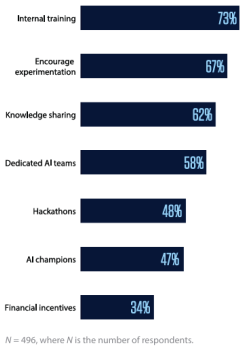
The Infosys AI-first GCC Index, based on a survey of 500 Indian GCC heads and senior executives, reinforces this AI-first positioning. Nearly three-quarters of respondents reported that they have implemented internal AI training programs within the past 12 months (Figure 4).
Figure 4. Fostering AI culture in GCCs
Source: Infosys
Beyond formal training, 62% are running structured knowledge-sharing initiatives, while 58% have established dedicated AI innovation teams. Almost half are organizing AI hackathons or innovation challenges, and 47% have appointed internal AI champions to accelerate adoption. A third are reinforcing these efforts through financial or career-based incentives.
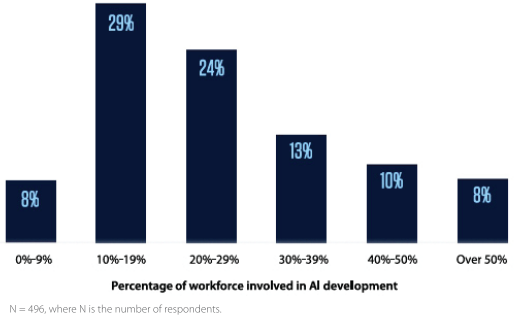
The Infosys AI-first GCC Index also found that a typical GCC today has around 20% of its workforce involved in developing or deploying AI solutions, underscoring the need for deep, specialized talent pools that can support enterprise transformation (Figure 5).
Figure 5. One in five GCC workforce involved in AI development
Source: Infosys
Together, these measures demonstrate that AI transformation within GCCs is not incidental — it is being systematically engineered.
This structured approach extends to talent strategy. In the Infosys AI-first GCC Index, when asked how they are securing the right AI capabilities, 25% of respondents identified training existing GCC employees as a primary lever. By comparison, 20% hire directly from the local talent market and 14% rely on external vendors for specialized roles. This emphasizes that Indian GCCs are prioritizing sustainable capability building over transactional talent acquisition.
“GCCs in India are truly AI first,” said Vishwanath Taware, vice president, strategic technology group at Infosys. “They offer deep human worker AI expertise and the knowledge to build a team of AI-powered digital workers.” Over decades of operation, India has developed repeatable systems that span site selection, talent acquisition, and governance. Well-accrued technology development and deployment experience across disciplines completes the circle. This makes delivering on transformation goals much easier.
India also remains highly focused on skills development. Upskilling in areas such as machine learning, large language models, and cybersecurity helps shorten time to value. “People have to learn the skills that businesses need today,” said Deval Shah, GCC practice head at Infosys. “The advantage for global enterprises is that in India, upskilling costs are a fraction of what they would be in more developed markets.”
Lufthansa Group’s GCC is a good example of India’s strength as a GCC destination. Its Bengaluru-based center has a wide remit, developing core aviation platforms, including flight planning, operations, and scheduling systems used by 400 airlines worldwide. The array of core business functions managed out of its capability center highlights the benefits of being able to access a broad range of engineering skills and digital capabilities.
The case for India
So, why should business leaders choose India to set up a GCC? India’s ecosystem has grown through multiple cycles of expansion. GCCs are constantly reinventing themselves to solve current and emerging business challenges.
Organizations looking to create value beyond cost reduction will benefit from this expertise. But seeing is understanding: business heads need to visit India’s GCCs themselves to understand their full capabilities and learn first-hand how other companies are already using them to innovate and grow.
As highlighted by industry leaders at a recent London GCC panel, “GCCs in India have moved from operations to becoming innovation and product engineering engines and are driving product evolution.”
India’s advantage does not come down to any single attribute. Being able to tap into an India capability center’s concentration of strengths makes for a compelling case to set up GCCs there. Businesses that need access to diverse talent, leadership, infrastructure, sector knowledge, and a vast pool of AI-skilled professionals should place India at the top of the list.
Organizations must modernize while protecting margins, scale innovation without sacrificing governance, and embrace an AI-first mindset — all while growing the business and competing harder.
India’s mature ecosystem with its skilled and well-educated workforce helps businesses tackle all of this head-on.

Why GCCs are now a boardroom imperative
Transforming global capability centers (GCCs) into engines for growth and innovation requires a deliberate, board-level GCC strategy.
GCCs must become essential business partners with a voice in corporate direction. Robust governance from the board drives this evolution.
This new model works because GCC workforces are already highly capable, with up-to-date AI and technology skills. Because GCCs can scale talent quickly, they can move fast and innovate when governance gives them the freedom to do so.
“It used to be that the headquarters drove everything and GCCs were the ones that were delivering, not partnering,” explained Ardhendu Banerjee, strategy and growth leader for the GCC practice at Infosys. “Now GCC leadership is consulted and has a voice in setting the agenda.”
Rethink oversight
A strategic GCC relies on governance aligned with enterprise headquarters. This should cover every layer of the GCC organization and establish clear levels of responsibility and autonomy for each. GCC leaders need decision-making authority at the corporate level. It’s a distinct shift from the previous model, in which even top GCC leaders reported to lines of business at the company headquarters.
Instead, GCCs become true partners for the enterprise. Updated GCC governance helps drive innovation. It enables the GCC to launch new initiatives and create internal business structures as needed. For example, the ability to create a lab ecosystem enables GCCs to develop new products and services. Labs provide an agile and flexible structure for bringing together expert teams focused on specific challenges.
A GCC for one handset manufacturer, for instance, established a lab to work with local vendors and academic institutions — in India, these are often top universities or institutions like the Indian Institutes of Technology. The result: a tailored product for a regional market not previously served by the corporation.
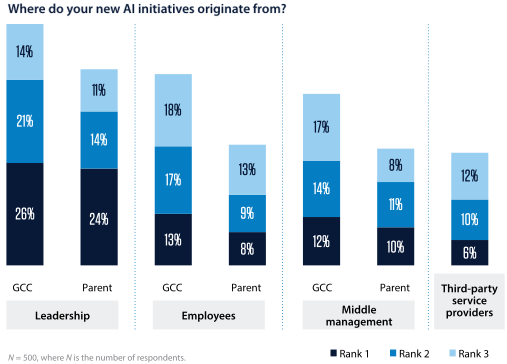
Evidence of this shift is already clear. According to the Infosys AI-first GCC Index (Volume 1, 2026), based on a survey of 500 GCC leaders, 46% of GCCs report directly to the CEO or COO. AI initiatives are reshaping that reporting line. The survey found that although 24% of GCCs say AI initiatives originate primarily from their parent company leadership, 26% say their AI initiatives come from their own GCC leadership’s directives (Figure 6).
Figure 6. Leadership-driven AI initiatives
Source: Infosys Knowledge Institute
Strategic business unit
So what defines a GCC as a strategic business unit? Shared ownership of outcomes. Achieving this requires a well-designed operating model. This covers what services the GCC will deliver, the reporting structure, and how work is allocated, monitored, and delivered. It also defines GCC responsibilities, which reduces the risk of micromanagement from headquarters. Key operational requirements include clear key performance indicators (KPIs) and objectives and key results (OKRs). Enterprise and GCC leadership need to work together to identify OKRs and KPIs that best reflect progress toward their goals. It’s critical for both to share the same priorities, said Deval Shah, GCC practice head at Infosys. “Now the GCCs have the same priorities as the headquarters, and they are building a culture which is exactly the same as the headquarters. There are no diverging priorities,” he said.
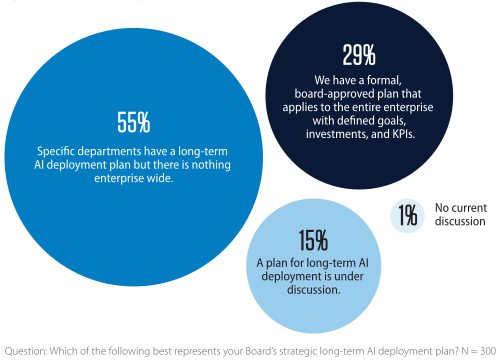
The challenge is that most companies do not have a formal strategic AI plan led by their board. And without clear enterprise priorities, GCCs may struggle to align their AI initiatives with broader business goals. Research by the Infosys Knowledge Institute in partnership with the National Association of Corporate Directors in 2025 found that only 29% of companies have a formal board-approved plan across the entire enterprise (Figure 7).
Figure 7. AI deployment strategies in boardroom
Source: Infosys Knowledge Institute
The good news is that GCCs are increasingly being entrusted with global mandates. As one executive in the Infosys GCC Index explained, “It’s not that we are sitting in India… the first word in GCC is ‘global’... We always let our teams think from that perspective: how can you think more broadly and more globally.”
With shared goals established, how can businesses measure a strategic GCC’s ability to deliver value? One indicator is how much GCC work contributes to the process of bringing a new product or service to market. For example, how many patents related to an offering are filed by the GCC’s workforce? And how does that compare to the overall number of patents for that offering? If GCC talent, say, is responsible for between 20% and 40% of the patents for a product, the revenue generated from those products can serve as an input into understanding the GCC’s contribution to business growth.
One GCC leader, interviewed as part of the GCC Index research, defined value as something that is won through successful delivery: “There is no replica of your quality of work and the delivery of what you do. That’s the only thing that defines you… That’s how you gain trust from your executive.”
Trust is built through consistent delivery at scale. Another GCC leader added, “Once one project is successful, other business units start to take notice and reach out to the GCC to replicate that success.” It’s also important to set quarterly milestones, so organizations can measure progress and the pace of innovation. This helps the GCC plan sprints and deliver regular, measurable results within short timeframes.
“A compelling example is Infosys’ collaboration with Citizens Bank to build an AI-first GCC. Through agentic self-service, autonomous workflows, and intelligent automation, the bank is reducing manual effort, improving operational efficiency, and targeting an uplift in revenues” said Biswa Prateem Das, solution architect for the GCC practice at Infosys.
The role of the board
Board leaders must recognize the benefits of a GCC that operates as more than a support services provider. This requires strategic oversight that enables capability centers to function as satellite organizations empowered to make business-impacting decisions.
The transformation starts with the enterprise CEO and other C-suite executives. They need to put in place organizational structures, governance, infrastructure policies, and investments required for GCC success.
Rather than driving execution, boards increasingly define the business problems that need to be solved. As one GCC leader explained in the GCC Index, “We never explore for learning… the board gives the problem; we solve it.” This reflects a shift toward outcome-led transformation.
“It’s essential that someone at the top of the organization takes ownership of the GCC’s success,” said Mitrankur Majumdar, executive vice president and global head of services at Infosys. “For a GCC, there is usually an executive sponsor from headquarters. It’s like a new baby who needs a mother or father figure. There’s a lot of change management involved to rally the organization to support an innovation center that you’re opening that may have a massive positive impact on the rest of the organization.”
GCCs were already evolving before the arrival of AI chatbots and agents. Financial services businesses, for example, saw capability centers as a way to maintain control over data privacy and security. To meet strict regulatory requirements around data, they chose to shift in-house data responsibilities to their own GCCs rather than to third-party service providers.
This offered a way to keep data handling within their organizations and take advantage of GCC workforce scalability, said Shrirang Raddi, associate vice president and head of client relations for financial services at Infosys. “Some large banks decided that rather than having an outsourcing-heavy or partner-heavy approach, they wanted to be insourcing-heavy,” he explained. “If you’re going to execute a lot of these projects in house, then you need both the volume as well as the depth of capability, which is what they built into the GCCs.”
This evolution required GCCs to share the same data infrastructure as corporate headquarters. It also required GCC access to the same levels of technological capabilities and adequate financial support. As this happened, GCCs became more able to act as partner organizations. With an AI-first operating model, they’re now empowered even further.
The GCC model provides scalable access to large, skilled workforces. It delivers cost savings to the business through arbitrage, taking advantage of India’s typically lower salaries for various professional roles compared with the US and parts of Europe. By shifting to an AI-first model, enterprises can now amplify that expertise within GCCs. With deeper data-driven analytics insights and the ability to automate processes with AI agents, GCC workforces can do more and innovate faster. This multiplies the operational and strategic efficiencies that a GCC can deliver.
Board leaders can enable this using a responsible, accountable, supporting, consulted, informed (RASCI) model. This establishes clear expectations for GCC roles and how they fit into the international organization’s operating framework. It also means clarifying decision rights and including GCC leaders in board-level decision-making.
When board leaders empower GCC leadership, their GCCs are freed to focus on expanding the services they deliver and innovating within them.
GCC agency in agentic AI
When board leaders empower GCC leadership, their GCCs are freed to focus on expanding the services they deliver and innovating within them. This is particularly important as centers adopt an AI-first model that can pave the way for strategic change across the entire business.
AI agents can handle many tasks with minimal human supervision. Retailers and banks have begun using agentic AI to handle common customer queries and complaints, freeing up time for customer service teams to provide more personalized support to callers with more complex needs. Agentic systems can also provide GCCs with deeper data insights and more opportunities to innovate.
For example, AI agents make it possible to adjust prices or marketing strategies in real time based on customer demand. They enable organizations to mine customer histories to identify new opportunities for personalization or new offerings for unmet needs. When GCCs are freed by the board to explore such capabilities, they can become hubs of innovation.
At the Infosys GCC Conclave, Rajneesh Malviya, executive vice president, service offering head, financial services, Infosys, spoke about the advantages GCCs have for AI-led innovation. “GCCs are at the forefront of redefining how innovation can happen at speed,” he said. “AI-first is the right approach for GCCs because they have the right capabilities, talent at scale, and the ability to experiment rapidly at relatively low cost. That puts them in a strong position to redefine how organizations operate with AI as a core capability. I believe AI-first GCCs, particularly those adopting AI-first as a strategic approach and helping define enterprise-wide strategy, have a unique advantage.”
Similarly, Vishwanath Taware, vice president, strategic technology group at Infosys, said: “We see now how AI can work in conjunction with humans and we’re finding that, going forward, most GCCs will say, ‘I’m going to build the human capital plus the AI capital to deliver my services back to the enterprise.’ With AI in place and the scaling of GCCs, we can innovate much faster.”
Organizations drive transformation by embedding leaders in GCCs who are empowered to use AI in such ways and act on the opportunities they identify with AI. In-house leadership, opportunities for career advancement, and financial incentives for employees within the GCC also help drive innovation. So does providing the resources and support for centers of excellence.
It follows that the most successful GCCs today have end-to-end ownership of products and services. They’re guided by in-house leadership with a seat at the corporate table, have access to AI platforms and tools to transform business processes, and have the autonomy to serve local markets and contribute directly to the company’s revenues and growth.
Also speaking at the conclave, Kajla Piplani, director, Bank of APIs delivery lead, NatWest, explained that GCCs need to move beyond the simple adoption of AI tools and instead embed the technology into how they solve customer challenges. “It’s important to understand the business problems, the customers you deal with, and then come with an AI-integrated solution at every layer,” she said. “I think if we embrace AI for problem solving that helps the customer, then we will definitely give them value out of it.”
At the same event, KS Viswanathan, an independent digital transformation advisor, underlined the importance of reviewing and updating business processes in line with the application of agentic solutions. “From an agentic AI perspective, it will create new and unimagined opportunities — provided we don’t simply treat it as an automation tool but instead undertake complete process reengineering and workflow reimagination to derive the greatest benefits from agentic AI,” said Viswanathan.
A focus for the board
GCCs are an ideal hub for AI experiments to be tested and scaled because they house critical data, process, and governance capability.
Any improvement in a GCC’s efficiency, effectiveness, quality, or scalability through AI brings direct returns to the parent company. But only if leadership, operating model, funding, and outcomes are truly integrated. This is where the board has a role to play: ensuring that an international company’s global centers are valued and designed as innovation force multipliers, not just cost centers.
What does it take to transform a GCC into a center that’s empowered to lead and innovate?
Start by identifying the organization’s goals for the GCC: what will it deliver and how will it work? Then define the GCC’s responsibilities and establish in-house leadership roles using a RASCI model. Decide on clear KPIs and OKRs, including expected ROI, for the GCC. And support the GCC with AI-driven infrastructure and adequate resources for innovation.

How to build successful GCC operations in India
To achieve long-term return on investment (ROI) from a global capability center (GCC) in India, enterprises need to align strategy, governance, talent, and AI from day one.
When all these elements are integrated into an AI-first GCC organization, the facility can evolve beyond cost savings and become a hub for business innovation. So how is this done in practice?
This GCC implementation guide provides a complete roadmap, covering strategic direction, regulatory setup, organizational design, governance, AI-first thinking, and value realization. With the right planning and execution, enterprises will position their GCC as a long-term engines of enterprise value.
Phase 1: Strategic planning
Clarity of purpose is essential from the start. An enterprise needs to clearly understand what it wants the GCC to achieve. Ashish Bhatla, head of EMEA GCC operations at Infosys, said: “What are the business outcomes that an organization wants from a GCC? Those need to be defined very sharply. This is a key success criterion.”
These outcomes are typically financial — either in terms of cost savings or increased revenues. But the enterprise might also be looking for operational efficiencies or strategic business benefits. As one GCC leader explained in the Infosys AI-first GCC Index Survey (Volume 1, 2026), based on a survey of 500 GCC leaders, “Every full-time equivalent is tied to ROI — revenue uplift, profitability, and customer experience impact.” The focus is shifting to measurable business outcomes.
But the value case should also account for less easily quantified benefits. One GCC leader in the GCC Index noted, “Some benefits of GCCs are intangible — they create value that cannot be compared in dollar terms but still generate strategic value.”
Businesses also need to envision how an AI-first approach could help transform processes, operations, and outcomes. Clear ROI metrics and tracking mechanisms need to be established at the outset. And it’s vital that the GCC’s objectives are supported by every part of the business, especially by the board and key stakeholders.
At the recent Infosys GCC Conclave, Mitrankur Majumdar, executive vice president and global head of services at Infosys, said successful GCCs focus on the business value AI can deliver. “Whenever GCC leaders think about AI, they think about the business relevance of what AI is going to solve. They don’t think of it as a technology solution.”
Besides identifying its outcome goals, the organization also needs to decide how quickly it wants to implement the GCC. This helps answer the next most critical question: What is the best GCC model?
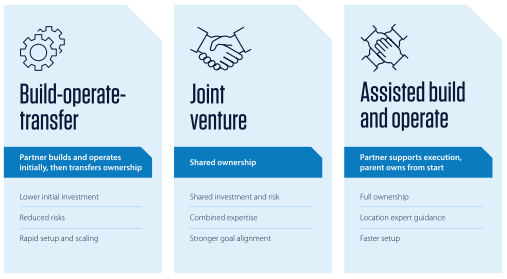
The options include build-operate-transfer (BOT), joint venture (JV), and assisted build and operate (ABO) models (Figure 8). A BOT, for example, involves working with a partner that sets up the GCC and manages it for a specified period before handing it over to the organization. It’s a model that lets a business implement a GCC quickly by working with an experienced partner.
How to choose a model
Which type of GCC model to choose depends on an organization’s needs and objectives:
BOT model: A partner establishes the infrastructure, manages compliance, and optimizes workflows. After meeting predefined benchmarks, the partner then transfers GCC ownership to the organization. This enables the business to scale rapidly without having to invest the full upfront costs of a GCC. Benefits include reduced risks, faster time to value, and long-term ownership.
JV model: In this co-ownership model, the partner brings local expertise in building the infrastructure and talent while the enterprise brings its capabilities in implementing solutions at scale and integrating with larger workflows. Since both parties are invested from the start, the goals are more likely to align, with reduced or shared risk.
ABO model: The organization owns the GCC from the start. The partner supports execution by handling setup, talent acquisition, training, and more in accordance with the organization’s goals. The benefits include accelerated launch with expert guidance and immediate, full control of the GCC.
After selecting a preferred model and location, the organization needs to build a business case with an AI-first approach. This will support ROI through automation, cost and operational efficiencies, and revenue-enhancing innovation. The strategic planning phase also helps identify the GCC’s legal structure, which is covered in more detail in the following section.
Phase 2: Practical setup
Successfully implementing a GCC requires careful navigation of local tax and compliance issues.
An organization can build the right legal foundation by working with a partner with expertise in the type of GCC it is looking for, and experience in the region in which the GCC will be located. Partner selection also matters because experienced providers can bring domain knowledge and implementation experience. One interviewee for the GCC Index explained that partners “bring those accelerators, they are bringing those use cases… Then you work on the business cases and that helps you reduce the overall cycle.”
Bhatla noted: “Setting up the legal entity is the first part of setting up a GCC. That’s complex and you need the right partner to do that.” Wherever the GCC is located, it will need to meet labor, business, and tax regulations. These requirements are affected by the choice of GCC model, which can determine whether the organization or its GCC partner is the employer of record. India, and in particular states including Karnataka, Maharashtra, and Telangana, offers various government incentives for organizations looking to invest in a GCC. These include special economic zones (SEZs) and software technology parks (STPs) with tax exemptions and simplified compliance.
Compliance also depends on the GCC legal structure chosen by the organization. Requirements about taxation and profit repatriation, for example, will vary according to whether a GCC is structured as a wholly owned subsidiary, branch office, or limited liability partnership. Organizations also need to comply with India’s labor laws, data protection regulations, and requirements for foreign direct investment approvals.
Such compliance considerations will impact decisions about who is responsible for hiring and training, how the GCC is answerable to the board, and what career paths and GCC leadership look like.
Depending on the model used, the business may or may not own the actual GCC facility and its technology infrastructure.
Clarity of purpose is essential from the start. An enterprise needs to clearly understand what it wants the GCC to achieve.
Phase 3: The business culture
When the legal foundations are in place, the enterprise must build the GCC’s workforce, leadership structure, and cultural foundations.
The enterprise or its partner needs to recruit the workforce, develop training and capability-building programs, and implement talent retention plans to strengthen the GCC’s employee value proposition. This positioning is essential if the center is to stand out as a hub for innovation.
Unlike traditional approaches to outsourcing, the BOT model provides an organization with complete operational control. But the right GCC partner is essential for executing that model. One strategy to quickly build workforce capabilities involves the organization’s partner bringing in a seed team of people with knowledge in key areas. This enables a GCC to start executing its mission even as the rest of the workforce is still being hired and trained.
The organization’s partner can also support a fast start by creating a success team. Consisting of leaders from the partner company, the success team temporarily leads the GCC to help it deliver on goals from the moment it begins operations. This team remains in place while the business builds out its own full leadership team. At that point, the GCC leaders take over.
“The Success Team functions as the governing layer, providing oversight, driving accountability, and ensuring consistently high-quality delivery outcomes.”
Biswa Prateem Das, solution architect, GCC practice at Infosys, said, “The success team is like the governing layer. It’s there to ensure that the delivery is at the highest quality.”
Options for a seed team and success team may or may not be available with other models and GCC partners. Organizations need to clarify the available strategies for talent development before choosing a partner.
Phase 4: Strong governance
Building a successful GCC requires strong governance, especially for an AI-first GCC. This helps the center focus on achieving its desired business outcomes and clarifies responsibilities and accountability. It also ensures that AI use is accountable, ethical, and transparent.
Good governance establishes the guardrails needed for data security and regulatory compliance. It also helps define processes and manage risks around areas such as AI usage. Beyond control, governance enables agility. It supports flexible decision making and gives the center the ability to act on new opportunities as they arise.
Centers of excellence (CoEs) play a critical role in driving structured and consistent innovation. A GCC can establish multiple CoEs depending on its mission. For example, an AI CoE can help accelerate AI adoption across both the GCC and the wider enterprise. It can provide a centralized structure for establishing AI governance, identifying use cases, and developing proofs of concept and deployment plans. It also helps to bring together experts from across different functions to speed development. The index also found that having dedicated AI teams, such as those in a CoE, can deliver a 5% increased chance that the GCC will report significant improvements from AI initiatives.
Phase 5: Strategic balance
Organizations gain the greatest value out of GCCs when they enable them to operate as strategic partners. This requires board-level support, as well as board representation for GCC leaders. It also requires a mindset that embraces innovation and is ready to explore the capabilities of emerging technologies like AI.
GCCs must have end-to-end ownership of the products and services within their remit. And they need autonomy to act on innovation opportunities. They also need adequate budget and the right data and technology infrastructure to support their goals. This includes access to advanced AI tools and platforms, and mechanisms for knowledge transfer.
Building a culture of continuous improvement is critical. Businesses can enable this by collaborating with their GCC to build a comprehensive KPI framework. They also need to establish GCC ROI metrics and regular milestones that align with the organization’s desired business outcomes.
Organizations need to clarify the available strategies for talent development before choosing a partner.
Avoid common pitfalls
Organizations wanting to build a successful GCC must look out for gaps at every stage of development. A GCC can fall short of its goals for many reasons. Common pitfalls include the lack of a clear vision with measurable outcomes, or a failure to provide GCCs with the autonomy needed to build ownership and foster innovation. Other challenges often relate to regulatory compliance.
Decisions about GCC talent also provide multiple opportunities to miss out on potential value. The center must be able to offer a compelling employee value proposition, with opportunities for advancement, recognition, and incentives. And GCC leaders must feel like they are true partners to the organization.
At the conclave, Sridhar Rengan, managing director for finance, Brookfield Asset Management, talked about the importance of retaining talent with access to innovative tech. “The average age of the talent force is sub-30,” he said. “They are very tuned to bringing in fresh ideas, and AI today is capturing everybody’s imagination.
It’s not only about improving processes, we also see it as an important talent-retention tool because if you don’t adopt AI, we will see this talent migrating to institutions which have adopted AI.”
It’s also critical to start with the talent needed to enable an AI-first mindset, said Majumdar. “You cannot just say, ‘I will do an AI-first GCC without having the correct talent.’” But with the proper foundation, GCC teams can lay the groundwork for AI-enabled transformation that will ripple across the entire business.
In addition to the need for strong governance, GCCs must also be built with resilience in mind. This requires organizations to regularly assess the GCC’s ability to work toward its goals, monitor for potential disruptions, and have recovery and business continuity plans in place.
Building a GCC for innovation today requires an AI-first approach that must have ongoing support from the organization. AI-first must be built into the GCC’s way of working from the start. As Kumaresh Shekki, GCC global deal architect at Infosys, said, “Such a project has to come from the top. It cannot be at the project kickoff stage or at the ribbon-cutting stage. It has to be continual.”
Roadmap to GCC success
Building an AI-first GCC requires strong leadership commitment. It also needs support from every other part of the business, as well as from other stakeholders and potential partners.
This is pertinent because the GCC Index survey found that seven in 10 GCCs are using generative AI across all business functions. Siloed AI initiatives do not fundamentally change a business.
Success starts with clear goals, desired outcomes, and a well-supported business case.
Four key priorities can help organizations translate these ambitions into a successful GCC, as outlined below (Figure 8).
Figure 8. Three common GCC setup models
Source: Infosys
Contributors
Mitrankur Majumdar
Executive vice president | global head of services, utilities, resources, and energy | Infosys
Rajneesh Malviya
Executive vice president | service offering head | financial services | Infosys
Deval Shah
Vice president | GCC practice head | Infosys
Vishwanath Taware
Vice president | strategic technology group | Infosys
Bal Shukla
Chief technology officer and senior partner | financial services | Infosys
Shrirang Raddi
Associate vice president and head of client relations | financial services | Infosys
Padma Kumar
Associate vice president and GCC solutions head | Infosys
Ashish Bhatla
Head of EMEA GCC operations | Infosys
Ardhendu Banerjee
Strategy and growth leader | GCC practice | Infosys
Biswa Prateem Das
Solution architect | GCC practice | Infosys
Kumaresh Shekki
GCC global deal architect | Infosys
Editor
Samad Masood
Infosys Knowledge Institute
Editorial and production
Kate Bevan
Infosys Knowledge Institute | London
Pragya Rai
Infosys Knowledge Institute | Bengaluru
Sandeep
Infosys Knowledge Institute | Bengaluru
Dylan Cosper
Infosys Knowledge Institute | Richardson


Agentic AI is already proving its value in broad domains, such as IT, business operations, and information intensive business processes. However, in this new Tech Navigator report, we shine a spotlight on how Infosys is using agentic AI to solve real-world challenges in five distinct industries.
- 14 Oct, 2025
- 45 min read

Explore the seven trends intersecting digital technologies and life sciences that will enable leaders to harness rapid change and deliver breakthroughs for life.
- 14 May, 2025

This study uncovers how companies use generative AI, how much they spend on it, how it’s being rolled out in organizations large and small, and where it makes an impact in the energy, mining, and utilities industries.
- 09 Jan, 2025
- 7 min read
