
Insights
- AI-first R&D shifts food innovation from trial and error to guided learning.
- The biggest gains come when connected data, predictive models, workflow copilots, and governance work as one operating model.
- Explainability and data maturity determine whether AI recommendations can be trusted, repeated, and defended.
- F&B companies should start with focused high-value use cases, baseline performance, and scale only when data, governance, model monitoring, and traceability are in place.
F&B companies face a difficult innovation equation: launch products faster, improve success rates, and control costs while relying on R&D models that have changed only little over decades. At the same time, they must respond to evolving consumer preferences while managing fragmented workflows, siloed data, and manual handoffs across product launch and development. Sustainability and labeling requirements add further complexity. The result is a model that is slow to learn, expensive to iterate, and increasingly misaligned with the pace of market change.
AI-first R&D offers a different path. By connecting product data, applying predictive models, and automating routine workflows, companies can make better decisions before expensive lab and pilot work begins. But in regulated food environments, speed alone is not sufficient. AI recommendations must also be explainable, reproducible, and traceable to scientific evidence, especially when they influence formulation decisions, shelf-life claims, nutrition labeling, or launch approvals.
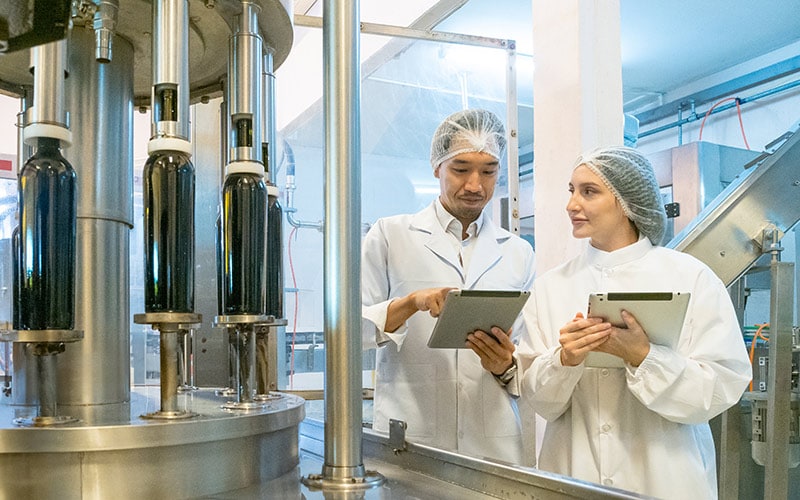
AI-first R&D helps food and beverage companies move from trial-and-error innovation to guided learning, narrowing formulation choices before expensive lab and pilot work begins.
That distinction matters because AI value is not automatic. Infosys’ AI Business Value Radar 2025 found that about 20% of enterprise AI use cases deliver on all business objectives, while just over 30% are close to doing so. The research also links AI success to changes in operating models, data architecture, and workforce readiness. For consumer packaged goods (CPG), the opportunity is real but still developing. Infosys Knowledge Institute research found that 55% of AI use cases in CPG generate tangible business value, broadly in line with the cross-industry average.
The innovation challenge is structural, not cyclical
Product development in the F&B industry is inherently multidisciplinary. Teams must optimize taste, texture, ingredient functionality, nutrition, shelf life, manufacturability, cost, and regulatory compliance simultaneously. Much of this work still depends on physical experimentation, as teams move from concept to formulation, sensory testing, and pilot production through repeated trial-and-error cycles.
Across CPG, the challenge is visible in launch outcomes. A peer-reviewed analysis of 83,719 new stock-keeping units across 31 CPG categories in the US found that one in four new products is no longer purchased after one year, and approximately 40% fail within two years.
Part of the problem is how R&D work is organized. Product knowledge is often scattered across product life cycle management (PLM), electronic laboratory notebook (ELN), laboratory information management systems (LIMS), quality systems, supplier files, spreadsheets, and institutional memory. This fragmentation makes it harder to reuse prior learning, choose the best starting formulation, or flag scale-up and compliance risks early.
The operational effects are visible across the development life cycle. R&D teams move through multiple prototypes before they have enough confidence in a formulation, iterating on ingredient ratios, processing parameters, and sensory targets across successive lab batches. Digital tools do not remove the need for lab and pilot work, but they can help teams identify promising formulations, surface scale-up risks earlier, and reduce avoidable experimentation.
AI-first R&D changes where decisions happen
AI-first R&D is shifting F&B innovation from a sequential, experiment-heavy process into a connected and predictive operating model. Instead of waiting for physical trials to reveal every formulation, sensory, or scale-up issue, teams can use connected data and predictive models to narrow the field before expensive lab and pilot work begins.
Nestlé’s innovation overhaul shows this shift in practice. The company reduced project approvals from six stage gates to three, established R&D accelerators globally, and reported that average project duration fell from 33 months to 12 months, with some F&B categories moving from concept to launch in six to nine months. NotCo shows the AI-native version of the same shift. Its Giuseppe platform uses machine learning (ML) to analyze more than 300,000 plant ingredients, including molecular structures and physical-chemical properties. It proposes formulations that match a target product’s sensory profile while optimizing for taste, texture, cost, sourcing, and regulatory requirements.
The AI-first R&D operating model
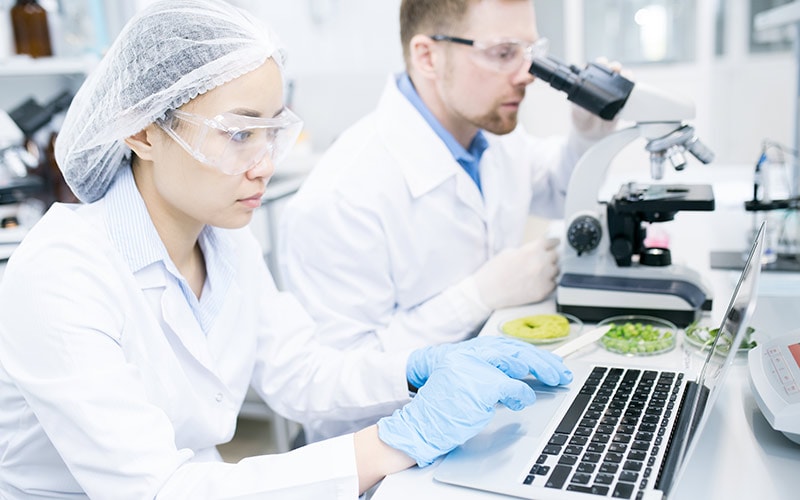
The operating model has four layers: connected data, predictive intelligence, workflow copilots, and governance.
Connected data foundation
The first layer brings design, experiment, and production data into a common, governed structure. It connects PLM specifications, ELN metadata, LIMS results, sensory data, quality records, manufacturing histories, and supplier information into a data fabric or knowledge graph.
This work is often more complex than it appears. Legacy ERP, PLM, ELN, and LIMS integrations are rarely clean, and sensory data is often inconsistent, subjective, or stored outside core systems. Before model development begins, companies should assess the completeness, consistency, accessibility, lineage, and ownership of critical R&D records.
Infosys’ work with pladis illustrates the importance of a strong data foundation. The company undertook an analytics transformation with Infosys to improve decision-making and operations across business functions, including R&D, demand forecasting, sales, and supply chain. The work focused on building a stronger data foundation, reverse-integrating consumer data into the enterprise, and using analytics to help decision-makers make sense of complex business signals.
Predictive intelligence
This layer shifts effort from late-stage correction to earlier prediction. Formulation models can recommend ingredient combinations that balance taste, cost, nutrition, allergens, and regulatory constraints. Digital twins can simulate process conditions and manufacturing line interactions before the physical setup begins.
Nestlé used virtual simulations for its Nescafé Dolce Gusto Neo coffee system to model the interaction between coffee, paper packaging, and the machine, then applied technical settings to physical equipment while manufacturing lines were set up with digital twins. Similarly, Infosys has worked on a related formulation-intelligence problem for a global F&B company, using Azure ML to infer competitor product formulations from publicly available information such as nutrition facts panels and ingredient labels. The model also used market share information to help the company decide which competitor products deserve closer attention.
Predictive sensory, shelf-life, and quality models can then help flag risks before they appear in pilot. In regulated R&D, however, these outputs must be interpretable. Scientists need to understand what a model recommends and why. Methods such as SHapley Additive exPlanations (SHAP) can show which variables most influenced a recommendation, while confidence indicators can flag when a prediction may be less reliable.
Workflow copilots
Workflow copilots are beginning to show value in the knowledge-heavy parts of R&D, particularly where scientists, engineers, regulatory teams, and documentation specialists need to search, compare, and reuse prior research. Unilever’s AI-powered R&D assistant connects more than 150,000 scientific documents from over a century of research, allowing scientists to query prior knowledge in natural language.
The broader use of copilots across formulations, scale-up, regulatory evidence assembly, and launch documentation is still emerging. In those areas, the near-term value is likely to come from reducing search time, drafting documentation for expert review, and helping teams find relevant prior experiments faster.
Infosys’ Generative AI Radar: CPG Industry Report supports this cautious framing. It found that CPG companies are exploring generative AI for content creation, operational efficiency, personalization, and product development, but at the time of publication in 2024, most had not yet moved from experimentation to proven business value.
Governance and trust
Governance determines whether AI can move from experimentation to approved R&D use. It defines who can access data, how models are validated, when experts must review outputs, and how decisions are monitored over time.
A global F&B company may need to satisfy different expectations across regions, from food safety and labeling rules to privacy, data residency, and AI accountability requirements. Global frameworks can help set consistent principles even when local requirements vary. The OECD principles on AI emphasize accountability, transparency, explainability, and human-centered values; the US National Institute of Standards and Technology’s AI risk management framework provides a practical risk-management structure; and the European Food Safety Authority’s guidance emphasizes the importance of uncertainty analysis in scientific assessments. Infosys’ Enterprise AI Readiness Radar reinforces this point by identifying governance as one of five building blocks of AI readiness, alongside strategy, talent, data, and technology.
Connected data, predictive models, workflow copilots, and governance must work together for AI recommendations to be trusted, repeated, and defended in regulated food environments.
Where the value appears first
Better concepts and stronger starting formulations
The earliest gains are likely to come from focused use cases where better learning improves decision-making. At the front end of innovation, AI can help teams sense consumer signals, surface prior formulation knowledge, and narrow the options worth physical testing. That improves the quality of the first experimental round and reduces time spent on low-probability ideas. In F&B, where formulation means balancing flavor, texture, function, cost, label requirements, and manufacturability, better upstream filtering matters.
Fewer physical experiments and smarter testing
AI-first R&D makes experimentation more selective. Predictive models, simulation, and active-learning approaches can help scientists decide which ingredient combinations or processing variables deserve lab time, especially in categories where ingredient variability, sensory performance, and shelf life make experimentation costly.
NotCo’s Giuseppe platform is one example of this approach. The company reports that the platform can reduce trial-and-error iteration by up to 10 times and compress development timelines from 18 to 24 months to weeks for partner companies.
Stronger scale-up and transfer
A strong concept only creates value if it survives transfer to pilot and plant. The transition from bench to manufacturing is often where value can erode. Process variability, ingredient interactions, batch size, equipment settings, packaging, and shelf-life conditions can change product performance after lab success.
Predictive models and digital twins help teams anticipate these risks earlier by comparing production scenarios, flagging sensitive variables, and identifying where a formulation might need adjustment before it reaches the plant. The benefits are practical: fewer late-stage surprises, better technology-transfer decisions, and more confidence when moving from lab success to commercial production.
Faster documentation and compliance
Documentation is a persistent bottleneck in R&D. Scientists and regulatory teams spend significant time recording results, retrieving prior work, and preparing technical documentation. In F&B companies, that work becomes more complex when formulations, claims, and labels must be reviewed across markets.
Copilots can draft experiment summaries, prepare specification updates, compare previous test results, and organize evidence packages for expert review. However, the output from these tools requires human review, clear source traceability, and documented approval, especially if they affect claims, labels, safety, or compliance.
How to begin
Start with a focused use case
Start with a single product or innovation stream that has clear business value, sufficient historical data, and manageable regulatory complexity. The strongest entry points are typically formulation search, experiment documentation, or scale-up decision support, as these areas are tied to visible pain points and measurable outcomes.
The use case should meet clear entry criteria, including minimum data availability, defined model scope, named business owner, validation plan, regulatory review path, and success metrics. Without these guardrails, focused use cases risk becoming disconnected pilots rather than repeatable capabilities.
Measure current performance before deployment
Before deployment, establish a clear picture of current performance across time-to-market, prototype iterations, first-pass yield, scientist productivity, documentation effort, and compliance review effort. External benchmarks from published research and industry surveys can help size the opportunity, but they should not substitute for internal measurements. Impact should be measured against validated reference points that reflect the company’s category mix, data maturity, regulatory exposure, and operating model.
Build sequentially
The path to portfolio-level impact should be sequential. Map how PLM, ELN, and LIMS represent the same product across stages. Identify the decision points where better predictions would reduce iterations or improve confidence. Then deliver a minimum viable result, such as fewer prototypes to hit a sensory target, faster change-control approval, or improved first-pass yield on a difficult scale-up. As the capability scales, it should be wrapped with model versioning, data governance, confidence scoring, retraining cadence, human-in-the-loop review, and traceable approvals.
From trial and error to guided learning
AI-first R&D shifts F&B innovation from a trial-and-error model to guided learning. It gives teams a clearer view of what to test, what to avoid, and where scientific effort can create the greatest commercial value.
The economy improves because experimentation scales in software. The odds improve because decisions are informed by the right data at the right moment. But the advantage lasts only when AI is embedded in disciplined ways of working that include validated models, accountable review, and evidence that can travel from formulation to launch.
For F&B leaders, the question is whether it will remain a set of isolated tools or become the way the organization learns, decides, and launches.


Regulatory change is accelerating and breach costs are rising, yet most institutions still rely on periodic, manual risk assurance. Three structural gaps, spanning visibility, third-party oversight, and governance, leave institutions unable to keep pace. Building risk assurance as a continuous, AI-augmented capability closes these gaps. A four-phase roadmap helps institutions get there.
- 11 Sep, 2026
- 15 min read

The difference between AI work and AI that works lies in the discipline to scale adoption, governance, and value realization
- 10 Sep, 2026

Learn how automated integrity checks and human oversight can help enterprises control AI agent sprawl, reduce duplication, and manage risk at scale.
- 08 Sep, 2026
