

Insights
- Telecom's workforce is motivated, AI-ready, and already using AI in daily work.
- Yet that readiness is playing out in isolated projects, with little organizational architecture to scale it.
- Strategic clarity, leadership support, and training are not consistently in place — leaving a willing workforce without direction.
- The good news is that the foundation exists. Four priorities can close the gap: enterprise strategy, role redesign, capability investment, and rigorous measurement.
The telecom industry is under pressure. Despite soaring network traffic, average revenue per user has stagnated across most markets. AI, embedded in networks, operations, and customer management, has become the industry's strategic answer, with global operators racing to become AI-native. The Infosys Frontier Telco framework describes what that transformation demands — and at its core, it relies on people.
An Infosys Knowledge Institute survey of over 2,600 workers across geographies and industries finds that telecom employees are well into their AI journey. Nearly all (96%) are already using AI at work, with most doing so multiple times a day. More than half feel motivated by AI, compared to 39% in other industries. Positive sentiment is broad: 83% report feeling good about AI at work, and both skepticism and worry are lower than the cross-industry average. Telecom workers use AI with confidence, save real time each week, and in many cases choose to invest that time in learning new skills.
The workforce is ready for AI. The same cannot be said for the supporting structure around it.
The AI gap facing telecom operators
Our research found that while telecom employees are positive and engaged in AI, their organizations have not kept pace. Two gaps stand out.
Gap 1: AI remains fragmented
Across industries, a disconnect exists between the top layer and the middle layer of organizations. Nearly half of senior leaders believe their company is transforming with AI, but fewer than a quarter of middle managers see the same picture. A strategy that exists at the leadership level but does not reach those who execute it stays fragmented rather than directed.
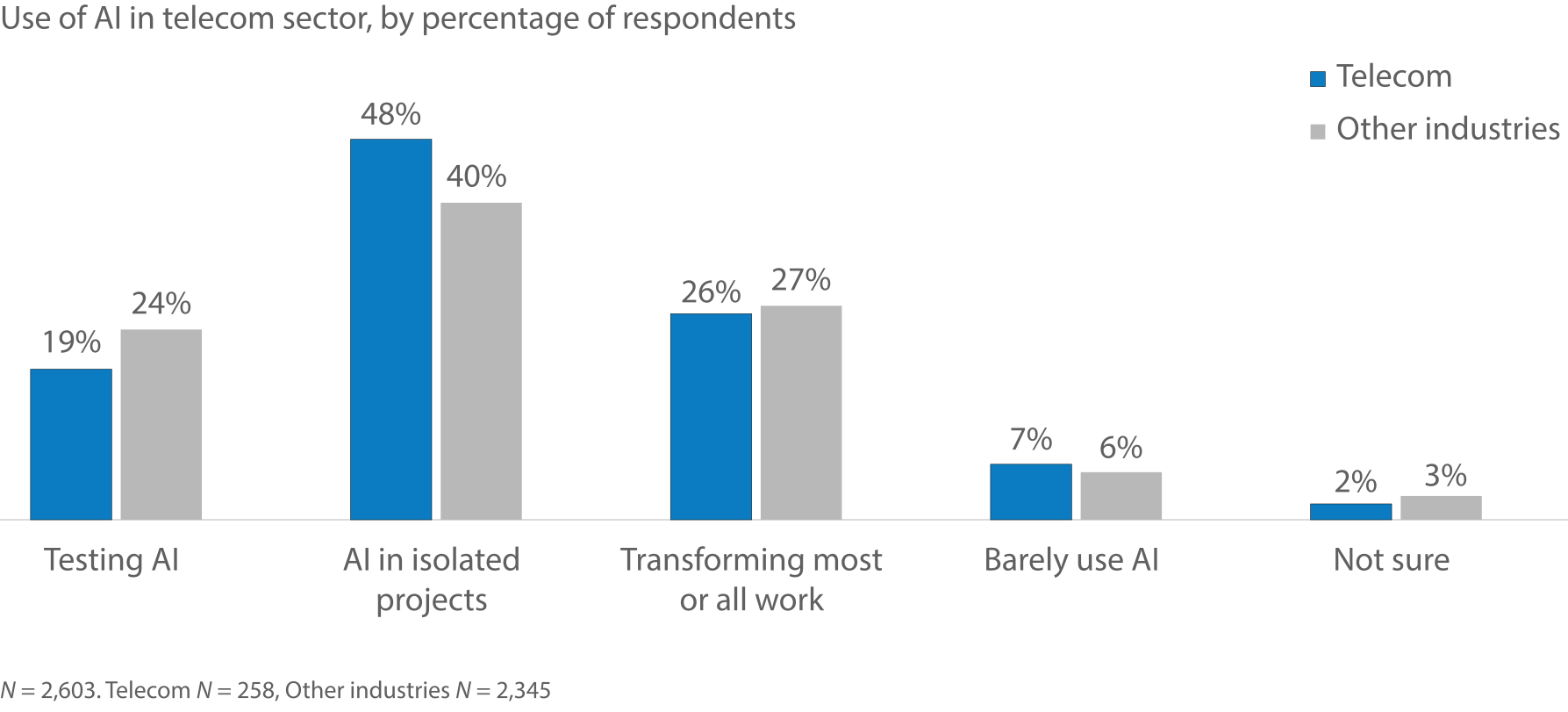
Telecom is no exception. Nearly half of telecom workers report AI confined to isolated projects — a higher share than in other industries and at par with automotive (Figure 1). A further 19% see AI still in testing phases, compared to 24% in other industries — meaning the pipeline that enables pilots to transition toward enterprise deployment appears weaker in telecom than elsewhere. With only a quarter of workers seeing their organizations transforming most or all work with AI, the sector has considerable ground to cover. What is missing is the organizational architecture to convert it into coordinated, enterprisewide impact.
Figure 1. Telecom is experimenting widely with AI but has yet to commit to enterprisewide transformation
Source: Infosys Knowledge Institute
The industry recognizes this challenge. At MWC 2026, TM Forum launched its AI-Native Blueprint to help telecom operators move from isolated AI pilots to trusted, production-scale operations.
Gap 2: Organizational enablers hold back capability
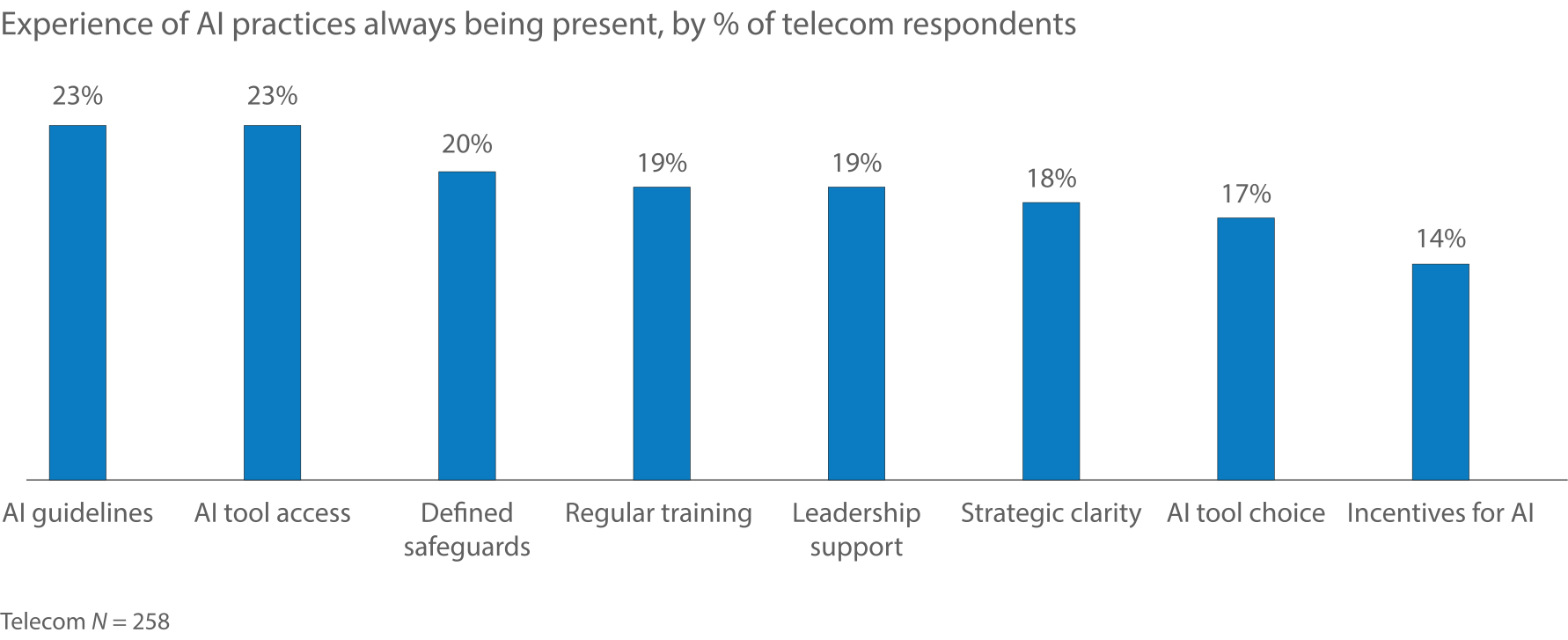
A motivated workforce can only go as far as its organization allows. Telecom organizations have yet to build that infrastructure to match their people's readiness. Only 18% of telecom workers report consistent strategic clarity on AI (Figure 2). Less than a fifth say leadership support and regular training are always present. Only one in five report clear AI safeguards. For a sector whose workforce is measurably more motivated about AI than any other surveyed, the absence of stronger organizational direction and support is the gap that matters the most.
Figure 2. Fewer than one in four telecom workers report AI organizational enablers always present
Source: Infosys Knowledge Institute
The foundation to build on
There is one genuine organizational bright spot in telecom. Experimentation support — the consistent encouragement to try new things with AI — is reported by 23% of telecom workers, compared to 16% elsewhere. The instinct to experiment is present. What is missing is the enterprise strategy to channel it.
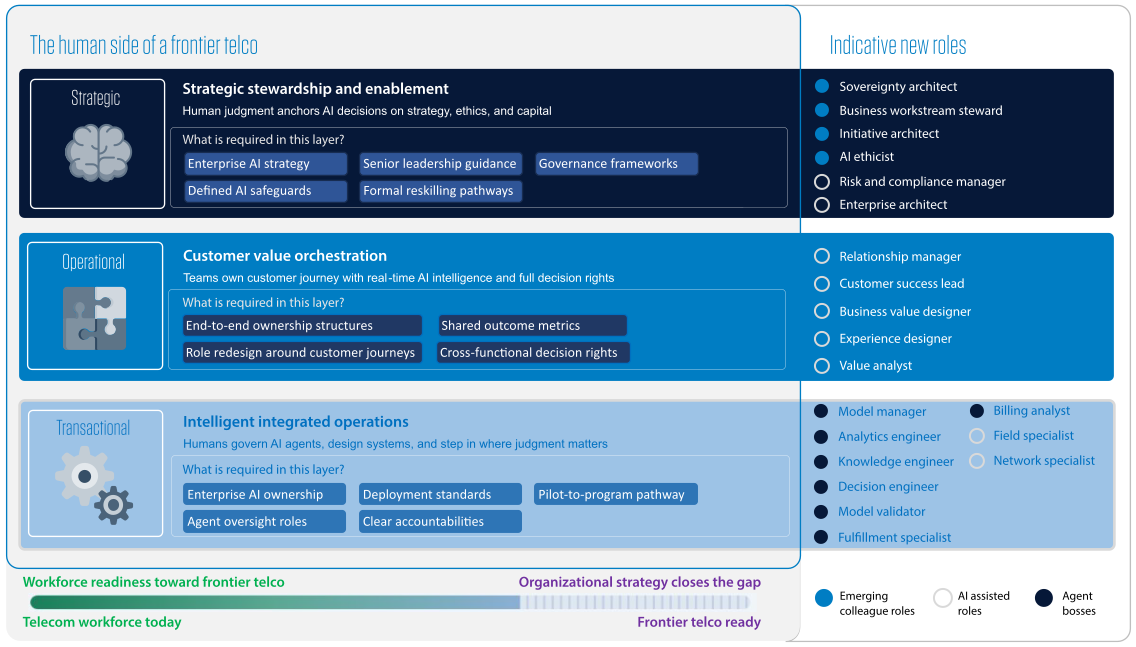
The Frontier Telco framework describes where that strategy must lead: A telecom redesigned around intent rather than tasks, where AI orchestrates decisions, humans govern outcomes, and the enterprise operates as a coherent whole. It rests on three interconnected layers:
- The strategic stewardship and enablement — the steering: This is where the enterprise sets direction, where human judgment anchors decisions that carry strategic, ethical, or financial weight, and where new roles such as AI ethicists, workstream stewards, and sovereignty architects reflect a fundamental shift in what leadership means in an AI-native organization.
- The customer value orchestration — the front: This layer brings all customer-facing roles together into stable customer value stream teams. Here teams own the customer journey end-to-end, using real-time AI intelligence to manage commercial relationships, shape tailored solutions, and eliminate the departmental handoffs that slow legacy models down.
- The intelligent integrated operations layer — the engine: Here routine work becomes largely automated and human roles shift from executing tasks to designing systems, supervising AI agents, and stepping in where judgment matters.
Each layer requires a distinct set of organizational requirements and human capabilities to function (Figure 3).
Figure 3. The human side of the Frontier Telco framework
Source: Infosys Knowledge Institute
Workforce readiness
The telecom workforce is ready for this shift. Around 96% use AI at work, more than half do so multiple times a day, and nearly 70% save over three hours weekly. Workers are reinvesting that reclaimed time productively — choosing more interesting work and developing new skills. Motivation runs measurably above every other sector.
The gap sits on the organizational side. As the framework above shows, each layer has requirements that have not yet been met. Roles have not yet been redesigned. Strategy has not been clearly communicated. Pilots have not been connected to programs.
Four priorities for telecom leaders
Telecom operators’ priority is organizational: build the strategy, structures, and capability investment that will convert a ready workforce into a transformed enterprise.
Build an enterprise AI strategy
Strategy and governance convert dispersed AI activity into directed transformation. Telecom operators should:
- Communicate AI direction visibly and consistently, not as a leadership statement — but as operational guidance that reaches the people doing the work.
- Appoint enterprise-level AI owners with clear accountability for scaling pilots to programs, across functions.
- Prioritize where AI will be deployed first, define how the transformation will unfold, and establish measurable outcomes at each stage.
Redesign for the AI-native telecom company
The framework requires a different kind of human at every layer — agent bosses governing autonomous operations, value stream owners orchestrating customer outcomes, AI ethicists and workstream stewards anchoring strategic decisions. Telecom companies should:
- Map current roles against what each frontier telecom layer demands, identifying where existing job architectures are misaligned with how work gets done in a human-plus-agent model.
- Redesign roles around human-plus-agent collaboration, with clear boundaries between what humans own and what AI handles.
- Treat role architecture as a board-level priority, with the same investment in design and governance as network transformation programs.
Invest in capability at the speed of network
Telecom has never been slow to invest when a technology cycle demanded it. The same urgency needs to reach workforce capability. Telecom organizations should:
- Replace one-time training with continuous learning linked to changing roles.
- Connect capability development to different parts of the organization, from AI oversight in operations to customer decision-making and strategic governance.
- Treat reskilling investment with the same financial discipline and board visibility applied to network infrastructure.
Measure workforce transformation
Without measurement, reclaimed time gets absorbed, role redesign stalls, and capability gaps widen invisibly. Telecom operators should:
- Go beyond adoption rates to understand how AI is changing the work people do.
- Track progress in role redesign and the adoption of human-plus-AI ways of working.
- Report workforce transformation metrics alongside operational and financial performance, making people metrics as visible as technology and business metrics.
Telecom's AI story has been told largely through the network — autonomous systems, self-healing infrastructure, zero-touch operations. That story is real and the investment behind it is substantial. But every autonomous network will be designed, governed, and continuously improved by people. The quality of that human layer will determine how much of the technology's potential is realized.
Telecom has built some of the most complex, reliable, and high-performing infrastructure in the world. The next infrastructure challenge is human — and the foundation is already there.


The next telecom customer may not be human. AI agents are already consuming network services autonomously, and the operators that build the commercial infrastructure to serve them will define the future of machine-to-machine commerce.
- 07 Sep, 2026

A unified platform balances business unit autonomy with enterprise-wide integration, governance, and service assurance. deployment.
- 17 Aug, 2026
- 8 min read

AI costs are exploding and businesses are struggling to manage them. Telecom companies have the billing infrastructure, sovereign networks, enterprise trust, and data assets to become the AI consumption layer companies need. Five monetization lanes define the opportunity. Early movers are already in the market.
- 17 Aug, 2026
