

Insights
- Telecom B2B portfolios have expanded well beyond traditional connectivity, but expansion alone does not create value.
- The way forward lies in deliberate portfolio choices: what to own and differentiate, what to partner or outsource, and what to exit from.
- Translating those choices into results requires organizational action — classifying every offering, defining an AI product strategy, designing for specific customer segments, and building the sales capability and operating model to match.
Connectivity has long been the foundation of telecom business-to-business (B2B) portfolios. Voice, broadband, and mobile data remain central to the industry, accounting for approximately 70% of operator B2B revenues globally. But sticking to that foundation is no longer a viable growth strategy. Revenue from mature connectivity products is mostly stagnant as enterprise customers migrate away from legacy voice and data services. A McKinsey survey of more than 3,000 B2B decision-makers found that nearly 80% believe telecom companies should play a broader role beyond connectivity, while nearly 60% now prefer to procure core connectivity as part of an integrated solution that includes cloud, security, or collaboration tools. The opportunity this expansion is chasing is significant: enterprise spending on technology services beyond connectivity, projected at around $500 billion in 2025, is set to climb to nearly $1 trillion by 2030 — growing at a 14% CAGR against connectivity's 3%.
Telecom operators are responding by expanding their B2B portfolios toward information and communications technology (ICT) services that include cybersecurity, cloud, managed services, and industry-specific solutions alongside their connectivity businesses. New categories continue to emerge in AI products and nonterrestrial network capabilities.
The B2B product portfolio
Most operators are competing across a mix of product categories.
Advanced connectivity and technology solutions
Operators are building on their network foundations with connectivity offerings such as software-defined wide area network, unified communications, private networks, network slicing, and managed connectivity services. These extend network value by adding flexibility, performance guarantees, and programmability that standard broadband cannot offer. Telstra's Aura Network, for example, provides wavelength, dark fiber, and high-capacity connectivity services that give enterprises the performance and resilience that mission-critical operations require.
On top of that, operators are expanding into the broader ICT services layer — cybersecurity, cloud, internet of things (IoT), managed services, AI, and digital transformation — to access larger growth markets, address customer needs beyond connectivity, and reduce dependence on network revenues. Orange Cyberdefense, Orange’s dedicated cybersecurity business, accounts for 18% of Orange’s B2B segment and is growing at 10.6% year-on-year. Telefónica Tech, which combines cloud, cybersecurity, IoT, and digital transformation services, also grew revenues by 18.9% to €2.2 billion ($2.4 billion) in the 2025 financial year. The two represent some of the clearest examples of telecom operators reaching genuine scale in a technology adjacency.
Industry-specific solutions
There is a growing opportunity to bring together connectivity and ICT services to address sector-specific needs — propositions built around the outcomes that matter in each sector. Examples include healthcare platforms, connected manufacturing solutions, smart logistics services, financial services ecosystems, and public-sector solutions. TELUS in Canada built a healthcare platform through targeted acquisitions, combining specialist networks, clinical workflow integrations, and managed service delivery into a single proposition. Singtel, Singapore's largest telecom company, has expanded its IT and systems integration service offerings through NCS, a wholly owned subsidiary serving government, enterprises, and healthcare customers across Asia Pacific.
The strategic distinction is the shift from selling technology to solving industry-specific business problems. Operators can access larger industry profit pools, create stronger customer differentiation, and participate directly in digital transformation spending within different sectors. The strongest positions here are built on repeatable, scalable platform propositions tied to measurable business outcomes, rather than customized, project-by-project delivery.
AI products
AI is opening up an opportunity for telecom operators to create new products.
AI infrastructure services are the most capital-intensive bet — sovereign compute capacity, large-scale data centers, and AI factories that serve enterprise and government demand. SK Telecom is building national data centers, aiming to become Asia’s AI infrastructure hub. China Mobile has built a sovereign AI stack anchored by its Jiutian foundation model, covering more than 50 industry-specific large models deployed across enterprise AI projects.
AI business services represent the product layer closest to the enterprise customer — covering AI agents, workforce assistants, and AI-powered operations tools. Network application programming interfaces (APIs) and digital trust services — identity, location, fraud prevention, and quality-on-demand APIs — allow operators to monetize their network as a platform, exposing capabilities that third-party developers and enterprises can build on.
Agent-to-agent communication is the earliest-stage category. It represents infrastructure and protocols that allow AI agents to communicate, transact, and coordinate autonomously across enterprise systems. Telcos are a secure, low-latency communication layer that agent ecosystems will require.
According to a McKinsey survey of 125 senior telecom executives across Africa, Asia, Europe, the Middle East, Latin America, and North America, AI currently drives less than 2% of total revenues for more than half of operators that have tested AI use cases. Yet 64% of those leaders expect it to contribute more than 5% of revenues in the near future. Operators that establish credible AI capabilities early can create new sources of differentiation, capture a greater share of enterprise technology spending, and strengthen the strategic relevance of their networks in an AI-driven economy.
This portfolio expansion has created a complex B2B portfolio, one that spans products with very different growth trajectories, investment requirements, competitive dynamics, and customer expectations. Managing the portfolio has become as strategically important as building it.
Growth is not straightforward
Broad expansion dilutes margin
Sub-scale IT services dilute telco margin rather than adding to it. Infosys’ experience of working with large telecom operators globally shows that most have built dedicated IT service units over the last two years, expanding simultaneously into cybersecurity, cloud, managed services, and systems integration. Without a clear vertical position, a telecom IT services unit becomes interchangeable with hundreds of managed service providers and systems integrators competing on the same capabilities. Only the operators that have reached genuine depth in a chosen domain can create defensible returns. Singtel's NCS is the clearest example of what that depth delivers. Its earnings before interest and taxes grew 39% in fiscal year ending March 2025, with bookings of S$3.2 billion (US$2.4 billion) driven by wins across government, enterprise, and healthcare. That is what separates a focused vertical platform from a sub-scale IT services arm.
Cybersecurity is evolving beyond traditional offerings
Most operators now have dedicated cyber units, which means that simply offering managed security is no longer a differentiator. As industries move away from legacy approaches such as SMS-based authentication and perimeter-based security models, demand is shifting toward AI-driven threat detection, identity protection, and security embedded directly into network infrastructure. The competitive frontier is therefore moving toward autonomous, AI-driven, and network-native security capabilities. For example, Bell Cyber uses AI automation to detect and contain threats in under five minutes. Swisscom's beem integrates cybersecurity directly into its network infrastructure, so that every connected device is automatically protected without requiring installation or management by the customer. Getting there requires significantly greater investment and ecosystem partnerships than building a conventional cyber practice.
AI infrastructure services carry capital and demand risk
Sovereign AI investments are being driven by digital sovereignty goals, regulatory requirements, national security considerations, and geopolitical concerns, alongside commercial demand.
As operators move into this space, the relationship with hyperscalers, whether as partners, co-investors, or competitors, is one that each operator will need to answer for itself. Building at scale requires significant capital, and demand must justify the investment. Operators that have moved furthest in this space have typically secured anchor customers before committing capital, and their choice of partners reflects different answers to the hyperscaler question. Bell Canada's AI Fabric facility secured partnerships with Cerebras and CoreWeave, specialist AI infrastructure providers, before construction began. Reliance Jio's sovereign AI data center secured Meta, one of the world’s largest hyperscalers, as a contracted tenant before the facility came online. Operators that are unable to do this face the challenge of deploying significant capital ahead of proven market demand.
The telecom product orchestrator model
These three pressures are distinct but compounding. Each requires a different response, but all share the same root cause: product portfolios are expanding faster than operators can effectively prioritize and manage them.
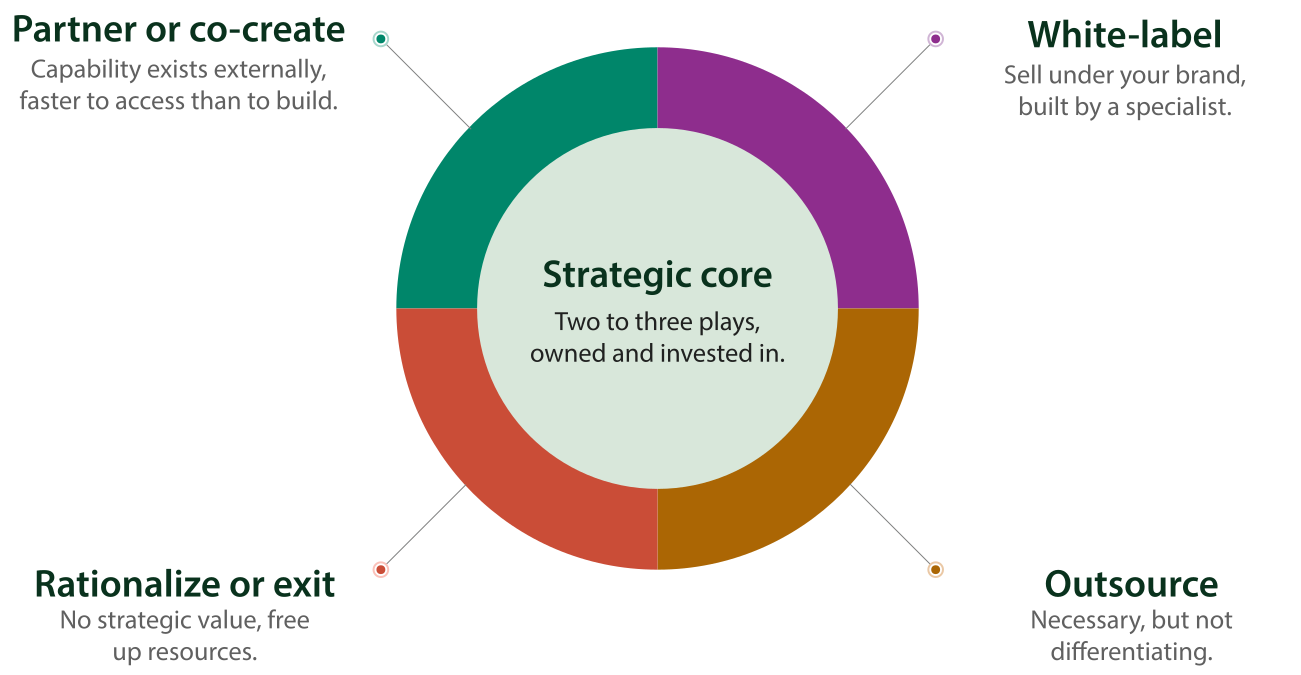
The most successful operators are responding by being more deliberate about how each part of the portfolio is managed. The telecom product orchestrator model distinguishes between products that an operator should own, invest in, and differentiate — the strategic core — and products that can be delivered effectively through partners, white-label arrangements, or outsourced operations (Figure 1). In doing so, operators maintain a complete ICT portfolio while redirecting capital, talent, and management attention toward the products most likely to drive future growth and differentiation.
Figure 1. Telecom product orchestrator model
Source: Infosys
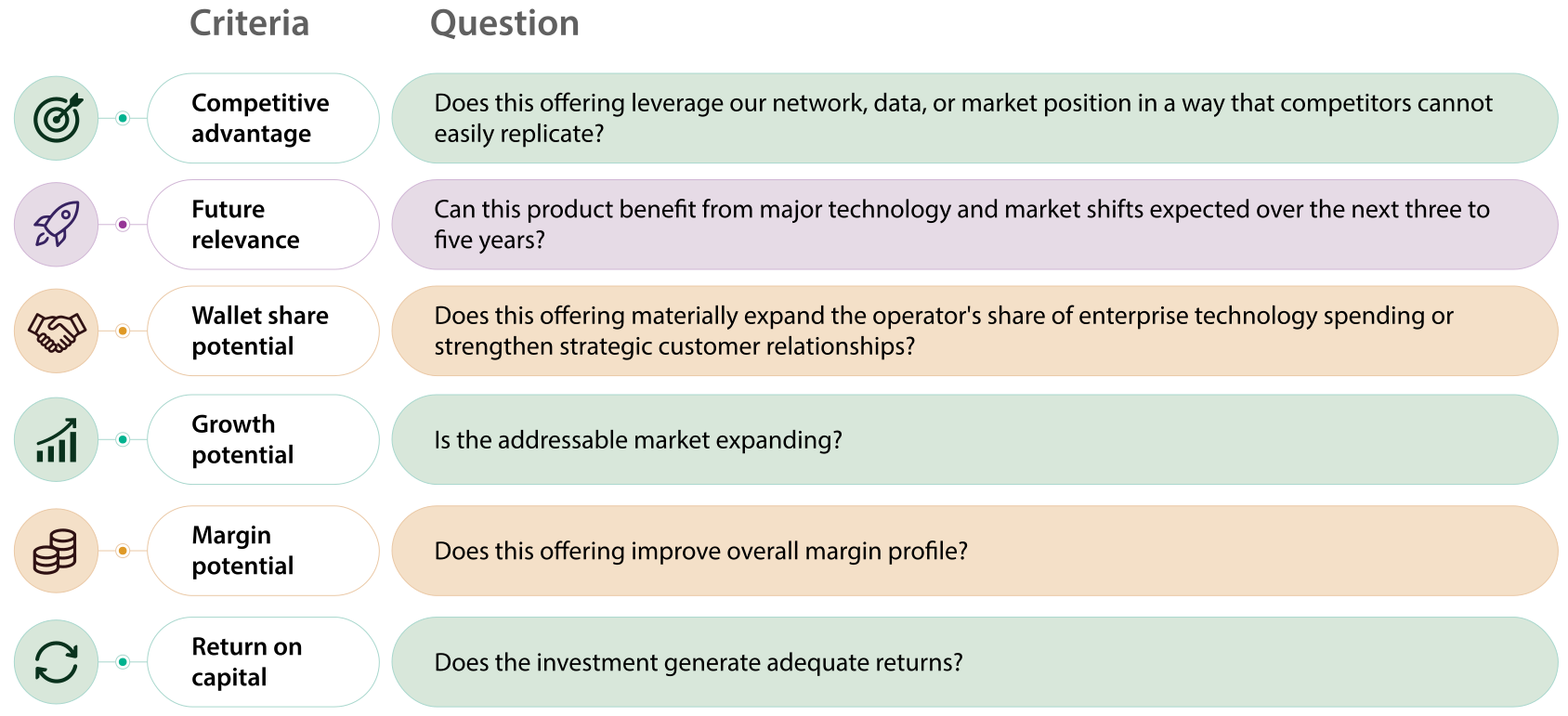
There are several ways telecom operators can approach this classification. They might use existing portfolio review frameworks, market attractiveness models, or internally developed scorecards. The following six criteria can help inform the decision (Figure 2).
Figure 2. Strategic core assessment criteria
Source: Infosys
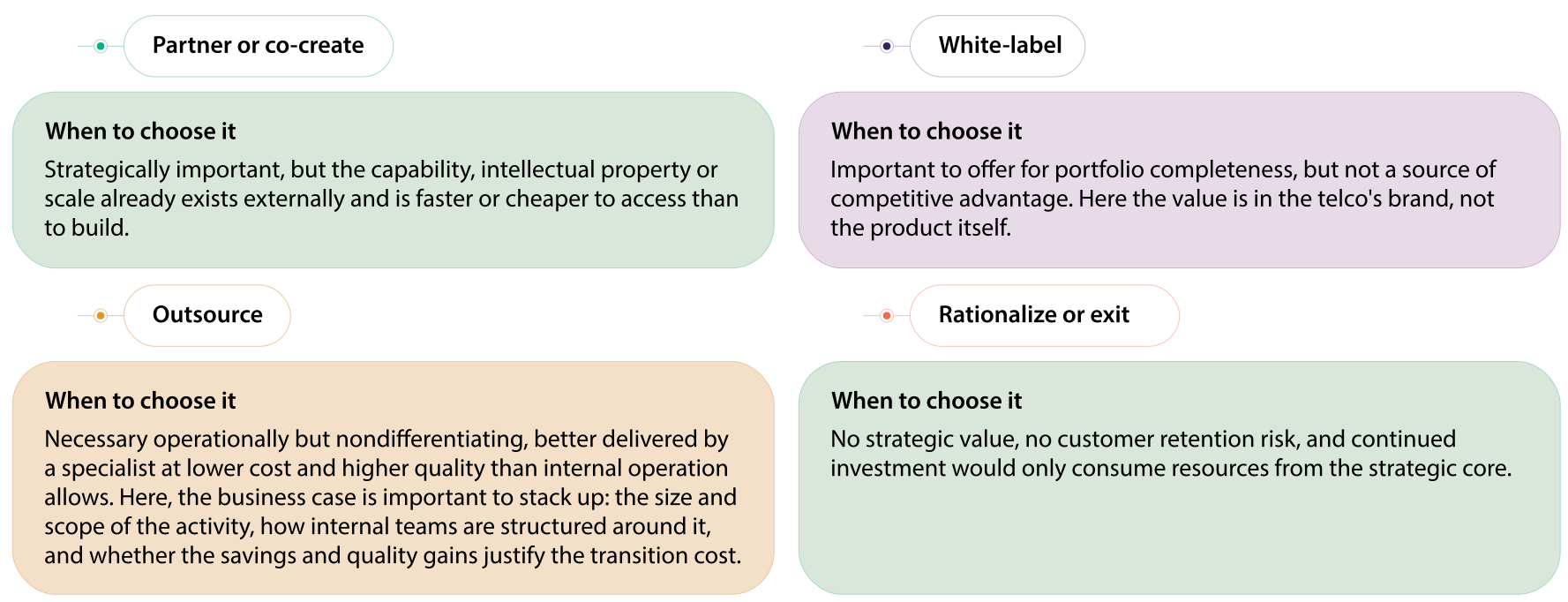
Where the answers point clearly toward strategic value, the offering belongs in the core. Where they do not, a deliberate nonstrategic decision is needed (Figure 3).
The right path depends on the offering’s strategic importance, the operator’s internal capability, and practical constraints that govern what is actually executable.
Figure 3. Nonstrategic decision paths
Source: Infosys
In practice, execution is rarely immediate. Existing commercial commitments — long-term contracts with customers, vendor agreements, or regulatory obligations — can constrain how quickly a nonstrategic decision can be acted on, even when the strategic logic is clear. Organizational structure adds another layer of complexity: products managed across multiple internal teams are harder to transfer or outsource cleanly, and products that are already operationally efficient present a weaker business case for outsourcing. The portfolio classification should therefore also capture the timeline over which each nonstrategic decision becomes executable and the organizational conditions that determine how.
Case study: Lumen Technologies — the strategic versus nonstrategic framework in practice
Lumen Technologies is the clearest public example of a telecom company explicitly classifying its portfolio into strategic and legacy plays, while also using grow, nurture, and harvest categories to indicate how different revenue streams are managed.
Strategic: Next-generation offerings include AI-ready fiber infrastructure, private connectivity fabric, programmable networking, and network-as-a-service.
Legacy: Traditional voice, private line, and mature networking products.
By the second quarter of 2026, strategic revenue had crossed 53% of the total revenue, growing 14% year over year, with legacy business declining by 15% over the same period. The nonstrategic decisions were equally deliberate. Lumen sold its Latin American, EMEA, and content delivery network businesses, and in early 2026 sold its Mass Markets consumer fiber business to AT&T for $5.75 billion. Each exit reduced debt and redirected capital toward the strategic core. The company repositioned itself as the trusted network for AI, concentrating on enterprise fiber and private connectivity for hyperscalers. The lesson is deliberateness: every product has a classification, every classification has a management approach, and capital follows strategy.
Takeaways for telecom operators
Deciding what belongs in the strategic core is the easier half. Executing the decision requires certain organizational shifts.
Run a portfolio audit
Classify every offering against the six criteria, in line with the operator’s brand positioning and the ICT proposition it aims to deliver to enterprise customers. Most operators have never formally classified their portfolio this way. Assign each offering a path: strategic core, partner, outsource, white-label, rationalize or exit. Map the commercial commitments attached to each nonstrategic product so the timeline for execution is clear from the outset. Strategic products should receive disproportionate investment, while nonstrategic products should receive a deliberate decision.
Define your AI product strategy
AI products require an explicit strategic decision on where to build, where to partner, and where to wait. For AI infrastructure, anchor demand must be confirmed before capital is committed. For AI business services and network APIs, the network asset is the differentiator — build around it and partner for the rest. Agent-to-agent communication is the earliest-stage category but potentially the most structurally significant — telcos that establish themselves as the secure, low-latency layer for autonomous AI ecosystems early will be difficult to displace later. Not deciding defaults to the most expensive outcome.
Adopt a micro-market strategy lens
One B2B portfolio cannot serve every customer segment equally. Large enterprises, small and medium businesses, public-sector organizations, and regulated industries require different features, service levels, commercial models, and price points. Operators should design product bundles around specific customer segments. The products that belong in the strategic core might differ by market, segment, and customer need.
Build the partner ecosystem to deliver end-to-end ICT services
Most telecom operators engage partners reactively when a deal requires capability they do not have. The orchestrator model suggests building partnerships before they are needed, so the operator can go to market as an integrated ICT provider. The partner ecosystem should be designed to fill the gaps that the strategic core does not cover.
Build the organizational model to match the strategy
Sales teams built around connectivity sales with short cycles, product-led pitches, and volume metrics will not be able to sell AI or vertical solutions, which require longer relationships, consultative engagement, and domain credibility with the customer. Realigning incentives and building the right skills is the starting point. In telecom, AI products often handle sensitive customer data or operate in regulated industries that require legal clearance before launch. Questions such as who owns the data, who is liable, and whether the product meets local compliance requirements must be answered upfront, not under time pressure after the product is live. Product cycles also need to compress. New AI products are built and launched in months, not years. A telco that runs a 12-month development process will consistently arrive after the market has moved. Partner-first development, smaller teams, and faster decision rights are what make the difference.
The window for B2B growth in telecom is open, but not equally open to every operator. The operators that will capture it have made the harder decision: what to own, what to partner, and what to exit. That clarity applied consistently across the portfolio, the commercial model, and the partner ecosystem turns a strategic framework into a commercial result. And when it works, the reward is the shift from being seen as a connectivity provider to being seen as the partner that helps the customer achieve desired outcomes.


With a strong platform foundation and disciplined execution, telecom companies can unify fragmented service desks into an integrated, measurable service operation.
- 22 Oct, 2026
- 6 min read

What's holding back revenue management in telecom, and how AI and ontology can finally make billing predictable.
- 17 Sep, 2026

The next telecom customer may not be human. AI agents are already consuming network services autonomously, and the operators that build the commercial infrastructure to serve them will define the future of machine-to-machine commerce.
- 07 Sep, 2026
