
Postcards from the future
Postcards from the future of cloud is a series of articles imagining the state of enterprise technology infrastructure in five years. We describe the future based on tools and frameworks in development today, recognize pitfalls to avoid, and identify tasks to take on now to build the infrastructure for the future. These postcards aim to guide companies in a world where technology and business requirements shift quickly.

Insights
- The future fabric of IT operations uses advances in autonomy, low-code platforms, and rapid customization to better deliver for enterprises.
- Enterprises need automation, network intelligence, and flexible architecture.
- Quick customization allows greater capabilities from temporarily custom systems.
- Security must be woven into IT operations and will become part of a seamless, ambient IT operation.

The basic promise of technology is to make work easier, better, or more efficient. Business technology breaks that promise too often. The future fabric of IT operations, now being woven, will deliver better.
The new fabric is possible, thanks to advances in autonomy, low code, no code (LCNC) platforms, and customization. These future IT operations are informed by the principle of ambient IT: technology that operates proactively in the background without calling attention to itself.
Like a high-performance fabric, the future of IT operations will be both durable and flexible. It will address problem areas while enhancing existing strengths. Tailored to the business context, it will improve how the entire enterprise operates and performs.
The end of the highly functional mess
When technology doesn’t make life easier, the problem often lies in the details.
IT operations have grown larger, better, and more essential, but at the same time harder to manage. In the process of adding more capabilities, IT operations have become intricate, sprawling, and opaque. New features mounted to old systems work well enough, so new capabilities keep on coming.
The rollout of artificial intelligence (AI) tools in the last three years has made the messy innovation problem even worse. New systems are layered on top of the old ones, often without integration or orchestration. A new dashboard might solve a local problem, but complicate things at a broader scale. The result is patchwork integration that works hard but not together.
Then there’s all the data. Systems spew data measuring every microsecond of IT operations, and dashboards bloom on every display. But can the human operators make sense of it all? And do IT operations serve the business purpose?
In 2025, most enterprises operate fragmented, siloed technology systems, with multiple hybrid clouds, edge sites, and legacy systems stitched together by human effort and improvisation.
Outdated measures of success like uptime and ticket count can lead IT goals astray. This is where Goodhart’s law comes into play: When a measure becomes a target, it ceases to be a good measure. IT teams are rewarded for uptime, ticket closure, and incident volume, reactive measures of the past. These measures keep the lights on in the office, but do not illuminate the path forward for the business.
The dark secret is that technology can function perfectly without making the business more productive, employees more engaged, or customers more satisfied.
The start of intelligent networks and ambient IT
Enterprises need more than automation to create joined-up systems. They must build network intelligence into a thoughtful and flexible architecture. Network intelligence here will be built by bringing AI and machine learning (ML) tools to work on data from network operations, internet of things devices, and business performance standards. This network intelligence enables digital networks to become adaptive, predictive, autonomous, and self-optimizing with minimal human intervention (see Postcard 2, your own personal, thinking network).
Weaving network intelligence into IT operations also requires IT managers to shift their thinking, to, for example, align success measures around business outcomes, instead of network uptime. With that thinking in place, technologists and business strategists will make good use of emerging technologies such as AI, large language models (LLMs), digital twins, and advanced automation.
Imagine a network that is automatically proactive, bespoke for the moment, secure, and sustainable, and can change its actual form. These are the three threads that will make the future fabric of IT operations.
Automatically proactive
IT operations that automatically predict and proactively address issues have become a reality. In this context, automation evolves into orchestration and leaders develop architecture that learns and acts for itself.
The proactive network will run itself. Even hybrid estates peppered with COBOL mainframes and cloud-native applications will tune, scale, and patch autonomously. For example, Tanium offers autonomous endpoint management platforms that can operate across scores of devices. IBM has trained its Watsonx AI system to observe and remediate legacy infrastructure issues.
Tickets and service requests will disappear. Ambient IT concepts mean that devices self-configure. This is where automation functions in support of user experience. Companies, including Rippling, offer unified control of identity and device provisioning. Microsoft Autopilot automates setup and recovery for enterprise hardware. And service platforms such as Moveworks use conversational AI to resolve support issues, often before the user even reports them.
Service desks won’t receive calls, because the autonomous service management grid predicts the issues before they are reported, or even happen. When the fix comes first, the call won’t happen. Platforms such as BigPanda and Symphony AI have deployed AI agents to learn from enterprise knowledge graphs to anticipate and resolve issues.
Bespoke for the moment
Just because IT operations evolve beyond tickets and service calls doesn’t mean users can’t customize. It’s just that customizing won’t be a specialist function. Custom IT operations will be self-service.
For instance, LCNC infrastructure automation will enable users to tailor their own environment to their specific business task. Imagine an analyst who needs an AI environment to test customer data. All she has to do is ask, in plain language, and an orchestration platform will make it happen.
Platforms like ServiceNow, Zapier, and OutSystems are already extending LCNC tools into the infrastructure layer. They are enabling what might be called citizen operations, where teams across business functions can create and control their own digital sandboxes safely, within enterprise guardrails. Think of it as an acceptable level of shadow IT. And when the business goal is complete, the same tools that enabled customization in a compliant and secure manner will make sure that it is temporary. This helps minimize cost as well as the potential attack surface for bad actors.
Just as infrastructure can be customized on a temporary basis, infrastructure itself can be temporary. AI and other modern uses will demand massive compute, but only for a moment. Practical tools that deliver on-demand computing, and serverless graphics processing units (GPUs) are in the market. Vercel and Spot.io offer automated, on-demand computing. Lambda Labs offers serverless GPUs that train AI models when called and vanish when done. The result is ephemeral computing — resources that exist only as long as they’re needed.
Secure and sustainable
Even as IT operations grow more automatic and ephemeral, they must exist in the real world. This means operations must be designed and prepared for the real-world challenges of security and sustainability.
Security will become invisible as it is woven into all aspects of IT operations. Authentication will be a continuous process in the background, based on user behavior and context.
Imagine this cross-border research scenario: When a developer in one country accesses sensitive R&D data from another, postquantum encryption will activate mid-session. Data will re-encrypt dynamically as behavior or risk changes.
Companies like Twingate and Zighra are already advancing this model. Their systems assume compromise as a starting point, then build adaptive defenses around verified behavior. This invisible mesh of trust will make enterprise security seamless and stronger.
Present-day AI data center developers have learned that they must account for their power and other resource usage. Future IT operations must be sustainable and accountable. Systems in development will shift workloads based on real-time carbon data, chasing where renewable resources are most abundant and affordable.
Organizations such as WattTime already provide application programming interfaces with live carbon-intensity data to guide such decisions. The Green Software Foundation and Cirrus Nexus are building frameworks to make energy optimization a first-class feature of IT operations.
Design with intent and automation
The intelligent, self-sustaining fabric of network operations won’t arrive by accident. It must be designed deliberately, with clear purpose and trust in automation’s potential.
The next five years will decide which enterprises adopt and benefit from this new fabric. Success will depend on combining human insight and machine autonomy into a single, elegant weave. Here is how to lay the groundwork for this future.
First, replace fragmented automation with orchestration. Choose platforms over point tools, and unify visibility across data center, cloud, and edge. The goal is not just control but coherence.
Second, redefine success. Shift from uptime and incident counts to measures that matter — customer experience, self-healing capability, and carbon efficiency. When systems can correct themselves, uptime becomes a given, and real value lies in how gracefully they do it.
Third, let AI handle the predictable so people can focus on purpose. Human engineers should define boundaries and outcomes; agents should handle the rest.
Fourth, measure sustainability into every process. Carbon optimization should be as routine as cost optimization. Circular IT, where devices are refurbished, reused, and repurposed, should be part of the operational rhythm, not a side initiative.
Finally, cultivate design discipline. In the best fabrics, every thread supports the pattern. In the best systems, every process reinforces clarity, trust, and resilience. In the context of business IT, this means IT operations oriented around business strategy and operations agile enough to adjust as strategy shifts.
By 2030, the organizations that succeed won’t be those that run the most powerful systems. Powerful IT systems are already here. The future differentiator will be how powerful IT operations deliver business results. Success will go to companies with IT operations that fit best with their people, and their goals.

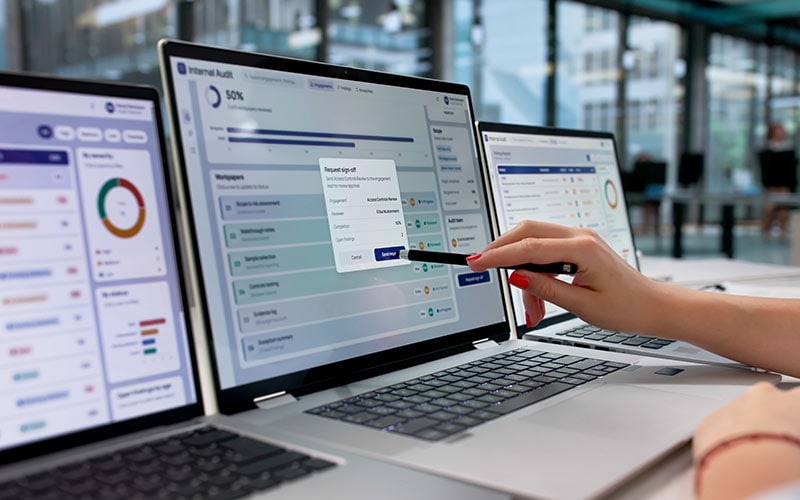
Regulatory change is accelerating and breach costs are rising, yet most institutions still rely on periodic, manual risk assurance. Three structural gaps, spanning visibility, third-party oversight, and governance, leave institutions unable to keep pace. Building risk assurance as a continuous, AI-augmented capability closes these gaps. A four-phase roadmap helps institutions get there.
- 11 Sep, 2026
- 15 min read

The difference between AI work and AI that works lies in the discipline to scale adoption, governance, and value realization
- 10 Sep, 2026
Learn how automated integrity checks and human oversight can help enterprises control AI agent sprawl, reduce duplication, and manage risk at scale.
- 08 Sep, 2026
