
Insights
- The source-to-pay (S2P) process for most CMT organizations is vulnerable to supply chain risks, geopolitical instability, and manual procurement, sourcing, negotiation, and contract execution strategies.
- Problems surface throughout the value chain. Not only is the S2P process manual and fragmented, but organizations battle lack of supplier choice, price volatility, supplier noncompliance, and supply/demand concerns.
- Agentic AI can help in all parts of the process, going beyond rule-based automation toward real-time, intelligent procurement execution.
- We recommend three steps to empower procurement teams, including integration of agentic AI in ERP platforms; ethical sourcing; and supply chain continuity through adaptive AI agents.
As the semiconductor market grows, thanks to continued demand for the chips at the heart of artificial intelligence (AI), internet of things (IoT) devices, and automotive applications, its dependence on a robust, resilient supply chain rises too.
Any inefficiency in the source-to-pay (S2P) process — the end-to-end workflow to obtain goods and services from external suppliers, from original need to performance evaluation — has a knock-on effect right through the value chain.
Geopolitical tensions and supply disruptions cause ripples across East Asia, where most semiconductors are made and sold.
Meanwhile, foundries such as TSMC, Samsung, and Intel; outsourced semiconductor assembly and test providers, such as ASE, Amkor, and JCET; and raw material suppliers, such as SUMCO Corporation, GlobalWafers, and Air Products add complexity to the supply chain, as they require talent and capital expenditure. With nearly 75% of the global semiconductor manufacturing concentrated in East Asia, including all sub-10nm chip production limited to Taiwan and South Korea, the potential fragility of the supply chain is quite clear. Further, fragmented and reactive procurement strategies lead to slow supplier onboarding and suboptimal negotiations and contracts.
While these problems were treated as business as usual, and inefficiency as part of the S2P process, AI tools can transform the semiconductor industry and reduce risk.
Agentic AI, comprising autonomous, goal-seeking AI agents trained on company data, can improve procurement by continuously learning from new market information, assessing risks, negotiating contracts, and optimizing sourcing, going beyond rule-based automation toward real-time, intelligent procurement execution.
Business challenges in semiconductor S2P
What are the key challenges in semiconductor supply chains, and how can agentic AI help overcome them?
- Manual and fragmented processes. The semiconductor S2P process involves multiple complex steps, from supplier selection to contract negotiation and payment processing. These steps are often manually driven workflows, requiring significant human intervention. Disconnected operations across procurement, legal, and finance make inefficiencies worse, especially when it comes to contract approvals, compliance checks and invoice reconciliation. Further, coordinating with multiple vendors lengthens cycle times.
- Little choice. The industry relies on a few dominant suppliers, including those needed for wafer fabrication, assembly, and testing of raw materials. Switching to alternative vendors is difficult: components are specialized and require costly validation, design adjustments, and regulatory compliance. This makes changing suppliers risky, slow, and potentially disruptive to production continuity. However, fabricating chips in-house costs billions or even trillions in investment, requiring precision equipment, research and development (R&D), and skilled labor. Going it alone would further increase chip prices. According to the Semiconductor Industry Association (SIA), every $1 rise in chip price necessitates a $3 increase in end-product pricing to keep margins stable.
- Complexity and price volatility. Because the procurement process is complex, prices are inherently volatile. Traditional procurement suffers from a lack of real-time insights into market trends and supplier pricing. Also, organizations struggle with manual cost negotiations, and with so much at stake, those new to the game often lock in contracts without dynamic adjustments, leading to financial loss when prices change.
- High levels of risk and supplier noncompliance. Procurement must navigate complex regulations, supplier environmental, social, and governance (ESG) commitments, and geopolitical risks. Current processes lack visibility into supplier compliance, with audits infrequent and teams relying on outdated reports. Meanwhile, regulations like the US CHIPS Act and the European Chips Act make supplier selection difficult as they impose sourcing, security, and subsidy conditions. Companies are encouraged to prioritize domestic suppliers: the CHIPS Act states that US companies receiving government support might be restricted to buy from US fabrication sites, while the UK’s national semiconductor strategy encourages domestic design and IP to increase resilience to global shocks on the supply chain. Statutes in the US and Europe mandate that companies meet compliance requirements while ensuring traceability of materials.
- Supply/demand concerns. Finally, traditional S2P is confounded by demand fluctuations, supplier delays, and stock shortages, leading to production bottlenecks and cost escalations.
Transform S2P with agentic AI
Infosys is already working on an agentic solution to many of these challenges, though as yet we haven’t conducted any full-scale implementations. That said, these initial proofs of concept are encouraging, and have the potential to be transformative. Success will depend on thoughtful and careful design of agentic systems, with escalation paths built in for human approval where necessary. Here, we set out how AI agents can help in six different areas of S2P so that communications, media, and technology (CMT) organizations can build an integrated intelligence layer over their procurement operations to mitigate problems in that process. S2P agents and agentic systems benefit all industries, though as yet, little literature exists to prove success of these solutions in the high-stakes semiconductor space. However, with the right implementation strategy, CMT organizations can build upon agent-led S2P successes in other industries.
1. Agent-led buying
As part of a request for proposal, Infosys looked at the end-to-end S2P process for one leading semiconductor integrated device manufacturer. A semiconductor buyer carries out many activities, including sharing forecasts and purchase orders (POs) with suppliers, reviewing supplier commitments and adjusting as necessary, and evaluating alternative suppliers in case of any under-commitment or delayed delivery from the supplier.
A buyer agent with human in the loop can automate all these activities. A buyer agent can interact with external agents such as a supplier agent, and can autonomously determine if there is an under-commitment or delayed delivery. In case of exceptions, the agent can recommend that semiconductor suppliers readjust priorities based on downstream production orders. It can also recommend alternative strategies, such as getting materials from alternate suppliers, or looking at stock transfers from other depots or plants based on a cost-benefit analysis.
2. AI-driven supplier discovery and risk assessment
AI agents can scan global supplier networks to monitor performance trends, geopolitical risks, and ESG compliance in real time. The agents leverage predictive models to assess the suppliers’ financial stability, regulatory risk, and operations reliability to prevent disruptions before they occur. TSMC, for example, concentrates most of its operations in Taiwan, leaving it vulnerable to both the geopolitical tension with China and the impact of US export controls. And pressure to shift some production to the US, driven by geopolitical instability and the proximity of key customers like Apple and Nvidia, introduces challenges of scale, culture, and operational transition.
When risks of this nature are identified, agentic systems can autonomously propose alternative suppliers to mitigate potential disruptions.
Thanks to the agents’ proactive, context-aware, and largely self-directed process, human intervention becomes the exception rather than the norm, limited to reviewing only the highest-risk recommendations flagged for approval.
According to Infosys’ client work in this area, agentic AI reduces supplier dependency risks by proactively identifying backup vendors without any human intervention, while considering all regulatory requirements. It also improves risk response time, preventing procurement delays and last-minute escalations.
3. Autonomous sourcing and procurement
AI agents can analyze historical pricing data, market trends, supplier performance, and risk factors to identify the best semiconductor sourcing options. They can autonomously negotiate pricing and contract terms with suppliers based on predefined procurement policies, and draft supplier contracts by leveraging past agreements and industry benchmarks, ensuring compliance with company policies. Depending on the level of automation the supplier is comfortable with, AI agents can either act as copilots to human negotiation teams, or complete the whole negotiation process autonomously, within AI guardrails and with disclosure agreements in place.
A fully self-directed sourcing agent performs data analysis, market intelligence, and strategy generation by suggesting optimal contract terms, and negotiation, escalating to a human when exceptions occur. This autonomous negotiation helps manage volume commitments, tiered pricing, supplier qualification, and risk trade-offs more rapidly than human-to-human negotiations. Of course, agent-to-agent negotiations make some organizations uncomfortable: agents could reach a stalemate over key terms in the contract, and a human will be needed to manage working beyond programmed boundaries.
Reducing procurement risk is a reason why, for now, copilot sourcing agents are so attractive: with access to so much data, agents can identify potential risks in supplier contracts or terms and conditions such as unfavorable payment terms, compliance issues, or clauses that could lead to disputes and flag them for review by humans.
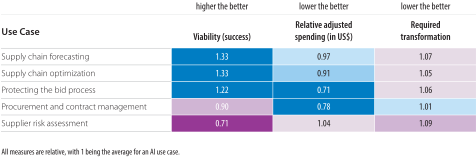
According to the AI Business Value Radar 2025, using AI for supply chain optimization, like autonomous supplier sourcing and negotiation, is a strong use case, scoring 1.33, which means it’s likely to succeed since anything above 1 is considered successful in the analysis. Supply chain optimization is also relatively cheap according to the same analysis, with a normalized average spend of $0.91, where anything below $1 is considered cost-effective.
While agents enable dynamic contract drafting, minimized contract risks, and reduced procurement cycle times, the biggest benefit Infosys has found through initial work with clients comes from faster, cost-effective procurement decisions, with agents handling most processes autonomously, and humans acting as assurance partners.
4. Agentic AI for contract execution and compliance
Our work on solving inventory discrepancy in the retail industry shows what’s possible when automating contract execution, approvals, and compliance. Though we haven’t yet worked on this use case in the semiconductor industry, we’re confident that AI agents will soon review finalized chip contracts for discrepancies, enforce compliance, and automate approvals across procurement, legal, and finance teams. The AI system will also streamline supplier onboarding by automating due diligence, compliance verification, and risk assessment before procurement teams engage with new vendors.
Further, AI agents can monitor contract executions, ensuring chip suppliers meet delivery schedules, quality standards, and agreed pricing, and the agents can even identify contract breaches or deviations, prompting corrective action where procurement and legal teams only review flagged contract deviations for resolution.
This could all lead to faster contract execution by reducing manual interventions and automating compliance validation, and enhanced supplier compliance through real-time contract performance monitoring, ensuring adherence to agreed-upon terms.
5. Predictive procurement analytics and autonomous PO processing
Agentic systems can analyze historical demand patterns, production schedules, and external factors to predict procurement needs, and then automatically trigger POs for critical materials based on these predictive insights, ensuring timely replenishments. The PO process is further amplified as agents can conduct PO validations for potential errors and optimize order timing, reducing procurement inefficiencies.
Analytics are also needed to monitor real-time disruptions such as geopolitical risks, extreme weather, or shipment delays, and assess their impact on open POs. If a delay is detected, AI agents recommend alternative strategies, such as sourcing from backup suppliers, expediting transport, or reallocating inventory. Humans are needed here only to review flagged exceptions, such as major disruptions or high-risk procurement decisions before approval.
Though the AI Business Value Radar 2025 report referenced earlier shows that procurement and contract management has a success score of 0.90, so below average on our AI use case success metric, we believe that this use case will become more viable as the organization transforms its operating model and data architecture around agentic AI (Figure 1).
Experts we’ve spoken to for this paper believe that agentic AI will enable proactive procurement by aligning PO generation with real-time demand signals; minimize supply disruptions through early risk identification and automated mitigation strategies; and reduce manual workload, allowing the procurement team to focus on strategic sourcing rather than firefighting operational issues.
Figure 1. The relative success of AI in different parts of the S2P process varies, as does spend and transformation
Source: AI Business Value Radar 2025, Infosys Knowledge Institute
6. Autonomous vendor collaboration and transaction processing
Finally, vendor collaboration can be made more efficient. AI agents can autonomously track order confirmations, shipment status, and invoice details across multiple vendors, while other agents perform automated invoice matching, flagging discrepancies between POs, goods receipts, and invoices.
The transaction processing part of the S2P process is given a leg-up as agent-driven reconciliation processes resolve mismatches and trigger automated payment approvals based on contract terms. In all of this, these smart workflows only escalate unresolved discrepancies to procurement teams for human review and approval.
Again, the value of agents here is obvious. Agentic AI can eliminate manual effort in vendor coordination, reducing administrative burden; accelerate invoice processing and payment approvals, improving supplier relationships; and reduce financial risk by ensuring accurate reconciliation and preventing overpayments.
The path to implementation
The path for semiconductor procurement involves a strategic shift toward agentic AI. Though Infosys is only beginning to work with clients in many of these areas, some companies are starting to use agentic AI tools that read contracts, spot risks, and suggest better payment terms based on how many semiconductor wafers are being produced. These tools also help speed up approvals and raise alerts when something needs attention. This has helped companies save time, follow rules better, and reduce financial risks.
As mentioned, the negotiation process is also already seeing the benefits of agentic AI intelligence. One semiconductor company was struggling with delays in getting ABF substrates, a type of printed-circuit-board substrate. It used agentic AI to automate the sourcing process. The system noticed demand from factory plans, sent out requests to suppliers, reviewed their responses using risk and performance data, and even suggested, through a copilot, how to negotiate better deals. This reduced the time it took to source materials from weeks to just a few days, and helped the company secure supplies early, keeping production on track.
Regardless of the use case, good implementation requires integrating AI agents with existing enterprise resource planning (ERP) systems through secure model context protocol (MCP) servers.
MCP is a technology that enables agents to talk with commercial-off-the-shelf (COTS) systems like SAP and Oracle by exposing intelligence in these systems as an array of skills, such as data skills for enterprise data stores or package skills for SaaS or COTS packages. Each skill is a discrete, callable capability that becomes available to the agent in its operating environment.
Organizations must do this while maintaining a commitment to ethical and transparent AI-driven decision-making, and introduce the right amount of human involvement to achieve gains in productivity, contract quality, and risk mitigation.
Another factor is considering how much automation is appropriate. Agents must be auditable, and teams must resist the temptation to over-automate sensitive decisions, as AI still has significant limitations.
Three steps should be taken to empower procurement teams:
Step 1. Ensure integration
Agentic AI should be built into the S2P process flow. This means that AI agents should be embedded within ERP platforms like SAP Ariba, Coupa, and Oracle Procurement to autonomously execute procurement decisions such as PO approvals, supplier risk monitoring, and payment reconciliations, all while ensuring compliance with enterprise policies.
Step 2. Make it ethical
Agentic AI systems must prioritize ethical sourcing, regulatory compliance, and transparency in procurement decisions by maintaining auditable records of AI-driven supplier selection, contract negotiations, and pricing adjustments.
Step 3. Be adaptive
Supplier continuity is critical. AI agents should continuously analyze supply chain risks such as geopolitical disruptions, trade restrictions, and natural disasters, and dynamically adjust sourcing strategies, including automatic supplier reallocation, order redistribution, and expedited logistics recommendations, to ensure supply continuity.
A new business strategy
Agentic AI has the potential to transform the semiconductor S2P process. Agentic systems can make procurement more intelligent, autonomous, and resilient. AI-driven sourcing, negotiation, and risk management can help semiconductor companies achieve greater efficiency, cost-savings, and supply-chain stability.
Organizations that integrate AI-first procurement strategies will gain a competitive advantage by mitigating supply chain risks and will improve supplier collaboration. Though all the problems with agentic AI haven’t been ironed out yet, such as hallucinations and memory-loss in the underlying LLMs, how procurement teams should be organized to work with agentic AI systems, and the need to balance AI efficiency with human expertise, companies should act now to realize agentic AI’s full potential. This will ensure a steady supply of chips to fuel AI business strategy in 2026.

Regulatory change is accelerating and breach costs are rising, yet most institutions still rely on periodic, manual risk assurance. Three structural gaps, spanning visibility, third-party oversight, and governance, leave institutions unable to keep pace. Building risk assurance as a continuous, AI-augmented capability closes these gaps. A four-phase roadmap helps institutions get there.
- 11 Sep, 2026
- 15 min read

The difference between AI work and AI that works lies in the discipline to scale adoption, governance, and value realization
- 10 Sep, 2026
Learn how automated integrity checks and human oversight can help enterprises control AI agent sprawl, reduce duplication, and manage risk at scale.
- 08 Sep, 2026
