Skip to main content Skip to footer
Skip to footer
Aerial view of lush green forest

Waste

Global waste generation is projected to reach 3.4 billion tonnes by 2050, contributing significantly to greenhouse gas emissions. But at Infosys, we see waste not as something to discard, but as a resource to reclaim.

99% waste diverted from landfill

Global waste increase is driven by population growth and changing consumption patterns, resulting in increased waste generation and environmental pollution. Developing countries face challenges like limited resources and inadequate infrastructure. While waste prevention and management measures can help reduce annual costs, projections indicate that adopting a circular economy model, which decouples waste generation from economic growth through waste avoidance, sustainable business practices, and comprehensive waste management, could yield a net benefit.

Through systematic reduction and recovery, we are moving beyond waste management to resource segregation, where 99% of what we generate stays out of landfills, and every material re-enters the circular economy. This is climate positivity in practice: turning environmental burden into a regenerative solution that restores more than it consumes.

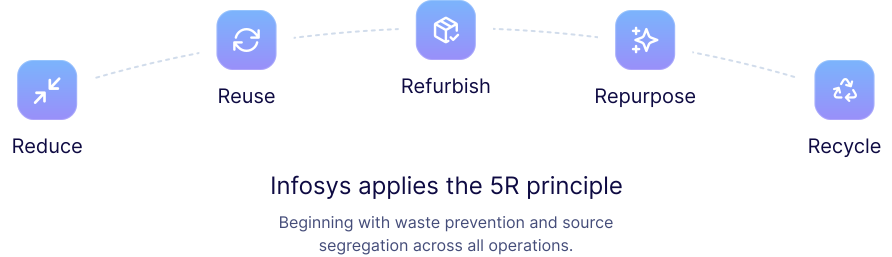
Infosys applies the 5R principle - Reduce, Reuse, Refurbish, Repurpose, Recycle

Our approach

Waste is a global concern, and we recognize the need for a structured approach to managing the various types of waste we generate. Our waste management approach is based on the philosophy of Segregation, Reduce, Reuse, and Recycle. Our ESG ambition on waste is to achieve 'Zero Waste to Landfill'. We seek to uphold our ambition through active minimization, combined with technology investment in recycling and streamlining systems and processes.

At Infosys, solid waste management begins with effective waste segregation at the source. Our goal is 100% segregation at source. We segregate waste into two categories: hazardous and non-hazardous.

Waste generation and segregation

We contribute to a circular economy by converting waste into resources and collaborating with suppliers who share this goal.

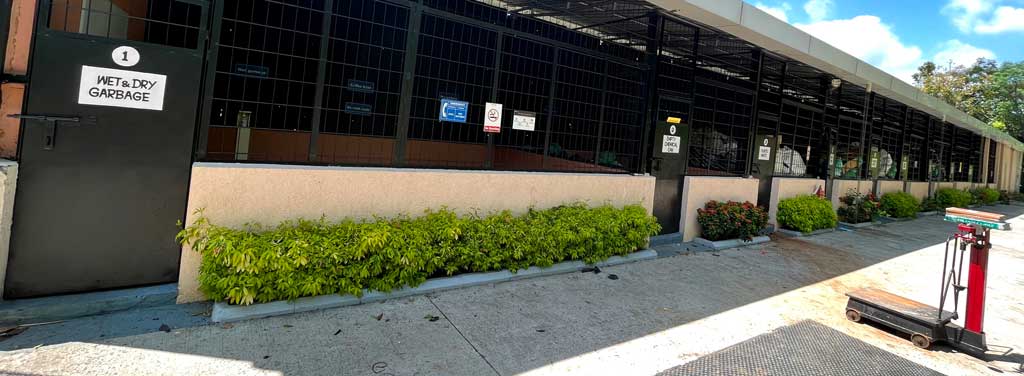
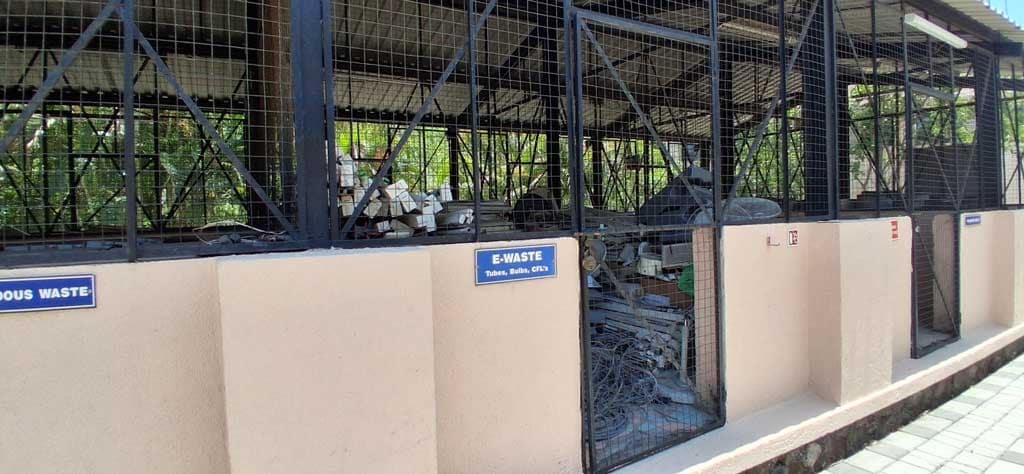
Our scientifically designed scrapyards ensure effective waste management.

Our scientifically designed scrapyards ensure effective waste management.

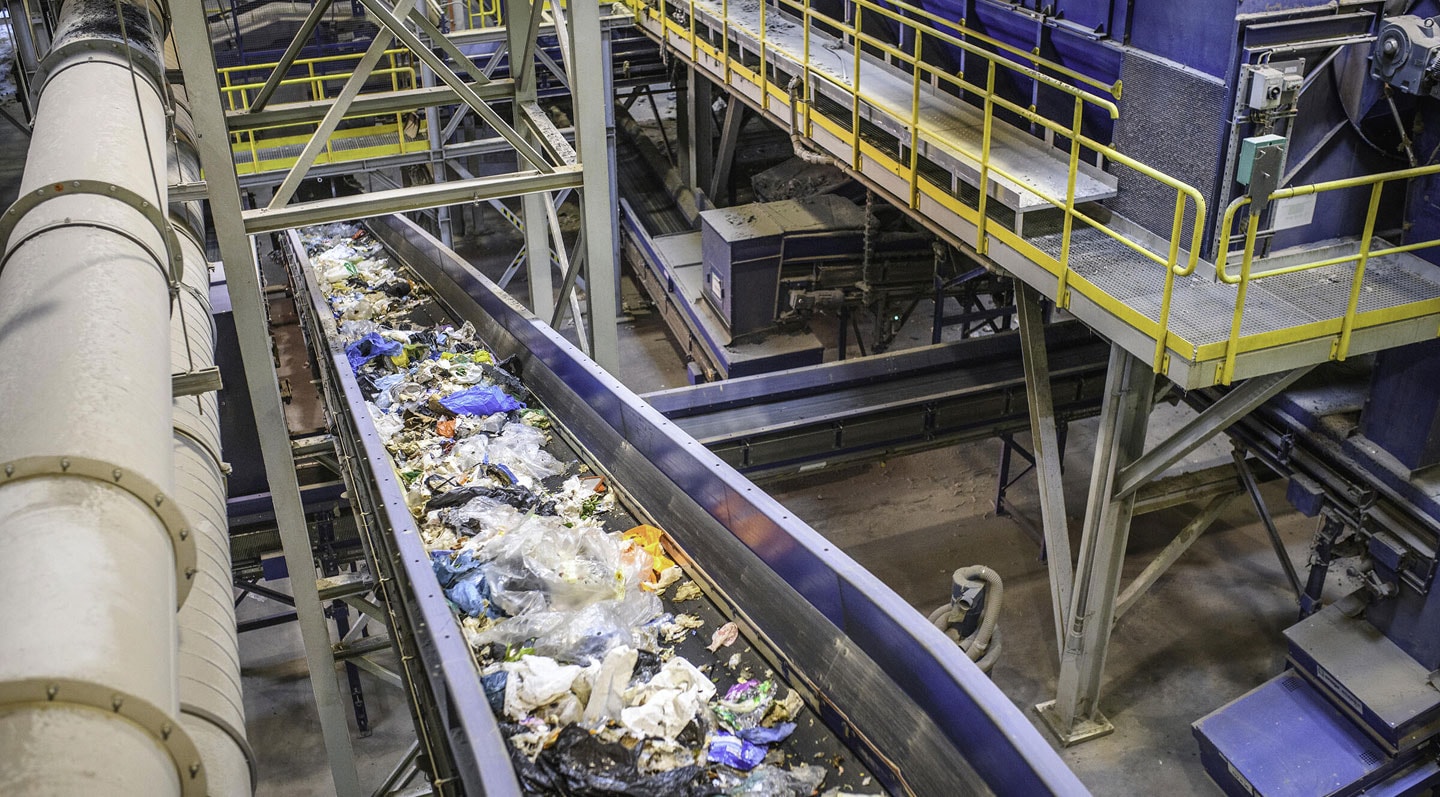
Infosys has implemented comprehensive waste management procedures that include source segregation, secondary segregation, effective waste processing and collection, recycling, and proper disposal, all aimed at minimizing negative environmental impacts. Waste segregation is facilitated by color-coded, labeled bins for different waste types. Each waste type is stored in designated areas within specified waste storage yards.

Reduce waste at source

Infosys demonstrated leadership in reducing waste at source by eliminating plastic and thermocol (expanded polystyrene) packaging from IT equipment procured across the organization.

Approx.
5.7 tonnes
of plastic and thermocol waste was avoided in laptops procured during the year

Through strengthened sustainable procurement specifications, suppliers were required to replace conventional fossil-fuel-based packaging with paper-based, recycled, and biodegradable fibre-based materials, including plant-derived and agricultural-waste alternatives such as bagasse, bamboo fibre, and other natural polymers.

This shift embeds circular economy principles directly into procurement decisions, preventing plastic waste generation before it enters operational streams. By integrating sustainable packaging criteria into supplier evaluation and delivery requirements, Infosys is driving upstream accountability across its value chain while reducing landfill burden, and setting industry benchmarks for waste minimization at scale.

Disposal

Waste disposal is the process of removing undesired materials. It is a critical part of keeping our environment clean and healthy.

Waste is segregated at source on our campuses.

Waste is segregated at source on our campuses.

Waste can be disposed of in different methods, each having specific advantages and disadvantages. Waste is categorized as hazardous and non-hazardous and is disposed either as waste diverted from disposal and waste directed to disposal.

Waste diverted from disposal

It refers to the process of redirecting waste away from landfills or incinerators through methods such as recycling, composting, and reuse. Infosys focuses on this methodology, which minimizes environmental impacts and enables the adoption of the principle of circularity.

E-waste: Refurbish and recycle

As an IT company, we generate e-waste. We have been persistent in our efforts to reduce, reuse, recycle, and dispose of e-waste responsibly. Our e-waste includes IT equipment, mobile phones, printers, cartridges, electrical and electronic equipment such as refrigerators, microwaves, and air conditioners, lithium-ion batteries, and cables, among others. We put effort into extending asset life through hardware upgrades, component replacements, and re-imaging.

Migration from physical servers to cloud infrastructure is one of the initiatives which enables:

  • Reduction of the need for new on-prem server procurement
  • Avoiding frequent hardware refresh cycles
  • Prevention of generation of future e-waste from servers, storage, networking gear
  • Shared, high-utilization infrastructure, reducing per-unit hardware demand

The Company has adopted a progressive approach to electronic waste management, transitioning toward a refurbishment-first model where feasible. This aligns with circular economic principles while maintaining partnerships with authorized recycling vendors for materials that cannot be refurbished. The authorized recyclers/refurbishers are evaluated based on their adherence to applicable legal requirements and the extent of resource circularity in their processes.
Biogas

High-rate bio-methanation plants across Infosys campuses process food and garden waste to generate biogas, which is reused as an LPG substitute in food courts. The digestate slurry is dried and applied as manure for campus landscaping. These systems operate at high organic loading rates, even near rated capacity.

Total biogas plant capacity installed across Infosys campuses
8.5 tonnes
per day
10%
cooking gas (LPG) replaced by biogas across campuses in FY26

Material recovery: Recycle and reuse

Material recovery from waste involves extracting valuable materials through recycling or reuse processes. We follow a waste hierarchy and prefer reuse over recycling. Paper, plastic, metal waste, and other waste generated at Infosys are recycled, repurposed, and recirculated into the supply chain.

Construction and demolition waste is sent to government-authorized landfill sites, which the municipal corporation reuses for land levelling and other purposes. Wastewater generated is treated and reused for irrigation, flushing, and in our HVAC systems after further treatment. Used kitchen oil is used in biogas plants because it has a high COD (Chemical Oxygen Demand), which, in turn, increases biogas production. Dried section sludge from STP and biogas slurry are reused as manure within the campus.

Organic waste converters (OWCs)

Infosys has adopted composting practices comprising manual vermicomposting beds and organic waste converters, which convert landscape/garden waste and part of food waste unsuitable for biogas production into compost, which is then used as organic manure in our landscaping applications, thereby increasing soil fertility and exemplifying effective resource circulation.

As part of our employee engagement initiatives, we also encourage our staff to utilize compost generated within their local communities. At Bhubaneswar DC, we have established a partnership with a local farmer who collects compost from the campus for agricultural purposes.

During the year,
~1,57,000 kg
of compost was generated through OWCs and utilized.

Vermicomposting

Garden waste in some of our locations is composted using earthworm / black soldier fly vermicomposting methods. The resulting compost, which is biologically richer and produced with lower energy and operational intensity, is used as landscape manure, ensuring complete utilization of green waste.

~27,000 kg
of compost was generated through vermicomposting, during the year.
Composting through sludge drying beds:

The sludge generated by Sewage Treatment Plants (STPs) is treated in innovative or conventional solar sludge-drying beds to produce compost. This serves as an agricultural input, demonstrating effective resource recovery from waste streams.

~17,12,000 kg
of sludge is converted to compost and used for landscaping across our campuses

During the year at our Hyderabad location, we diverted a part of landscape waste for the production of biomass briquettes, which in turn was used in our food court as an alternate fuel

Co-processing:

It achieves superior environmental performance compared to landfill and incineration, as demonstrated through lifecycle assessment of waste. The process involves using waste as a raw material or energy source in place of natural mineral resources and fossil fuels.

Waste with a high calorific value that cannot be recycled or repurposed is typically chosen for co-processing. Some waste materials collected by Infosys are sent to be co-processed, including tetra packs, tea bags, rubber waste, paper packaging, low-value plastic, plastic gunny bags, thermocol, foam, carpets, discarded mop refills, ceramic waste, flex banners, artificial grass mats, floor mats, glass waste, etc.

We have diverted 98% of waste from landfills during the year across India locations.

Waste directed to disposal

Waste directed to disposal refers to the total amount of waste materials that are ultimately sent to final disposal sites. This includes waste disposed of through various methods, such as landfilling, incineration, and other methods.

Authorized agencies, such as those handling oil-contaminated waste and certain categories of biomedical waste, incinerate certain categories of waste. The resultant ash is sent to Treatment, Storage, Disposal Facility (TSDF) landfills for safe disposal, and in a few locations, it is diverted for cement manufacturing.

waste-vendor

Waste vendor evaluation

We ensure rigorous oversight of waste management partners through regular audits of vendor facilities to verify recycling practices, compliance with requirements or certificates, and assess adherence to environmental standards, among others.

Zero-waste

TRUE zero waste certification

The TRUE certification program measures and promotes the use of sustainable resource management and waste-reduction techniques that lead to favorable environmental, health, and financial outcomes. The TRUE certification program evaluates, enhances, and honors zero-waste performance.

46%
of campuses owned in India are True Zero Waste certified

The aim of a TRUE-certified project is to divert all solid waste from landfills and incineration (waste-to-energy) and to protect the environment. The certificate helps achieve ZERO waste to landfill by working with more resource-efficient, environmentally conscious methods and contributes to converting waste into savings. Closed loop helps reduce greenhouse gas emissions, manage risk, minimize pollution and waste, reinvest resources locally, generate employment, and add value to their community and organization.

We are working toward the 2030 goal of zero waste to landfills by adopting TRUE Zero Waste Certification at our India campuses.

During the year, our owned campuses in India - Trivandrum, Hyderabad SEZ, Mangaluru and Mysuru have been certified under TRUE Zero Waste by Green Business Certification Inc. (GBCI).

employee-engagement

Amplifying the impact through employee engagement

To reach our goal of zero waste to landfill, we continuously engage our employees to build ambassadors who carry our initiatives into the communities where they live, thereby influencing the broader ecosystem.

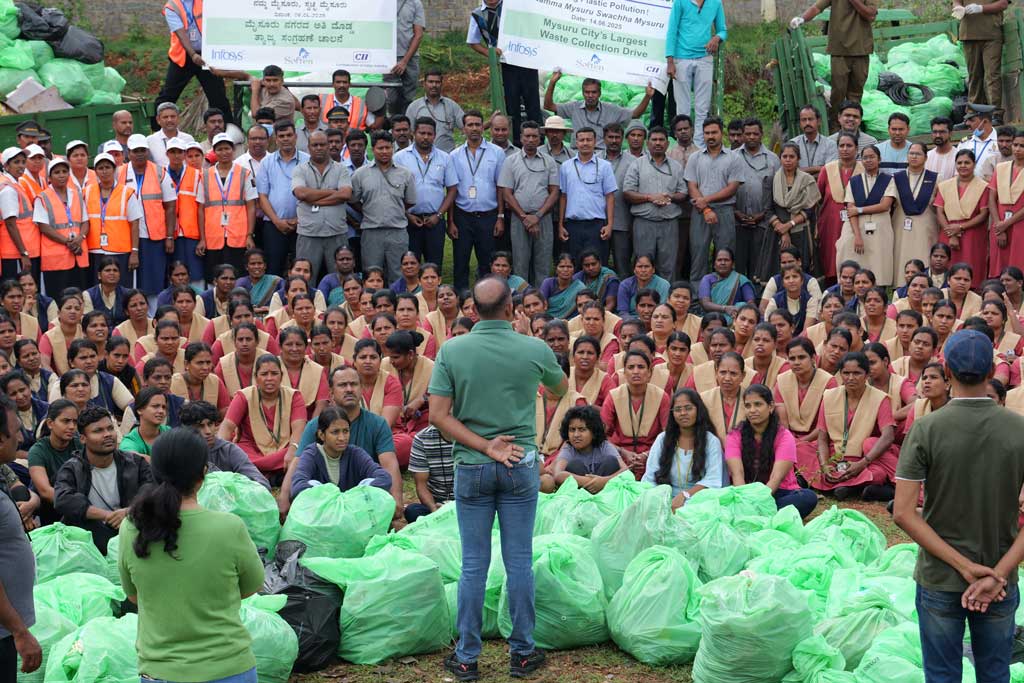
Employees and community members unite to raise awareness on effective waste management.

Employees and community members unite to raise awareness on effective waste management.

Throughout the year, numerous activities were conducted across locations, including communication through mailers, activities on 'Beat plastic pollution', distribution of manure to employees, awareness sessions, distribution of sustainable products, waste plogging drives around campuses or local areas involving employees, and engaging school students with sustainable products.
environmental-compliance

Environmental compliance

We have a strong environmental management system aligned with ISO 14001:2015 standards across all India locations in line with our HSE strategy, and covers a significant portion of the employees across the organization.

The management system is implemented globally across locations in accordance with applicable legal requirements and internal benchmarks and is part of our internal audit coverage. We ensure compliance with applicable legal requirements across our locations. We conduct environmental impact assessments for all our routine and non-routine activities, and the significant environmental impacts include resource depletion (e.g., power and water), waste generation and disposal, and emissions associated with our material aspects.
Environmental impacts of new services, activities, and changes in processes or legislation are also conducted. We conduct environmental impact assessment studies for all new projects, wherever applicable, covering impacts on air, water, social aspects, and biodiversity, among others. A process for monitoring requirements in line with legal requirements is established, and we ensure that all parameters are always maintained well within the defined norms.