
Insights
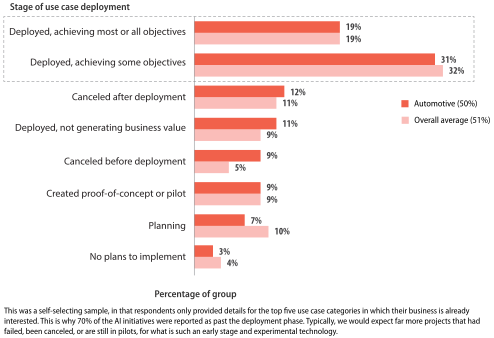
- Only half of AI programs show any measure of success in the automotive industry, with just under a third either canceled or not generating any value at present.
- More successful AI use cases are functional in nature, such as software engineering and supply chain, while automotive-specific use cases such as autonomous driving and usage-based insurance are less successful.
- To get value from automotive-specific AI use cases requires transformation of data architecture and operating model.
- To move ahead, automotive companies should also form partnerships with the tech industry, redesign processes to unlock value, and supercharge the workforce.
- The report also provides insight into how the UK automotive industry is pulling ahead of other markets in our data by reimagining supply chains, partnering with universities for high quality talent, and focusing on cybersecurity, another highly successful AI use case.
Executive summary
The automotive industry is grappling with cost pressures and the demands of the shift to electric vehicles (EVs). This transition requires better charging infrastructure, more resilient supply chains for critical battery materials, deeper software engineering capabilities, and a workforce prepared for increasingly AI-driven systems.
AI could deliver some of the needed improvements. However, our research finds that though makers of passenger and commercial vehicles, including EVs and hybrids, are implementing AI, it isn’t yet delivering on its full promise. Only half of AI programs show any measure of success in the automotive industry, with just under a third either canceled or not generating any value at present (Figure 1).
Figure 1. Half of AI initiatives deliver some impact
Source: Infosys
Functional use cases such as software development and supply chain are doing well. Our data shows that automotive companies have instituted significant change management and employee upskilling initiatives. Automotive operations, especially on the manufacturing front, are moving to higher automation levels . Agentic AI is also driving success in IT operations, enhancing customer experience, and streamlining support.
Automakers and high-tech companies are collaborating on AI technologies, which could turn out to be a source of competitive advantage.
General Motors and Nvidia are working together on AI-driven simulation for next-generation vehicles, factories and robots, while Toyota and Waymo announced a partnership in April 2025 to codevelop AI-powered in-vehicle navigation systems for global automakers. Results will validate if these partnerships allow for a more productive workforce and faster innovation cycles, though automakers will enjoy access to specialized talent and scalable platforms for shared services, vehicle data, and in-car commerce.
This report considers the promise and the challenges of AI in the automotive industry, using Infosys Knowledge Institute data analysis of 250 respondents from automotive companies in the US, UK, Europe, and Australia and New Zealand. Recommendations are drawn from the UK industry, a market using AI to increase competitive advantage as we move into 2026.
From disillusionment to hope
Some of the challenges automakers face in 2026 relate to rising cost pressures, as well as to pessimism about autonomous vehicles, despite two-thirds of respondents in a recent survey by S&P Global expressing interest in using autonomous features for highway driving. Issues with technology integration, semiconductor complexity, and distressed energy markets must also be resolved, while new skills needed for work on EVs must be onboarded quickly.
Getting ahead also means navigating a fragmented regulatory environment, negotiating geoeconomic forces by reconfiguring global trade and supply chains, and making a strategic bet on greener transmission, where EVs are expected to account for between 40% and 65% of global car sales by 2030. Automakers must do all this while demonstrating the ability to provide a better driving experience via software.
This will do a lot to reignite growth, especially in Europe, where new car registrations increased by just 0.9% year-on-year in 2025.
The need for AI
As AI develops — along with strategies, talent, and data for deploying it effectively — it could play a major role in improving the future outlook of the industry. One of the reasons it is such a powerful technology is that it can reimagine and automate key business processes, reducing costs, while helping executives make better and faster decisions based on proprietary data.
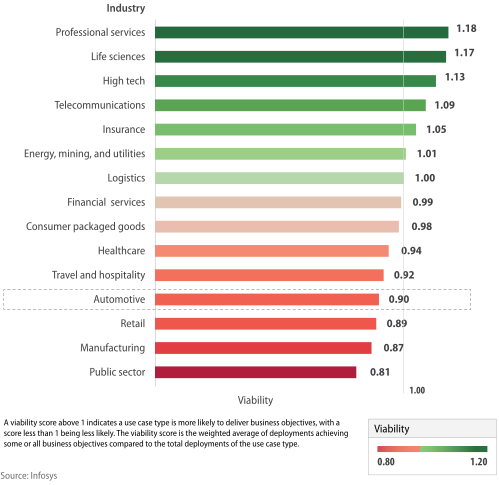
However, as of 2025, the automotive industry ranks below average on our list of industries doing well with AI technologies, as determined by the success of AI projects (Figure 2).
Figure 2. Automotive lags in AI business value
Source: Infosys
In the AI Business Value Radar 2025, we looked at 55 functional use case types across 14 business categories, and a further five industry-specific use cases relevant only to the automotive industry. We found that the more successful use cases were functional in nature, such as software engineering and supply chain, while automotive-specific use cases such as autonomous driving and usage-based insurance were falling behind on our success metric. For instance, software development scored 1.09 and supply chain scored 1.08, whereas autonomous driving scored just 0.58, where 1 is average and anything below 0.9 is less likely to produce business value. See the appendix for a full breakdown of how this score was determined, along with a full list of the 55 functional and five automotive industry-specific use cases that were used in the analysis.
For instance, software engineers are using Microsoft Copilot and other AI technology to augment the software development lifecycle (SDLC), or the V-Model, as it’s known in automotive software development. This has led to gains in powertrain management, advanced driver assistance systems, and connected car ecosystems such as Hyundai’s Bluelink technology, or BMW’s ConnectedDrive app. In supply chain, Infosys is working on using AI to automate the supply chain negotiation process, especially as it applies to semiconductors, though many of these implementations are still in the pilot phase. Though agentic AI’s impact wasn’t measured in the research, some companies are starting to use agentic AI tools that read supplier contracts, spot risks, and suggest better payment terms based on how many semiconductor wafers are being produced. This has helped companies save time, follow rules better, and reduce financial risks, according to Infosys experts.
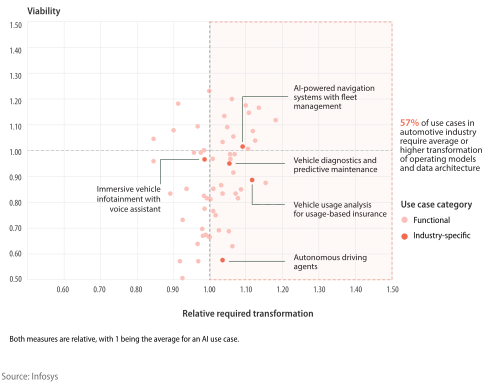
To move beyond functional use cases and get value from core industry use cases like predictive maintenance and vehicle usage analysis requires transformation of the data architecture and operating model.
While 57% of use cases in the automotive industry need significant transformation, Figure 3 shows that almost all industry-specific use cases require this level of effort, mainly because they touch core parts of the business.
To deliver value from AI in vehicle diagnostics, for instance, data must be prepared adequately. This is a growing concern for many clients we work with who are looking to modernize their applications with AI where data is scattered across numerous vendor-supplied systems and is in the wrong format for machine learning (ML). Further, many workflows are manual and siloed; AI only works effectively when AI insights automatically trigger actions such as parts ordering, technician guidance, and customer notifications.
Figure 3. Higher transformation required
Source: Infosys
The importance of partnerships
AI transformation also requires good partnerships with government agencies, universities, and the tech industry.
Joining with the likes of OpenAI, Microsoft, Nvidia, and supply chain leaders allows for faster innovation, agile development practices, fresh thinking, and agentic platforms to operationalize automotive use cases at scale. These partnerships can then develop into collaborative strategies, where both automotive companies and tech organizations work together to create software-defined, co-development models, sharing architecture, validation tools, and agile development practices.
For example, Jaguar Land Rover (JLR) has partnered with CesiumAstro, a space technology organization, to accelerate the development of in-vehicle connectivity and high-performance communication systems. The British automaker is also working with ChipFlow, which helps product companies make their own silicon chips, and with ev.energy to develop AI-driven, smarter, grid-responsive EV charging solutions, reinforcing its commitment to sustainability and intelligent energy management.
Together, original equipment manufacturers and innovation partners can balance short-term pressures with long-term goals, maintaining competitiveness in an increasingly dynamic and regulatory-charged environment.
Process redesign to unlock value
Real customer value goes beyond embedding AI in discrete use cases to rearchitecting entire customer journeys with AI at the center. Research shows that startups, which often don’t have such entrenched business processes to begin with, are better able to generate value than legacy organizations. Incumbent carmakers should pick one or two domains that, once reimagined, would increase business outcomes substantially. McKinsey estimates such transformations to increase EBITDA by at least 30%.
Audi revealed in June 2025 that more than 100 AI projects are now in operation across its global production network. The company is not just rolling out scattered AI use cases but is using AI as a core part of its manufacturing infrastructure. Whereas many automakers have tested AI in narrow domains, Audi has created a full-stack approach to AI in the production environment that can adapt dynamically. For instance, the core process for making vehicle bodies utilizes computer vision to inspect surface finishes and structural welds with high consistency and accuracy; another application uses AI to detect possible weld splatter on vehicle underbodies; and computer vision is used again to verify whether labels with the correct technical data are correctly attached to the vehicle. This reimagination of the production process produces data that is then used to train ML models that further optimize how the factory is run.
The Renault Group similarly reimagined its supply chain, using a dedicated team to design, deploy, and maintain digital processes and solutions. The company is also exploring new applications, such as the use of AI agents to automate decision-making and to make supply chains increasingly efficient, agile, and sustainable.

Supercharge the workforce
Achieving value from AI also means instituting good change management. Phil Benton, a partner at Infosys Consulting, says: “Without good change management and upskilling initiatives, even the most brilliant product won’t garner traction with employees and customers.”
To gauge just how ready automakers are on this dimension, we asked executives to rate their workforces as one of four options:
- Trailblazers: Full workforce preparation strategies in place, where employees are actively engaged in AI training, change management, and are supported to understand and adapt to AI systems. A majority of the workforce also participates in product development.
- Pathfinders: Similar to Trailblazers, but have not made change management a core pillar of their enterprise AI strategy.
- Explorers: Have taken some initial steps to prepare their workforce, but are just at the beginning of their preparation journey.
- Watchers: Very little, if any, effort has been made to prepare the workforce for the AI era.
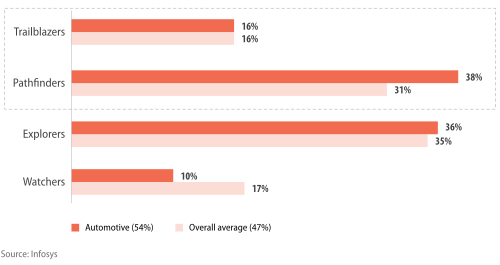
Figure 4 shows that the automotive industry is further ahead than other industries, with more Pathfinders and fewer Watchers.
Figure 4. Auto is further along in workforce preparation than other industries
Source: Infosys
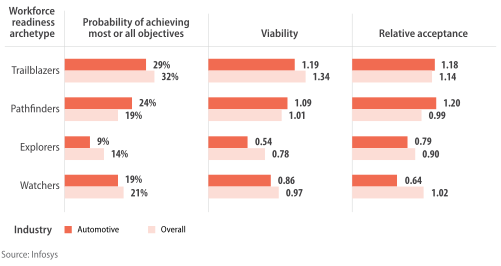
Our analysis also shows that automotive Trailblazers can expect a 20 percentage point uplift in the chance of use cases achieving all business objectives, compared with Explorers, and a 5 percentage point higher likelihood than Pathfinders. Trailblazers also have far higher acceptance of their products (Figure 5).
Figure 5. Go all in on workforce preparation
Source: Infosys
The message is clear: upskilling and change management lead to significant business benefits.
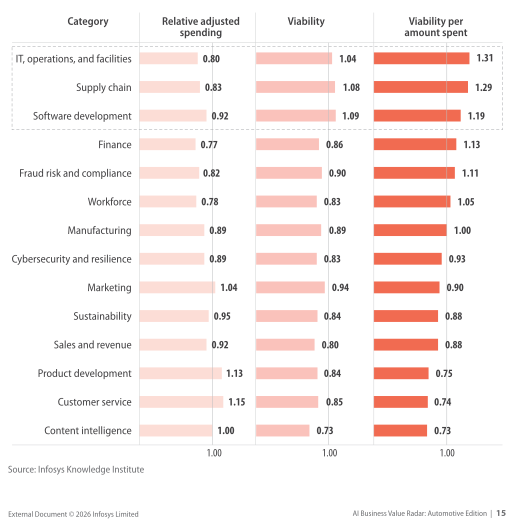
Some roles require more AI upskilling than others. While AI in IT operations, supply chain, and software development is delivering business outcomes, areas like product development and customer service are lagging (Figure 6). In product development, designers should learn to work with generative design, simulation, and material-optimization tools, including Autodesk Fusion 360 (used by Toyota), Dassault Systèmes (Mercedes-Benz), and Altair (Mitsubishi).
Figure 6. Functional uses generate most value
Source: Infosys Knowledge Institute
A case study: The British automotive industry
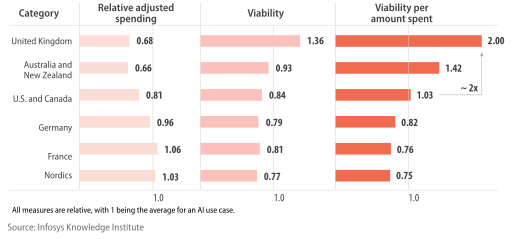
Britain’s automotive industry is doing well in AI as compared with other regions (Figure 7).
Figure 7. UK leads in getting AI to work
Source: Infosys Knowledge Institute
In fact, the UK is twice as good as the US in getting AI to work per dollar spent, and almost three times better than in the Nordics — good news for a market that is seen to produce cars at a slower rate than competitors, and which is under significant margin pressure.
How UK automotive companies have successfully integrated AI into operations provides clear recommendations for others:
- Start with the basics, not the boardroom: Automotive companies should fix their supply chains first, as JLR did in 2023 by partnering with supply chain mapping experts. Supply chain is a great use case for AI, with a viability-to-spend score of 1.29, only behind ITOps at 1.31 (Figure 6).
- Use an iterative approach to process reengineering: Much of the UK’s success in AI could be attributed to a long-horizon, phased approach to operational excellence, according to a new study by IDS-INDATA on the UK manufacturing industry. Layering AI slowly by picking key domains and generating value before moving on is essential to process engineering excellence.
- Build ecosystems, not siloes: UK automakers partner with universities, startups, and government-backed testbeds to fill a skills gap in AI and materials engineering and to help spur innovation.
- Regulate with a light and steady hand: Britain has been good at permitting AI trials and embedding responsible AI tenets into software development, along with providing ethical guidelines on data use. "You need responsible and ethical AI. Setting guardrails up front ensures that AI systems operate within ethical and regulatory boundaries specific to your industry," says Dave Malik, a Cisco executive we spoke to for this report.
- Let scarcity sharpen focus: Facing pressure on its margins, in November 2021, Aston Martin, a British maker of high-end luxury vehicles at low volume, articulated a vision for improving margin per vehicle and increasing manufacturing efficiency. Executives emphasized cost and investment control to support cash flow generation and deleveraging, leading to a profit margin of 27.9% in 2025, 20 percentage points greater than the global average.
- Focus on cybersecurity: The recent cyberattack on the JLR production facility in the UK reinforces the need for secure software. Though not yet delivering business value, with a success score of 0.83, according to our analysis, automakers should consider whether using AI in cyberdefense could improve their overall security.
The AI implementation imperative
Automotive companies are battling headwinds, as we have set out in this report. AI could help, but to get it to work requires investment in people, processes, technology, and responsible development.
Technology partnerships and value-driven process reengineering are not just important; they will be key strategic levers of successful automakers.
In the end, implementation excellence, including good change management processes, will be needed to turn Explorers into Trailblazers. Getting this part right will rewire for competitive advantage and turn AI from optimizer to transformative force as the automotive industry moves forward.
Appendix A: Use cases
We collated 55 functional use case types across 14 categories (Figure A1). Similarly, we collated 77 industry-specific use cases across 15 industry sectors (Figure A2).
Figure A1. Functional categories and their use case types
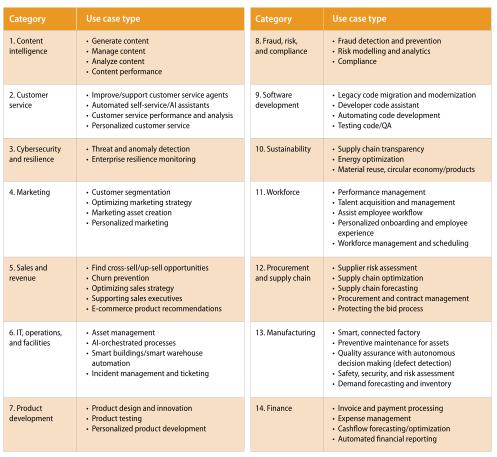
The survey asked the respondents to select up to five functional categories out of 14 (Figure A1). As such, this is a self-selecting sample, and in Figure 1, for example, we would typically expect far more projects that had failed, been canceled, or been in pilots.
Each functional category had between two and six use case types. For each use case type within a category, respondents were asked about the stage of implementation of their initiative(s). Options for this question were: no plans to implement; planning; created proof of concept or pilot; canceled before deployment; deployed, not generating business value; canceled after deployment; deployed, generating some business value; deployed, achieving most or all objectives. Respondents were then asked about spending for that use case type, amount of operational or business model change needed, as well as the amount of change in data structures and technical architecture required for that use case.
Figure A2. Industry-specific use case types
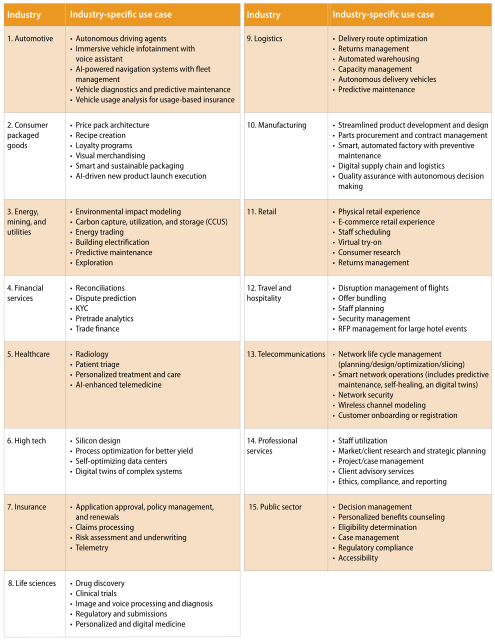
Finally, respondents were asked about the proportion of their user base that accepted and used the AI tool deployed, if any, for each use case type. The same series of questions was asked for industry-specific use case types relevant to respondents (Figure A2).
Appendix B: Research approach
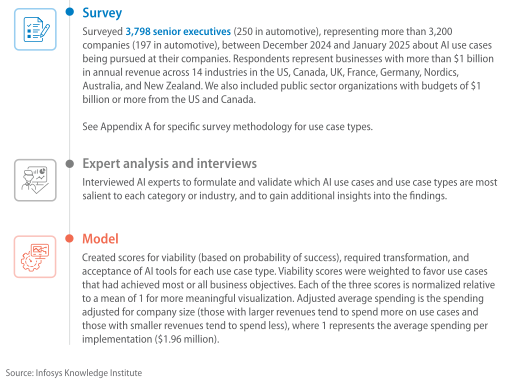
Source: Infosys Knowledge Institute


Retailers must embrace an AI-first, real-time, unified experience architecture that integrates customer insights, inventory, and omnichannel operations.
- 22 Jan, 2026
- 6 min read

Advanced data, AI, and integrated technologies can empower retailers to proactively detect, predict, and prevent shrink.
- 22 Jan, 2026
- 6 min read

As organizations enter the agentic AI era, product-centric value delivery (PCVD) must evolve to integrate autonomous AI agents and human expertise.
- 01 Jan, 2026
- 12 min read
