

Insights
- As AI applications become embedded in core enterprise workflows, risk scales with them.
- Executives need assurance that AI systems will not leak sensitive information or introduce unmanageable risk, necessitating predictable, governable behavior.
- Prepackaged model safety mechanisms aren’t enough as they don’t onboard key business policy mandates.
- To move ahead, guardrails with appropriate policy coverage should be implemented at two LLM checkpoints to screen and validate responses.
- Our reference architecture and recommendations for responsible AI (RAI) adoption emphasize hybrid controls and continuous evolution through monitoring and updates.
As adoption of artificial intelligence (AI) grows, expectations are rising. Users want large language models (LLMs) to be helpful, safe, and increasingly, consistent in the outputs they produce, especially when agentic AI models are connected to internal documents, tools, or workflows. In risk-averse industries and regulatory environments, users also want assurance that sensitive information will not leak, outputs will not be harmful or discriminatory, and systems will behave predictably under pressure.
But there’s a problem. Delivering on these expectations requires more than selecting a good LLM such as Claude or Google Gemini with prepackaged safeguards. These software-as-a-service controls often don’t account for enterprise-specific data, workflows, or threats, leaving gaps exploitable through input, output, or policy manipulation.
Deploying third-party AI in an enterprise requires tailored guardrails that examine what goes into the model and what comes out. These guardrails underpin RAI, enforcing policies for security, privacy, safety, fairness, and transparency. RAI and guardrails help keep the organization safe and mitigate brand or reputational risk.
Why guardrails are so important
Two approaches dominate enterprise guardrail design. Template based guardrails evaluate prompts against explicit business policies using LLM driven reasoning guided by system templates. Model based guardrails rely on specialized transformer based classifiers, or systems that read a text’s meaning and then judge what specific category or categories those words should be in, all in order to detect content-specific risk to the enterprise.
Template based guardrails offer transparent policy enforcement and strong intent reasoning before a response is generated. That said, they add latency, cost, and operational overhead, particularly with hosted or third party models. Model based guardrails are faster and better suited for domain specific or latency sensitive environments. However, they are probabilistic — predicting the next word based on likelihood rather than certainty — so rare or previously unseen edge cases can still be missed.
Regardless of architectural implementation, you need both. LLMs treat all input the same, be that data, instructions, or contextual information. So malicious content can pass as valid guidance, creating security, privacy, and social‑engineering risks. These issues are amplified in agentic AI workflows, where model outputs influence downstream actions, tool usage, or automated decisions, increasing the impact of misuse or misinterpretation.
Common failure modes include prompt injection, jailbreak attempts, toxic or profane inputs, unintended privacy leakage, and biased or unfair outputs. One guardrail technique is not enough.
This hybrid approach, combining template based and model based guardrails, uses multiple, layered security controls to protect both systems and data, with final design choices guided by latency requirements, infrastructure availability, and deployment context.
The two-stage moderation pipeline
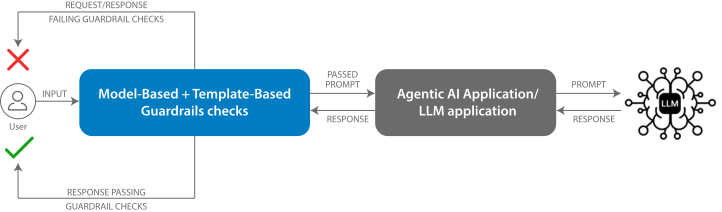
The solution does not just mitigate poor or misguided prompting, but designs a workflow that balances the RAI tenets of safety, privacy, fairness, and reliability. The pipeline has two checks: one on the request, one on the response. Separating these checks reduces blind spots. If one layer misses something, the other can catch it.
- Request moderation (entry): Screens the prompt before it reaches the LLM. It flags prompt injection attempts, jailbreak framing, restricted topics, toxicity or profanity, and sensitive data. Failed prompts are blocked, refused, or sent back for rephrasing the request.
- Response moderation (exit): Reviews the model’s output before it reaches the user. It catches unsafe content, policy drift, and sensitive data leaks. It ensures the response is safe, private, secure, and doesn’t have any toxic implications or intent.
Moderation with template-based and model-based approaches
Both request and response moderation are implemented using RAI guardrails at the application level, using template‑based and model‑based checks.
In practice, organizations could use template based guardrails during request moderation and model based guardrails during response moderation to balance reasoning capability and latency. Organizations can also use either approach at both stages, or run them in parallel as hybrid (Figure 1).
Figure 1. Infosys reference architecture for safe LLM implementations
Source: RAI Office, Infosys
Next steps: Implementation roadmap
There are twelve prudent steps an organization should follow to successfully implement this reference architecture:
- Keep the reference architecture adaptive: Update guardrails to handle new attack patterns, evolving usage, and domain‑specific vocabulary.
- Use template‑based guardrails where explanation and intent matter: Apply LLM‑driven template evaluation when policy reasoning, explainability, and generic coverage are priorities, and when additional cost or latency is acceptable.
- Use model‑based guardrails for efficiency and domain specificity: Prefer classifier‑based checks for latency‑sensitive paths, cost optimization, and domain‑specific data where fast, high‑confidence screening is required.
- Align to business policy: Guardrail outcomes should map to defined enterprise policies to support auditability and user guidance.
- Make templates modular and reusable: Design one template per policy category, with a consistent output format to simplify maintenance, logging, and monitoring.
- Handle multilingual inputs: If guardrails support multilingual understanding, no additional steps are required; otherwise, translate non‑English text to English before evaluation and retain original‑language checks where needed.
- Operationalize guardrails through logging and iteration: Log moderation outcomes with minimal sensitive data, review misses or false negatives, and continuously refine guardrails through feedback and testing.
- Separate responsibilities across teams: Policyowners define requirements, engineers implement guardrails, and security and legal teams validate coverage for high‑risk areas.
- Optimize for latency and cost: Perform guardrail checks in parallel where possible, or selectively use deeper analysis only when required, to avoid unnecessary overhead.
- Maintain control over request and response moderation: Choose guardrail detectors that are easy to test and tune using curated examples without requiring changes to the underlying LLM.
- Design clear response strategies for failures: Define explicit actions for guardrail failures, such as blocking, redaction, warnings, clarification requests, or routing to safer workflows.
- Prefer hybrid setups: When constraints allow, use template‑based and model‑based guardrails together to provide layered protection and stronger assurance across request and response checkpoints.

The agentic-first enterprise
Agentic AI will define the next technology shift. Many enterprises are experimenting, but few have moved beyond pilots to successful production use cases. The barrier isn’t only finding the right ideas. It’s the complexity of building, operating, and governing agents across enterprise systems.
The good news: the foundations already exist from a decade of digital and cloud transformation. But architectures built for human interfaces now need to evolve in a world where autonomous agents execute workflows and make decisions alongside humans.
To move from ambition to execution, and improve customer outcomes, AI investments need clear technology choices that drive measurable value, from better experiences to stronger profits.


Token efficiency, or tokenomics, is now a primary design concern in AI deployments. To get ahead, organizations should build a framework of four composable levers, or thinking modes, applied across the agent stack to cut token expenditure without degrading output quality.
- 17 Sep, 2026
- 7 min read

Regulatory change is accelerating and breach costs are rising, yet most institutions still rely on periodic, manual risk assurance. Three structural gaps, spanning visibility, third-party oversight, and governance, leave institutions unable to keep pace. Building risk assurance as a continuous, AI-augmented capability closes these gaps. A four-phase roadmap helps institutions get there.
- 11 Sep, 2026
- 15 min read

The difference between AI work and AI that works lies in the discipline to scale adoption, governance, and value realization
- 10 Sep, 2026
